Sanxingdui: The Giant Bronze Masks Burned and Buried on Purpose
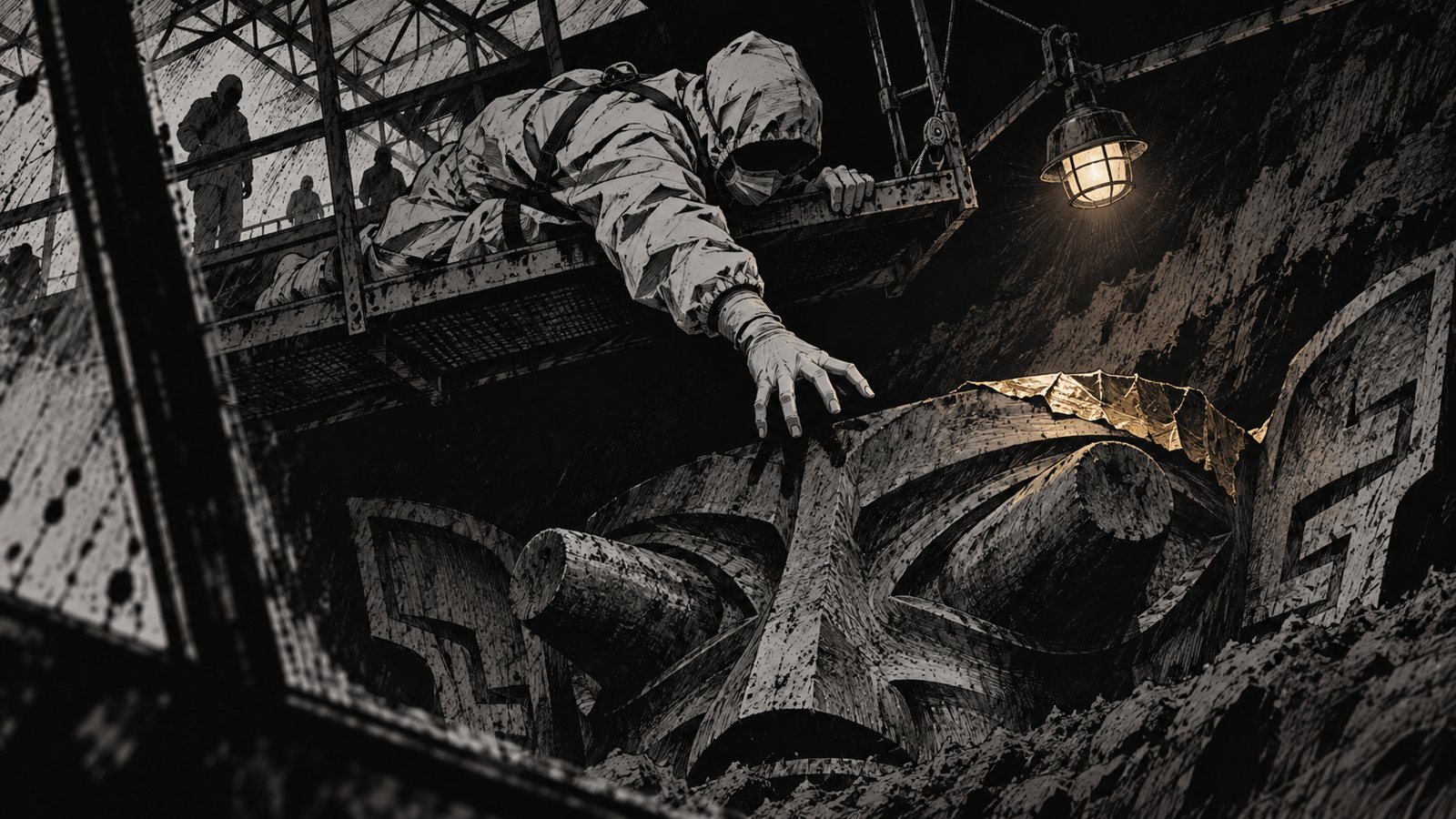
Sanxingdui, Sichuan, China, about 3,000 years ago. In 1986 brick workers led archaeologists to pits packed with giant bronze faces and a bronze tree almost four metres tall, all broken and burned before they were buried. No writing has ever been found at the site.


Narrated Mystery: press play and hear the whole case read aloud, like a true crime podcast episode, or an audiobook for a long drive (about 10 minutes). The narrator is an AI voice.
What the record shows
- What: Eight pits of deliberately broken and burned ritual treasures
- When: Buried about 1200–1000 BC; found in the late 1920s, 1986 and 2019–2020
- Status: Four pits radiocarbon-dated in 2025; purpose unexplained
Still uncertain
- Why the objects were destroyed, and for whom.
- Whether the people of Sanxingdui wrote anything down.
- Why the city emptied around 1000 BC, and whether its people founded Jinsha.
Tusks on top

Why would anyone cast a bronze tree nearly four metres tall, break it, burn it and put it in a hole?

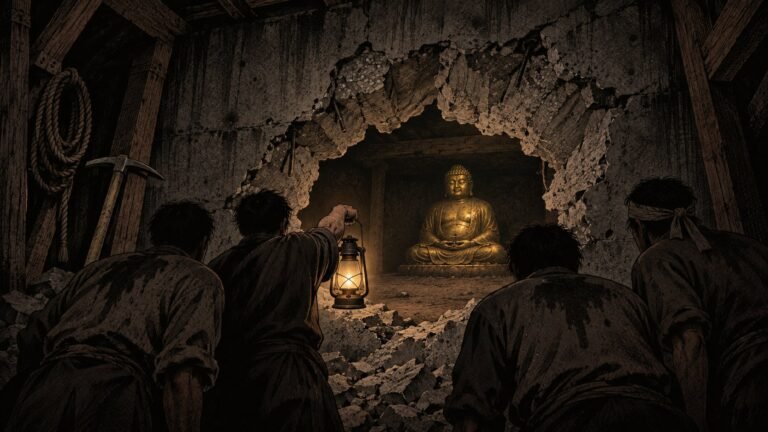
Guanghan, Sichuan province, 1986. Workers digging clay for a brick factory had turned up jade, and archaeologists had followed them into the field. One pit was already open. About a month later a second appeared close by. (ST21)

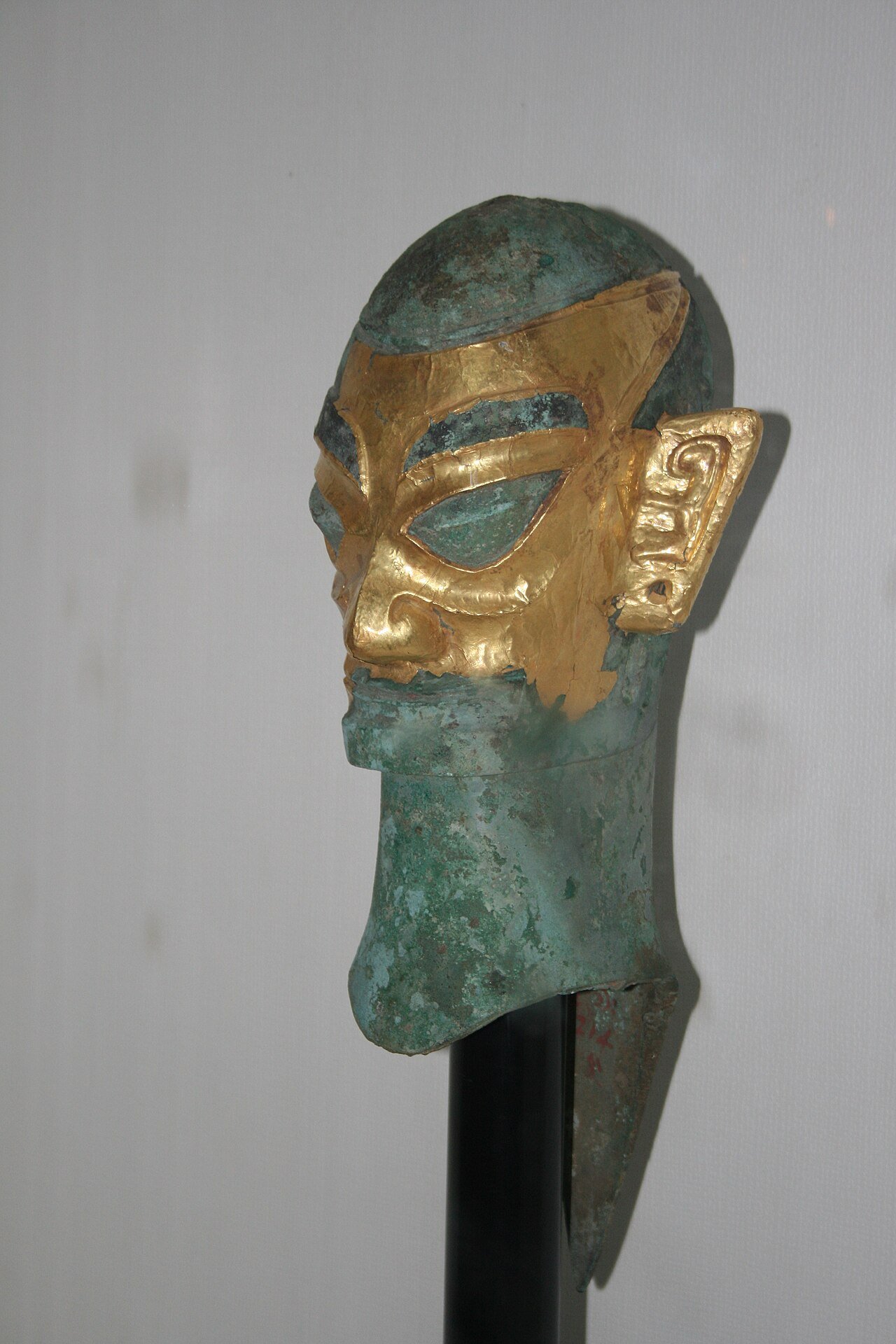
Under the topsoil lay elephant tusks. More than sixty of them, charred. Beneath the tusks the bronzes were packed tight: heads, faces, a statue on a high base, pieces of trees. (THE) (ST21)
Almost nothing was whole. The objects, one report says, “appeared to have been deliberately smashed and burned before being buried, a practice the archaeologists had never seen before.” (ST21)
There were no human remains in either pit. They were not tombs. (PBS) (LS21)
A farmer’s spade
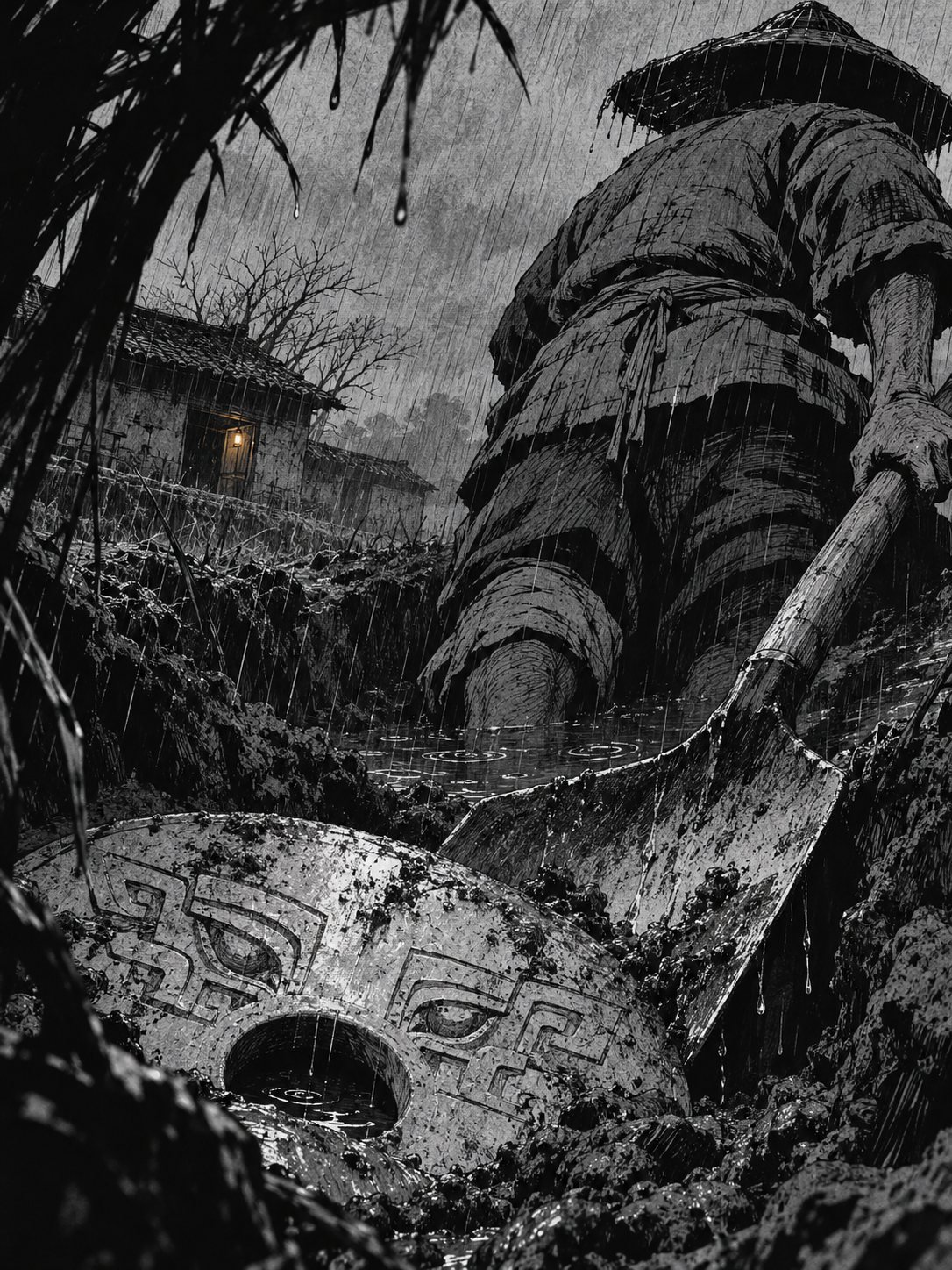
The site had given a warning sixty years earlier.
In the late 1920s a farmer working his plot at a place called Moon Bay, north of Chengdu, struck a cache of jade. He was digging a well in one account and a ditch in another, and the year is 1927, 1928 or 1929 depending on who tells it. (ST21) (CWA) (ANT23)
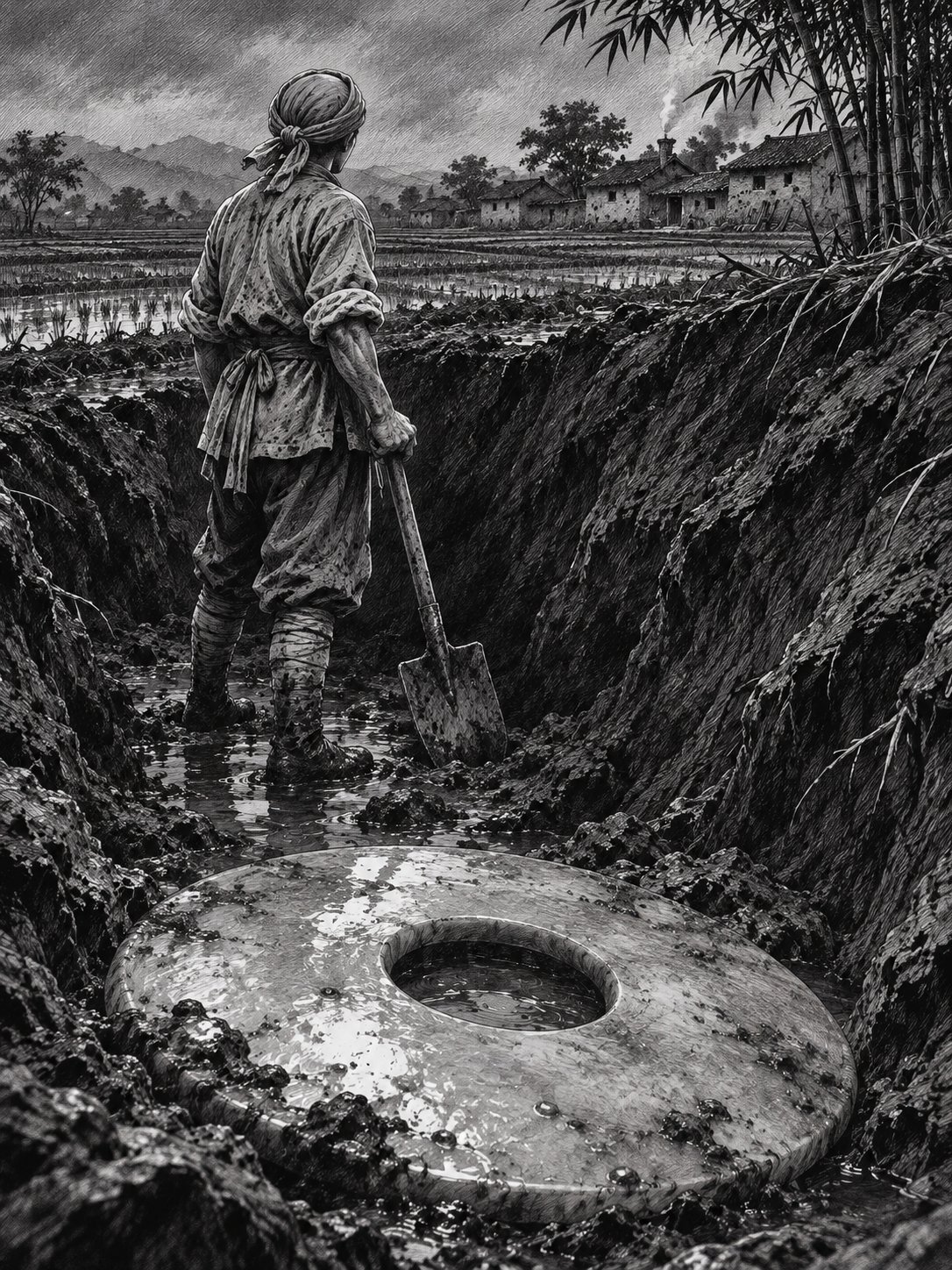
David Crockett Graham, a missionary and museum curator in Chengdu, organised the first excavation at the farm in the early 1930s. It produced hundreds more pieces of jade, stone and pottery. (ST21) (ANT23)
Then the field went quiet for half a century.
Three mounds that were a wall

Sanxingdui means “Three Star Mounds.” The name comes from earthworks that stood on the plain. (CWA)

Surveys in the 1980s showed what the mounds were. They were the remains of a city wall about 40 metres wide at its base. (CWA) Later work traced four walls enclosing roughly 3.6 square kilometres, inside a site that spreads across about 12. (CD24-MASK) (ANT23)

So this was a city, and a large one. It stood about 40 kilometres north-east of modern Chengdu and flourished while the Shang dynasty ruled the Central Plains far to the north-east. (ANT23)
The first 1986 pit measured 4.5 by 3.3 metres. Besides bronze and gold it held thirteen tusks and more than three cubic metres of burnt, broken animal bone. (ST21) (THE)
Eyes on stalks

The faces are what people remember.

One bronze mask lifted in 1986 is 138 centimetres wide. Its pupils are cylinders that push out nearly 17 centimetres from the face. Archaeologists reportedly took it for the back of a chair at first. (CD24-MASK) (GAC)

A fourth-century gazetteer of the region, the Huayang Guo Zhi, says the land of Shu once had a ruler named Cancong “who had protruding eyes and who made himself a king.” (CD24-MASK) The match is tempting, and the excavators noticed it at once. (PBS)
It is also a text written well over a thousand years after the pits were closed. “We can’t really use archaeological discoveries to prove an ancient myth,” Sichuan University archaeologist Yu Mengzhou told Sixth Tone, though he allowed that “these old tales may provide some clues.” (ST21)
The second pit also held a standing figure 2.6 metres high with its base, slender, robed, its huge hands curled around something that is no longer there. (CWA)
The tree

Restored, the bronze tree from 1986 stands 3.96 metres. It has a mountain-shaped base and a straight trunk, with fruit and birds on its branches. Chinese state media describe it as arguably the largest single bronze object ever found in the country. (CD-TREE) (CGTN24)
It came out of the ground in pieces.
Broken, burned, buried

Here the record stops and reconstruction begins. Nobody wrote down what happened at the edge of those pits. The night ritual in our illustrations is an artist’s guess.

What the soil does show is an order of events. In the first pit, the excavators concluded, animals were killed and burned, jades and bronzes were broken and burned, and the whole mass was then tipped in and covered. (THE)

Robert Bagley, the Princeton art historian who studied the 1986 finds, judged that the evidence ruled out the alternatives: each pit was one large sacrifice. He added the caveat that still stands. The occasion, the purpose and the recipient are unknown. (THE)
Six more pits

In October 2019 archaeologists went back to the ground beside the two old pits. They found a third that December, and five more from March 2020. (CD21)
This time nothing was rushed. Glass cabins were built over the pits to hold temperature and humidity steady. (ANT23) (CD21)


On Saturday 20 March 2021 the team announced more than 500 objects, among them over a hundred tusks. (CD21) The smallest pit, No. 5, gave up half of a gold mask: about 280 grams, 23 centimetres wide, roughly 85 per cent gold. (CGTN24) (ANT23) Pit 3 produced a bronze mask 131 centimetres across. (CWA)
By June 2022 the count from the six new pits stood at nearly 13,000 objects, of which 3,155 were relatively complete. (ST22) The total for the whole site has since passed 17,000. (CD24-WORK)

The pieces that fit
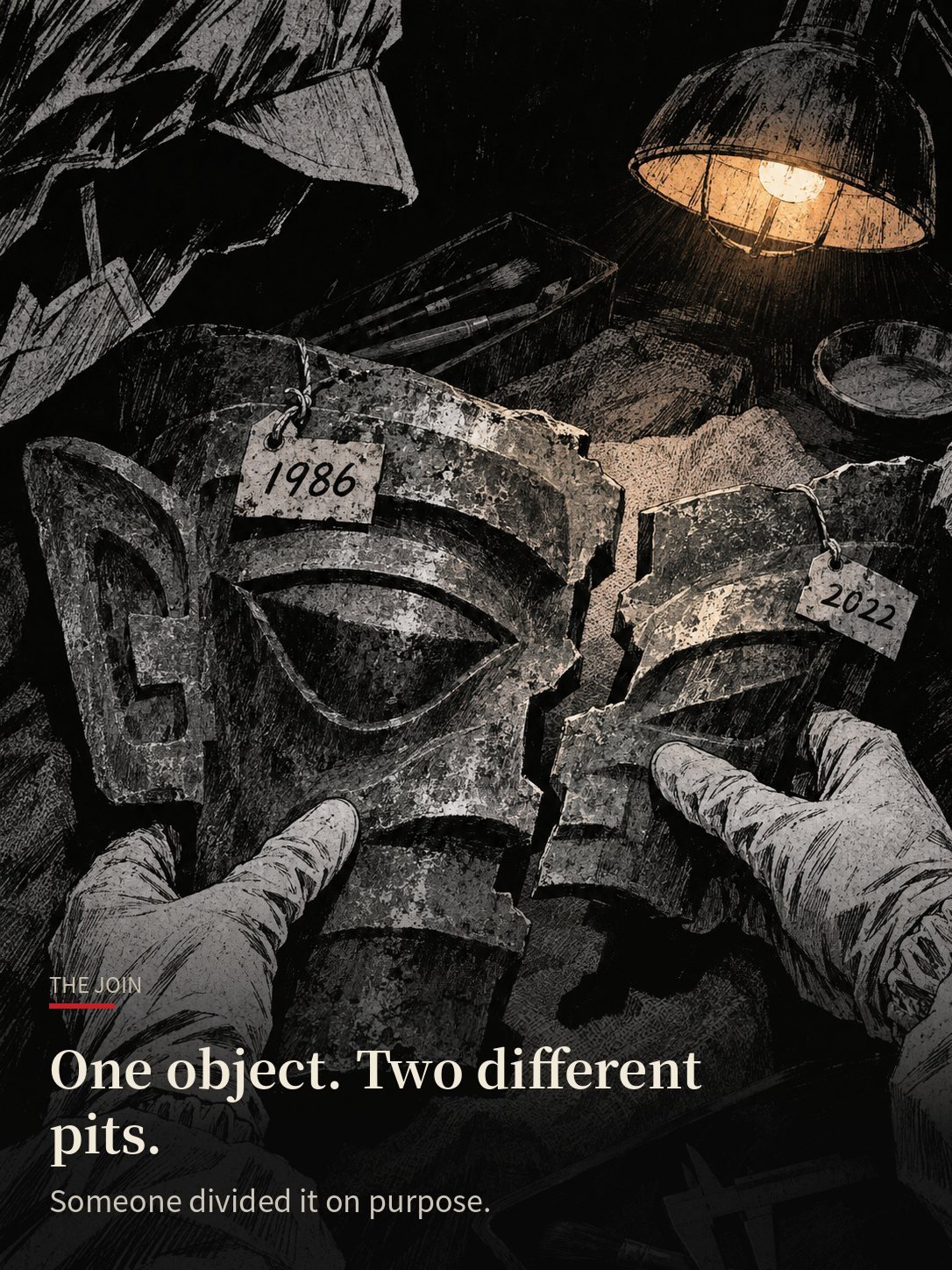
Then the fragments began to match.
Parts of the same objects turned up in pits 1, 2, 3, 4, 7 and 8. (CGTN25) China Daily reported that a pit opened in 2021 held the missing left ear of the great mask lifted 35 years earlier. (CD24-MASK)
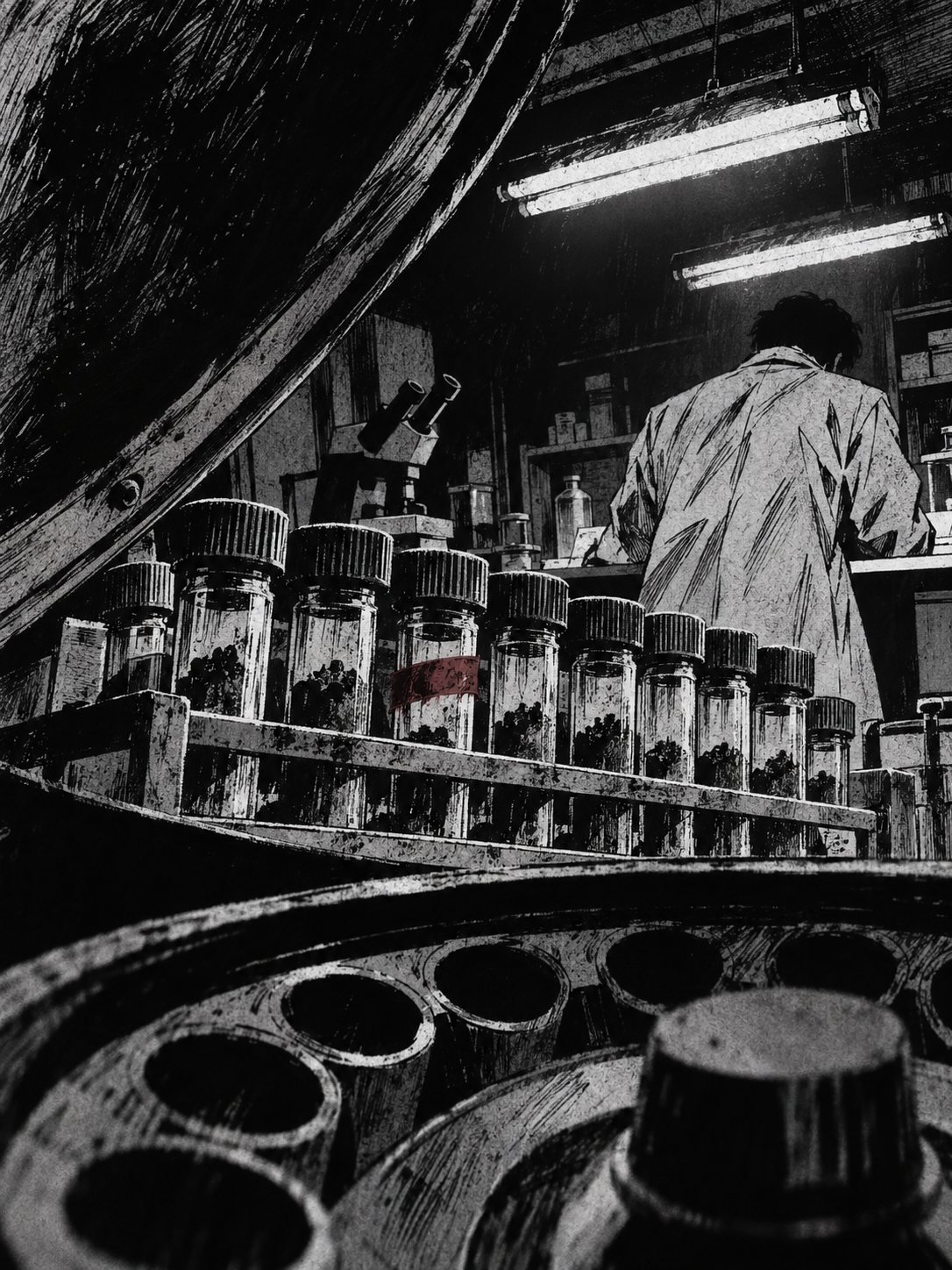
Someone, in other words, broke single objects and divided them between holes.
For Ran Honglin, who leads the Sanxingdui work for Sichuan’s provincial archaeology institute, the joins show these pits were filled at the same time. (CD25) In September 2025 his institute and Peking University put a date on it. Radiocarbon results gave a 95.4 per cent probability that pits 3, 4, 6 and 8 were buried between 1201 and 1012 BC. (CGTN25)
Not everyone was ready to close the question. When earlier dates were announced in 2022, Fudan University archaeologist Chen Chun said the evidence was not yet enough to explain the context of the objects. The work, he said, was “like a detective’s analysis.” (ST22)
Iron from the sky

Pit 7 held one more surprise, and it took five years to read.
In 2021 excavators noticed a badly corroded lump set into the pit wall and lifted it in a block of soil. In March 2026 a team led by Haichao Li of Sichuan University reported that the three fragments, parts of an axe-shaped object about 20 centimetres long, are iron. Nickel-rich, evenly mixed iron of a kind no late Shang furnace is known to have produced. Their conclusion: it was worked from a meteorite. (SA26) (CD26) (ARCH26)

That is unusual but not unearthly. Thirteen meteoritic iron objects were already known from Bronze Age China, mostly small inserts in bronze weapons from the north. This is the first from the south-west and, the study says, the largest. (CD26) Which kind of meteorite it came from has not been determined. (ARCH26)
A city without a word
Twelve square kilometres. Workshops, walls, bronze casting of great skill. No writing has ever been found. (ST21)
Ran Honglin thinks records existed and rotted. A city this organised, he has argued, “must have had good communication systems.” (ST21)
A study published in Antiquity in 2026 found silk residue on 101 objects from the pits, most of them bronzes. Cloth had been laid under, around or over the offerings. The authors float silk as a possible writing surface, and they call that a hypothesis. (SILK)
Around 1000 BC the city was abandoned. (CWA)
Evidence photos
Real photographs and published figures, kept separate from our illustrations. Each one says what it shows, and what it cannot prove.

Evidence box: documented vs. claimed
| What it is | What it supports | Its limits | |
|---|---|---|---|
| Documented | Eight pits excavated in 1986 and 2020–22 | Bronzes, gold, jade and ivory were broken and burned, then buried; no human remains | Shows what was done, not why |
| Documented | Radiocarbon study, Sichuan institute and Peking University, 2025 | Pits 3, 4, 6 and 8 buried between 1201 and 1012 BC (95.4% probability) | Announced at a forum and reported by state media; four pits only |
| Documented | Matching fragments across pits 1, 2, 3, 4, 7 and 8 | Those pits are linked, probably filled together | Pits 5 and 6 are not on the list |
| Documented | Jade and stone workshop, about 1,000 m², announced 2024 | Many objects could have been made on the spot | Dated 1550–1250 BC, earlier than the pits |
| Documented | Metal analysis of the Pit 7 iron, 2026 | The axe-shaped object was made from meteoritic iron | Meteorite type unknown; reports differ on nickel content |
| Claimed | The masks portray Cancong, the bulging-eyed king | A link between the bronzes and Shu legend | The text is some 1,400 years younger than the pits |
| Claimed | An earthquake diverted the river and emptied the city | Why Sanxingdui was abandoned | Its own author called it “very speculative” |
| Fringe | Aliens, or a civilisation imported from the Middle East | Nothing. No evidence has been offered | Rejected by archaeologists; contradicted by local workshops and casting methods |
Evidence locker
Primary records and real photographs only. Each caption says what the item shows and where it comes from.
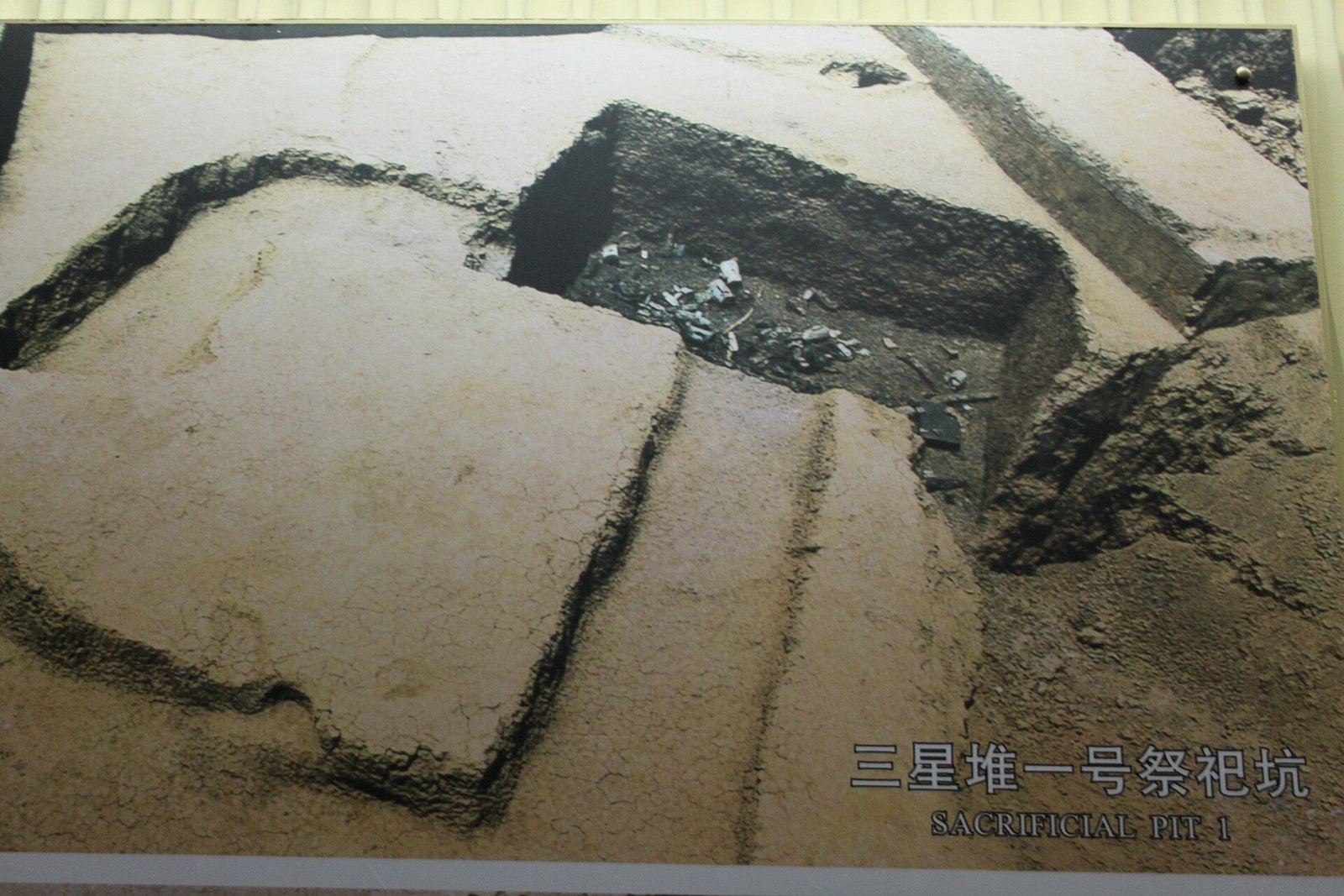 EXHIBIT A
 EXHIBIT B
 EXHIBIT C
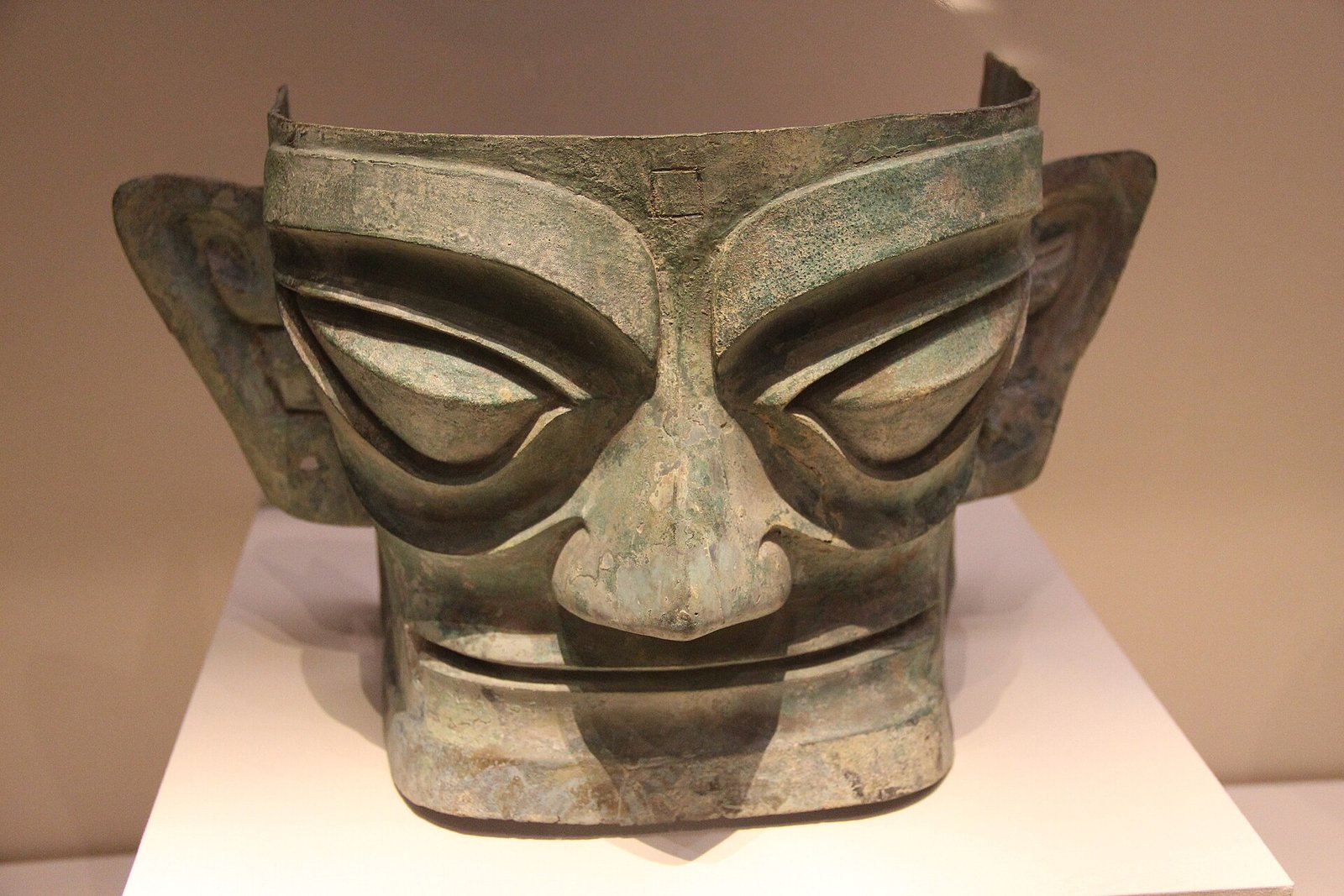 EXHIBIT G · PHOTOGRAPH
 EXHIBIT H · PHOTOGRAPH
Timeline
| Date | Event |
|---|---|
| c. 2700–1000 BC | Span of occupation given in the 2023 Antiquity report (ANT23) |
| 1550–1250 BC | Date range of the jade and stone workshop (CD24-WORK) |
| 1201–1012 BC | Burial window for pits 3, 4, 6 and 8 (CGTN25) |
| c. 1000 BC | City abandoned (CWA) |
| 1927–1929 | A farmer finds jade at Moon Bay; sources disagree on the year |
| 1933–34 | David Crockett Graham excavates (ST21) (ANT23) |
| 1986 | Brickyard workers expose pits 1 and 2 (ST21) |
| 29 Jan 2013 | Site placed on China’s UNESCO Tentative List with Jinsha (UNESCO) |
| Oct 2019 | Survey restarts beside the old pits (CD21) |
| Dec 2019 | Pit 3 found (CD21) |
| Mar 2020 onward | Pits 4 to 8 found (CD21) |
| 20 Mar 2021 | First announcement: 500-plus objects, gold mask (CD21) |
| 13 Jun 2022 | Nearly 13,000 objects reported (ST22) |
| Dec 2024 | Workshop announced (CD24-WORK) |
| 27 Sep 2025 | Radiocarbon dates released (CGTN25) |
| Mar 2026 | Meteoritic iron study reported (ARCH26) (SA26) |
| Oct 2026 | Silk study reported (SILK) |
The explanations, side by side
A great sacrifice (mainstream). This is the reading most archaeologists use, and the reason the holes are called “sacrificial pits.” It rests on the burning, the layering and the absence of bodies. Harvard’s Rowan Flad has suggested that destroying valuables in public could bind a community together, an idea the 2023 Antiquity report cites. (ANT23) What the theory cannot name is the god, ancestor or event behind it.
A burial, or a political break (minority, scholarly). Chen Shen of the Royal Ontario Museum has noted that some scholars see the pits as a kind of burial, with the body possibly reduced to ash. He also raised a second possibility: that they are tied to political change as people left the city about 3,000 years ago. (LS21) Neither has direct proof.
An earthquake and a lost river (speculative, scholarly). In December 2014 river scientist Niannian Fan told the American Geophysical Union that a quake may have triggered landslides, dammed the river in the mountains and sent it toward Jinsha, a later site near Chengdu whose gold work resembles Sanxingdui’s. He was candid: “the theory is still very speculative.” A geologist not involved asked the obvious question. Why would moving house require burying your treasures? (LS14)
The king with the protruding eyes (legend, used as a clue). Covered above. Scholars cite it. None claims it as proof.
Aliens or outsiders (fringe). After the 2021 announcement, Chinese social media filled with posts saying the masks looked alien, or must have come from a civilisation in the Middle East. Wang Wei of the Chinese Academy of Social Sciences dismissed the idea, and archaeologists quoted by the South China Morning Post called it “very far-fetched and not supported by any available evidence.” (SCMP) The excavated record points the other way: a local jade workshop, bronze vessels of the zun type shared with the rest of Bronze Age China, and casting methods studied in detail by Chinese and Cambridge researchers. (CD24-WORK) (CD21) (CD25) The meteoritic iron is sometimes folded into this story online. It is a rock that fell and was hammered into shape, as happened in several ancient cultures.
Where the records disagree
| Detail | What sources say |
|---|---|
| Year of the first find | 1927 (CWA); 1928 (ANT23); 1929 (ST21) (CD21) |
| What the farmer was digging | A well (ST21); a ditch (CWA) |
| Graham’s excavation | 1933 (ST21); 1934 (ANT23) |
| Objects in the 1986 pits | About 300 in Pit 1 (THE) or 420 (ST21); 1,500 from Pit 2 (ST21); “more than 900” for both (ANT23); “more than 6,000” (UNESCO) |
| Were pits 1 and 2 filled together? | Pit 2 about a generation later (THE); same burial date, on the fragment joins (CGTN25) |
| Date of pits 5 and 6 | Probably later, early Western Zhou (ANT23); Pit 6 inside the 1201–1012 BC window (CGTN25) |
| Nickel in the iron | 7.41% (SA26); “roughly 20 percent” (CD26) |
| Height of the bulging-eyed mask | 65 cm (CD24-MASK); 66 cm (GAC) |
What we still don’t know

- Why the objects were destroyed, and for whom.
- Whether the people of Sanxingdui wrote anything down.
- Why the city emptied around 1000 BC, and whether its people founded Jinsha.
- What the 2.6-metre figure was holding.
- How much is still in the ground. Only a small part of the 12 square kilometres has been excavated.
Sanxingdui has been on China’s UNESCO Tentative List since 2013, as part of the “Archaeological Sites of the Ancient Shu State.” (UNESCO) We could not confirm how far the nomination has moved since.
Where the argument is, and where we come down
There are two arguments, and only one of them is serious. The serious one is among Chinese archaeologists, and it is about what the pits are. The 1999 excavation report was titled Sanxingdui Sacrificial Pits, and the name stuck. Sun Hua of Peking University argues instead that they are burial pits for temple objects destroyed in a political upheaval, which he links to a struggle over whether to side with the Shang or the rising Zhou. Ran Honglin, who leads the current excavation for the Sichuan institute, told China News Weekly in 2022 that he uses “sacrificial pit” only for convenience and does not consider pits 1 and 2 to be sacrificial pits, and the magazine noted that his own institute is divided. The head of Peking University’s dating laboratory, Wu Xiaohong, said the radiocarbon results cannot decide between a single filling and several batches. A parallel scholarly strand concerns contact: Duan Yu has argued the gold staff reflects Near Eastern borrowing, while Li Xueqin warned against explaining Sanxingdui by diffusion. The second argument is public, on Chinese social media since the 2021 excavations were broadcast live: that the masks are alien or the culture came from the Middle East. Wang Wei, then chairman of the Chinese Archaeological Society, dismissed it, and that year he also publicly rebuked state television for featuring a tomb-raiding novelist in its Sanxingdui broadcast.
The narrow claim is strong; the label is not. That the objects were deliberately broken and burned, then buried in layers with no human remains, rests on primary excavation records from two campaigns. That several pits were filled at about the same time rests on fragments of single objects joining across six of them, together with the 2025 radiocarbon window. That evidence fits one great sacrifice and a crisis burial equally well, which is why scholars of equal standing still disagree. The alien and West-origin claims are the weakest of all: they rest on resemblance, and are contradicted by a jade workshop on site, zun vessels shared with the rest of Bronze Age China, and studied local casting methods.
The argument exists because the city left no writing, so the purpose of the act must be inferred from the act itself. A name chosen in the first excitement of 1986 framed every later reading, including the public’s. The bronzes look unlike anything from the Central Plains, which invites outsider stories, and livestreamed excavation turned an archaeological question into national entertainment.
On the record as it stands, we put more weight on a single, deliberate act of destruction and burial carried out by Sanxingdui’s own people than on the specific claim that it was a sacrifice. First, the cross-pit joins and the shared dates point to one planned episode, which both leading interpretations accept. Second, local workshops and casting methods tie the objects to the city that buried them. We could be wrong about the timing if pits 1, 2, 5 and 7, which were not in the 2025 dating study, prove to be separated by generations, which would favour repeated ritual over one crisis. If those dates are published, this section changes.
Sources for this section: chinanews.com.cn · aisixiang.com · m.thepaper.cn · livescience.com · degruyterbrill.com
Quick answers: Sanxingdui
What is Sanxingdui?
A Bronze Age walled city near Guanghan in Sichuan, China, linked by scholars to the ancient Shu kingdom. It is known for eight pits filled with broken and burned bronzes, gold, jade and elephant tusks.
How old are the Sanxingdui pits?
A 2025 radiocarbon study dated four of the pits to between 1201 and 1012 BC, the late Shang period. The city itself is older.
Why were the Sanxingdui masks broken and burned?
Nobody knows. Most archaeologists read the pits as large ritual sacrifices. Burial rites, political upheaval and abandonment after a natural disaster have also been proposed. None is proven.
Was Sanxingdui built by aliens?
No. That claim spread online in 2021 and has no evidence behind it. Workshops on the site, familiar Chinese vessel types and studied casting techniques show the objects were made by local people.
Did Sanxingdui have writing?
None has been found. Some researchers think records were kept on materials that decayed, perhaps silk, but that remains a hypothesis.
What is a little-known fact about Sanxingdui?
The pits were found in 1986 because workers digging clay for a brick factory turned up jade. In the second of the two pits, more than sixty charred elephant tusks lay on top, with the bronzes packed tight beneath them. (THE) (ST21)
Related files
Editor’s note
The detail I cannot stop thinking about is the object split between two pits. Breaking things and burning them, I can accept as part of a ceremony. People have done stranger things for their gods. But someone took the pieces of a single bronze and put them into different holes. That is not a moment of frenzy. That looks like a plan, as if somebody had decided in advance which fragment belonged where. I want to know who made that decision, and what the rule was.
My own guess is that these were things that could never go back into ordinary use once the ritual was over. Think of the work in that bronze tree, nearly four metres tall, all of it cast in bronze. Nobody smashes something like that out of carelessness. Archaeologists have a phrase for objects deliberately broken so they can belong only to the dead or to the gods, and Sanxingdui feels like that idea carried to an enormous scale. If that is right, the breaking was not the end of the objects’ purpose. It was the purpose.
Which leaves the question that unsettles me most. Did the people who cast the masks and the tree know, while they were working, that it would all be broken and buried? Did they make each piece knowing it was only meant for one day? Nothing was written down, so we may never know. All that survives is the bronze, burned and divided exactly the way someone wanted it.
— Strange World Files
Case file summary
- What: Eight pits of deliberately broken and burned ritual treasures
- Where: Sanxingdui, Guanghan, Sichuan province, China
- When: Buried about 1200–1000 BC; found in the late 1920s, 1986 and 2019–2020
- Toll: None. No human remains were found in the pits
- Status: Date established in 2025; purpose unexplained
Illustrations are AI-generated artistic interpretations, not photos. No real person is depicted with a recognizable face. Read how we research and illustrate these files.
Sources
- Li Y., Qiu T., Guo J., Li Y., “New discoveries at the Sanxingdui Bronze Age site in south-west China,” Antiquity 97(391), 2023, DOI 10.15184/aqy.2022.150
- UNESCO World Heritage Centre, Tentative List no. 5816, “Archaeological Sites of the Ancient Shu State,” submitted 29 Jan 2013
- Robert Bagley, “The mystery of the pits,” Times Higher Education (date not visible on page)
- “The lost world of Sanxingdui,” Current World Archaeology 122 / The Past, 23 Nov 2023
- Wu Haiyun and Ye Ruolin, “The Mysterious Ancient City That’s Rewriting Chinese History,” Sixth Tone, 7 Jul 2021
- Wu Haiyun, “New Sanxingdui Relics Offer More Clues of Ancient Civilization,” Sixth Tone, 13 Jun 2022
- China Daily, “Sanxingdui findings shed new light on ancient China,” 26 Mar 2021
- China Daily, “Massive bronze sacred tree from Sanxingdui site,” 12 Mar 2025
- CGTN, “Treasures of Sanxingdui unveil ancient Shu civilization,” 23 Feb 2024
- Zhao Xu, “More than just a pretty face,” China Daily, 16 Oct 2024
- Wang Kaihao, “Findings shed light on Sanxingdui layout,” China Daily, 30 Dec 2024
- CGTN, “Exact dating of the sacrificial pits at Sanxingdui site officially released,” 27 Sep 2025
- Peng Chao, “Gold, bronze and mystery,” China Daily, 11 Nov 2025
- “Bronze Age Chinese Iron Weapon Fragments Analyzed,” Archaeology (Archaeological Institute of America), 27 Mar 2026
- “Mysterious Ancient Culture Forged a Weapon From a Fallen Star,” ScienceAlert, 30 Mar 2026, reporting Li et al., Archaeological Research in Asia, DOI 10.1016/j.ara.2026.100692 (journal article not opened)
- Peng Chao, “Finding fragile fragments of iron,” China Daily Global, 29 May 2026
- Dario Radley, “Silk-wrapped sacred bronzes at Sanxingdui,” Archaeology News, 28 Oct 2026, reporting Guo et al., Antiquity 2026, DOI 10.15184/aqy.2026.10448 (paper not opened)
- Owen Jarus, “6 sacrificial pits filled with artifacts reveal rituals of ancient Chinese kingdom,” Live Science, 26 May 2021
- “Mystery of Ancient Chinese Civilization’s Disappearance Explained,” Live Science, 24 Dec 2014
- “Historical discovery revives wild theories of alien civilisation in ancient China,” South China Morning Post, March 2021 (exact date not shown)
- Benjamin Phelps, “The Accidental Discovery That Revealed a Lost Civilization,” PBS Secrets of the Dead, 20 May 2026
- Sanxingdui Museum, “Mask with protruding eyes,” Google Arts & Culture