The Great Fire of London: A Baker’s Oven, a Buried Cheese and a Man Hanged for a Fire He Could Not Have Started
What the record shows
- When: Sunday 2 to Thursday 6 September 1666
- Damage: 13,200 houses (Monument inscription), 87 parish churches (Britannica)
- Status: No cause proven; the one man hanged for it was almost certainly innocent
Still uncertain
- What actually lit the fire in the bakehouse after the oven was raked out.
- How many people really died.
- The name of Farriner’s maid.
Narrated Mystery: press play and hear the whole case read aloud, like a true crime podcast episode, or an audiobook for a long drive (about 13 minutes). The narrator is an AI voice.
Listen to the narration above first, then read along. The key words are underlined in the story.
- droughta long period with little or no rain
- guttera channel along a roof edge for rainwater
- firebreaksopen gaps made to stop a fire spreading
- demolitionsthe deliberate destroying of buildings
- scaffoldinga temporary frame put up around a building
- cryptan underground room beneath a church
- accomplicea person who helps someone commit a crime
- indictedformally charged with a serious crime
1. What did soldiers from the Tower of London use to make wider firebreaks?
Gunpowder.
2. How many houses does the Monument’s inscription say were destroyed?
13,200 houses.
3. How does the London Museum describe Robert Hubert?
It calls him “probably innocent.”
He confessed to a fire he could not have started
Autumn 1666. London was still a field of ash and chimneys.
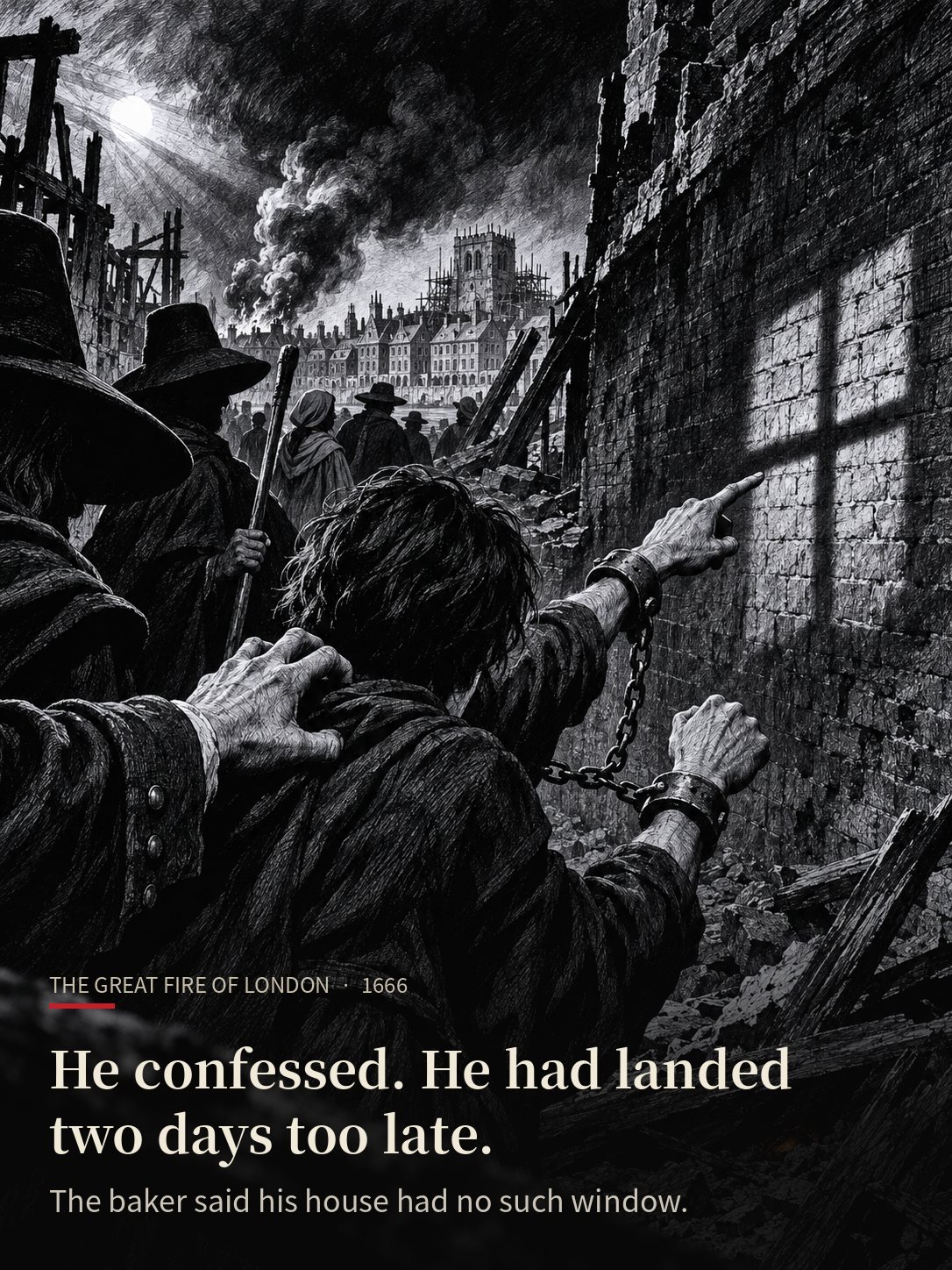
A young Frenchman named Robert Hubert, a watchmaker’s son from Rouen, told the authorities that he had started the Great Fire. He said he and an accomplice had made a crude fire grenade and pushed it through a window of the King’s baker’s house on Pudding Lane.
There were two problems with his story. The baker said his house had no window of the kind Hubert described. And the captain of the ship that brought Hubert from Sweden said Hubert had reached England two days after the fire began.
He was hanged anyway. To understand how, you have to go back to a dry Sunday night in September. (BL-HUBERT) (LM-PLAQUE)
September 1666. Four days of fire, a buried cheese, and a man who arrived two days too late to have started it.


A wooden city after a long drought

The summer of 1666 was long and dry. Samuel Pepys, a naval official who kept a diary, later wrote that the houses burned so easily “after so long a drought.”
John Evelyn, another diarist, described “a fierce eastern wind in a very dry season.”
Most of the buildings in the City of London were wooden, packed along narrow lanes. There was no fire service.
When a fire broke out, Londoners and a few soldiers fought it with leather buckets, hand-held water squirts and long iron fire hooks for pulling houses down. (PEPYS-1666-09) (TNA-EVELYN) (MONUMENT-ORG)
An oven “drawn by 10 a-clock”

Thomas Farriner was the King’s baker. His bakehouse stood on Pudding Lane, a short walk from London Bridge.
On Saturday night, 1 September, the oven was raked out. The Farriners later said it “was drawn by 10 a-clock at night,” and that by about midnight there was not fire enough left in it to light a candle.
That account came from Sir Robert Vyner, as reported by Pepys months later. One letter written that October says Farriner’s daughter was in the bakehouse at midnight.
Nobody has ever been sure what lit the fire. But two hours later, the stairs were burning. (LEICS-DISCOVERY) (MONUMENT-ORG) (BRIT-FIRE)
Out through the window and along the gutter
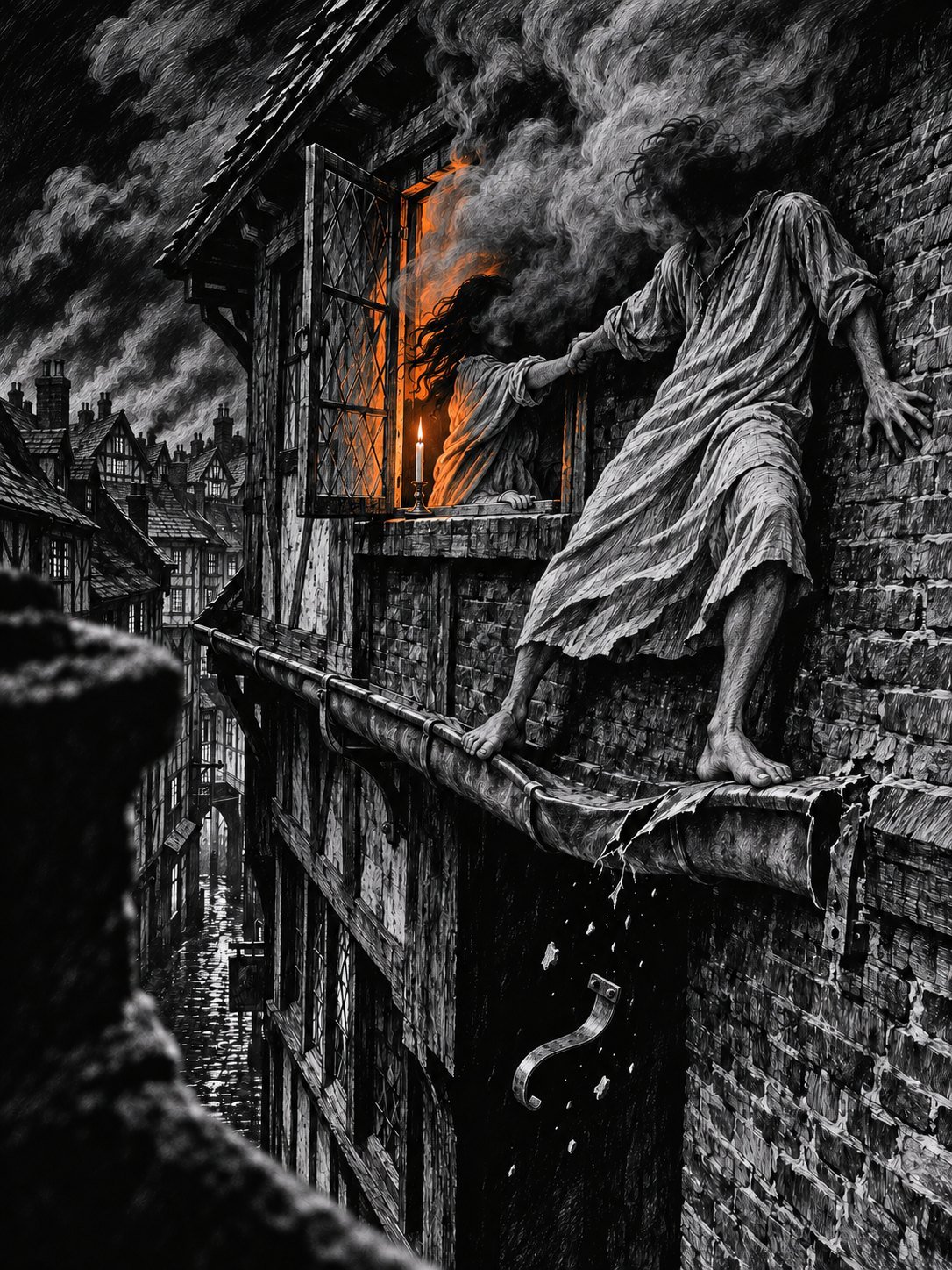
Sunday 2 September, between one and two in the morning by the household’s account, though some later histories say shortly after midnight.
The family woke to smoke and found “the fire coming up stairs.” A journeyman named in the later indictment, Thomas Dagger, is thought by one historian to have been the first to notice.
Farriner, his son, his daughter Hanna and a man of the house climbed “out of ye Windore and Gutter,” edging along the roof gutter to the next house. Hanna was “much scorched.”
Their maid did not escape. Her name is not recorded. The Monument’s own history names her as the fire’s only victim. (LEICS-DISCOVERY) (MONUMENT-ORG) (WIKI-FIRE)
Three in the morning, and Pepys went back to bed

Not far away, Pepys’s maid woke him.
“Jane called us up about three in the morning, to tell us of a great fire they saw in the City,” he wrote. She told him “above 300 houses have been burned down to-night.”
Pepys looked out, judged it far enough off, and went back to sleep.
By the time he went out to look later that day, St Magnus’s church by the bridge and most of Fish Street had already burned. (PEPYS-1666-09) (TNA-PEPYS)
“Lord! what can I do? I am spent”

The Lord Mayor of London was Sir Thomas Bloodworth, also spelled Bludworth.
Tradition says that when he was first called out in the night, he dismissed the fire with a crude remark about how little water it would take, and went home. That famous line is not in Pepys’s diary. The earliest source anyone has found for it was printed in 1807. A confession that did not fit the facts also sent an innocent man to prison in the Hwaseong serial murders case, where he served 20 years before his 2020 acquittal.
What Pepys did record is stranger. Later that Sunday he carried the King’s order to pull down houses in the fire’s path. He found the Mayor in Cannon Street “like a man spent, with a handkercher about his neck.”
The Mayor “cried, like a fainting woman”: “Lord! what can I do? I am spent: people will not obey me. I have been pulling down houses; but the fire overtakes us faster than we can do it.”
The King’s message had been plain: “spare no houses, but to pull down before the fire every way.” (GUTENBERG-PEPYS) (TNA-PEPYS) (WIKI-BLOODWORTH) (WIKI-FIRE)
Pigeons that would not leave

Pepys took a boat onto the Thames to watch.
He saw “nobody, to my sight, endeavouring to quench it, but to remove their goods.” People threw bundles into boats. Poor families stayed in their houses “as long as till the very fire touched them.”
And there was a detail he could not forget: “the poor pigeons, I perceive, were loth to leave their houses.” Some of them burned and fell.
“The wind mighty high,” he wrote, “and driving it into the City.” (TNA-PEPYS) (PEPYS-1666-09)
One arch of fire, from one end of the bridge to the other

After dark Pepys saw “one entire arch of fire from this to the other side the bridge.”
On Monday Evelyn wrote that “all the sky was of a fiery aspect, like the top of a burning oven.”
He heard “the noise and cracking and thunder of the impetuous flames” and guessed at “above 10,000 houses all in one flame.”
The light, he said, was “seen above forty miles round about for many nights,” under a cloud of smoke “near fifty miles in length.” (PEPYS-1666-09) (TNA-EVELYN)
He buried his parmesan
By Tuesday 4 September the fire was coming toward Pepys’s own street.
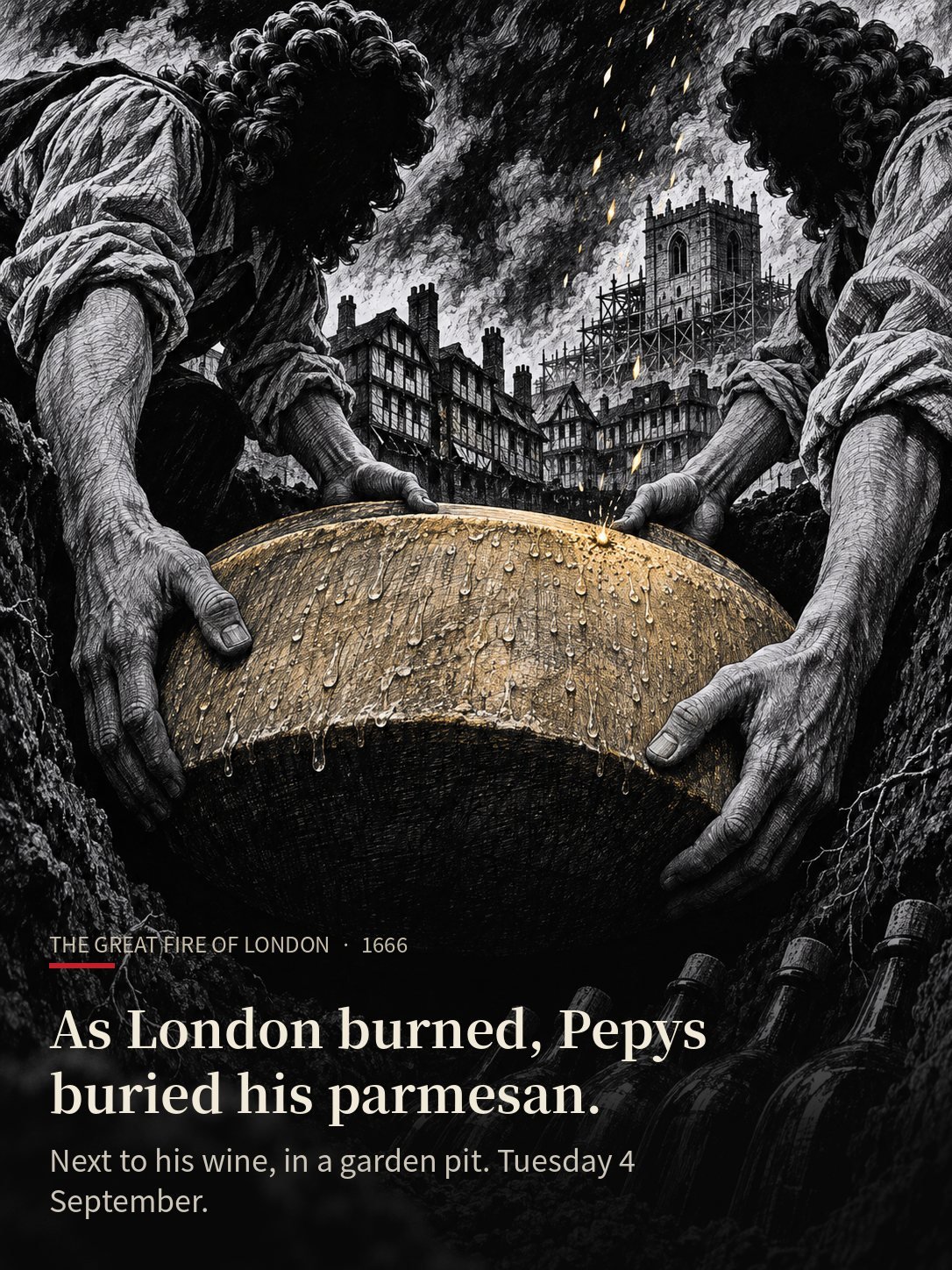
His neighbour, Sir William Batten, “not knowing how to remove his wine, did dig a pit in the garden.”
That evening Pepys and Sir William Penn dug another one, “and I my Parmazan cheese as well as my wine and some other things.”
It is one of the most famous lines in his diary. While London burned, a senior government official buried his cheese in the garden. (TNA-PEPYS) (PEPYS-1666-09)
Gunpowder in Tower Street

Pulling houses down by hand had not been fast enough. The wind kept carrying the fire across the gaps. Fighting fire without water also doomed passengers in the Ashtabula bridge disaster, where villagers carried pails down a frozen gorge in 1876 because the fire engines never pumped.
“Now begins the practice of blowing up of houses in Tower-streete,” Pepys wrote on 4 September.
Soldiers from the Tower of London used gunpowder to blast wider firebreaks. Evelyn agreed it was the only way: nothing would stop the fire but “the blowing up of so many houses as might make a wider gap.”
Britannica credits the gunpowder demolitions with finally bringing the fire under control. (PEPYS-1666-09) (TNA-EVELYN) (BRIT-FIRE) (MONUMENT-ORG)
The lead of St Paul’s ran down the street

On Tuesday night the fire reached Old St Paul’s Cathedral, the great medieval church on the hill. It was wrapped in wooden scaffolding for repairs.
Printers and booksellers from nearby Paternoster Row had carried their stock into the crypt, for safety. It burned.
Evelyn saw it happen. “The stones of Paul’s flew like grenados,” he wrote, with “the melting lead running down the streets in a stream,” and “the very pavements glowing with fiery redness.”
Pepys wrote simply: “Paul’s is burned, and all Cheapside.” (TNA-EVELYN) (LEICS-STPAULS) (PEPYS-1666-09) (WIKI-FIRE)
“The saddest sight of desolation”
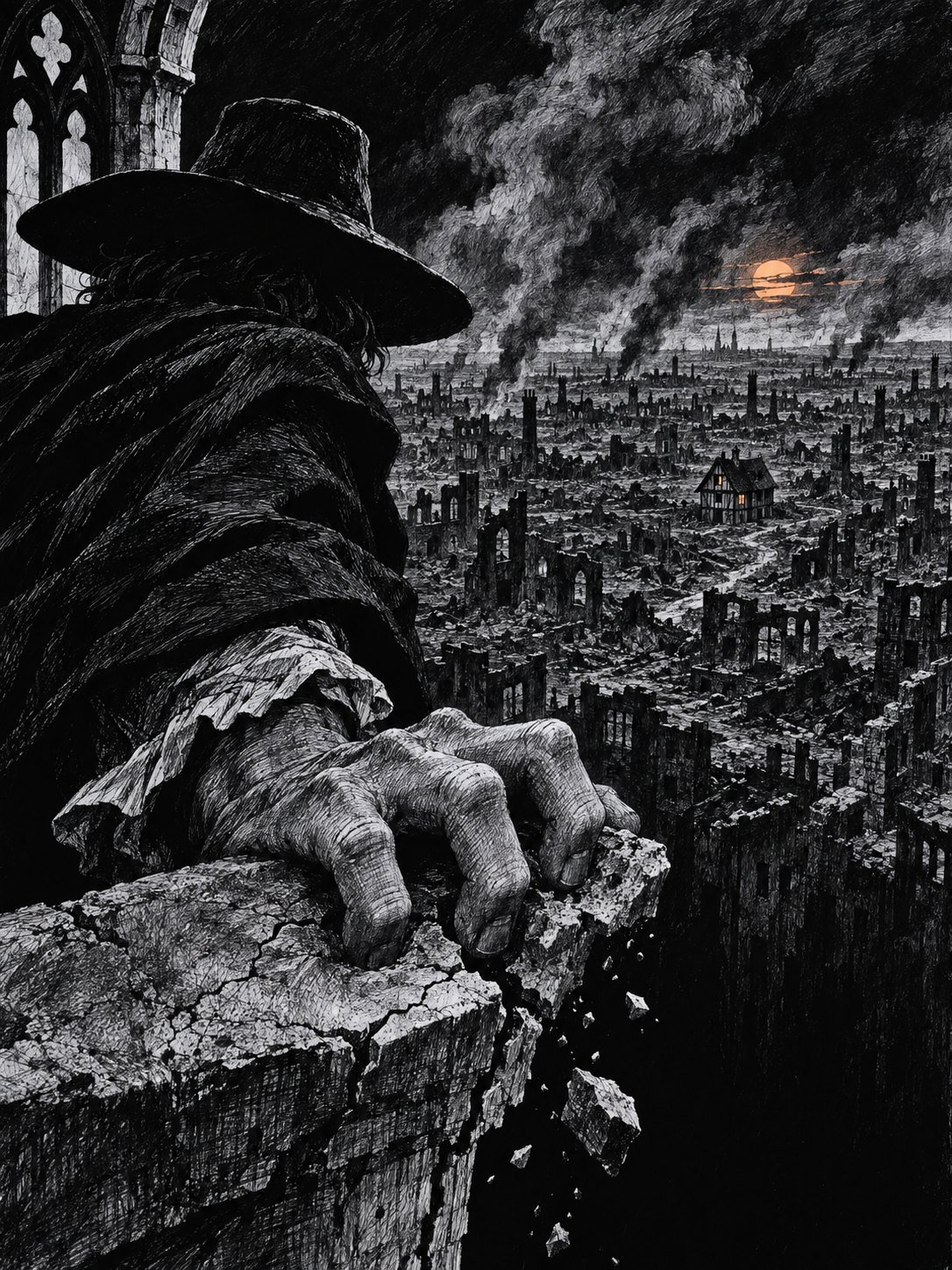
On Wednesday the fire began to slacken. Pepys climbed the steeple of All Hallows Barking, the church near his home, and looked out.
He “saw the saddest sight of desolation that I ever saw.”
By Thursday 6 September the fire was largely out, though it flared up again that evening at the Temple. Tradition says it finally died at Pye Corner in Smithfield, where a small gilded boy still marks the spot.
The Monument’s inscription later counted 13,200 houses destroyed. Britannica counts 87 parish churches. (PEPYS-1666-09) (BRIT-FIRE) (MONUMENT-INSCR) (WIKI-FIRE)
A cat in the chimney
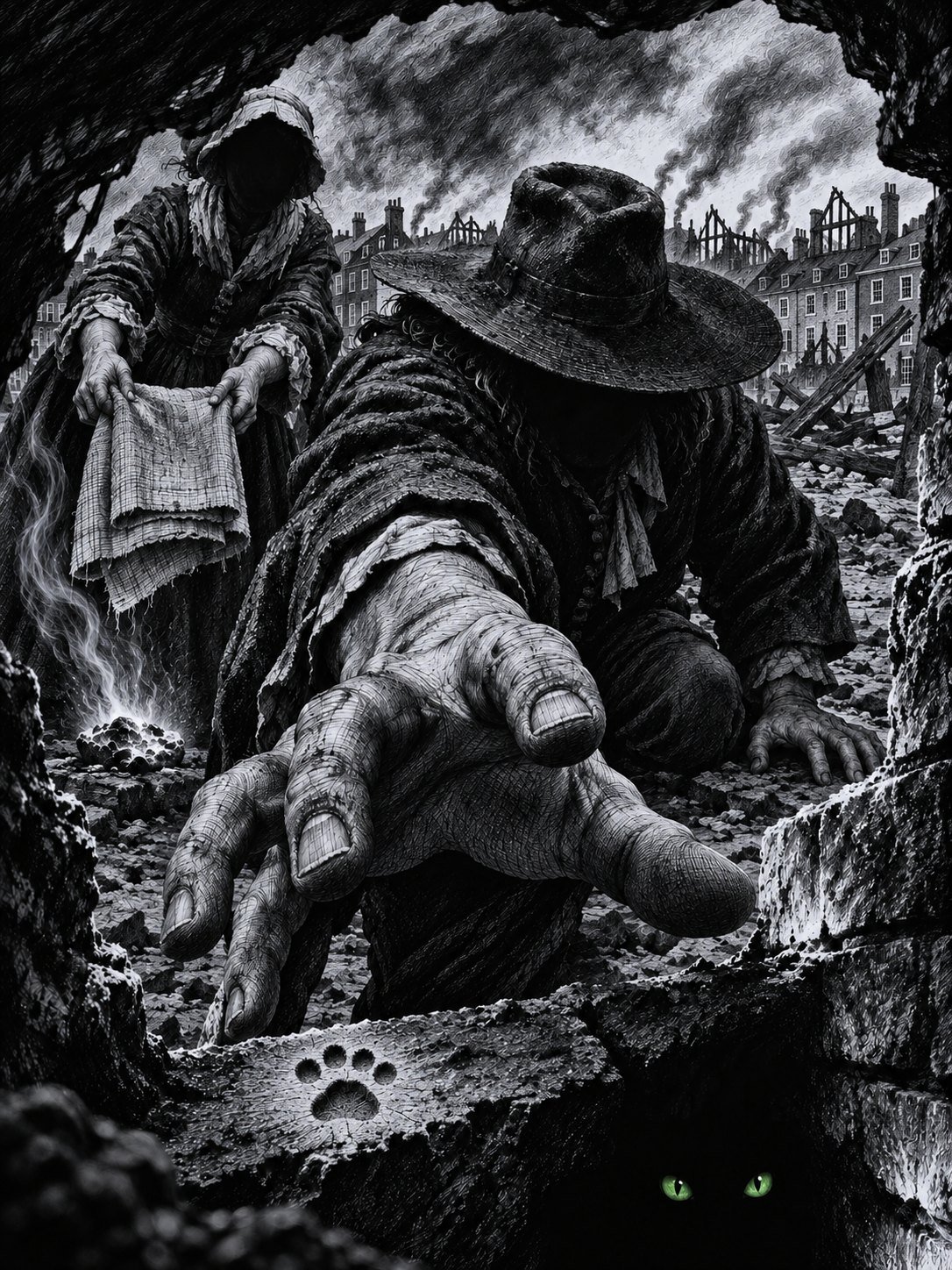
Pepys kept walking through the ruins.
He saw “a poor cat taken out of a hole in the chimney,” still alive, though its fur had been burned away.
Across the City, chimneys and brick hearths were often the only things left standing. Everything wooden around them was gone. (PEPYS-1666-09)
A city of tents in Moorfields
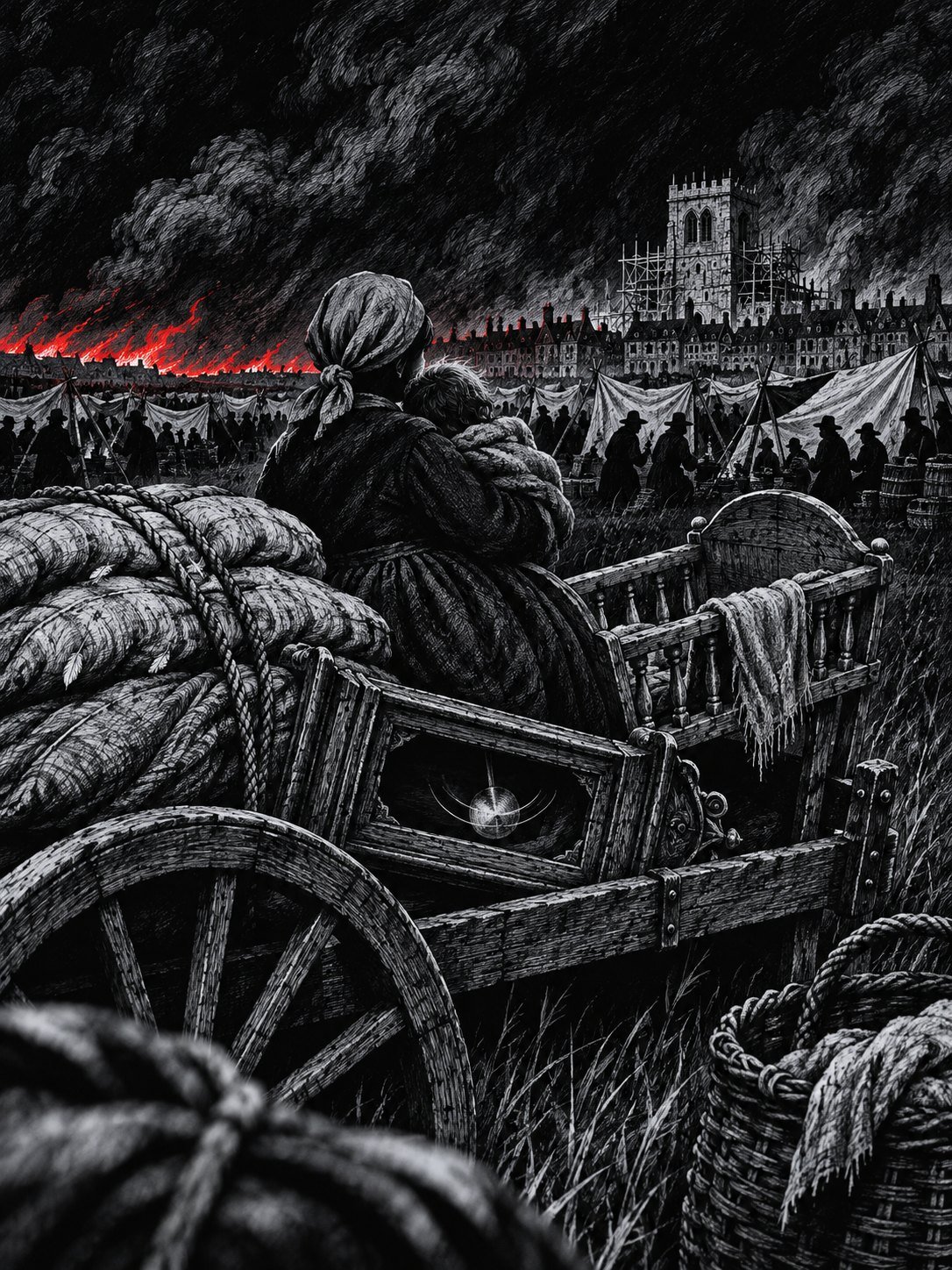
Tens of thousands of people now had nowhere to live.
“The poor inhabitants were dispersed about St. George’s Fields, and Moorfields, as far as Highgate,” Evelyn wrote. He thought one might have seen “200,000 people of all ranks and degrees dispersed.”
According to Britannica, most gathered in Moorfields, just north of the city wall, and some went as far as Hampstead and Highgate.
The Monument’s site puts the homeless at 130,000. The London Museum says around 100,000. (TNA-EVELYN) (BRIT-FIRE) (MONUMENT-ORG) (LM-MONUMENT)
Ground hot enough to burn his shoes

On Friday 7 September Evelyn walked across the City.
“The ground under my feet so hot,” he wrote, “that it even burnt the soles of my shoes.”
He found St Paul’s “now a sad ruin,” where “a sheet of lead covering a great space … was totally melted.”
Only a handful of deaths were recorded, traditionally six. Some historians think the true number was far higher. Neil Hanson argues it ran to several hundred, perhaps thousands, because the poor and unrecorded were never counted. (TNA-EVELYN) (LONDONIST-DEATHS) (LM-MONUMENT)
The trial of Robert Hubert
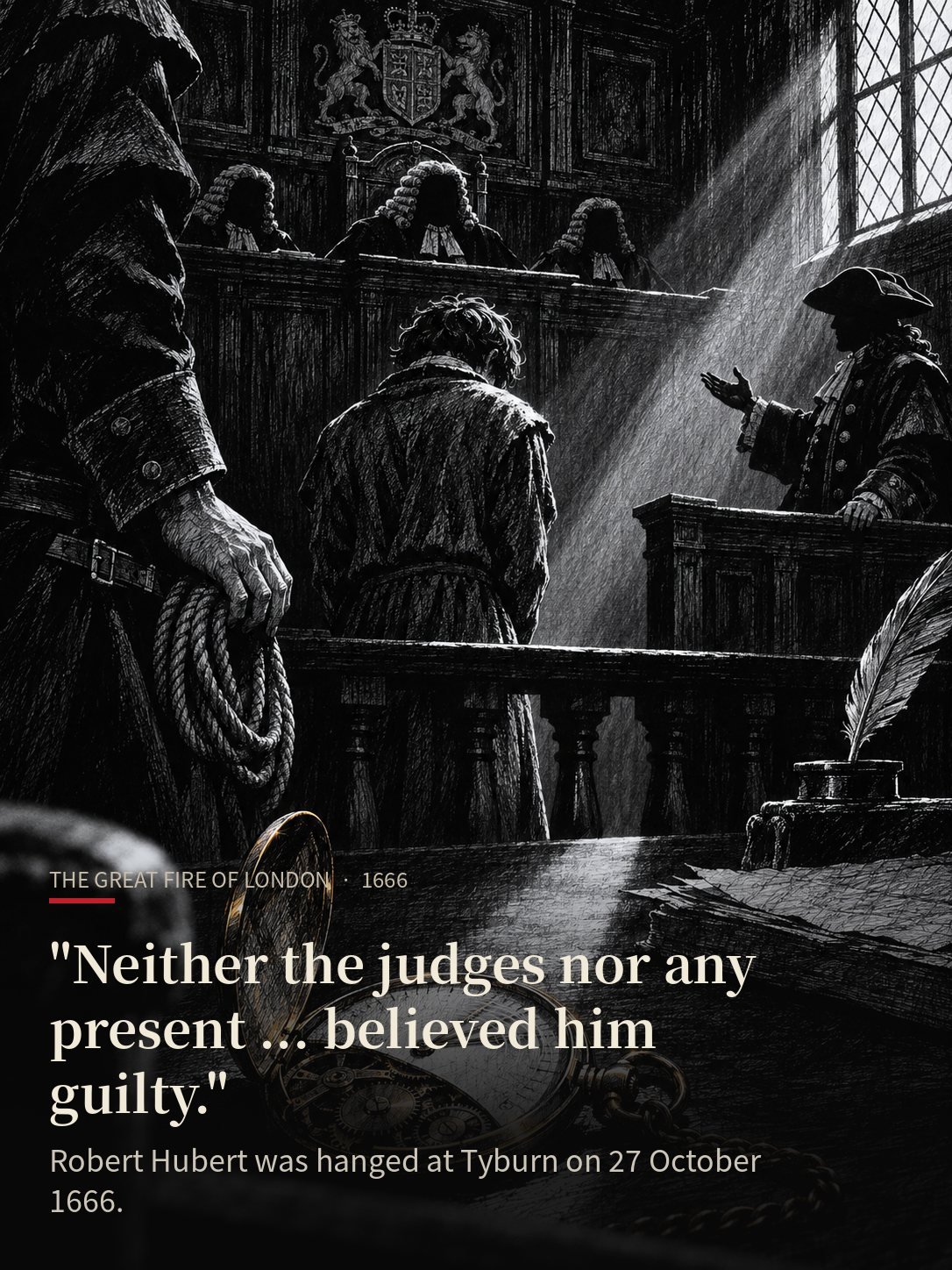
Someone had to be blamed. Rumours spread that foreigners had set the fire, and Hubert’s confession fitted.
He named an accomplice. His story changed during his imprisonment and trial. He was indicted that September and convicted.
The evidence against him fell apart in plain sight. The ship’s captain testified that he had landed two days after the fire began. The Lord Chancellor, Clarendon, called him a “poor distracted wretch, weary of his life,” and wrote that “neither the judges nor any present at the trial did believe him guilty.”
Robert Hubert was hanged at Tyburn on 27 October 1666. The London Museum calls him “probably innocent.” (BL-HUBERT) (LM-PLAQUE)
“Hell broke loose” on Pudding Lane
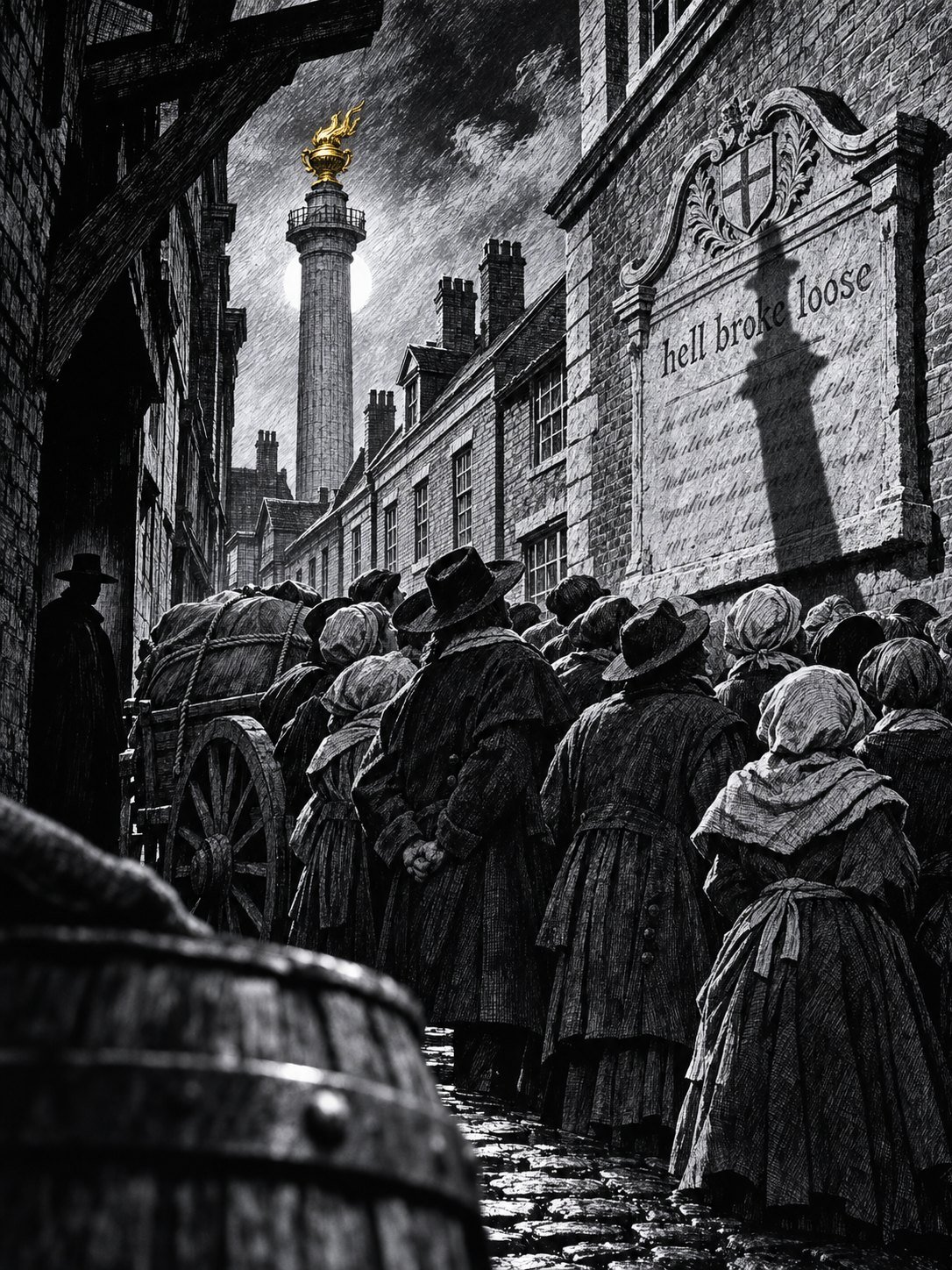
London was rebuilt over nearly fifty years. An Act of 1667 required new buildings to be brick or stone. Christopher Wren designed 51 new City churches and a new St Paul’s, finished in 1710.
Wren and Robert Hooke also designed the Monument, a stone column 202 feet tall, built 1671 to 1677. It stands 202 feet from the spot where the bakery stood.
In 1681, during a wave of anti-Catholic fear, the City added words blaming the fire on Catholics. A plaque went up on the Pudding Lane house: “Here by ye permission of heaven, hell broke loose upon this protestant city,” by the hand of Hubert, “who confessed.” Historians reject the claim, and the Monument’s lines were removed for good in 1830.
The plaque was taken down, reportedly because crowds stopped to read it and blocked the lane. In 1876 it was found in a backyard on Pudding Lane. It is now in the London Museum. (MONUMENT-ORG) (PARL-ACT) (BRIT-STPAULS) (LM-MONUMENT) (MONUMENT-INSCR) (LM-PLAQUE)
The evidence file
The objects and records this case rests on, and where they are now.
Exhibits
- Exhibit A — The Pudding Lane plaque, 1681. A stone plaque blaming “barbarous papists” and “their agent Hubert, who confessed”. The claim was false; the plaque was taken down (in the 18th century according to the London Museum, “probably” in 1830 according to another account) and found in 1876 in the backyard of 25 Pudding Lane. Held by the London Museum, object 119401. (London Museum; themonument.info)
- Exhibit B — Samuel Pepys’s diary, 2–7 Sep 1666. An eyewitness record: “Jane called us up about three in the morning”; the Lord Mayor’s “Lord! what can I do? I am spent”; the buried “Parmazan cheese”; and “Now begins the practice of blowing up of houses in Tower-streete”. (The Diary of Samuel Pepys; The National Archives)
- Exhibit C — John Evelyn’s diary, 3–7 Sep 1666. “The stones of Paul’s flew like grenados”, “the melting lead running down the streets in a stream”, and ground “so hot, that it even burnt the soles of my shoes”. (The National Archives)
- Exhibit D — The Harley letter, 20 Oct 1666. A contemporary letter describing how the baker’s household escaped “out of ye Windore and Gutter”. A maid of the household did not escape. (University of Leicester)
- Exhibit E — The Rebuilding Act, February 1667. It required all new buildings to be of brick or stone, limited their storeys, and ordered a column “on or as near unto the place where the said fire so unhappily began”. Held by the Parliamentary Archives, HL/PO/PU/1/1666/18&19C2n14. (UK Parliament)
- Exhibit F — Wren’s street plan, 1666. Presented to the King by 11 Sep 1666 and never adopted; the plans by Evelyn and Hooke were rejected too, and the old street layout was largely kept. Catalogued among the Wren drawings of All Souls College, Oxford. (All Souls College, Oxford)
- Exhibit G — The Monument and its removed lines. A column by Wren and Hooke, built 1671–1677, 202 ft tall and 202 ft from the bakery site. A line added in 1681, “Popish frenzy, which wrought such horrors, is not yet quenched”, was removed, restored in 1689 and removed for good on 6 Dec 1830. Standing on Fish Street Hill, London. (The Monument; themonument.info)
- Exhibit H — The case against Robert Hubert. He confessed to throwing a fire grenade through the bakery window, but the baker said there was no such window, and the ship’s captain said Hubert landed two days after the fire began. Clarendon wrote that “neither the judges nor any present at the trial did believe him guilty.” He was hanged at Tyburn on 27 Oct 1666. Summary based on the British Library and the London Museum. (British Library)
Evidence locker
Real archival images. Illustrations elsewhere in this file are AI-generated.
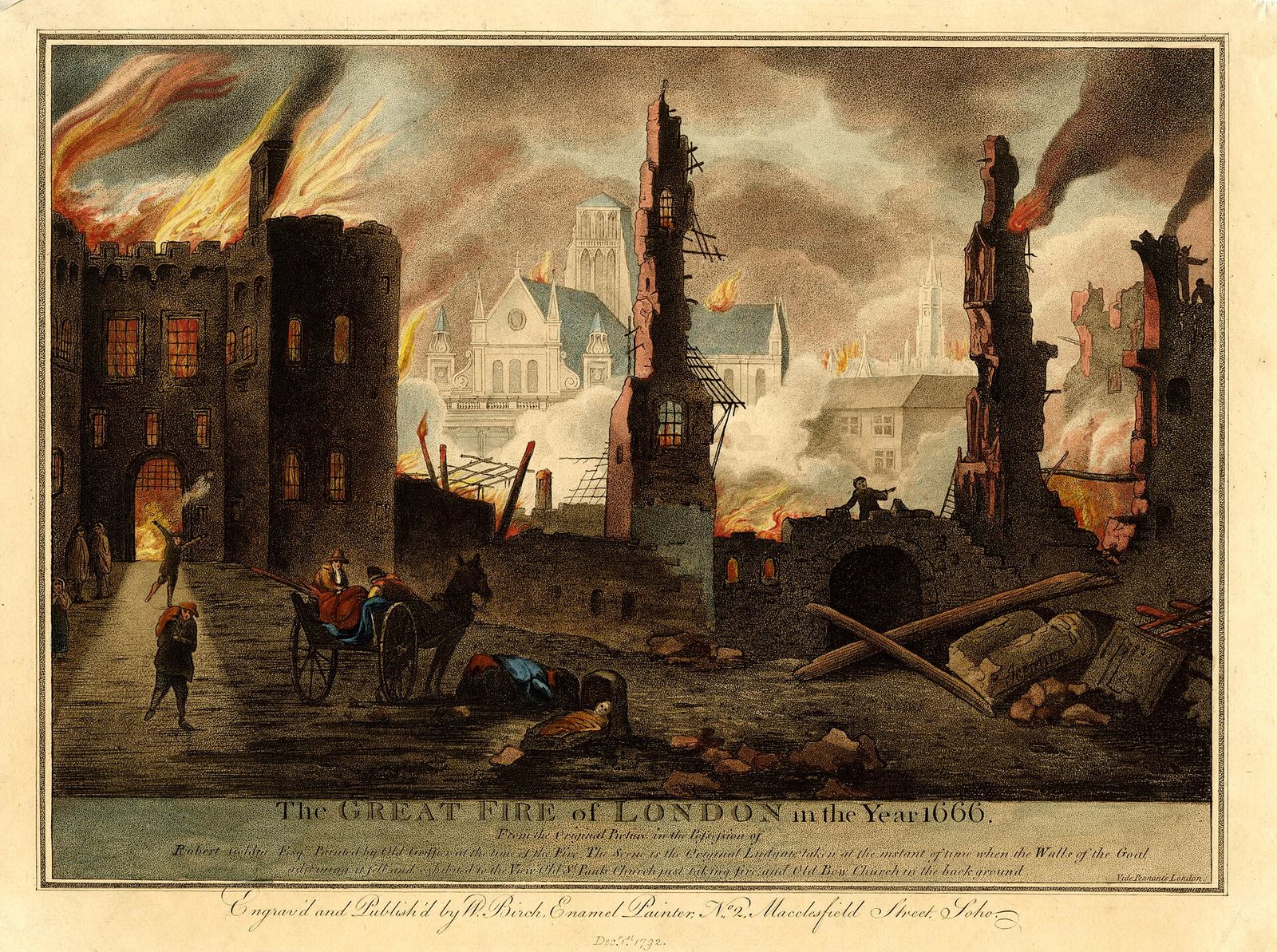 EXHIBIT A · TAP TO ENLARGE
In the record: “About two a clock this morning a sudden and lamentable fire brake out in this City” — The London Gazette, September 1666 (transcript, The National Archives).
Quick answers: the Great Fire of London
When was the Great Fire of London?
The Great Fire of London began in the early hours of Sunday 2 September 1666 and was largely out by Thursday 6 September, though Britannica gives the dates as 2–5 September. A strong east wind after a long, dry summer drove it through a city of mostly wooden buildings.
Where did the Great Fire of London start?
In the bakehouse of Thomas Farriner, the King’s baker, on Pudding Lane, a short walk from London Bridge. What actually lit it has never been known; the family said the oven had been raked out by 10 the night before.
How many people died in the Great Fire of London?
Only a handful of deaths were recorded, traditionally six. Some historians think the true number was far higher; Neil Hanson argues it ran to several hundred, perhaps thousands, because the poor and unrecorded were never counted.
How much of London was destroyed in the Great Fire?
The Monument’s inscription counted 13,200 houses destroyed, and Britannica counts 87 parish churches, along with Old St Paul’s Cathedral. Around 100,000 people were left homeless, by the London Museum’s count; the Monument’s site says 130,000.
How was the Great Fire of London stopped?
Soldiers from the Tower of London used gunpowder to blow up houses and make wider firebreaks, which Britannica credits with finally bringing the fire under control. Pulling houses down by hand had not been fast enough.
Who was blamed for the Great Fire of London?
Robert Hubert, a young Frenchman, confessed to starting it and was hanged at Tyburn on 27 October 1666, though the evidence showed he had reached England two days after the fire began. The London Museum calls him “probably innocent.”
What is the Monument to the Great Fire of London?
The Monument is a stone column 202 feet tall, designed by Christopher Wren and Robert Hooke and built from 1671 to 1677, standing 202 feet from where the bakery stood. Words added in 1681 blaming the fire on Catholics were rejected by historians and removed for good in 1830.
Case notes: a baker’s oven, a burned city and an innocent man
On 2 September 1666 a fire broke out in the King’s baker’s house on Pudding Lane. In four days it destroyed most of the City of London. A Frenchman who confessed was hanged, though he had arrived two days after it began (MONUMENT-ORG) (BL-HUBERT).
Where the case stands (as of November 2026)
Closed. No cause was ever proven. The only man convicted, Robert Hubert, could not have started it, and even the Lord Chancellor wrote that no one at the trial believed him guilty (BL-HUBERT) (LM-PLAQUE).
The fire is generally thought to have begun accidentally in Farriner’s bakehouse. The City’s 1681 claim that Catholics set it is rejected by historians (MONUMENT-ORG) (MONUMENT-INSCR).
Robert Hubert was hanged for starting the Great Fire, though he could not have started it.
PROVENEXAMINED
Timeline
| When | What happened |
|---|---|
| Summer 1666 | A long, dry summer; most City buildings are wooden (PEPYS-1666-09) (MONUMENT-ORG) |
| Sat 1 Sept, ~10 p.m. | Farriner’s oven on Pudding Lane is raked out, by the family’s account (LEICS-DISCOVERY) |
| Sun 2 Sept, ~1-2 a.m. | Household wakes to smoke; escape by window and gutter; the maid dies (LEICS-DISCOVERY) (MONUMENT-ORG) |
| Sun 2 Sept, ~3 a.m. | Pepys is woken, judges the fire far off and goes back to bed (PEPYS-1666-09) |
| Sun 2 Sept | The King orders houses pulled down; the Mayor says “I am spent” (TNA-PEPYS) |
| Mon 3 Sept | Evelyn: a sky “like the top of a burning oven” (TNA-EVELYN) |
| Tue 4 Sept | Houses blown up in Tower Street; Pepys buries his parmesan; Old St Paul’s burns (PEPYS-1666-09) (TNA-EVELYN) |
| Thu 6 Sept | Fire largely out after a last flare-up at the Temple (BRIT-FIRE) |
| Fri 7 Sept | Evelyn’s shoe soles burn on the hot ground (TNA-EVELYN) |
| 27 Oct 1666 | Robert Hubert hanged at Tyburn (BL-HUBERT) |
| Feb 1667 | Act for rebuilding: brick or stone only (PARL-ACT) |
| 1671-1677 | The Monument is built (MONUMENT-ORG) (LM-MONUMENT) |
| 1681 | Anti-Catholic wording added to the Monument and Pudding Lane (MONUMENT-INSCR) (LM-PLAQUE) |
| 1710 | Wren’s new St Paul’s completed (BRIT-STPAULS) |
| 6 Dec 1830 | Anti-Catholic lines removed from the Monument for good (MONUMENT-INSCR) |
| 1876 | The Pudding Lane plaque is found in a backyard (LM-PLAQUE) |
Where the records disagree
| Detail | What sources say |
|---|---|
| The Mayor’s famous remark | Widely quoted, but not in Pepys’s diary; earliest source found is from 1807 (WIKI-BLOODWORTH) (GUTENBERG-PEPYS) |
| When it started | Shortly after midnight, or about 1-2 a.m. by the household’s own account (WIKI-FIRE) (LEICS-DISCOVERY) |
| Deaths | Six by tradition, eight, “fewer than 10” or “single figures”; one historian argues hundreds or more (WIKI-FIRE) (LM-MONUMENT) (LONDONIST-DEATHS) |
| Churches | 87 parish churches (Britannica, Parliament); 85 to 90 elsewhere (BRIT-FIRE) (PARL-ACT) (MONUMENT-ORG) |
| Homeless | About 100,000 or 130,000; Evelyn saw “200,000” dispersed (LM-MONUMENT) (MONUMENT-ORG) (TNA-EVELYN) |
| End date | 5 or 6 September, depending on the source (BRIT-FIRE) |
| Hubert’s execution | 27 October (British Library) or 29 October (BL-HUBERT) (WIKI-FIRE) |
What we still don’t know
- What actually lit the fire in the bakehouse after the oven was raked out.
- How many people really died.
- The name of Farriner’s maid.
- Why Hubert confessed to a crime he could not have committed.
What happened after
Wren, Evelyn and Hooke all drew new street plans for the King. None was adopted, and the City was rebuilt largely on its old lines, in brick and stone (OX-WREN) (TNA-EVELYN-PLAN) (BRIT-FIRE) (PARL-ACT).
Editor’s note
We can understand why the confession was welcome. When you’ve lost your home and your livelihood in four days, “someone did this on purpose” gives all that grief and anger somewhere to go. But understanding the feeling is one thing. Accepting that a man was hanged while the evidence plainly didn’t fit is another. If anything, a confession like that should have been checked harder, not less. The more everyone wants to hear something, the more you need at least one person in the room asking whether it’s actually true.
And we don’t think this belongs only to the seventeenth century. When we read about something terrible, our own first thought is usually “who did this?” That reaction is human. The real test comes after: when evidence turns up that the first person everyone pointed at may not be the one, can we change our minds? If people hold on to a suspicion because admitting they were wrong feels worse, the anger of people who have just lived through a disaster can end up wrecking another innocent life.
As for the official death toll, we read it as the number of deaths that were confirmed and written down, not as everyone who died. It’s hard to believe it’s the full count, but a gap in the records doesn’t give anyone licence to invent a bigger number either. What we do wonder about is the people who were least likely to be counted: those who lived alone, those without a fixed place to stay, those with nobody to report them missing or go looking for them. Not having a name in the record doesn’t make a death weigh any less. It’s just bitter that the record is the only place we can meet them.
Case file summary
- What: A fire that destroyed most of the City of London
- Where: Started at Thomas Farriner’s bakehouse, Pudding Lane
- When: Sunday 2 to Thursday 6 September 1666
- Damage: 13,200 houses (Monument inscription), 87 parish churches (Britannica)
- Status: No cause proven; the one man hanged for it was almost certainly innocent
Illustrations are AI-generated artistic interpretations, not photos. No real person is depicted with a recognizable face. Read how we research and illustrate these files.
Sources
- The Diary of Samuel Pepys, September 1666 (month page, entries 1–30 September)
- Project Gutenberg, *Diary of Samuel Pepys*, August–September 1666 volume (plain text)
- The National Archives, “Great Fire of London: examine the evidence – Extracts from Samuel Pepys’ diary”
- The National Archives, “Extracts from John Evelyn’s diary”
- The National Archives, “John Evelyn’s plan for rebuilding London”
- The Monument (City of London), “The Great Fire” history page
- themonument.info, “History of the Monument – Inscriptions”
- London Museum, “The Monument to the Great Fire of London”
- London Museum, Great Fire Pudding Lane plaque, 1681 (object 119401)
- UK Parliament Living Heritage, “1666 Act to rebuild the City of London”
- Encyclopaedia Britannica, “Great Fire of London”
- Encyclopaedia Britannica, “Saint Paul’s Cathedral”
- British Library blog, “Robert Hubert and the Great Fire of London”
- University of Leicester, Pepys history project, “Who discovered the Great Fire?”
- University of Leicester news, “Destruction of Old St Paul’s Cathedral highlights Great Fire of London’s devastating impact”, September 2016
- All Souls College, Oxford, Wren drawings catalogue, “London plan 1666”
- The Gazette, “This month in history: the Great Fire of London”
- Londonist, “Is it true that only six people died in the Great Fire?”, August 2016
- English Wikipedia, “Great Fire of London”
- English Wikipedia, “Thomas Bloodworth”
- English Wikipedia, “Robert Hubert”