Gunung Padang: The “World’s Oldest Pyramid” That Was Retracted

Narrated Mystery: press play and hear the whole case read aloud, like a true crime podcast episode, or an audiobook for a long drive (about 14 minutes). The narrator is an AI voice.
What the record shows
- What: A megalithic terraced monument, and a withdrawn claim that it is a 27,000-year-old pyramid
- When: Terraces built about 2,000 years ago; paper published 20 October 2023, retracted 18 March 2024
- Status: Surface monument dated by excavation. Deeper claims unproven. State-backed research and restoration under way since August 2025
Still uncertain
- Whether anything human-made lies below the dated terraces. No controlled excavation has reached the depths in question.
- What the “chamber” in the scans is. A void, a change in rock, an artefact of the method: all remain possible.
- The full context of the 6,000 B.C. sample, and whether it will be published in a journal.
West Java, Indonesia. Soil dated to 27,000 years, a retracted paper, and a chamber nobody has dug down to.




A cylinder of soil

What exactly do you measure when you want to know how old a building is?
Between 2011 and 2014, on a hill in West Java, a team led by an Indonesian geologist drilled into the ground and pulled up cores. They took soil that was lodged between the rocks and had it radiocarbon dated. (NATURE) Claims about very old sites are easier to make than to keep. A Henan tomb of around 5,000 years held 350 treasures and no body at its centre.

The numbers that came back were enormous. Up to 27,000 years.
In October 2023 a peer-reviewed journal published the team’s conclusion: the hill, Gunung Padang, might hide the oldest pyramid on Earth, begun deep in the last Ice Age by people no one has ever found. Five months later the journal withdrew the paper. Its reason fits in a sentence. The soil was old, and nothing showed that anyone had built anything in it. (RW) (THE)
The stones on top of the hill are real, though. People carried them there and stood them up. The argument is about when, and about what is underneath.
Three farmers

Gunung Padang sits in Karyamukti village, Cianjur regency, about 120 kilometres south of Jakarta, among banana and tea plantations. (RRI) (SMH) (JP25)
Europeans wrote it down early. A visit in 1890 was mentioned in an 1891 book on Javanese antiquities by Rogier Verbeek, and the Dutch archaeologist N.J. Krom recorded the site in 1914. (WIKI) (ARCH)

Then the record goes quiet for decades.
In 1979, three farmers from Karyamukti came upon the stones again and told the local authorities. Excavations by Indonesia’s national archaeology institute in the 1980s exposed the basic layout. (ARCH)
Three hundred and seventy steps

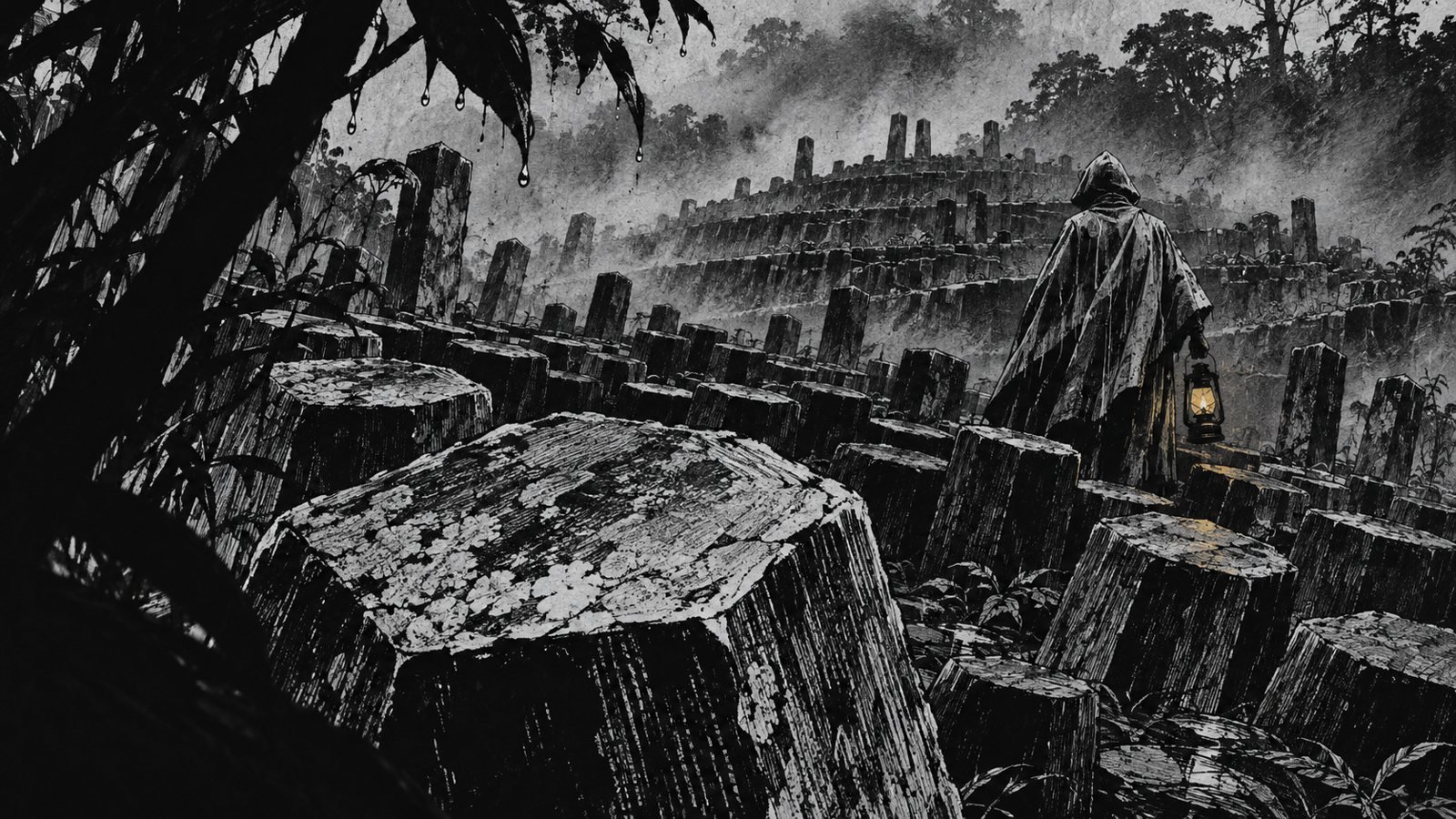
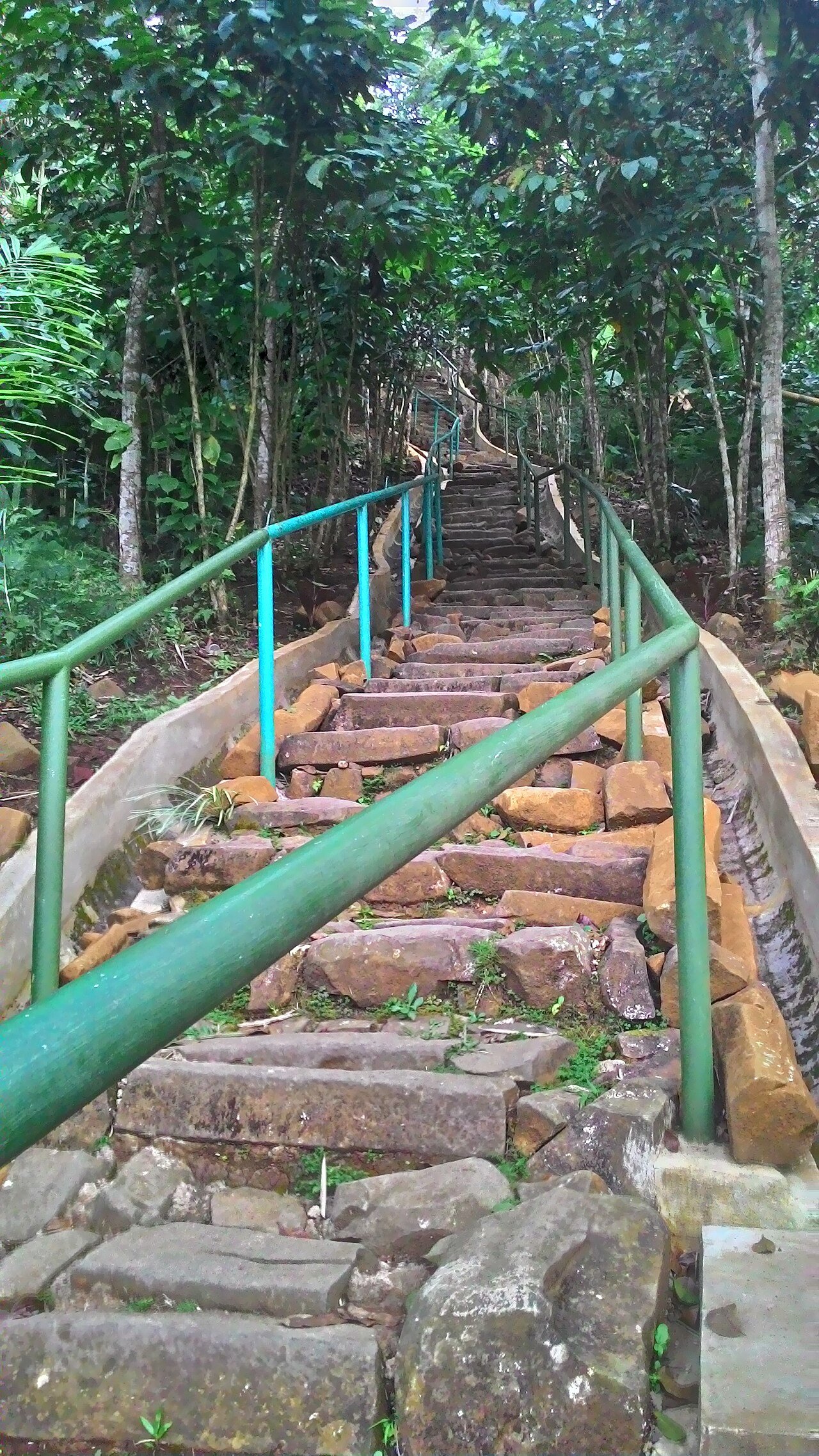
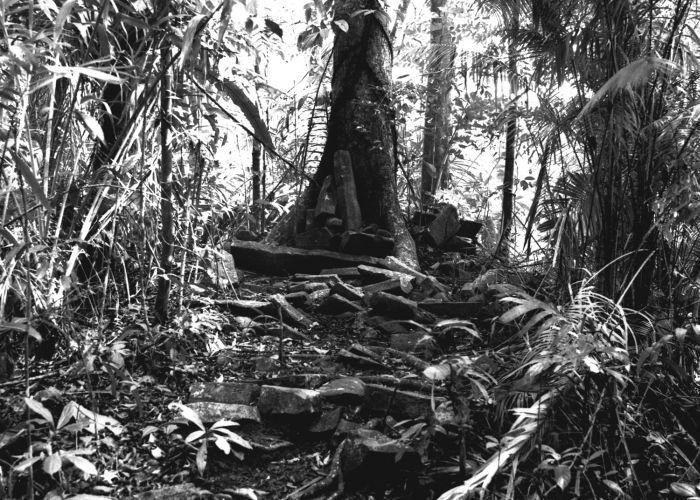
A staircase of 370 stone steps climbs from the valley. At the top are five artificial terraces, each held up by a stone retaining wall and covered with dark columns of rock, some standing and many fallen. (ARCH)
The columns look machined: long many-sided prisms, as regular as fence posts. Nobody carved them. They are andesite, a volcanic rock that cracks into prisms as it cools, a formation geologists call columnar jointing. The builders collected natural columns and arranged them. (ARCH)
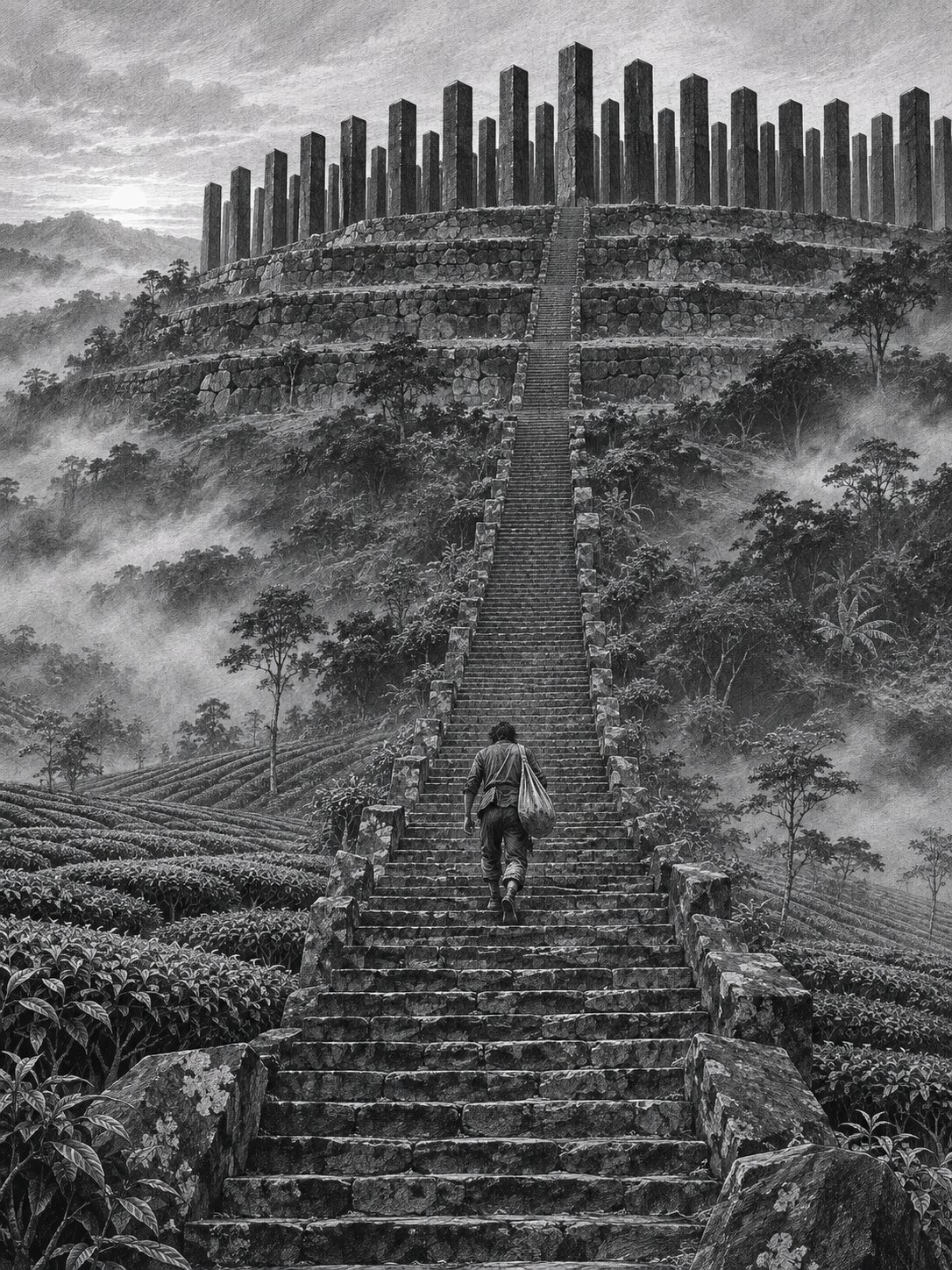
The hill itself is an extinct volcano, about 885 metres above sea level. (ARCH) (WIKI) The Sundanese people of the area hold it sacred. One local legend says the half-mythical King Siliwangi raised the whole thing in a single night. (ARCH)
The stone that rings
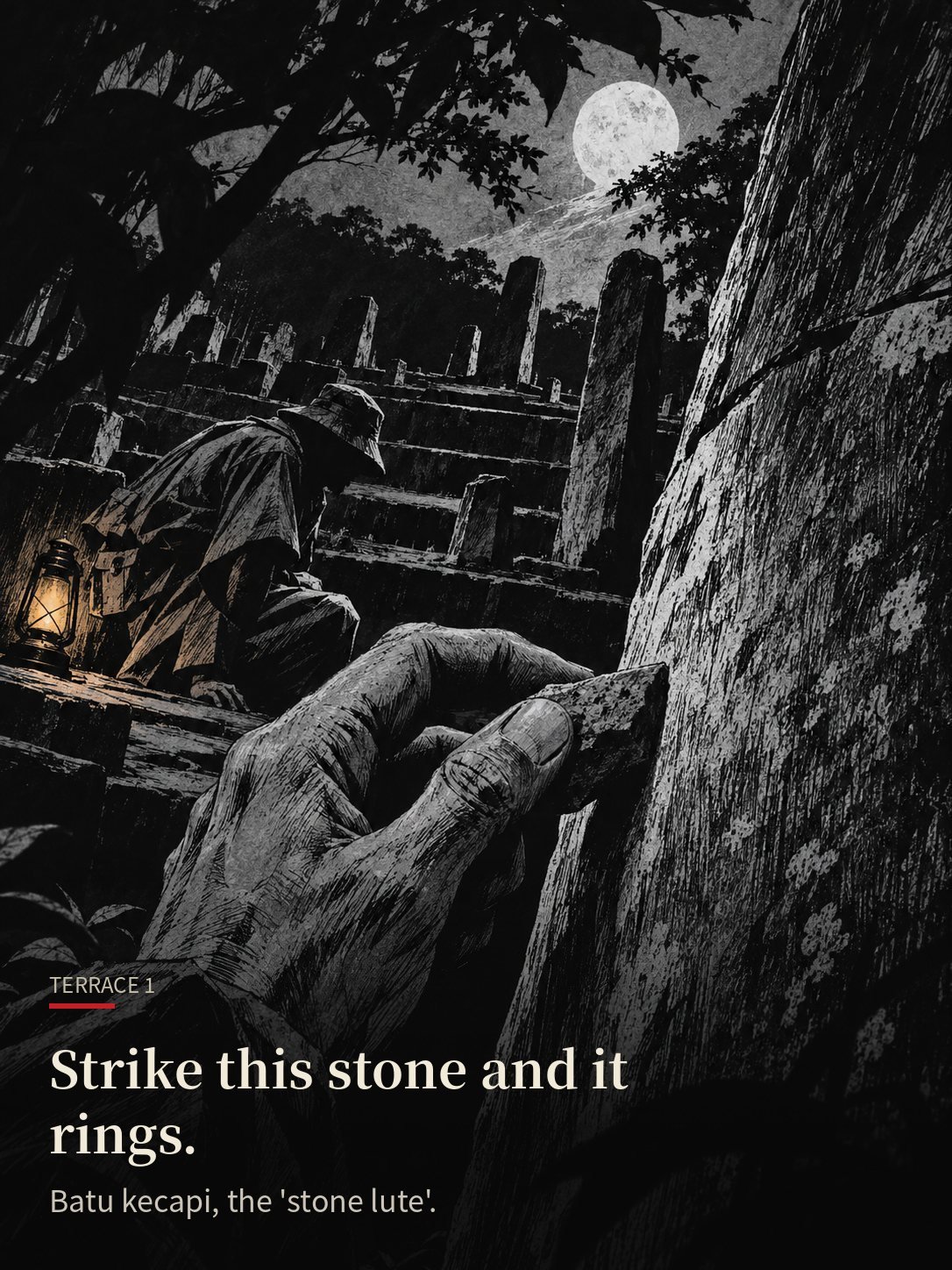
On the largest terrace, the first, lies an andesite block about five feet long. Local people call it batu kecapi, the stone lute. Strike it and it gives a loud, deep note. (ARCH)
The hill is still in use. Muslims from nearby villages read the Koran aloud among the columns. Hindus travel from Bali for rituals timed to the rising of the full moon. Practitioners of the martial art pencak silat train high on the slope. (ARCH)


Archaeologist Harry Truman Simanjuntak, of the Center for Prehistory and Austronesian Studies, told Archaeology magazine what such terraces were for. The practice, he said, rests on “the belief that the spirits of the ancestors have the power to give blessings of prosperity, fertility, and good luck.” They could also, he added, “mete out disasters to the surrounding community.” (ARCH)
What the trowels found
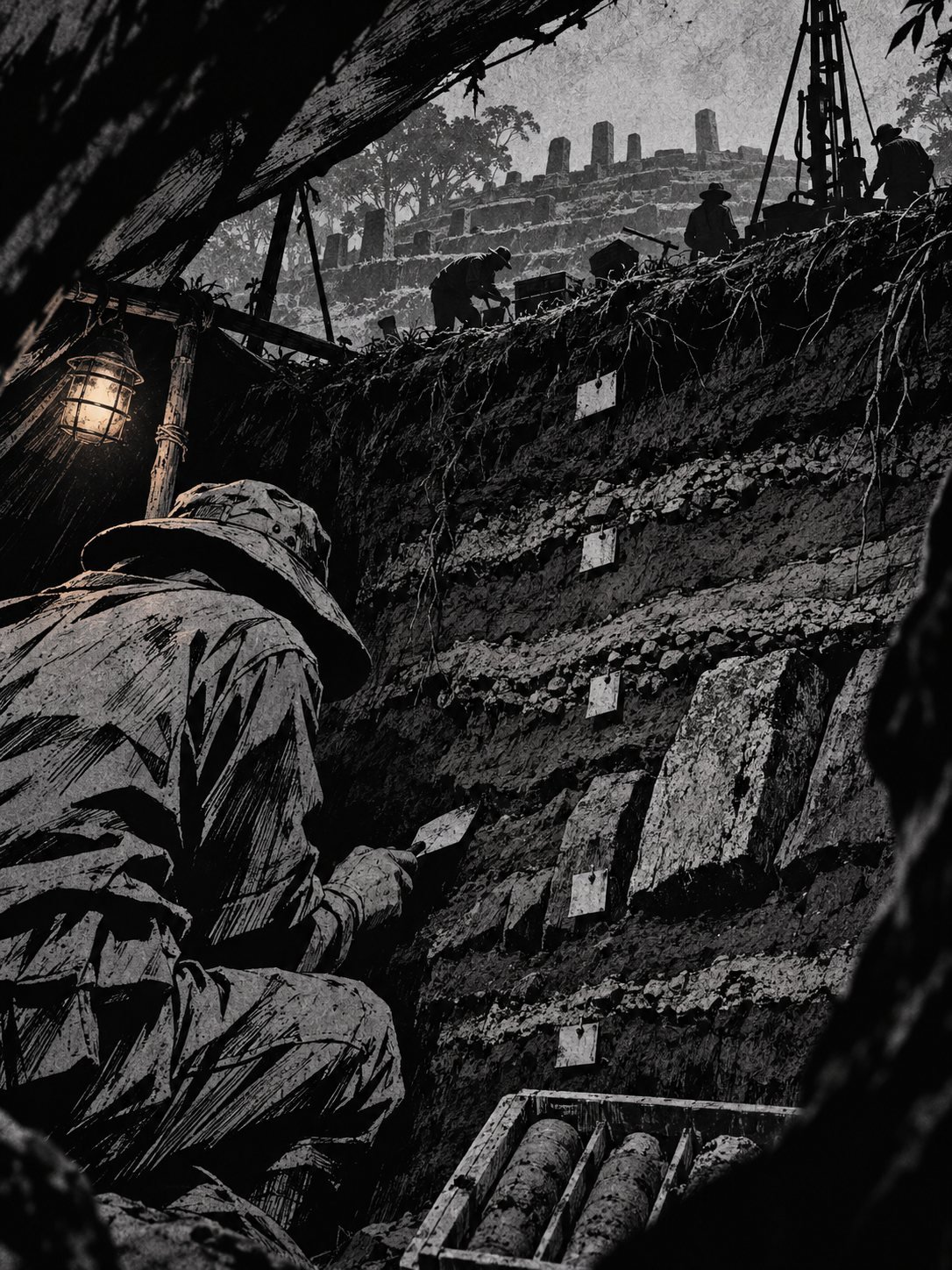
Lutfi Yondri has dug at Gunung Padang since the late 1990s. He is an archaeologist with Indonesia’s National Research and Innovation Agency, BRIN. (ARCH) (DETIK-VIEWS)
His method is the ordinary one. Find charcoal lying directly under something people built, then date the charcoal. Under the retaining wall of Terrace 1 he got a date of about 117 B.C. Charcoal beneath Terraces 2 and 4 clustered around 50 B.C. (ARCH)
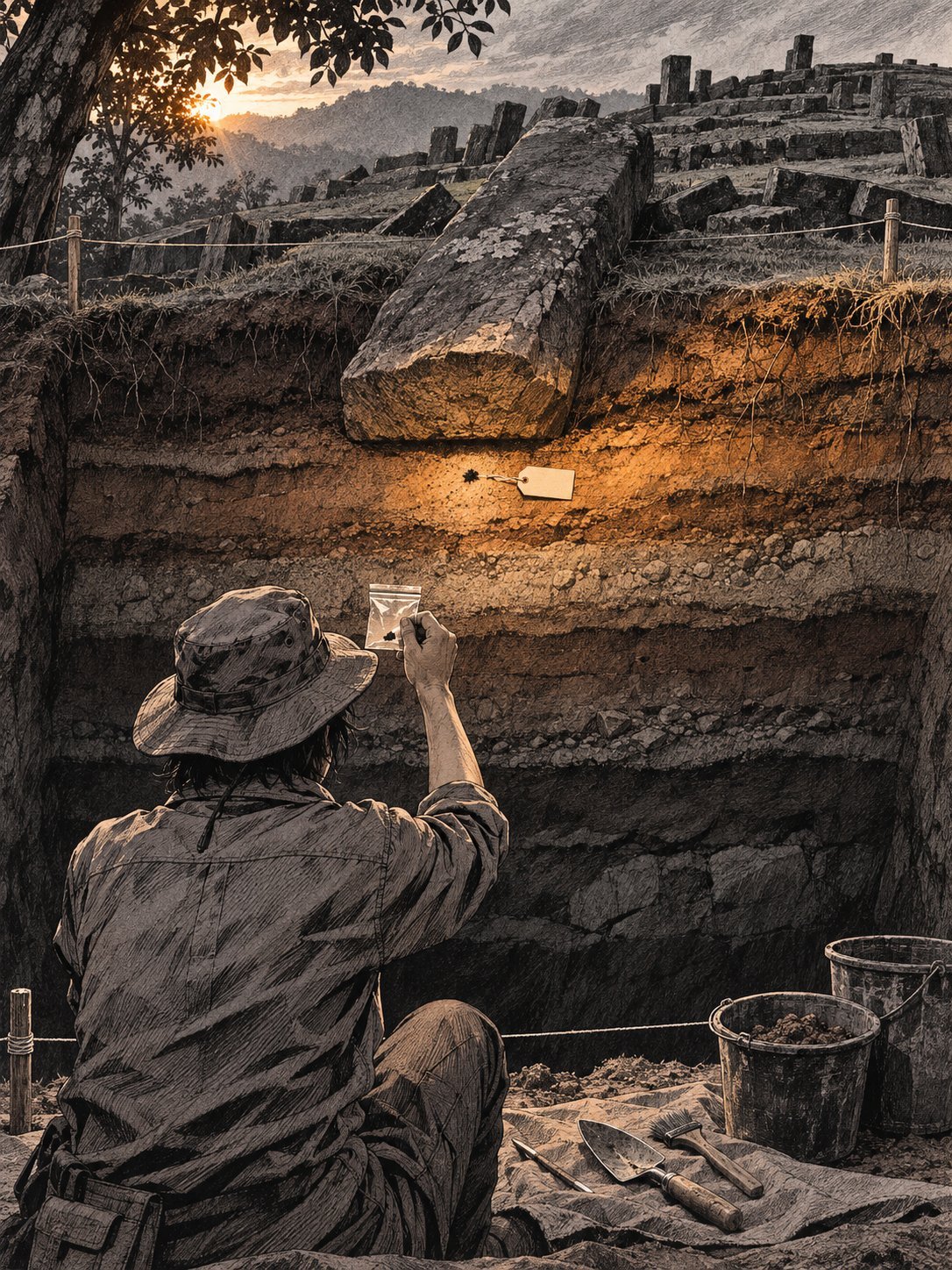
So the terraces went up roughly 2,000 years ago, and not all at once. They were, Yondri says, “not built by one generation.” His trenches also produced pottery and a grinding stone. (ARCH)
That is the mainstream position, and it is not a small one. In 2013 a group of 34 Indonesian archaeologists and geologists described the top of Gunung Padang as “the largest megalithic structure in south-east Asia.” (SMH)
A geologist looks down

Danny Hilman Natawidjaja is an earthquake geologist with a doctorate from the California Institute of Technology. From 2011 he and his colleagues studied the hill with ground-penetrating radar, electrical surveys and drill cores. (SMH) (NATURE)
His reading was that the terraces are only the top layer. Most of the hill, he argued, was built by people, in stages, over thousands of years. In 2013 he told the Sydney Morning Herald the structure was “older than 9000 [years] and could be up to 20,000.” He knew how that sounded. “It’s crazy, but it’s data.” (SMH)
The idea reached the presidential palace. Susilo Bambang Yudhoyono, then president, was briefed and appointed a task force, calling the work a “task of history.” (SMH)
Other scientists objected. The petition from those 34 specialists, sent to the president in April 2013, said the planned work lacked the norms of scientific conservation and put the site at risk. Volcanologist Sutikno Bronto said the hill was the neck of an old volcano and that the supposed ancient “cement” was a natural product of weathering. (SMH)
In September 2014 a Jakarta Post reporter watched Indonesian soldiers digging at the site with hoes. The head of the Bandung Archaeological Center, Desril Riva Shanti, said: “An archaeological excavation method shouldn’t have been carried out in that way.” (JP14) The funding ended after Yudhoyono left office that year. (NYT)
27,000

The claim came back in a stronger form. In 2022 the British author Graham Hancock featured Gunung Padang in his Netflix series Ancient Apocalypse. The Society for American Archaeology wrote to Netflix that December asking it to stop presenting the series as a documentary. (NATURE) (SAA)
Then, on 20 October 2023, the journal Archaeological Prospection, published by Wiley, carried the team’s paper: “Geo-archaeological prospecting of Gunung Padang buried prehistoric pyramid in West Java, Indonesia.” (NATURE) (RW)

It described four layers. The innermost was a core of hardened lava. According to the authors, the first stage of construction took place between 27,000 and 16,000 years ago, more was added between 8,000 and 7,500 years ago, and the final layer, including the terraces visible today, dated to between 4,000 and 3,100 years ago. (NATURE)
For scale: the oldest pyramid in Egypt, Djoser’s, is about 4,600 years old. Göbekli Tepe in Turkey, the oldest known megalithic site, is about 11,000. (NATURE)
“It’s not easy to build pyramids. You need high masonry skills,” Natawidjaja told Nature. The authors thanked Hancock in the paper for proofreading it. (NATURE)
The Palace of Westminster problem
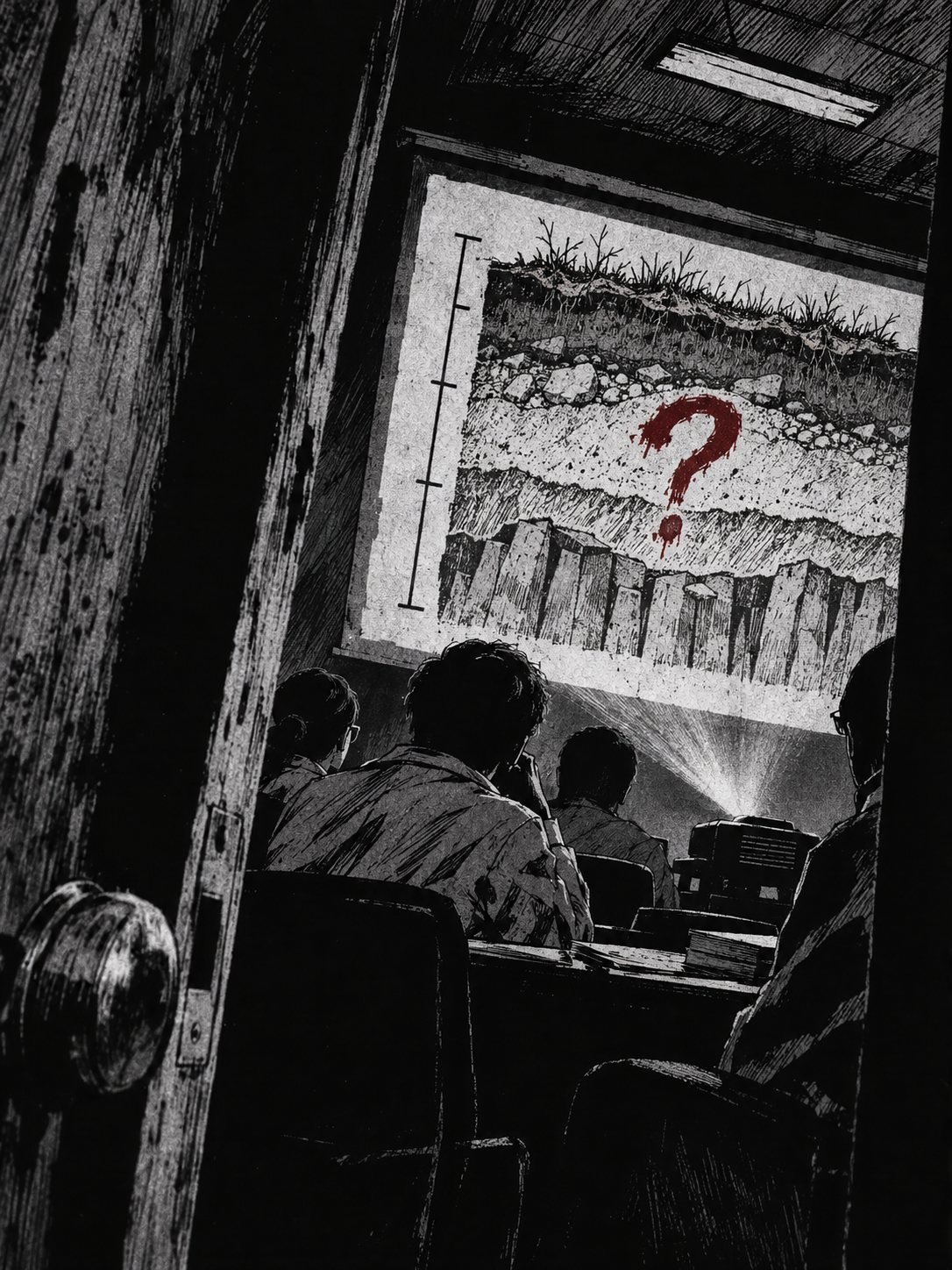
Archaeologists read the paper and went straight to the dating.
Flint Dibble of Cardiff University called the measurements themselves “legitimate data.” His objection was to what had been done with them. “I’m surprised [the paper] was published as is,” he told Nature. (NATURE)

He explained the flaw to the Observer with a comparison. “If you went to the Palace of Westminster and dropped a core seven meters into the ground and pulled up a soil sample you might date it as being 40,000 years old. But that does not mean the Palace of Westminster was built 40,000 years ago by ancient humans.” (SMITH)
Bill Farley, an archaeologist at Southern Connecticut State University, pointed out what the oldest samples lacked: any sign of human activity, such as charcoal or fragments of bone. Yondri’s own work shows people living in caves in the region between 12,000 and 6,000 years ago, with no evidence of advanced stonework. (NATURE)
On 28 November 2023 Nature reported that the journal and Wiley were investigating. Co-editor Eileen Ernenwein confirmed it by email. (NATURE)
“A major error”

The retraction notice appeared in March 2024. Most reports give Monday 18 March. (NYT) (ARTNET)

It said that specialists in geophysics, archaeology and radiocarbon dating had raised concerns, and that the publisher and editors had found “a major error” that peer review missed. The radiocarbon dating had been applied to soil samples “not associated with any artifacts or features” that could be reliably read as made by people. The interpretation that the site is “an ancient pyramid built 9,000 or more years ago is incorrect.” (RW) (THE)
Every author disagreed. Natawidjaja told Retraction Watch they were “baffled.” In a Facebook post headed “The Unjust Retraction of Groundbreaking Research” he asked whether the decision was “a severe form of censorship.” Hancock told the New York Times: “Science should not be about suppression.” (RW) (ARTNET) (NYT)
One point is easy to lose. A retraction for error is not a finding of dishonesty. Nobody accused the team of inventing numbers. The dates were real dates, of soil.
Digging again

The story did not end there, because Indonesia’s government picked it up again.
In January 2025 the culture minister, Fadli Zon, visited the hill. In February he told a forum of archaeologists and geologists that more research was needed. (JP25) That August a state-backed research and restoration team began fieldwork under Ali Akbar, an archaeologist at the University of Indonesia who had worked with the earlier team a decade before. (ANTARA1) (CNNID) (JPT14)
After two weeks the team reported a possible source for the columns at Mount Pasir Pogor, about five kilometres away, more terracing beside the stairway, and four upright stones set deep in the ground. Akbar also repeated an older claim, that surveys had detected structures far below, “possibly a large chamber.” (ANTARA2)
In late November 2025 the team announced a new age for the monument: about 6,000 B.C. It came from the carbon content of one sample, taken four metres down beneath the fifth terrace, where the team says it found a layer of rounded stones it interprets as a foundation. The reports name no laboratory and no published paper. (DETIK-AGE) (RRI)
Indonesian state media now routinely describe the site as “believed to be older than the Pyramids of Giza.” (ANTARA1) Yondri’s answer has not changed. Asked in August 2025, he said the hill holds a terraced sanctuary and no pyramid. (DETIK-VIEWS)
Restoration began on 15 December 2025, with fallen columns being set upright again. (DETIK-RESTORE) What the larger programme planned for 2026 has found, we could not confirm. Even well-studied monuments can lose their footing. Stonehenge’s six-tonne Altar Stone was traced to Scotland, and then no Scottish outcrop matched it.
The story you may have heard, and what the file says
| What gets repeated | What the record says |
|---|---|
| Gunung Padang is a 27,000-year-old pyramid, the oldest in the world | The 2023 paper that proposed 27,000 to 16,000 years was retracted in March 2024. The old dates came from soil samples with no tools, charcoal or bone in them. (NATURE) (ARTNET) |
| The retraction was a cover-up of inconvenient science | The publisher’s notice calls it a major error in the dating, not misconduct. The problem was what the dated soil contained: nothing made by people. (NATURE) (THE) |
| Scans found hidden chambers inside the hill | Chambers were read from geophysical scans. None has been excavated, and nothing from inside one has ever been brought to the surface. (SMITH) |
| It is all natural rock, nothing was built | Five stone terraces and a 370-step stair are a real megalithic monument. Charcoal under the terrace walls dates their construction to roughly 117 B.C. to 50 B.C. (ARCH) (DETIK-AGE) |
| A 2025 dig proved it is older than Giza | A 2025 team reported about 6,000 B.C. from one sample. No lab is named and the result has not been peer-reviewed as far as we could find. (JP25) |
Why the record is stranger than the legend: the legend needs the hill to be older than everything. The file says something harder to hold. The columns are natural rock, but people moved them. The terraces are real, but two thousand years old, not twenty thousand. The deep dates were real measurements of real soil; the soil simply had nobody in it. A hill that is both a natural rock formation and a human monument, with a retracted Ice Age underneath it and a new unreviewed date on top, is a stranger object than any pyramid. Elsewhere in Asia the caution runs the other way: the burial mound the Terracotta Army faces has never been opened at all.
Evidence photos
Real photographs and published figures, kept separate from our illustrations. Each one says what it shows, and what it cannot prove.


Evidence box: documented vs. claimed
| What it is | What it supports | Its limits | |
|---|---|---|---|
| Documented | Five stone terraces and a 370-step stair | A real megalithic monument, built by people | Says nothing about what is deeper |
| Documented | Charcoal under terrace walls, dated by Lutfi Yondri | Construction around 117 B.C. to 50 B.C. | Dates the terraces only |
| Documented | Pottery and a grinding stone from excavation | People used the terraces | No animal bones found |
| Documented | Columnar andesite | The columns are natural rock, moved and arranged | Source quarry still argued |
| Documented | Retraction notice, March 2024 | The 2023 dates came from soil with no artifacts | A finding of error, not misconduct |
| Claimed | 2023 paper: construction 27,000 to 16,000 years ago | An Ice Age builder culture | Retracted; no tools, charcoal or bone with the old samples |
| Claimed | Chambers deep inside the hill | A hidden structure | Read from scans; never excavated |
| Claimed | 2025 team: about 6,000 B.C. | A monument older than Giza | One sample; no lab named; not peer-reviewed as far as we found |
| Legend | King Siliwangi built it in one night | The hill’s sacred status | Folklore |
Evidence locker
Primary records and real photographs only. Each caption says what the item shows and where it comes from.
 EXHIBIT A
 EXHIBIT B
 EXHIBIT C
 EXHIBIT F · PHOTOGRAPH
Timeline
| Date | Event |
|---|---|
| 1890 | A visit to the site, mentioned in Verbeek’s 1891 book (WIKI) |
| 1914 | N.J. Krom records the site (ARCH) |
| 1979 | Three farmers from Karyamukti rediscover it (ARCH) |
| 1980s | National archaeology institute exposes the layout (ARCH) |
| Late 1990s on | Lutfi Yondri excavates; terraces dated to about 2,000 years ago (ARCH) |
| 2011–2014 | Natawidjaja’s team surveys and drills (NATURE) |
| April 2013 | 34 scientists petition the president (SMH) |
| September 2014 | Soldiers seen digging; archaeologists protest (JP14) |
| November 2022 | Ancient Apocalypse released on Netflix |
| 20 October 2023 | Paper published in Archaeological Prospection (NATURE) |
| 28 November 2023 | Nature reports an investigation (NATURE) |
| 18 March 2024 | Paper retracted (NYT) (ARTNET) |
| January–February 2025 | Culture minister visits, calls for new research (JP25) |
| August 2025 | State-backed team begins fieldwork (ANTARA1) |
| 28–30 November 2025 | Team announces a date of about 6,000 B.C. (DETIK-AGE) (RRI) |
| 15 December 2025 | Restoration begins (DETIK-RESTORE) |
The explanations, side by side
A terraced sanctuary on a natural hill (mainstream). The hill is volcanic. Around 2,000 years ago people gathered its natural columns and built five terraces for ancestor rites, a form Indonesian archaeologists call punden berundak. This is the only account backed by dated material found in direct contact with the architecture. It leaves one question open: nobody has excavated deep enough to say what, if anything, earlier people did there.
A buried Ice Age pyramid (fringe). Natawidjaja’s team holds that the hill was shaped and built up from 27,000 years ago. In its favour are subsurface images that the team reads as layers and voids. Against it: the dates come from soil with no trace of human work, no settlement or tools of such a culture have been found anywhere in the region, and the journal that printed the claim withdrew it.
Something in between (unproven). The 2025 team’s 6,000 B.C. would make the first building far older than Yondri’s dates and far younger than 27,000 years. It rests on a single sample announced to reporters. Until the context of that sample is published and reviewed, it is a claim. Dates decide what a site means. At Roopkund in the Himalaya, radiocarbon and DNA split one field of bones into groups separated by roughly a thousand years.
The geologist’s objection. Sutikno Bronto’s view, that what lies beneath is simply the neck of a volcano with weathered rock around it, has never been disproved. (SMH)
Seven ages for one hill
| Proposed date of first construction | Who | Basis |
|---|---|---|
| About 117 B.C. | Lutfi Yondri (ARCH) | Charcoal under the Terrace 1 wall |
| Perhaps 2500 B.C. | Some twentieth-century researchers (ARCH) | Comparison with other megaliths |
| 4,700–4,500 B.C. | Ali Akbar, 2014 talk (JPT14) | Carbon samples sent to a U.S. laboratory |
| About 5200 B.C. | National team, 2014 (JP14) | Team announcement |
| About 6,000 B.C. | Research and restoration team, 2025 (DETIK-AGE) | One sample, four metres under Terrace 5 |
| 9,000 to 20,000 years ago | Natawidjaja, 2013 (SMH) | Drill cores |
| 27,000 to 16,000 years ago | Natawidjaja et al., 2023 (NATURE) | Soil in drill cores; paper retracted |
Where the records disagree
| Detail | What sources say |
|---|---|
| Retraction date | 18 March 2024 (ARTNET, WIKI; the NYT says “Monday”); 19 March (THE) |
| Height of the hill | 885 m above sea level (WIKI); “almost 3,000 feet” (JP25); “about 100 metres” from base (SMH); “200 meters” (JPT14) |
| Krom’s record | 1914 (ARCH) (WIKI); “1941” in one newspaper, probably a slip (JP14) |
| Source of the stones | The hill itself (Yondri, DETIK-VIEWS); Ciukir, 2 km south, or Pasir Pogor, 5 km away (ANTARA2) |
What we still don’t know

- Whether anything human-made lies below the dated terraces. No controlled excavation has reached the depths in question.
- What the “chamber” in the scans is. A void, a change in rock, an artefact of the method: all remain possible.
- The full context of the 6,000 B.C. sample, and whether it will be published in a journal.
- What the 2026 restoration season found.
Where the argument is, and where we come down
The argument has three arenas, and the loudest is no longer the journal. Academically it is the retracted paper’s authors against archaeologists and the publisher: the radiocarbon specialists and archaeologists who objected, Flint Dibble of Cardiff University and Bill Farley of Southern Connecticut State among them, against Danny Hilman Natawidjaja’s team, who call the retraction unjust and have asked whether it amounts to censorship. In the broadcast arena the same dispute was staged at length on the Joe Rogan Experience, episode 2136, released on 16 April 2024, where Graham Hancock and Dibble argued over whether any physical evidence supports a lost Ice Age civilisation, with Gunung Padang among the sites in play; alternative-history communities have since treated the retraction itself as proof of suppression. The third arena is Indonesian and has grown since 2025. Ali Akbar of the University of Indonesia, now leading the state-backed programme, told detikInet in February 2025 that Western scientists dispute the site because “they simply cannot imagine it”; Lutfi Yondri of the national research agency BRIN still says the hill holds a terraced sanctuary, not a pyramid; and culture minister Fadli Zon convened a forum that February which Republika described as the first face-to-face meeting of the opposing sides.
The stronger case is the excavated one, and the reason is association. Yondri’s dates come from charcoal lying directly under built terrace walls, alongside pottery and a grinding stone: material in contact with the architecture it dates. The 27,000-year figures are genuine measurements, and even the paper’s critics call the data legitimate, but they date soil cores containing no tools, charcoal or bone, which is precisely the gap the retraction notice names. The subsurface “chambers” are interpretations of geophysical images, never excavated. The newest claim, about 6,000 BC, is the weakest of all: a single sample announced to reporters in November 2025, with no laboratory named and no paper published that we could find.
The argument exists because the hill gives each side something real. The columns are natural rock, so “it’s natural” is partly right; people moved and stood them up, so “it’s built” is partly right too, and the dispute lives in the space between. A Netflix series carried the deep-time version to a global audience that never read the retraction. In Indonesia the question has become one of national standing, and the programme now researching the site is led by someone who worked with the team behind the older dates, so the institution testing the claim is not independent of it. No controlled excavation has yet reached the depths in question.
On the record as it stands, we put more weight on the excavation account, terraces built roughly 2,000 years ago on a natural volcanic hill, than on any buried pyramid. First, it is the only dating tied to human-made material in direct context. Second, every older figure has either been withdrawn by the journal that printed it or has not yet been published with enough detail to check. We could be wrong if a controlled, fully published excavation found worked stone or charcoal in a sealed layer deep inside the hill. If that appears, or the 6,000 BC sample is published with its laboratory and context, we will rewrite this section.
Sources for this section: retractionwatch.com · jasoncolavito.com · sapiens.org · podwise.ai · inet.detik.com · cnbcindonesia.com · news.republika.co.id · detik.com · tirto.id · rmol.id
Quick answers: Gunung Padang
Is Gunung Padang the oldest pyramid in the world?
No evidence shows that. The 2023 paper making the claim was retracted in March 2024. Excavated material dates the visible terraces to about 2,000 years ago.
Why was the Gunung Padang paper retracted?
The journal found “a major error.” The radiocarbon dates came from soil samples that were not linked to any artifacts or built features, so they could not date construction. The authors disagree with the decision.
Is Gunung Padang man-made or natural?
Both. The hill is an extinct volcano and the stone columns formed naturally. People collected those columns and built five terraces on top.
How old is Gunung Padang really?
The terraces: about 2,000 years, from charcoal under their walls. Older figures, including 27,000 years and a 2025 claim of 6,000 B.C., have not been confirmed by peer-reviewed work.
Can you visit Gunung Padang?
Yes. It is a national heritage site in Cianjur regency, West Java, reached by a stair of 370 stone steps. It is also an active place of worship, and restoration work began there in December 2025.
What is a little-known fact about Gunung Padang?
Long before the pyramid claims, the Sundanese people of the area held the hill sacred. One local legend says the half-mythical King Siliwangi raised the whole thing in a single night. (ARCH)
Editor’s note
Reading the reason for the retraction, I felt a little deflated. “A 27,000-year-old pyramid” stopped me in my tracks at first. But what turned out to be old was the soil, and there was no trace of anyone building anything at that time. I found it easiest to think of it like a house: the ground under a house can be ancient, but that does not make the house ancient. And I have to admit that I was drawn in by the number before I asked what it was based on. The authors still reject the retraction. As far as I can tell from their own words, they read the buried layers in their drill cores and scans as stonework stacked by people, which is exactly the step the journal said the evidence could not support. I would like to see them answer that point directly.
If a series like Ancient Apocalypse showed me this, I would probably assume it was broadly confirmed. Very few viewers go and look up the scientific paper behind every episode. That is why I wish news of the retraction travelled as far as the original claim did. Someone who watched the show and stopped there may still believe the world’s oldest pyramid was found in Indonesia.
Retracting the paper was disappointing, but I think it was right. When something is wrong, it should be corrected. What I find a shame is what the big number did to the real site. The terraces on that hill are genuinely there, and genuinely old, about two thousand years. That is a mystery worth telling on its own. It just got buried under a far larger number.
— Strange World Files
Case file summary
- What: A megalithic terraced monument, and a withdrawn claim that it is a 27,000-year-old pyramid
- Where: Karyamukti village, Cianjur regency, West Java, Indonesia
- When: Terraces built about 2,000 years ago; paper published 20 October 2023, retracted 18 March 2024
- Toll: None
- Status: Surface monument dated by excavation. Deeper claims unproven. State-backed research and restoration under way since August 2025
Illustrations are AI-generated artistic interpretations, not photos. No real person is depicted with a recognizable face. Read how we research and illustrate these files.
Sources
- Eric A. Powell, “Java’s Megalithic Mountain,” Archaeology, July/August 2024
- Dyani Lewis, “Experts Doubt Claims that World’s Oldest Pyramid Was Discovered in Indonesia,” Nature news, 28 Nov 2023, as republished by Scientific American
- Retraction Watch, “Controversial pyramid paper retracted when authors turn out to have radiocarbon-dated nearby dirt,” 20 Mar 2024
- Times Higher Education, “Paper claiming ‘world’s oldest pyramid’ retracted over ‘error’,” 20 Mar 2024
- Mike Ives, “Study about purported ancient ‘pyramid’ in Indonesia is retracted,” New York Times, 20 Mar 2024, read in the ArtDaily reprint
- Artnet News, “A Controversial Paper on an Alleged ‘Prehistoric Pyramid’ in Indonesia Is Retracted,” March 2024
- Smithsonian Magazine, “Archaeologists Criticize Alleged Discovery of the ‘Oldest Pyramid in the World’,” December 2023
- Michael Bachelard, “Digging for the truth at controversial megalithic site,” Sydney Morning Herald, 27 Jul 2013, read in the Newcastle Herald syndication
- Arya Dipa, “Archaeologists slam excavation of Gunung Padang site,” The Jakarta Post, 24 Sep 2014
- The Jakarta Post Travel, “A new archaeological discovery in Gunung Padang may redefine what we know about Indonesia,” 14 Oct 2014, via Yahoo News
- The Jakarta Post, “Minister urges renewed study into Gunung Padang archaeological site,” 13 Feb 2025
- ANTARA, “Indonesian team studies pillars beneath ancient Gunung Padang structure,” 3 Aug 2025
- ANTARA, “Indonesian team discovers clues to ancient structures at Gunung Padang,” 18 Aug 2025
- CNN Indonesia, “Pakar Ungkap Deret Temuan Baru di Gunung Padang, Apa Saja?” 11 Sep 2025 (Indonesian)
- Ikbal Selamet, “Ketika Arkeolog Beda Pandangan soal Situs Gunung Padang,” detikJabar, 2 Aug 2025 (Indonesian)
- Ikbal Selamet, “Gunung Padang Berusia 6.000 SM, Lebih Tua dari Piramida Giza,” detikJabar, 28 Nov 2025 (Indonesian)
- “Pemugaran Dimulai, Situs Gunung Padang Segera Hadir dengan Wajah Baru,” detikJabar, 15 Dec 2025 (Indonesian)
- Voice of Indonesia (RRI), “West Java Site Older than Egypt’s Pyramids,” 30 Nov 2025
- Society for American Archaeology, “SAA Sends Letter to Netflix Concerning ‘Ancient Apocalypse’ Series,” 1 Dec 2022
- “Gunung Padang,” Wikipedia (leads only; used for the 885 m elevation and the Verbeek reference)