Qin Shi Huang’s Tomb: Farmers Digging a Well Found 8,000 Soldiers. The Tomb They Guard Has Never Been Opened
Near Xi’an, China, 1974. Below the head stood about 8,000 life-sized clay soldiers. A mile away, under a man-made hill, lies Qin Shi Huang, the First Emperor. An ancient historian wrote of rivers of mercury inside. In 2016, scientists measured mercury in the air above it. No one has looked inside.


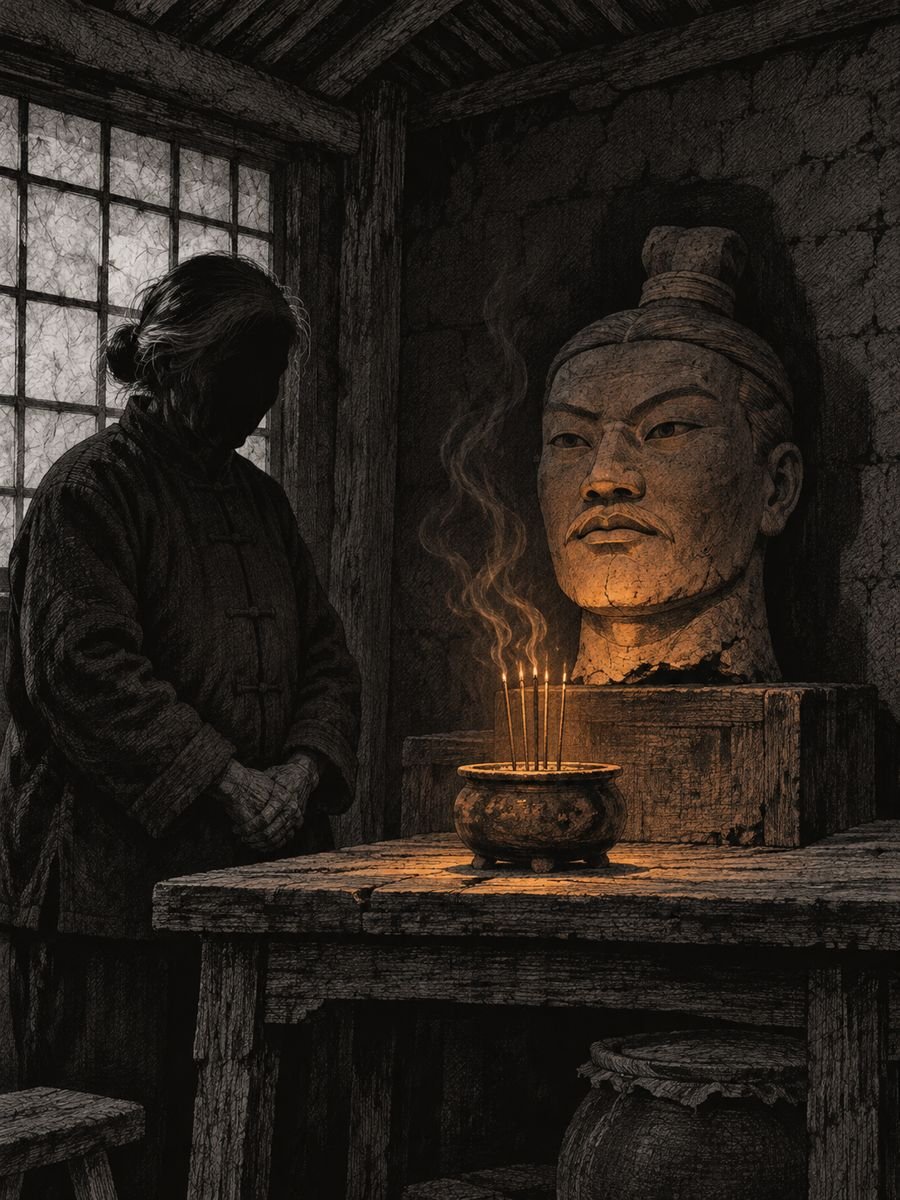
A head in the bottom of a well

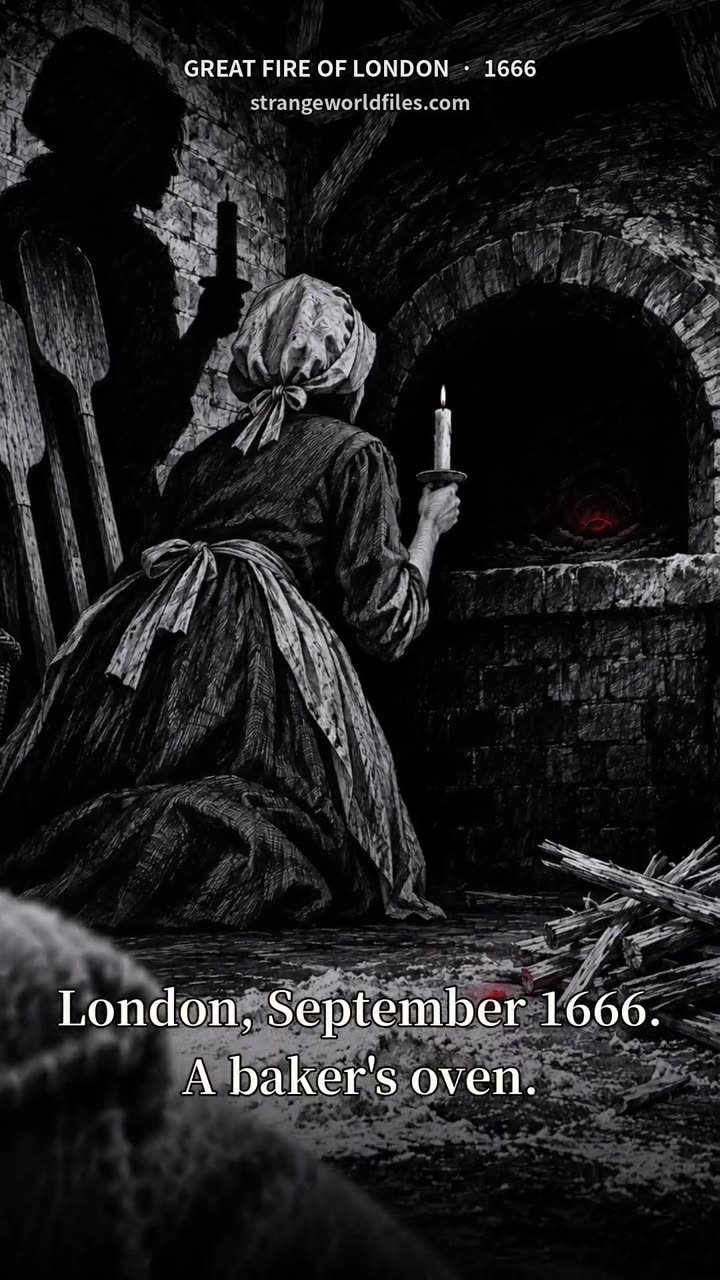
In late March 1974 (the date usually given is 29 March), a group of farmers from Xiyang village in Lintong, outside Xi’an, were digging for water on a patch of waste ground. One of them was a man named Yang Zhifa.
At about three metres down the soil changed. They hit charcoal and a layer of red, baked earth. A little past four metres, Yang’s hoe struck something hard, and a life-sized head made of fired clay came up out of the dirt.

The villagers did not know what it was. Some thought it was a temple figure, a “pottery god.” Then came bronze arrowheads, pieces of crossbows, and fragments of clay bodies wearing carved armour.
Archaeologists arrived, stopped the well, and filled three handcarts with broken pieces. What the farmers had hit was the edge of the Terracotta Army: thousands of life-sized soldiers, horses and chariots standing in underground pits.
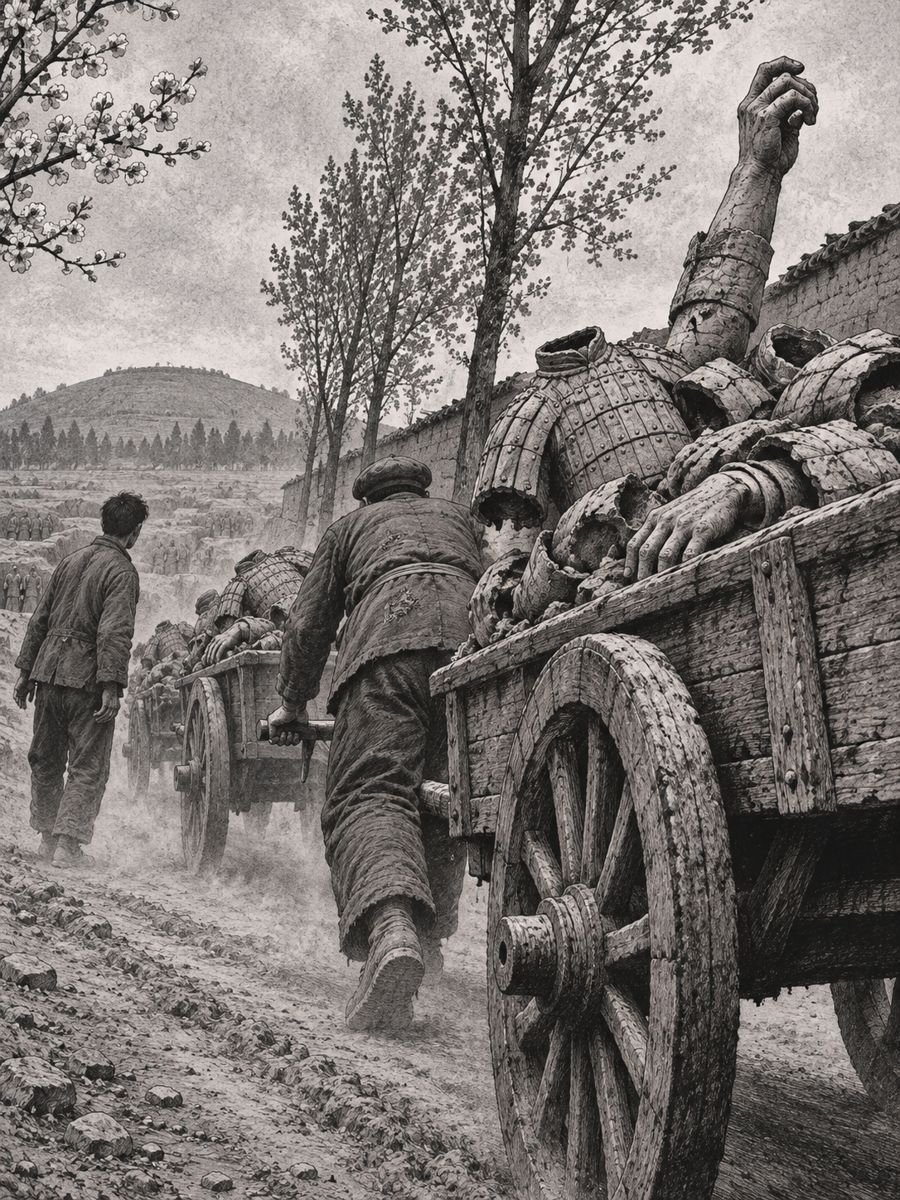
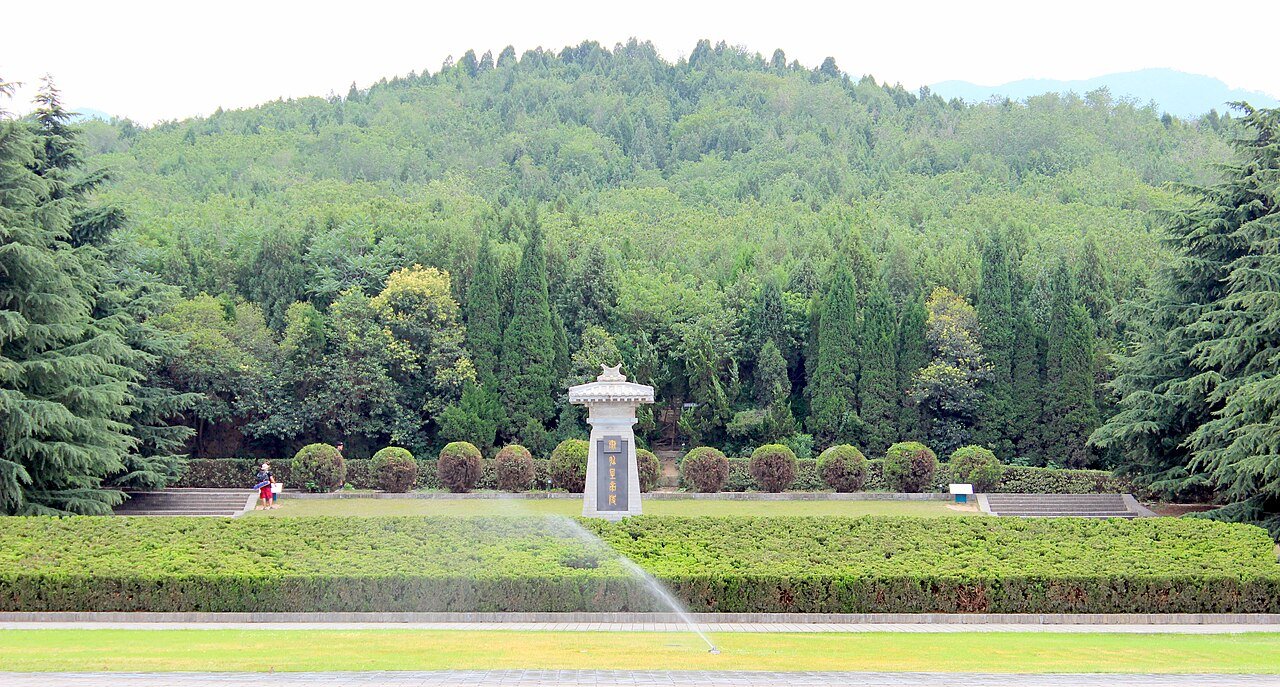
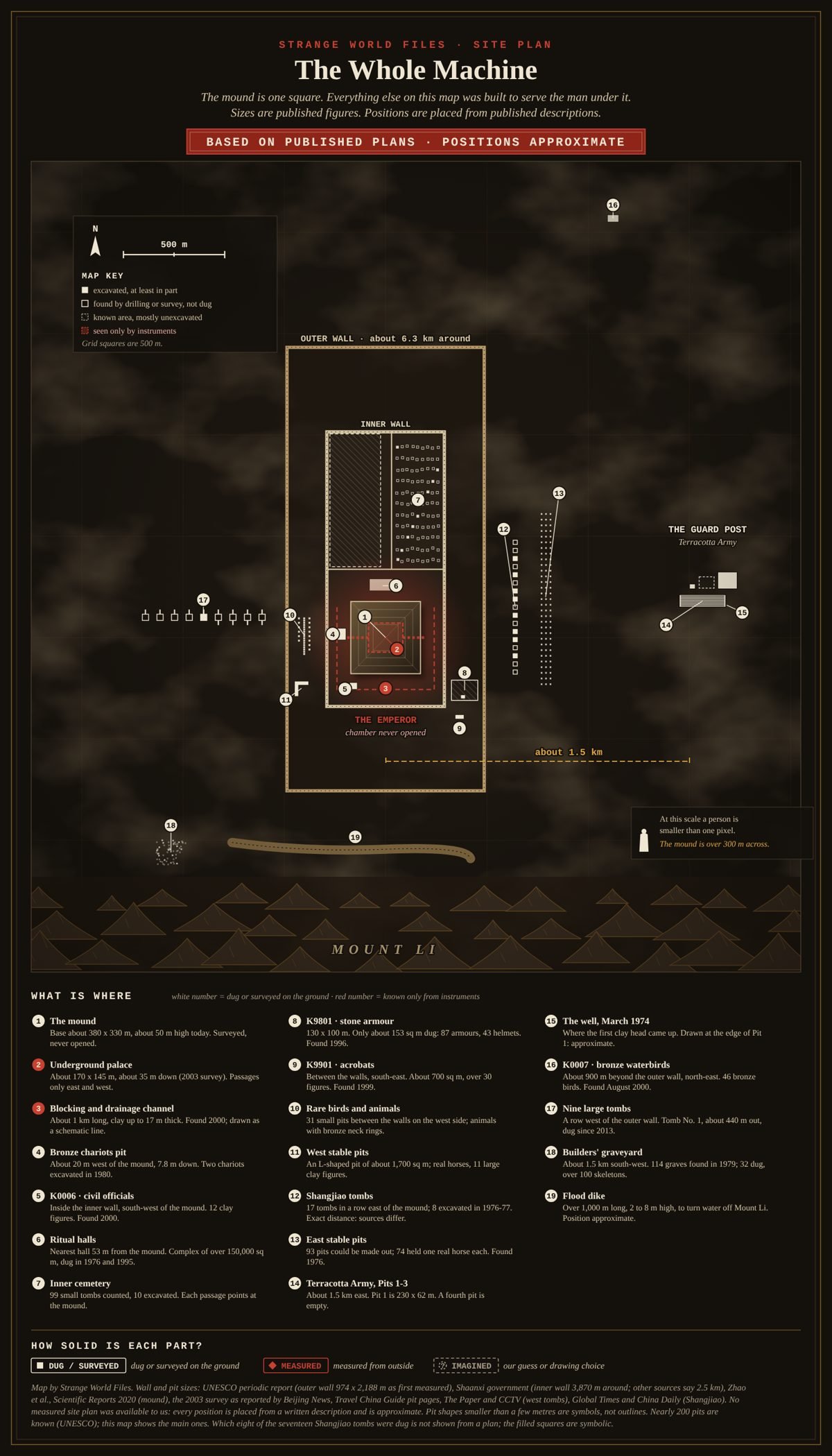
That is the part of the story most people know. Here is the part that matters more. The army was not the tomb. It was a guard post. The man it was guarding lies about a kilometre and a half to the west, under an artificial hill of earth that modern surveys put at about 50 metres high, and in the more than fifty years since Yang Zhifa’s hoe went through that clay head, no one has opened his burial chamber.
What the record shows
- What: The burial mound of Qin Shi Huang, China’s First Emperor, guarded by the Terracotta Army about 1.5 km to the east
- Found: Farmers digging a well near Xiyang village hit the first clay head in late March 1974
- Built: From 246 BC to 208 BC, 38 years of work
- Measured: Soil studies in the 1980s and an air study in 2016 found raised mercury over the mound
- Status: The burial chamber has never been excavated; a 1997 State Council notice says such tombs should wait until relics can be protected
Still uncertain
- Whether Sima Qian’s “rivers of mercury” exist, and how much mercury is left
- Whether the chamber was ever robbed
- Whether any crossbow traps were installed, or could still work
- What survives inside

The hill that is not a hill

From a distance the mound looks like a wooded hillside at the foot of Mount Li. It was meant to. The ancient historian Sima Qian wrote that once the burial was finished, trees and grass were planted over it so that it would look like a mountain.
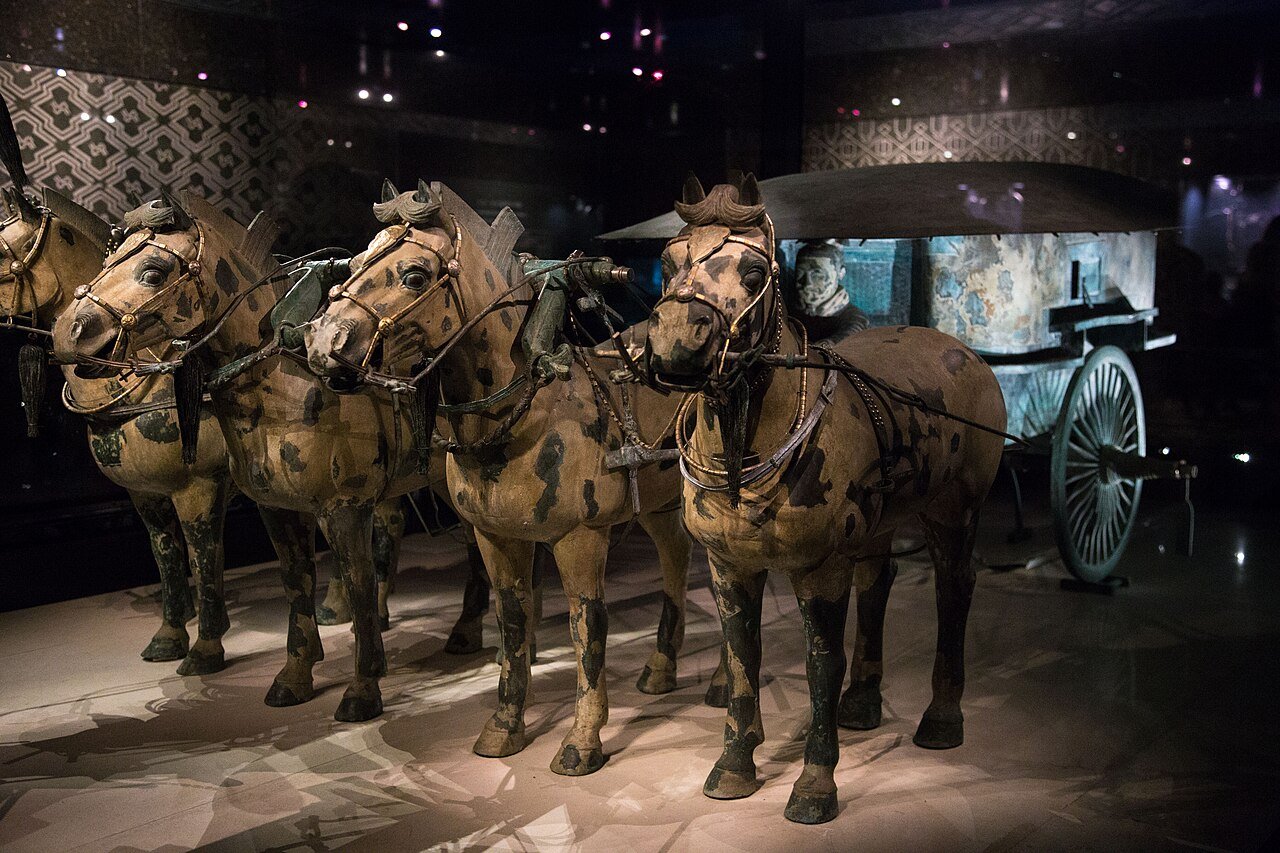
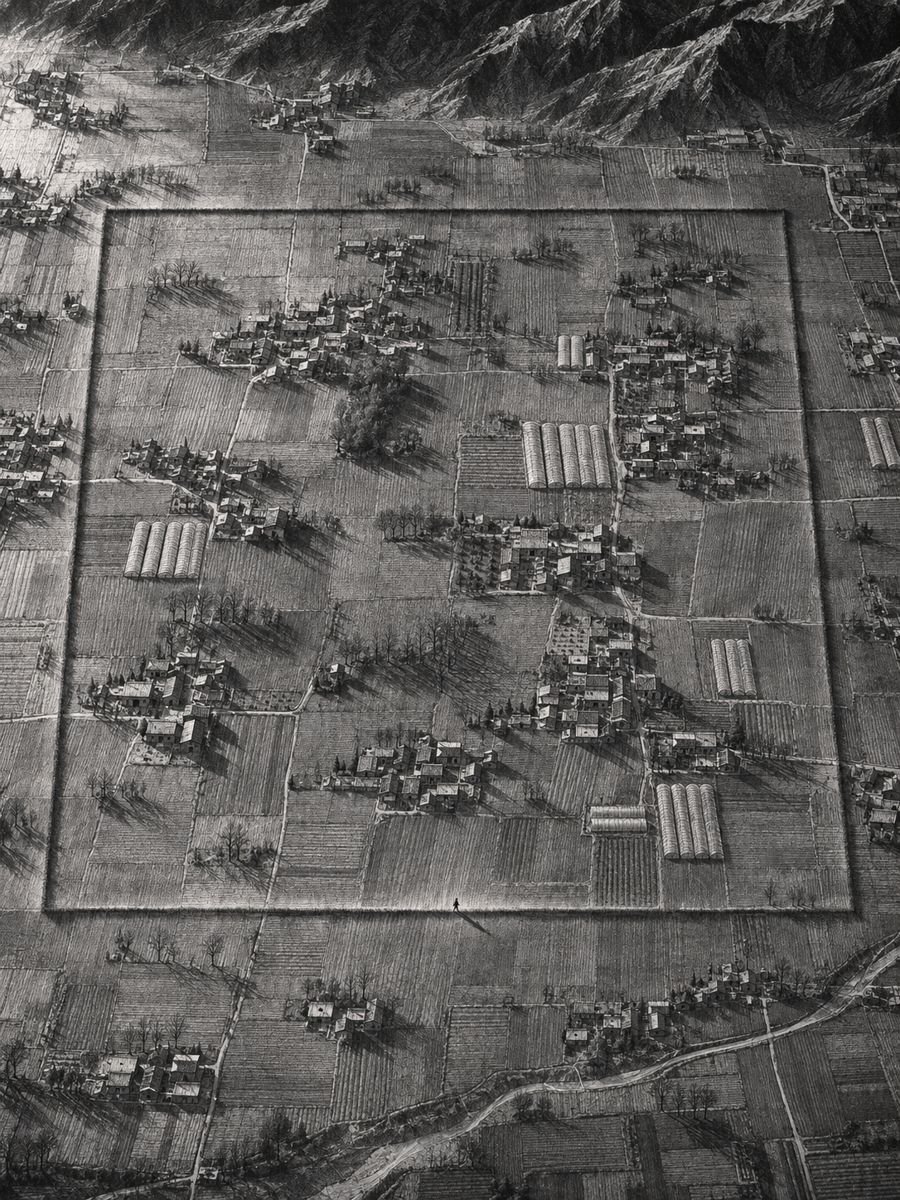
It is a tomb, and it is only the centre of something much larger. The emperor’s burial complex is surrounded by an inner and an outer wall; the outer wall alone runs about 6.3 kilometres around. Around and inside it, archaeologists have found pits of bronze chariots, stables, animal burials, stone armour, acrobats, officials and musicians, all placed underground for the emperor’s use after death. Only a small fraction of the whole complex has been excavated.
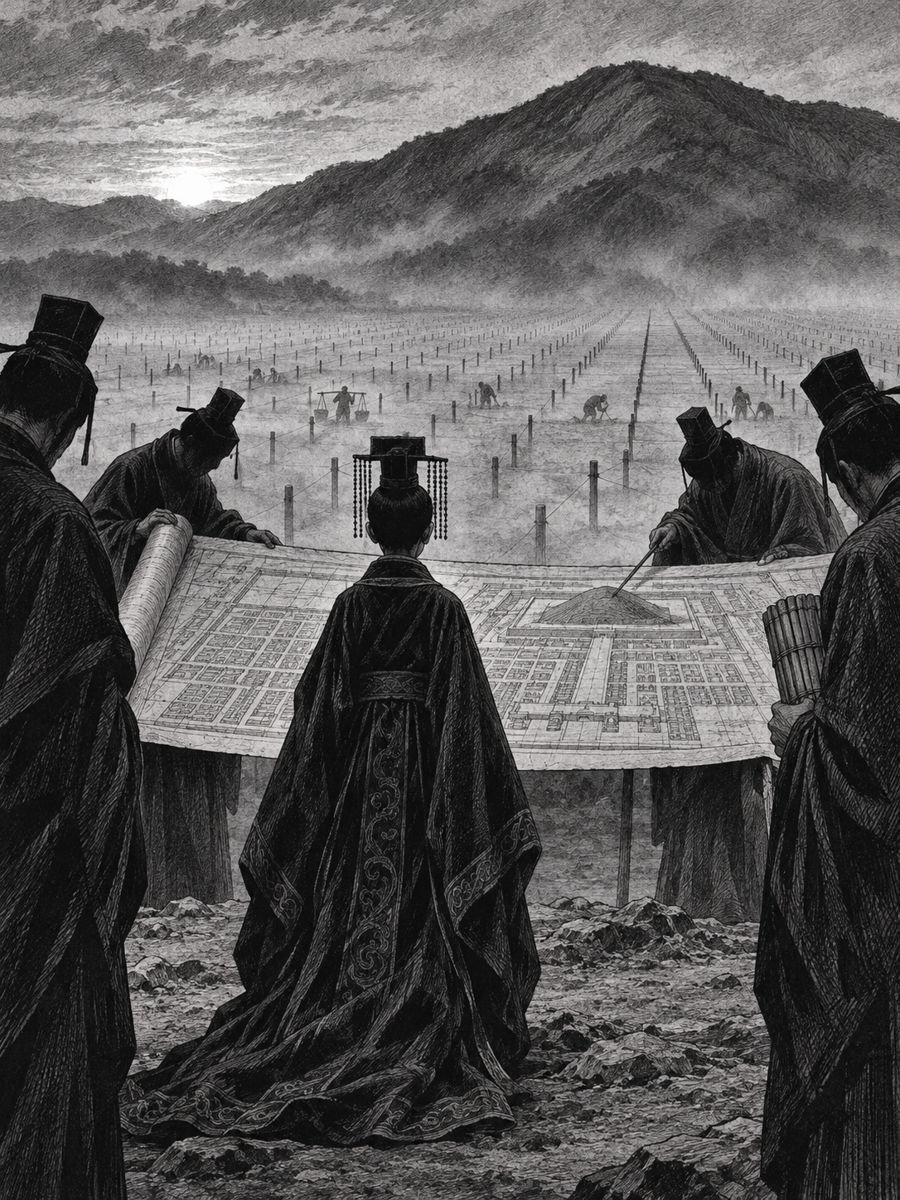
The man under the mound is Ying Zheng. In 221 BC, after decades of war, he finished conquering the rival states and declared himself Qin Shi Huang, the First Emperor. He standardised writing, coins, weights and the width of cart axles across a country that had never been one country before. He also spent much of his life afraid of dying.
He started building this tomb long before that. Work began in 246 BC, when he became king of Qin at the age of thirteen. It did not stop until 208 BC, two years after his death. That is 38 years of digging.
So the obvious question is the one the farmers’ discovery raised. If China knows exactly where the First Emperor is buried, and has spent half a century studying everything around him, why is the door still shut?
Seven hundred thousand men

Sima Qian, writing about a century after the emperor died, gave a number for the workforce: 700,000 men, sent from every part of the new empire. Many were convicts.
Archaeology has found some of them. Mass graves near the complex hold the remains of labourers and craftsmen who died during the decades of construction. Some of them were convicted criminals, and some were buried still in chains.

Others left their names behind. Many of the clay soldiers carry stamped or incised marks naming the workshops and foremen responsible for them. It was a system of accountability: if a figure was badly made, the state knew whose hands had made it.
And the figures were made with a care that still unsettles people who stand in front of them.

Eight thousand faces

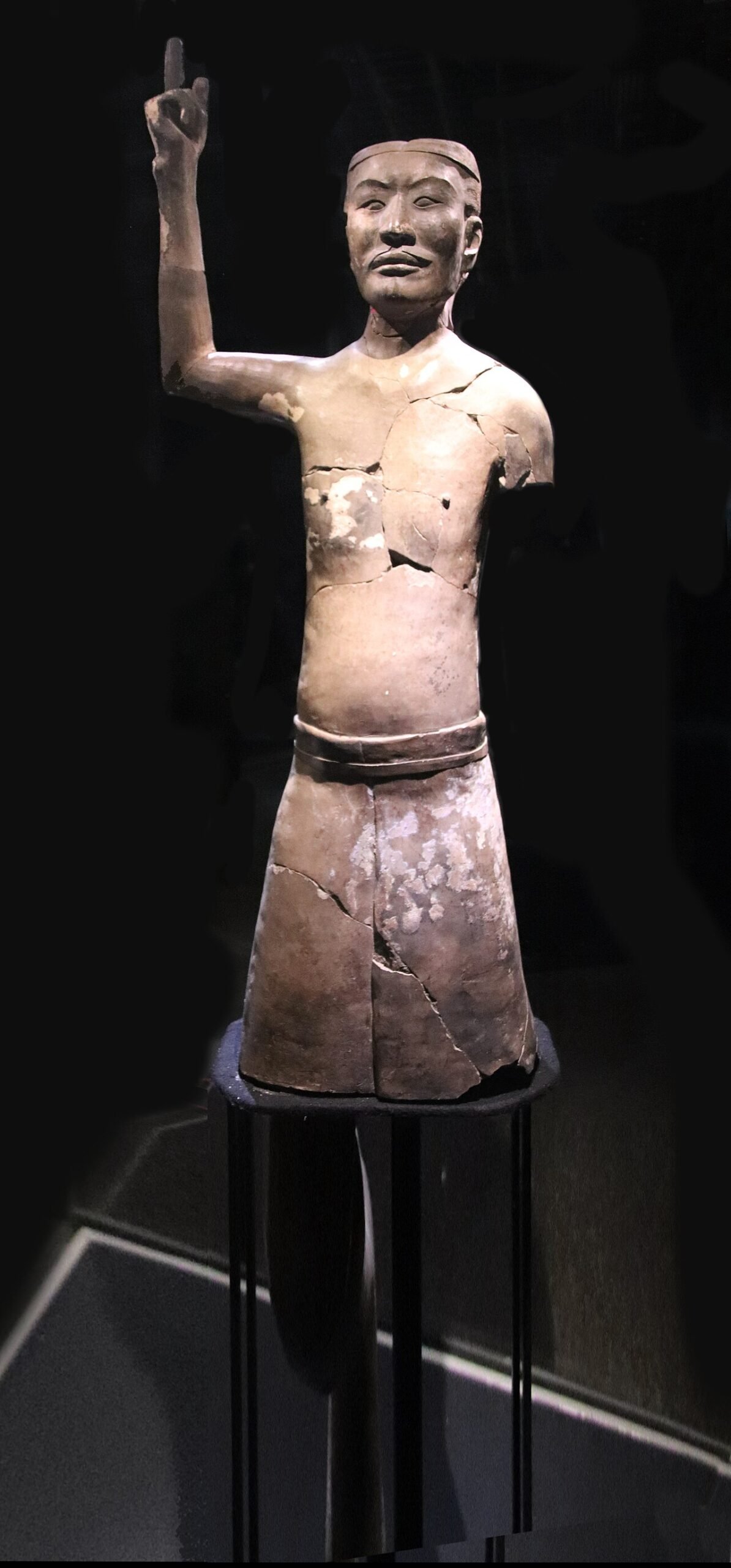
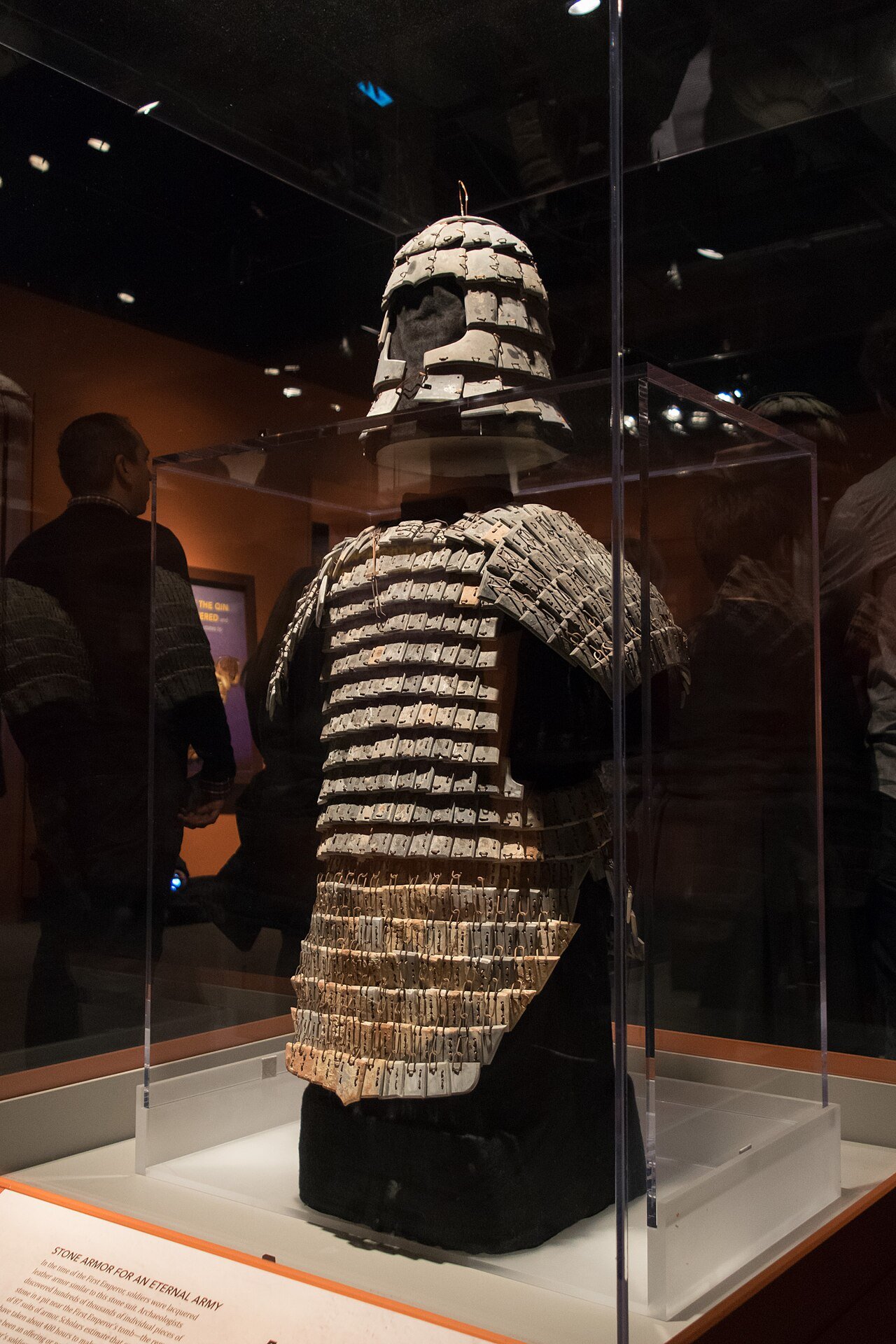
The soldiers are life-sized and taller than life. Their armour is carved plate by plate, with the rivets showing. Their hair is braided and knotted in different styles. Some wear caps that mark them as officers; some kneel with crossbows; some stand ready beside horses. Across the three main pits, the estimated total is close to 8,000 warriors and horses.
What strikes almost everyone first is the faces. They are not identical. Some are young, some lined; moustaches, cheekbones, the set of the mouth all vary.
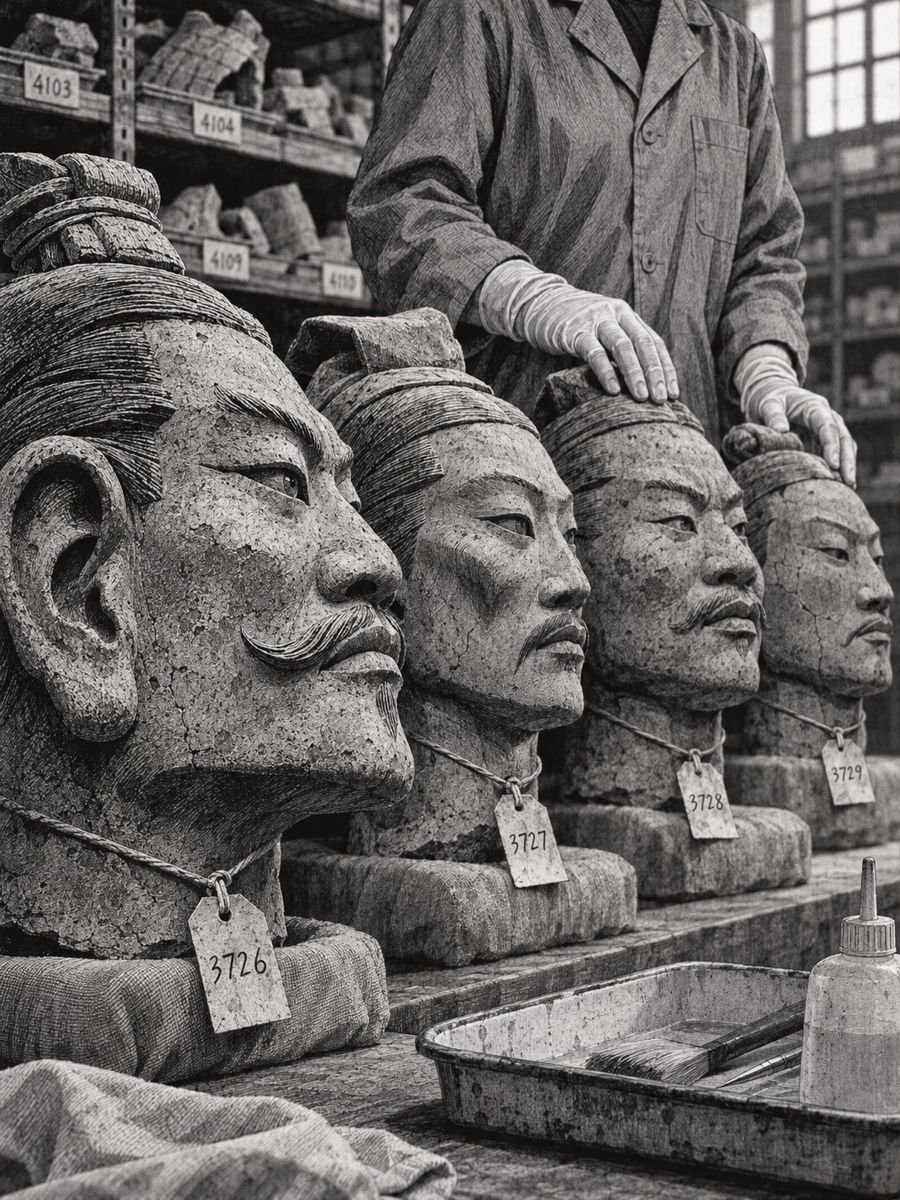
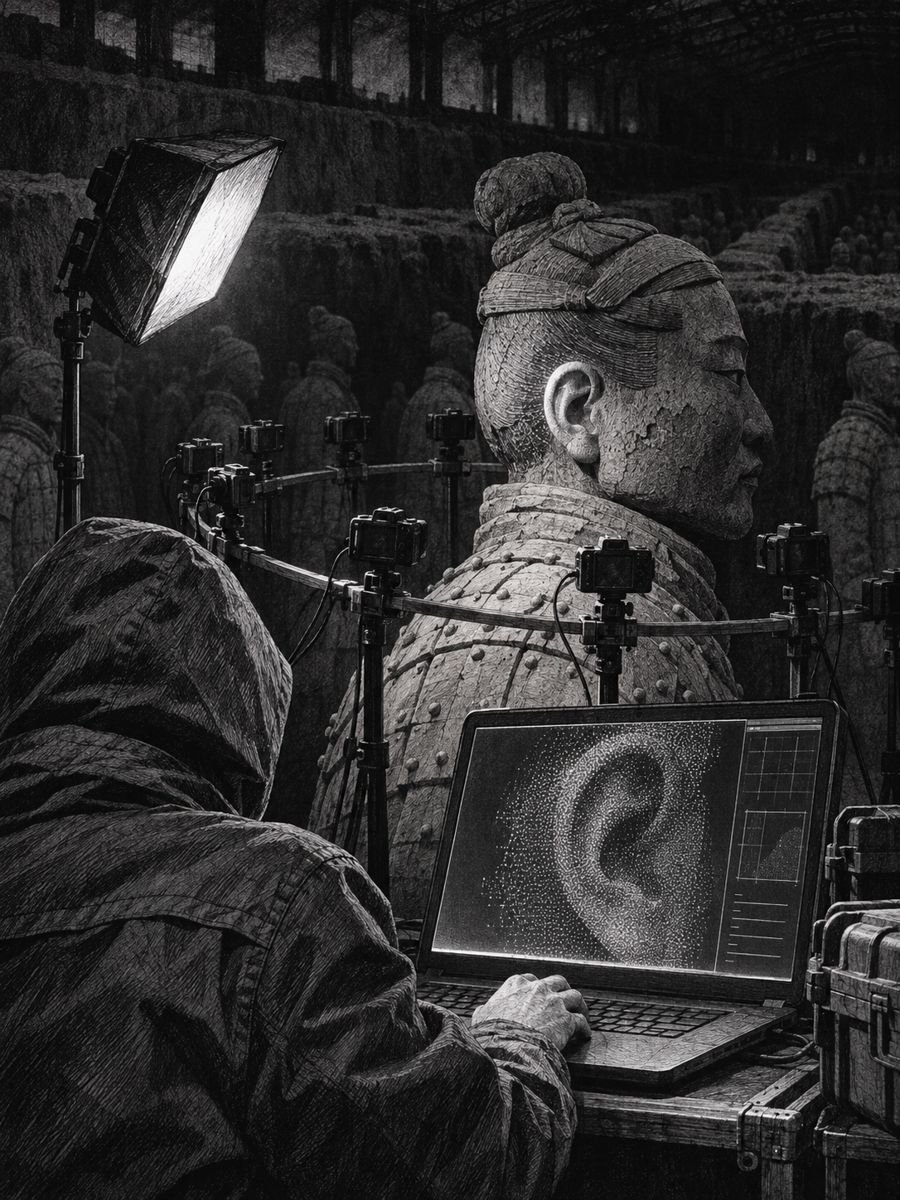
That raises a question researchers are still working on: were these portraits of real men in the emperor’s army, or a clever production system that mixed and matched features to create the look of individuality? In 2014, a team working with the Terracotta Army Museum used 3D models to compare the soldiers’ ears, one of the most individual features of a human face, and found real variation between them. The lead researchers were careful about what that means. The variation could reflect real individuals, or the habits of different workshops, or both, and they wrote that it “may well be hard to disentangle these things.”
You will see videos online saying face-recognition software has proved every warrior was modelled on a living soldier. The published work does not say that. What it shows is stranger in a quieter way: someone, 2,200 years ago, decided that an army made for the dead should not have two ears alike.
Fifteen seconds of colour

Today the warriors are the colour of dust. They were not made that way.

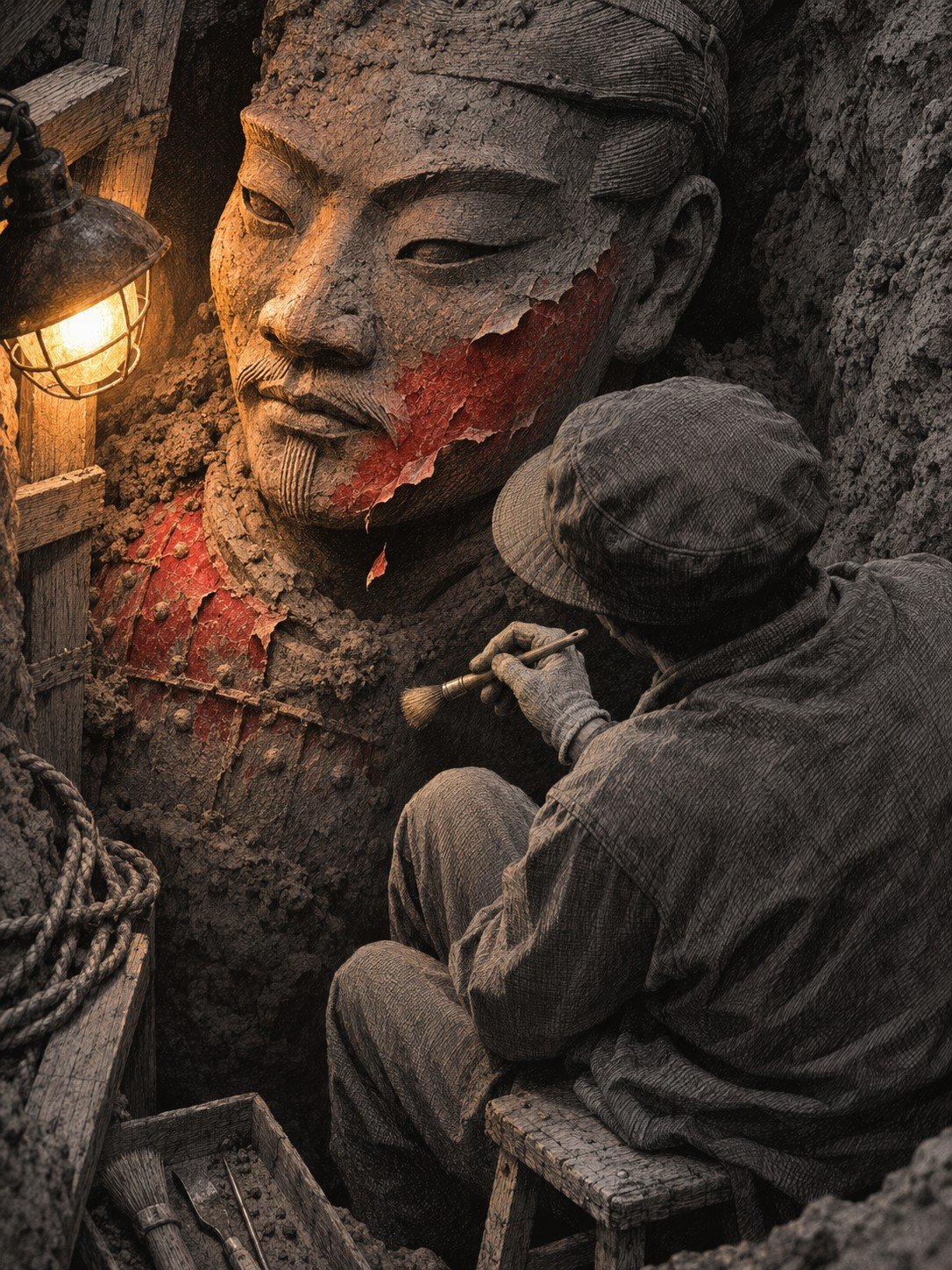
When they were buried, they were painted: faces in flesh tones, armour and robes in red, green, blue, pink and purple, all laid over a base of lacquer. Underground, in cool, damp darkness, much of that paint survived for two thousand years.

Then it met the air. Xia Yin, a conservation scientist at the site, has described what happens: the pigments start to change about 15 seconds after a figure is uncovered, and within four minutes the lacquer layer that binds them breaks away from the surface. The colour curls and falls off like flakes of dried skin. Early excavators lost much of it before photographers could even record it.
One of those colours turned out to be extraordinary. The purple on some figures is a synthetic pigment now called Han purple, a barium copper silicate that is extremely rare in nature and that ancient Chinese craftsmen made deliberately at high temperatures. In 2006, a team led by physicists at Stanford, working with Los Alamos and the University of Tokyo, chilled the same compound close to absolute zero under enormous magnetic fields and watched it behave in a way they had never seen: its magnetic structure appeared to collapse from three dimensions into two. A paint used on clay soldiers had become a subject of quantum physics.
But the fifteen seconds matter most for a different reason. The army was only the guard post. If the paint on clay soldiers falls apart in four minutes, what happens to silk, wood, lacquer, documents and a human body sealed for 2,200 years in the main chamber, the moment that chamber is opened?
That is the first reason the door is still shut. It is not the strangest one.
The legend of the swords that never rusted

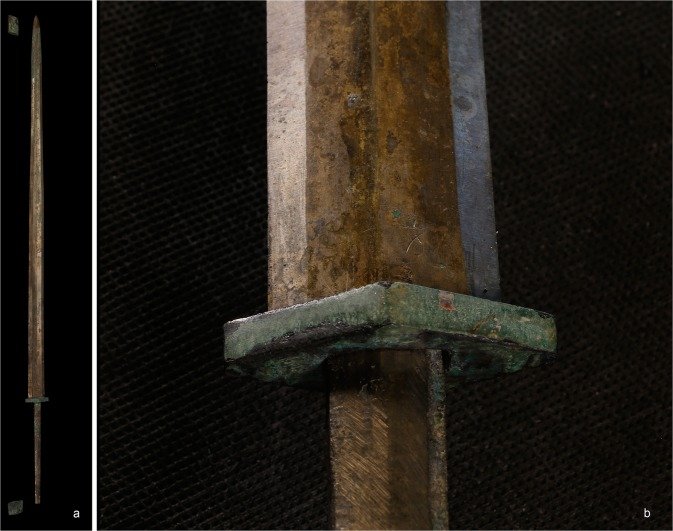
Among the warriors, excavators found tens of thousands of bronze weapons: swords, spearheads, halberds, crossbow triggers and arrowheads. Many came out of the ground bright, sharp and almost free of corrosion.
For decades, a story grew around them. Analysis in the 1970s found traces of chromium on the surface of some bronzes. From that came a famous claim: Qin weapon-makers had invented chrome plating, an anti-rust treatment the modern world did not patent until the twentieth century. You can still find it repeated as fact, often alongside a tale of a bent sword springing straight when a fallen statue was lifted off it.
In 2019 a team from University College London and the Terracotta Army Museum tested the chromium idea against hundreds of artefacts. Their answer was published in Scientific Reports. The chromium was real, but it was not a coating. It came from lacquer, the chromium-rich lacquer used on the wooden and bamboo hafts, handles and scabbards that once held the weapons. The highest chromium levels were found exactly where those parts had been attached. And some of the best-preserved weapons had no chromium on them at all.
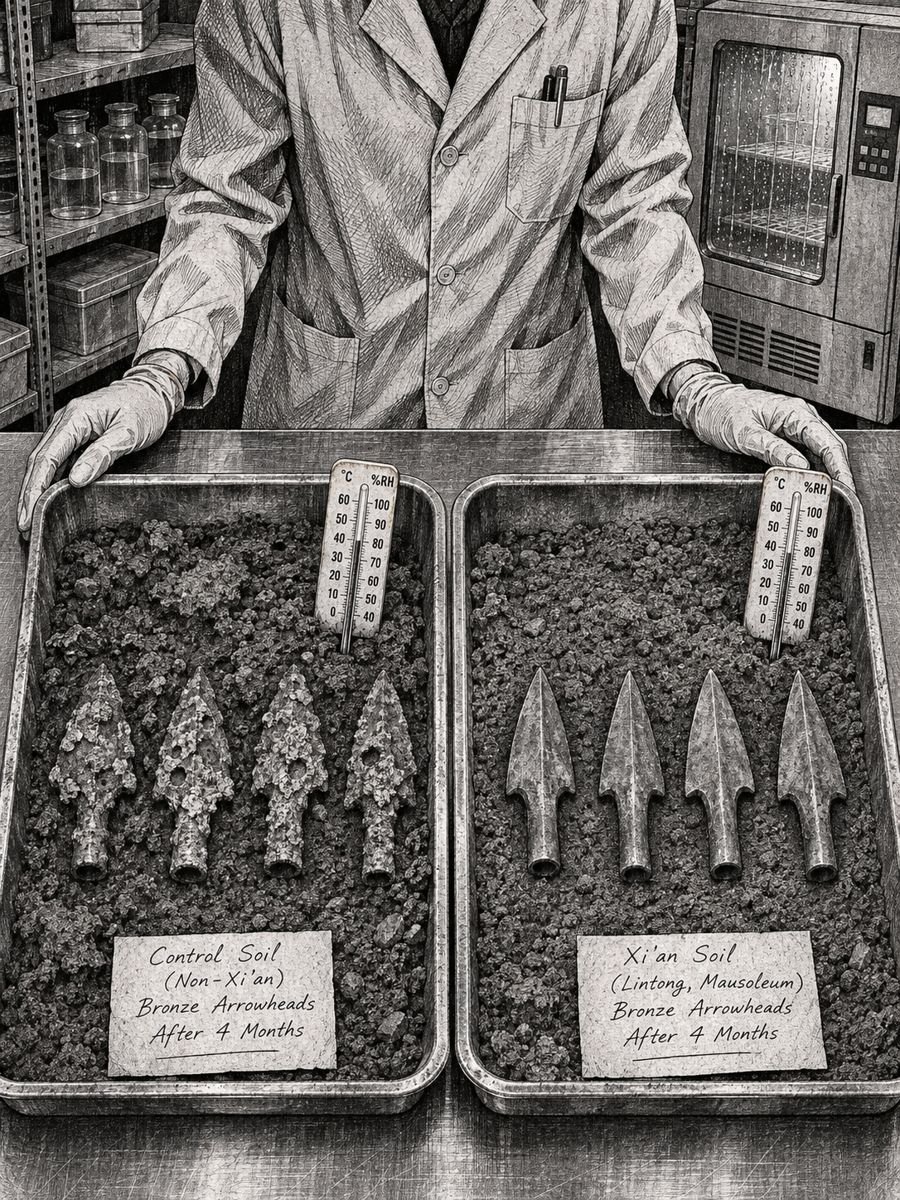
So why didn’t they rust? The team buried replica bronzes in soil from Xi’an and in an organic-rich control soil and put them through four months of heat and humidity. The control samples corroded badly. The Xi’an samples stayed almost pristine. The local soil, moderately alkaline, fine-grained and low in organic matter, had been protecting the bronzes the whole time.

The ancient chrome-plating story is gone. What replaced it is a reminder that the ground around this tomb behaves in ways nobody fully expected. And the ground is about to become the main character.
What did Sima Qian say was inside the tomb?
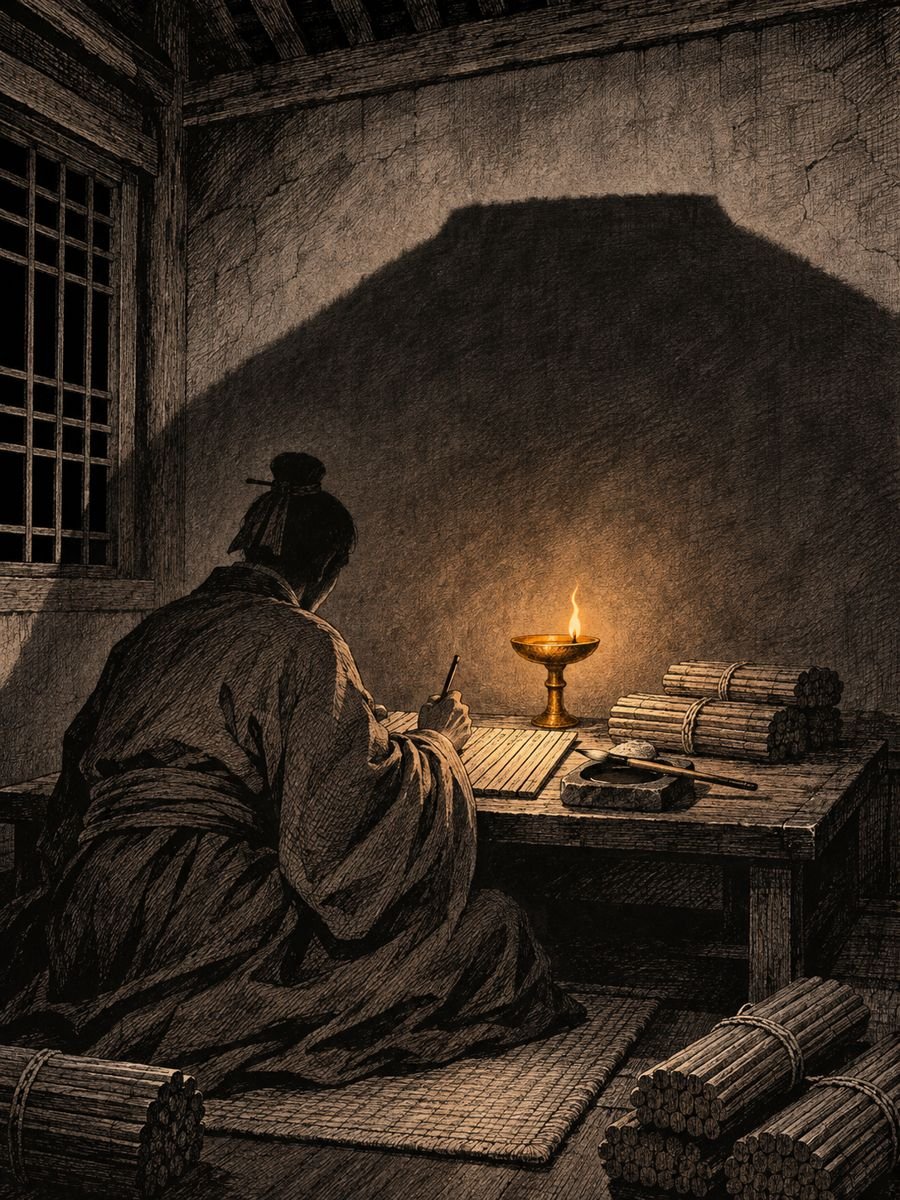
There is exactly one ancient description of the inside of the burial chamber. It comes from the Shiji, the Records of the Grand Historian, written by Sima Qian around a century after the emperor’s death.
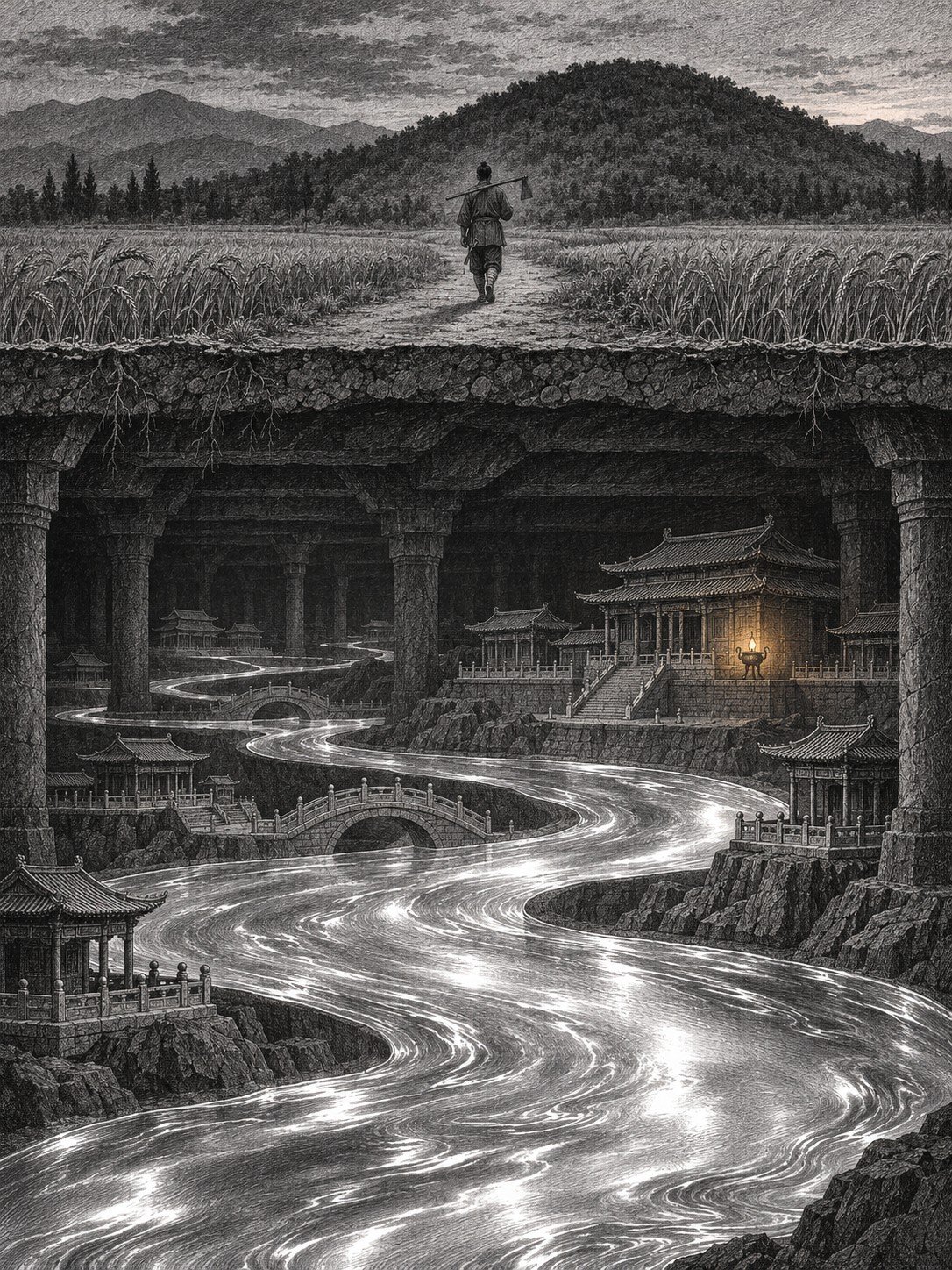
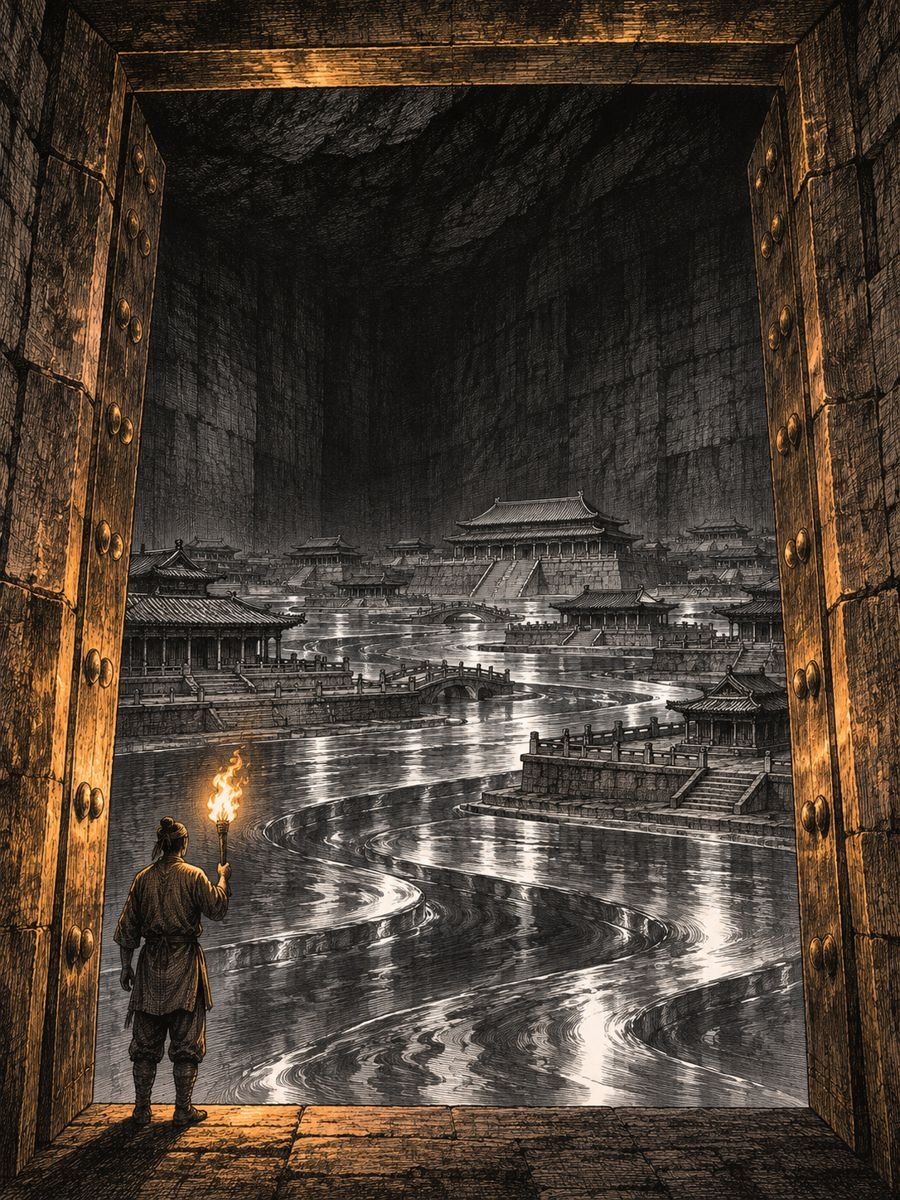
According to Sima Qian, the workers dug down through three layers of groundwater and sealed the chamber with bronze. They filled it with models of palaces and official buildings and with rare objects and treasures. Craftsmen were ordered to install crossbows that would fire automatically at anyone who broke in. The heavens were set out on the ceiling, and the land below. Lamps were fuelled with the fat of “man-fish” so that they would burn for a long time; scholars still disagree about what animal that meant, with whales and other sea or river creatures among the candidates.

And then the line that historians argued about for two thousand years: mercury was used to make the hundred rivers, the Yellow River and the Yangtze and the great sea, and machinery kept it flowing.
Mercury is the only metal that is liquid at room temperature. Its vapour is a poison that attacks the nervous system, the lungs and the kidneys. For most of history the passage read like poetry or propaganda: a dead emperor surrounded by moving silver rivers, lit by lamps meant never to go out.
Then scientists started measuring the soil.


Is there really mercury in the tomb?
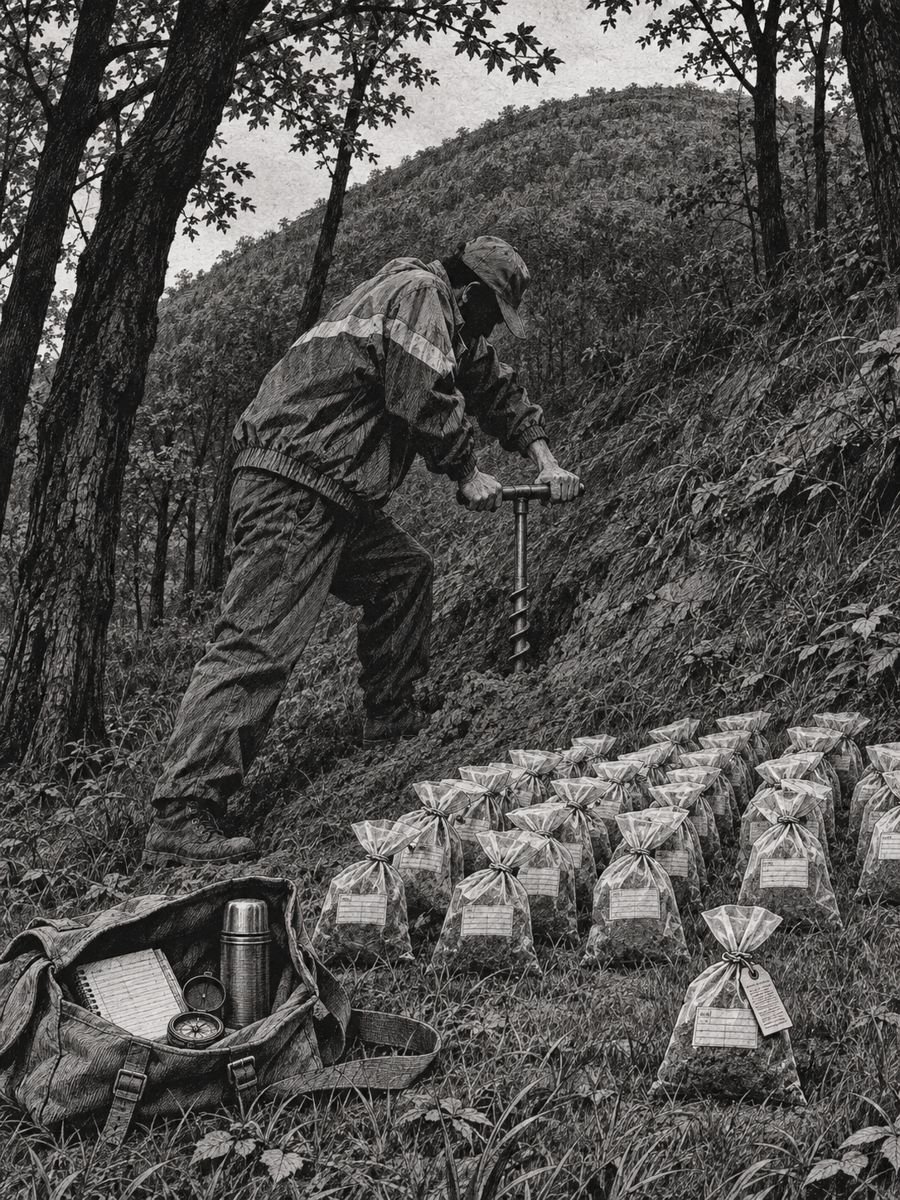
In the early 1980s, Chinese researchers took soil samples across the mound and reported something odd. Mercury levels over the tomb were well above what they found in the surrounding area. One sample reached 1,440 parts per billion; dozens of others averaged around 205.
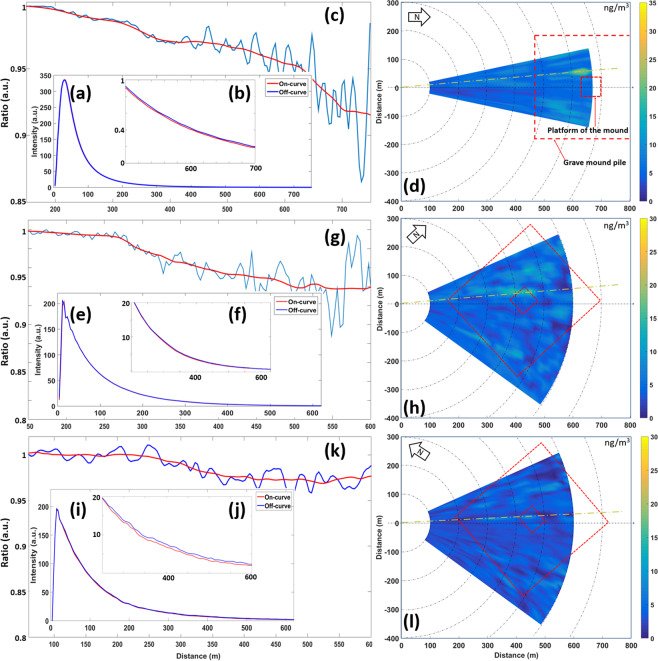
In 2020 a team including Chinese researchers and the Swedish laser physicist Sune Svanberg published a different kind of measurement in Scientific Reports. They had spent the summer of 2016 scanning the air above the mound with a laser system that can detect atomic mercury. Over the western slope, close to the top, they found hotspots of mercury in the air of up to about 27 nanograms per cubic metre, compared with a regional background of roughly 5 to 10. Their estimate was that something like a ton of mercury might have leaked out into the air over the centuries, though they stressed the “very large uncertainties.”

Their conclusion was careful but striking: the findings “add to the credibility” of Sima Qian’s 2,200-year-old account of large amounts of mercury in the tomb.
Two things are worth saying plainly, because the internet usually doesn’t. First, the scientists did not map rivers. Claims that the mercury readings trace the exact shape of the Yellow River and the Yangtze go far beyond what the published lidar work says; the authors themselves called the idea that surface patterns reflect a map of China unwarranted. Second, figures like “100 tons of liquid mercury” circulate widely, but they are estimates and extrapolations, not measurements from inside a chamber no one has entered.

There is also a counter-argument. The Xi’an area has had its own mercury pollution from industry, and some researchers argue that at least part of the soil signal could come from that. The 2020 team pointed to the hotspots’ match with the earlier soil findings, and to the fact that the tomb’s leak appears too small to affect the region’s air in any significant way, as reasons to think the tomb itself is a source.
What no one disputes is the uncomfortable possibility at the centre of it. If even part of Sima Qian’s description is true, opening the chamber means opening a sealed space that may still contain a poison, along with whatever else he said was put in there to kill intruders.
Did anyone get in?

A tomb this rich should have been robbed long ago. Many were.
The historical sources say that after the Qin dynasty collapsed, the rebel general Xiang Yu took the capital and plundered the emperor’s burial site. Later stories added a shepherd who lost a sheep in a passage and set a fire with his torch. Some modern scholars think the shepherd story lacks any solid evidence.

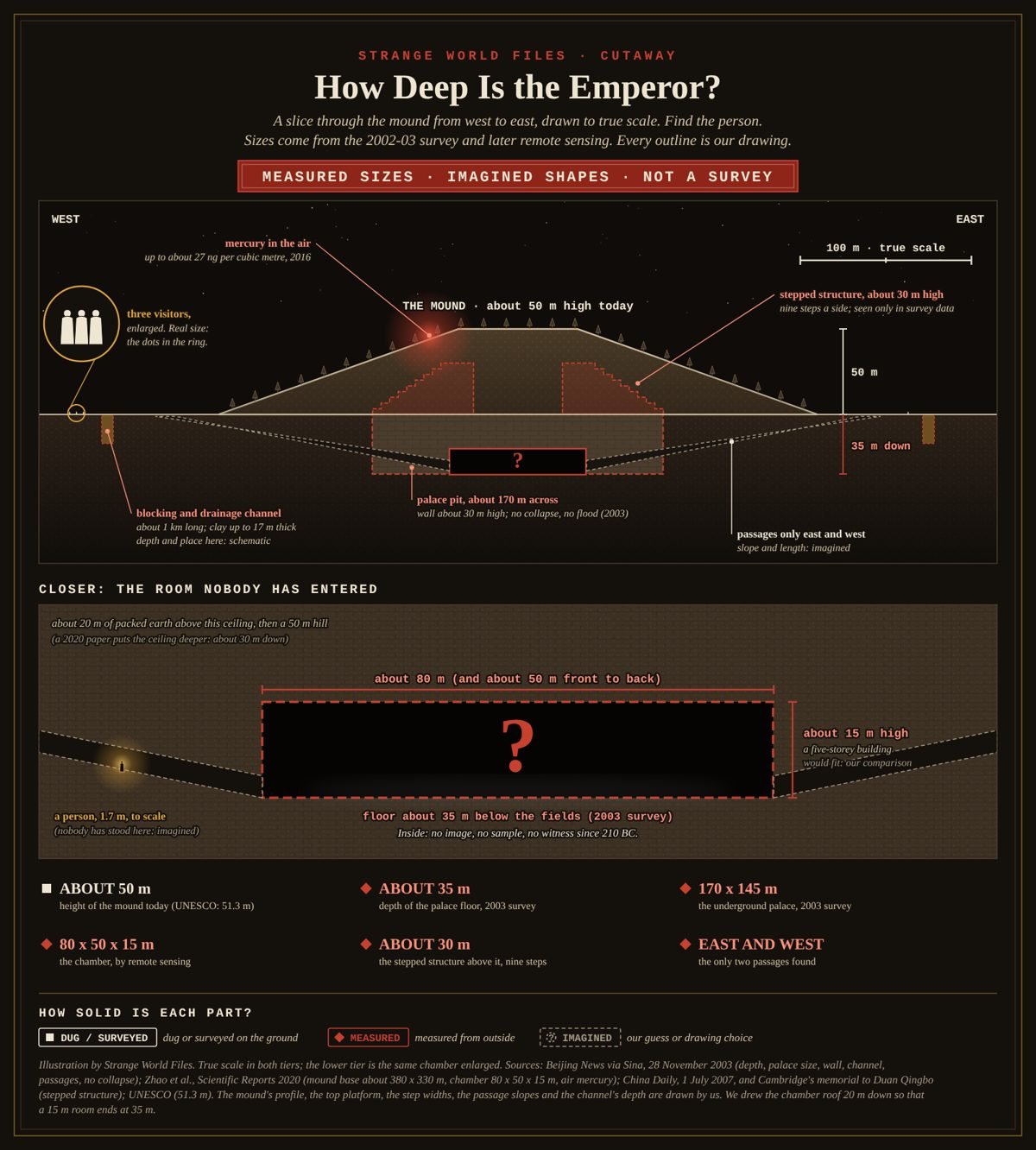
What scientists can say is more limited and more intriguing. Remote sensing surveys around the turn of this century reported a large underground structure beneath the mound: a chamber estimated at about 80 by 50 metres and around 15 metres high, inside thick walls. The mercury readings themselves point the same way: a heavily disturbed, open chamber would probably have lost much more of its contents. The 2020 researchers wrote that the chamber is believed never to have been opened or looted, while making clear that their study could not confirm it.
Nobody alive knows for certain what is inside. That uncertainty is part of why the next discovery hit so hard.


The brothers who were killed
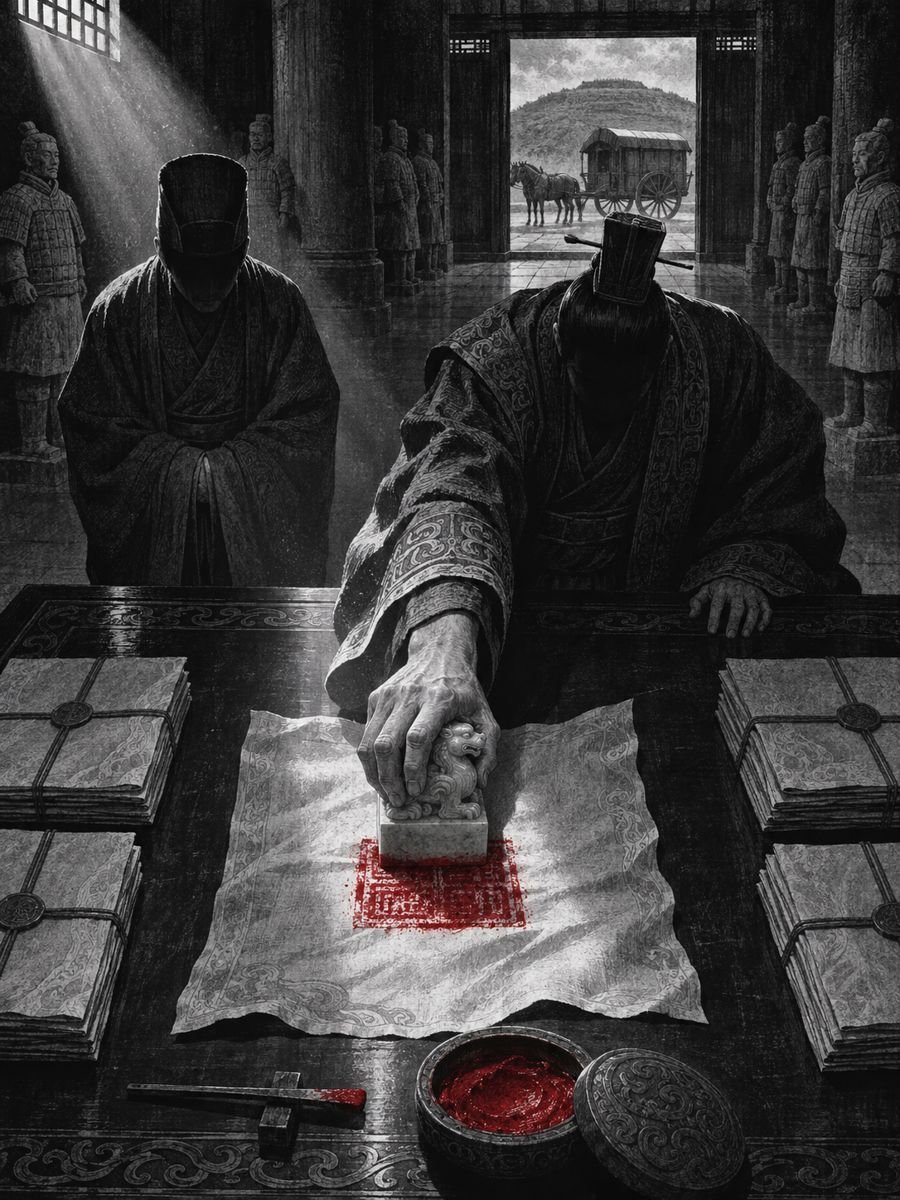
The First Emperor died in 210 BC, while travelling. What happened next, according to Sima Qian, was a palace coup. One of his younger sons, Huhai, conspired with the chief eunuch and the chancellor to forge the emperor’s orders, force the rightful heir to kill himself, and take the throne as the Second Emperor.
Then he dealt with his siblings. The Shiji records that twelve princes were executed in the capital, Xianyang, and ten princesses were killed at a place called Du.
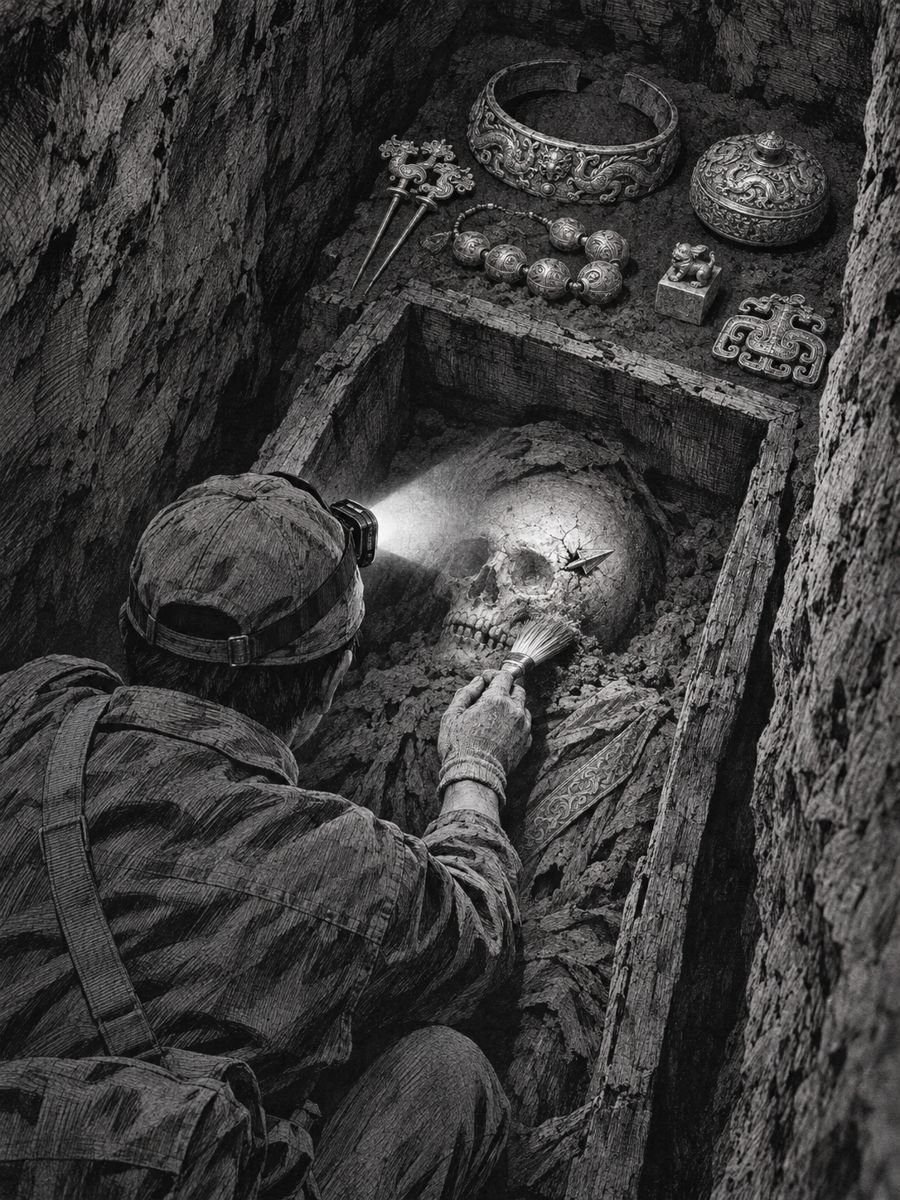
East of the mausoleum, near Shangjiao village, archaeologists found 17 accompanying tombs, some excavated as early as the 1970s. They held high-status objects of gold, silver and bronze. They also held bodies that had been treated with terrible violence. In one, the skull of a young man had a bronze arrowhead lodged in the right temple. His head and limbs had been cut from his body before he was placed in his coffin.
In November 2026, a research team at Northwest University in Xi’an released a digital reconstruction of that man’s face, built from his skull using a database of more than 3,000 modern faces. He was about thirty when he died. The face that came back has long, almond-shaped eyes and a high, prominent nose. The researchers noted that Sima Qian describes the First Emperor himself with exactly those features: a prominent nose and long eyes. They stressed that it is an approximation, not a portrait.

If they are right, it may be the closest anyone has come to looking at a member of the First Emperor’s family. He was murdered by his own brother, and buried just east of his father’s grave mound.
The ones who closed the door

Sima Qian’s account of the funeral ends with two more killings.
The Second Emperor ordered that his father’s concubines who had borne no sons should not be sent away. They were made to follow the emperor in death, and many died.

Then someone raised a problem. The craftsmen who built the chamber knew how it worked: where the treasure was, where the mechanisms were. Once the coffin was in place, the inner gate was closed and the outer gate was lowered, and the workers and craftsmen were sealed inside. According to the Shiji, none of them came out.
Whether every detail of that account is true is something only the chamber can answer.
The people who think everyone else is wrong
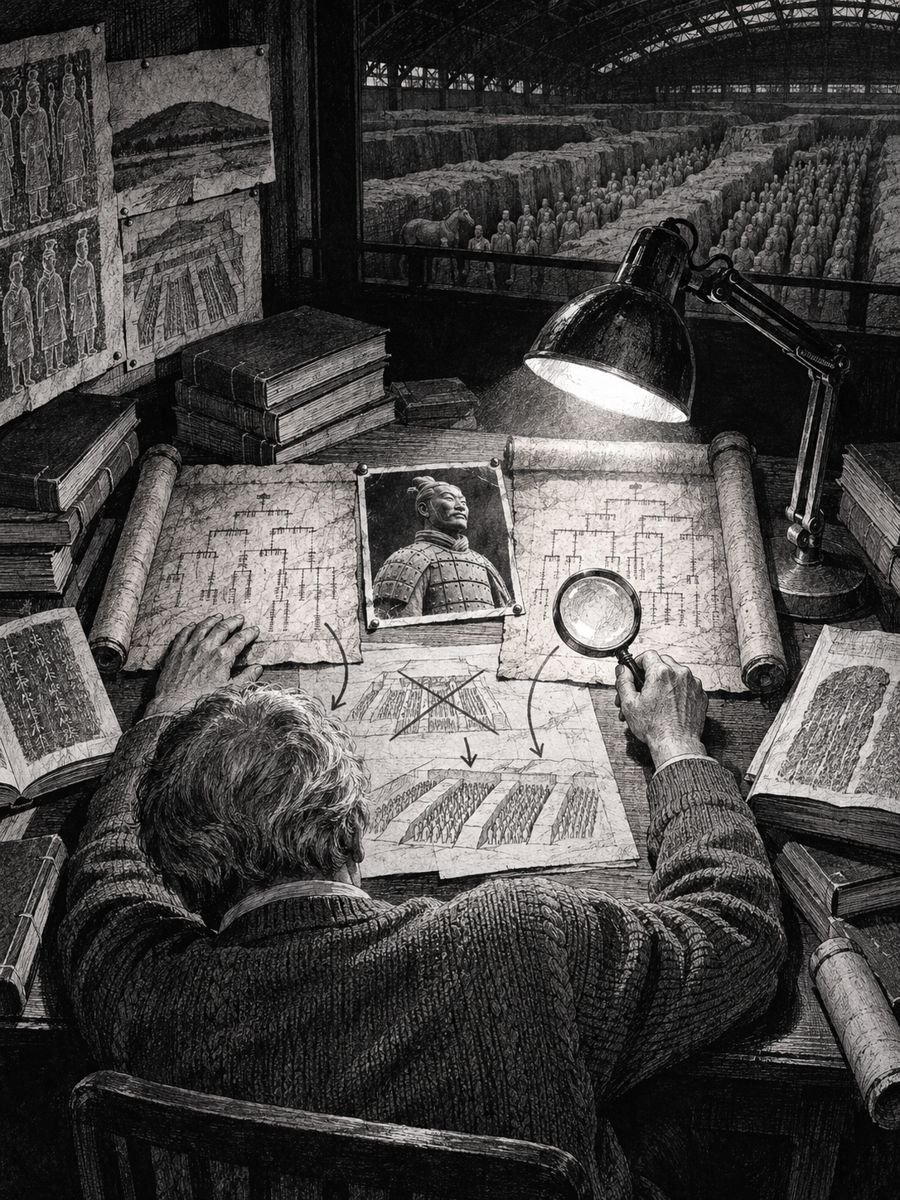
Up to this point the story has a clear shape. It is less settled than it looks. For almost every claim made about this tomb, someone with real credentials has argued the opposite, and some of those arguments are still running.
Whose army is it? In 2009 the historian Chen Jingyuan told China’s Global Times that the Terracotta Army may never have belonged to the First Emperor at all. His candidate was Queen Dowager Xuan, a powerful Qin queen who died before Ying Zheng was born, and he called her “the real mastermind behind the army.” The museum and most archaeologists treat the army as part of the First Emperor’s burial complex. Chen’s idea has stayed a minority view, but it has never quite gone away.

Who taught them to make life-sized men? Before the First Emperor, China had no tradition of life-sized human sculpture. Then, within a single reign, there were thousands. In 2013 the art historian Lukas Nickel argued in an academic journal that the sudden leap might reflect contact with Hellenistic art from the west. In 2016 the idea went global, helped by DNA from skeletons in north-western China that pointed to people of European descent in the region around that period, and by comments from the archaeologist Li Xiuzhen. The reaction was fast. Zhang Weixing of the mausoleum museum told AFP there was “no substantial evidence at all” of contact with Greeks. Li Xiuzhen said her words had been taken out of context and that the figures “were uniquely made by the Chinese.” The question of whether outside ideas reached the workshops is still argued; the claim that Greeks built the army is not supported by anything found at the site.
Did Xiang Yu get in? The rebel general who sacked the Qin capital is the prime suspect in every looting story, and fire damage really has been found in the Terracotta Army pits. In January 2023 the museum researcher Shen Maosheng reported that a passage in Pit 1 had been dug open in antiquity. His interpretation, which he presented as an inference, was that someone who knew how the pit was built had used the passage to get in, perhaps Qin soldiers who had surrendered to Xiang Yu. On the other side sit the 2003 survey results: a chamber that has not collapsed, a drainage system around it, and mercury that would probably have escaped from a broken tomb. The army may have been raided. Whether the emperor was is a different question.
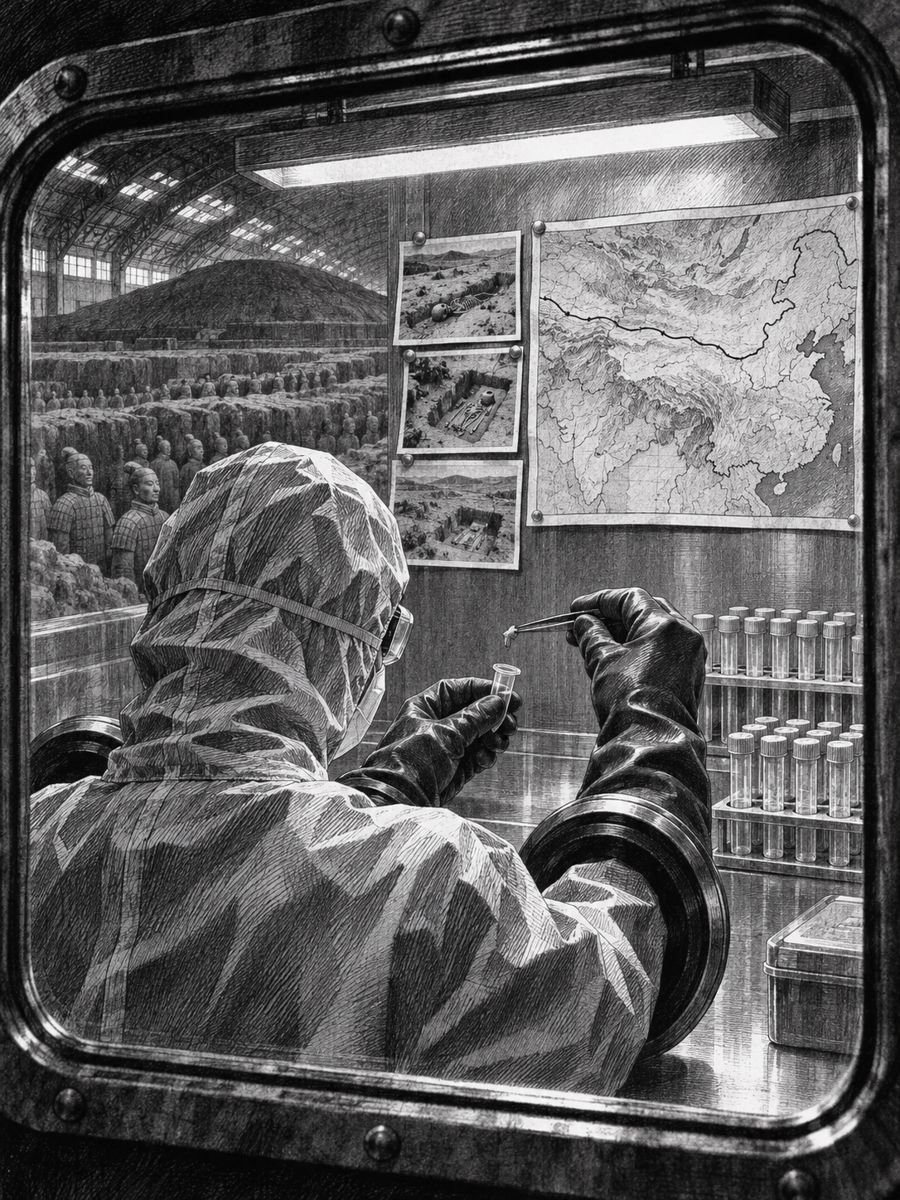
Was the only witness exaggerating? Sima Qian wrote about a century after the funeral. Some historians treat him as a careful collector of evidence; the Berkeley historian Michael Nylan has written about the care with which he weighed his sources. Others see a gifted storyteller. National Geographic’s reporting on the site has called his figure of 700,000 labourers likely exaggerated. The mercury readings moved the argument in his favour. The crossbows have never been tested.
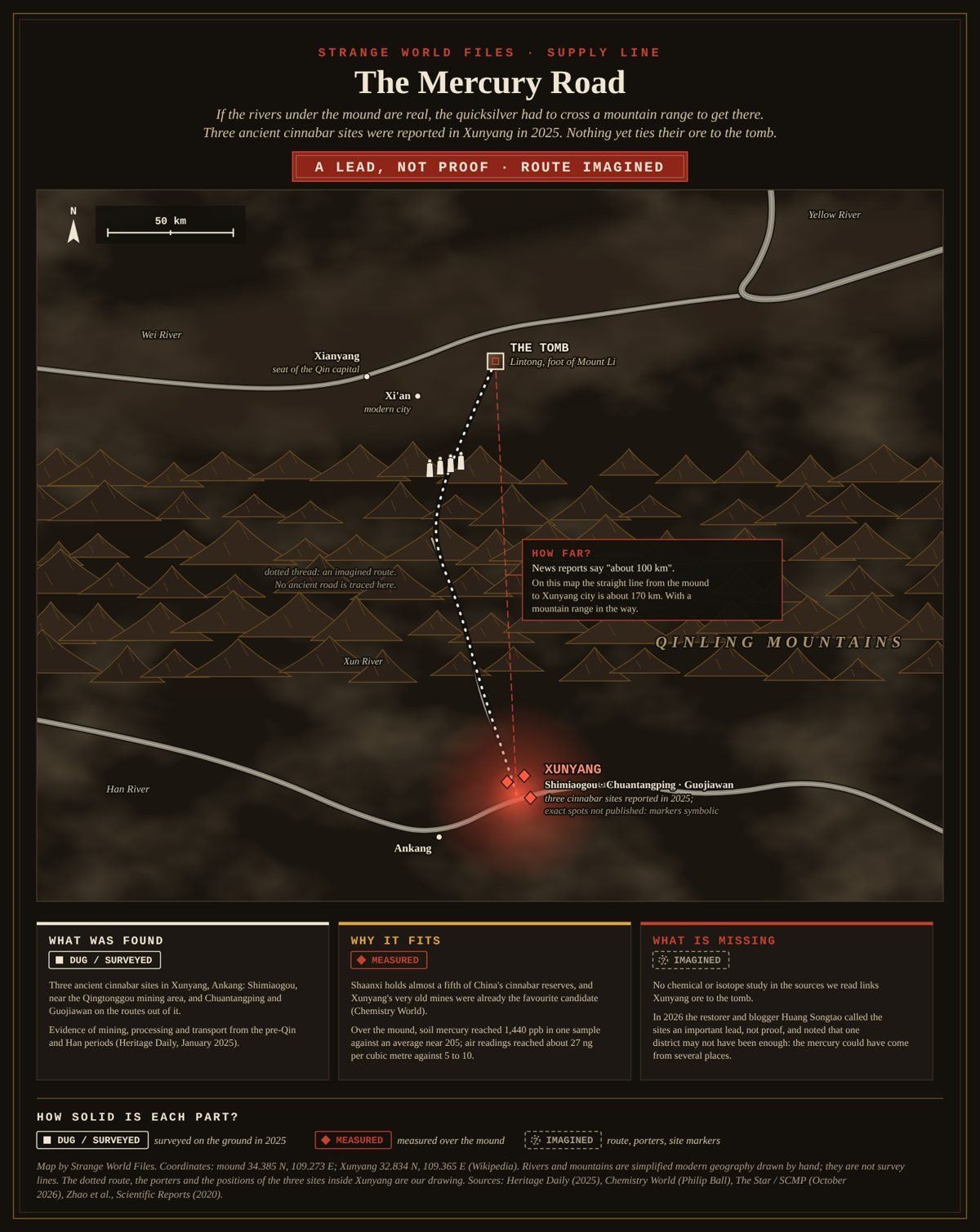
Where did the mercury come from? In 2025, surveys in Xunyang, about 100 kilometres from the mausoleum, reported three ancient cinnabar sites with evidence of mining, processing and transport, in a region that holds about a fifth of China’s mercury reserves. In September 2026 social media in China announced that the source of the tomb’s mercury had been found. Specialists pushed back: the sites are a lead, but nothing yet links that ore to that tomb. Even the experts who believe the mercury is real disagree about what it looks like now. The archaeologist Duan Qingbo has estimated the chamber held at most about 100 tons. His fellow excavator Zhang Yinglan has argued that the chamber probably collapsed long ago and the mercury has spread into the surrounding soil, so its present pattern cannot be read as rivers at all.

What is sitting on top of the chamber? After five years of remote sensing, Duan Qingbo described a buried structure about 30 metres high above the main chamber, ringed by stepped walls with nine steps each. His suggestion was that it “might have been constructed for the soul of the emperor to depart.” Nobody has seen it. It exists, for now, as a pattern in the data.
Should anyone open it? Proposals to excavate have been made since 1976, on the grounds that the site lies in an earthquake zone and that tomb robbers are active in the region. A 1997 State Council notice said large imperial tombs should not be excavated until the science exists to protect what is inside. In 2024 Wu Yongqi, honorary director of the mausoleum museum, went further. His hope, he told state television, is that the tomb is never touched, and that technology will one day let people see inside without opening it.

That is the strangest outcome of fifty years of research. The more scientists learn about this tomb, the more of them argue for leaving it alone.

Why has Qin Shi Huang’s tomb never been opened?

Over the decades, scholars and officials have argued about opening the tomb. China’s cultural heritage authorities have kept the same position: no excavation of the main chamber until the technology exists to protect what is inside, and until there is a research and conservation plan to match. They have refused permission even for nearby tombs where the risk of damage was judged too high.
Put the pieces together and the reasons are not mysterious at all. Paint that dies in four minutes. Organic treasures that could follow it. A chamber that may still hold mercury vapour. An account, written by the only ancient source we have, of crossbows set to fire at intruders. And the simple fact that once a 2,200-year-old seal is broken, it can never be put back.
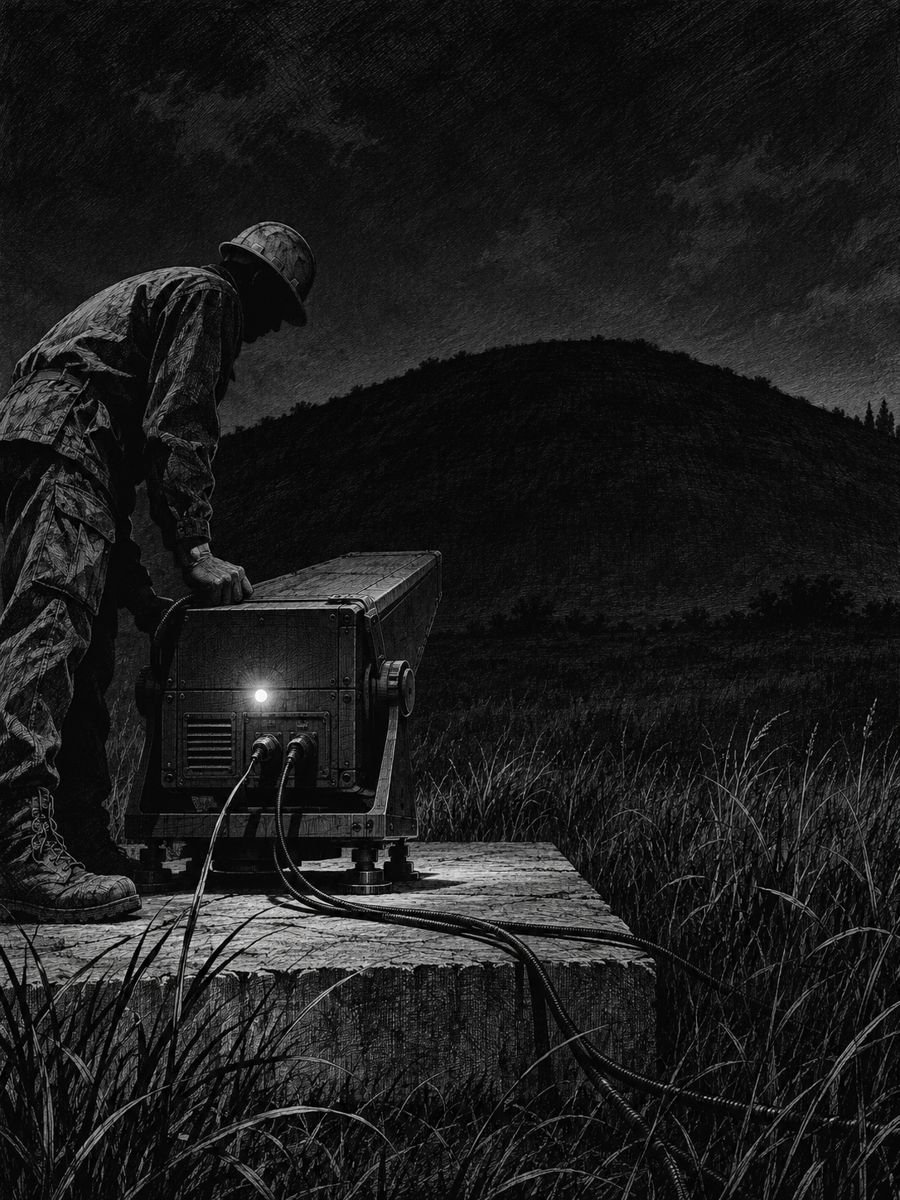
The farmers who found the army in 1974 were looking for water. The water never came out of that well. The emperor never came out of his hill.
The hill at the end of the field

Yang Zhifa spent his later years signing books at the Terracotta Army museum, the most famous farmer in China, a short walk from the pit where his hoe went through a clay head.
A kilometre and a half to the west, the trees still grow on the mound, just as Sima Qian said they were planted, so that it would look like a mountain. Somewhere beneath them, by every measurement anyone has been able to take from the outside, the air is still carrying traces of silver. Henan offers the opposite problem: a royal tomb dated to roughly 5,000 years ago gave up 350 objects, and yet the king himself was missing.

Case file summary
- What: The unopened burial chamber of Qin Shi Huang, China’s First Emperor, and the Terracotta Army that guards it
- Where: Lintong district, Xi’an, Shaanxi Province, China
- When: Built 246–208 BC; the army was found in late March 1974
- Scale: An estimated total close to 8,000 warriors and horses; an outer wall about 6.3 km around
- Status: Never excavated. Studied only from the outside
Evidence locker
Real photographs and published figures, kept separate from our illustrations. Each one says what it shows, and what it cannot prove.



What is documented, and what isn’t
Documented
- The Terracotta Army was discovered by farmers digging for water near Xiyang village, Lintong, in late March 1974 (usually dated 29 March); formal excavation began later that year.
- The pits hold an estimated total close to 8,000 warriors and horses, and many thousands of bronze weapons.
- The figures were originally painted; their paint and lacquer begin to deteriorate within about 15 seconds of exposure and can detach within about four minutes.
- A 2019 study found the chromium on Qin bronzes came from lacquer, not from an ancient anti-rust coating.
- Soil studies in the 1980s and an air study in 2016 (published 2020) found elevated mercury over the mound.
- Seventeen accompanying tombs near Shangjiao village are believed to belong to Qin princes and princesses; one man’s skull holds a bronze arrowhead, and his face was digitally reconstructed in 2026.
Interpretation
- That the mercury readings come from rivers and seas of mercury inside the chamber.
- That the main chamber has never been robbed.
- That the reconstructed man was a son of the First Emperor.
Not confirmed
- How much mercury is inside, if any remains in liquid form.
- Whether any crossbow traps were installed or could still work.
- What survives inside the chamber.

The arguments still open
| Question | One side says | The other side says | What would settle it |
|---|---|---|---|
| Whose army? | The First Emperor’s, as part of his burial complex (museum, mainstream archaeology) | Queen Dowager Xuan’s (historian Chen Jingyuan, 2009) | Inscriptions or records tying the pits to a specific ruler |
| Outside influence? | Life-sized sculpture appeared suddenly; Hellenistic contact possible (Lukas Nickel, 2013) | “No substantial evidence at all” of Greek contact (Zhang Weixing, museum, 2016) | Workshop evidence of foreign techniques or people at the site |
| Was the tomb looted? | Ancient texts blame Xiang Yu; fire damage in the pits; a Pit 1 passage was dug open (Shen Maosheng, 2023) | Chamber not collapsed, drainage intact, mercury still present (2003 survey team) | Entry, or non-invasive imaging of the chamber interior |
| Is Sima Qian reliable? | A careful weigher of evidence (Michael Nylan); mercury readings support him | His 700,000 workers figure is likely exaggerated (National Geographic reporting) | Finds inside the chamber |
| Where is the mercury? | Still concentrated in the chamber, at most about 100 tons (Duan Qingbo) | Chamber collapsed; mercury spread into the soil (Zhang Yinglan) | Direct measurement inside |
| Where did it come from? | Xunyang cinnabar mines about 100 km away (2025 surveys) | A lead, not proof; no chemical link yet (specialists, 2026) | Isotope comparison of tomb mercury and Xunyang ore |
| Open it? | Earthquake zone and robbers are risks; excavation proposed since 1976 | Wait for technology; ideally never touch it (1997 State Council notice; Wu Yongqi, 2024) | Imaging good enough to make opening unnecessary |

Timeline
- 246 BC: Ying Zheng becomes king of Qin at 13; work on his tomb begins.
- 221 BC: Qin conquers the last rival state; Ying Zheng takes the title Qin Shi Huang, First Emperor.
- 210 BC: The First Emperor dies while travelling; Huhai seizes the throne as the Second Emperor.
- 208 BC: Construction of the tomb ends after 38 years.
- c. 91 BC: Sima Qian completes the Shiji, including the only ancient description of the burial chamber.
- Late March 1974 (usually given as 29 March): Farmers digging a well near Xiyang village find the first terracotta head.
- 1970s: Tombs at Shangjiao village, east of the mausoleum, are found and partly excavated.
- Early 1980s: Soil surveys report elevated mercury over the mound.
- 1997: A State Council notice says large imperial tombs should not be excavated until relics can be protected.
- 2003: Remote sensing results: chamber not collapsed, strong mercury anomaly, drainage system around it.
- 2013: Lukas Nickel publishes the Hellenistic-influence argument; it becomes a global controversy in 2016.
- 2016: A laser-radar team measures mercury in the air above the mound.
- 2019: A UCL-led study disproves the “chrome-plated weapons” theory.
- 2020: The laser-radar mercury study is published in Scientific Reports.
- January 2023: Museum researcher Shen Maosheng reports that a passage in Pit 1 was dug open in antiquity.
- 2025: Ancient cinnabar mining sites are reported in Xunyang, Shaanxi.
- September 2026: Online claims that the tomb’s mercury source has been found; specialists call it unproven.
- November 2026: Northwest University releases the reconstructed face of a man from a Shangjiao tomb.

The story you may have heard, and what the file says
| What gets repeated | What the record says |
|---|---|
| The bronze weapons were chrome-plated, 2,000 years before the technique was invented | Disproved in 2019. The chromium came from lacquer on the weapons’ hafts and handles, not from a plating process. |
| There are 100 tons of liquid mercury inside the tomb | An estimate repeated online, not a measurement. Soil surveys show mercury above background; nobody has measured what is inside. |
| The mercury traces an exact map of China’s rivers | The published lidar study does not show this, and calls the idea of a surface map unwarranted. |
| Scanners proved every warrior is a portrait of a real soldier | The 2014 ear study found real variation between figures. It did not conclude that each one is a portrait. |
| Archaeologists are too scared to open it | The stated reasons are conservation and technology, set out in a 1997 State Council notice. Fear of booby traps is not among them. |
Three more claims travel with this tomb. A bent sword that sprang straight when a statue was lifted off it: no primary source supports the story. Greeks built the Terracotta Army: the published argument is about possible artistic influence, and the museum says there is no evidence of Greek contact at the site. The source of the tomb’s mercury has been found: ancient cinnabar mines in Xunyang are a lead, and no study has linked their ore to the tomb. Sichuan offers the stranger case: the giant bronze masks at Sanxingdui were burned and buried on purpose, and nobody has settled why.
Why the record is stranger than the legend: every one of these stories makes the tomb more magical and less interesting. The record does the reverse. Nobody needs a chrome process or a mercury map to explain what is there: a hill that was built, not formed, soil that still carries mercury after two thousand years, a historian who described rivers of it before anyone could test the ground, and a government that has looked at all of that and chosen, for half a century, not to dig. The legend says the tomb is guarded by traps. The file says it is guarded by a decision. Burial practice gets stranger further south. In Laos, 37 people were found inside a single stone jar.
Evidence locker
Real photographs and primary records only.
 EXHIBIT A
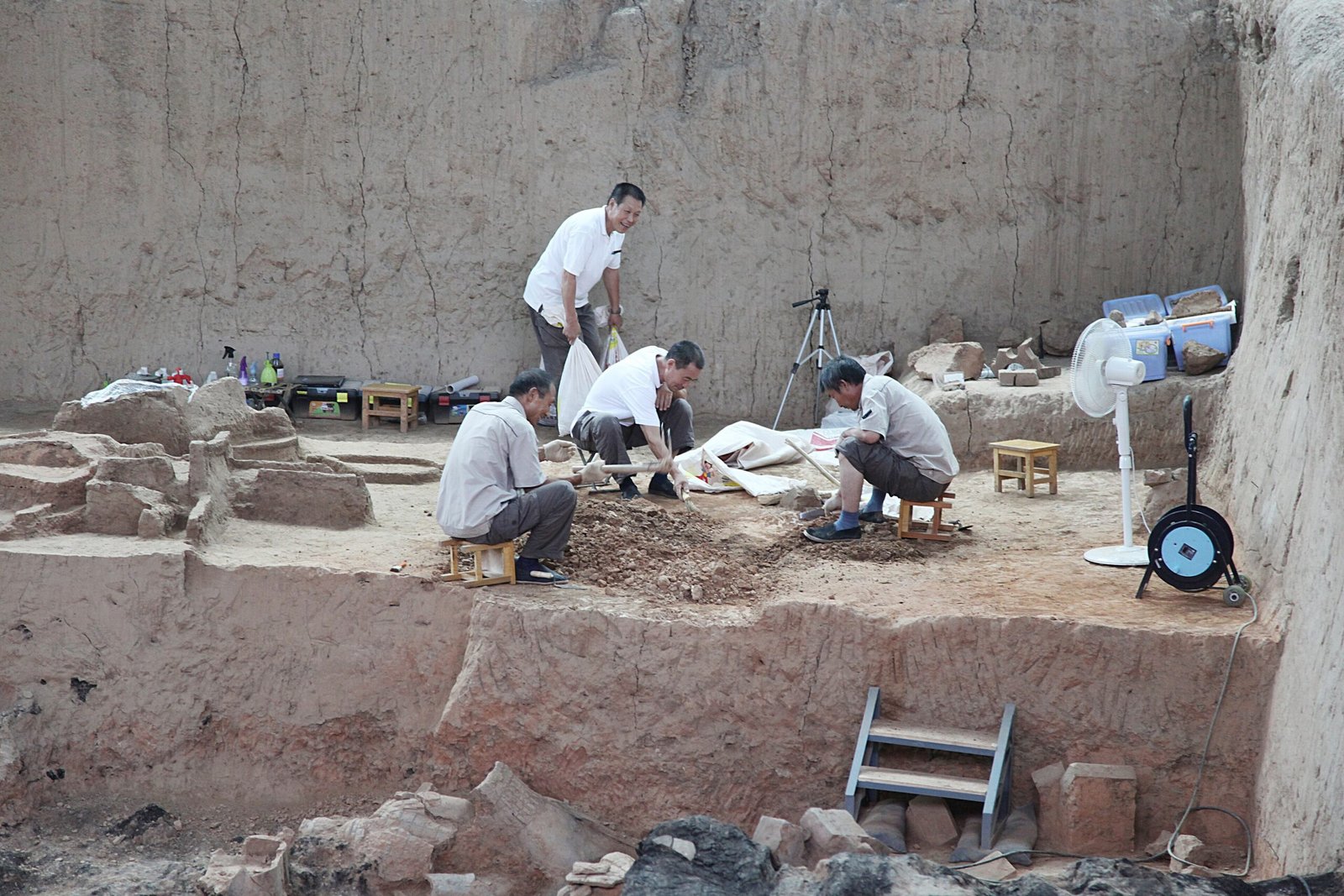 EXHIBIT B
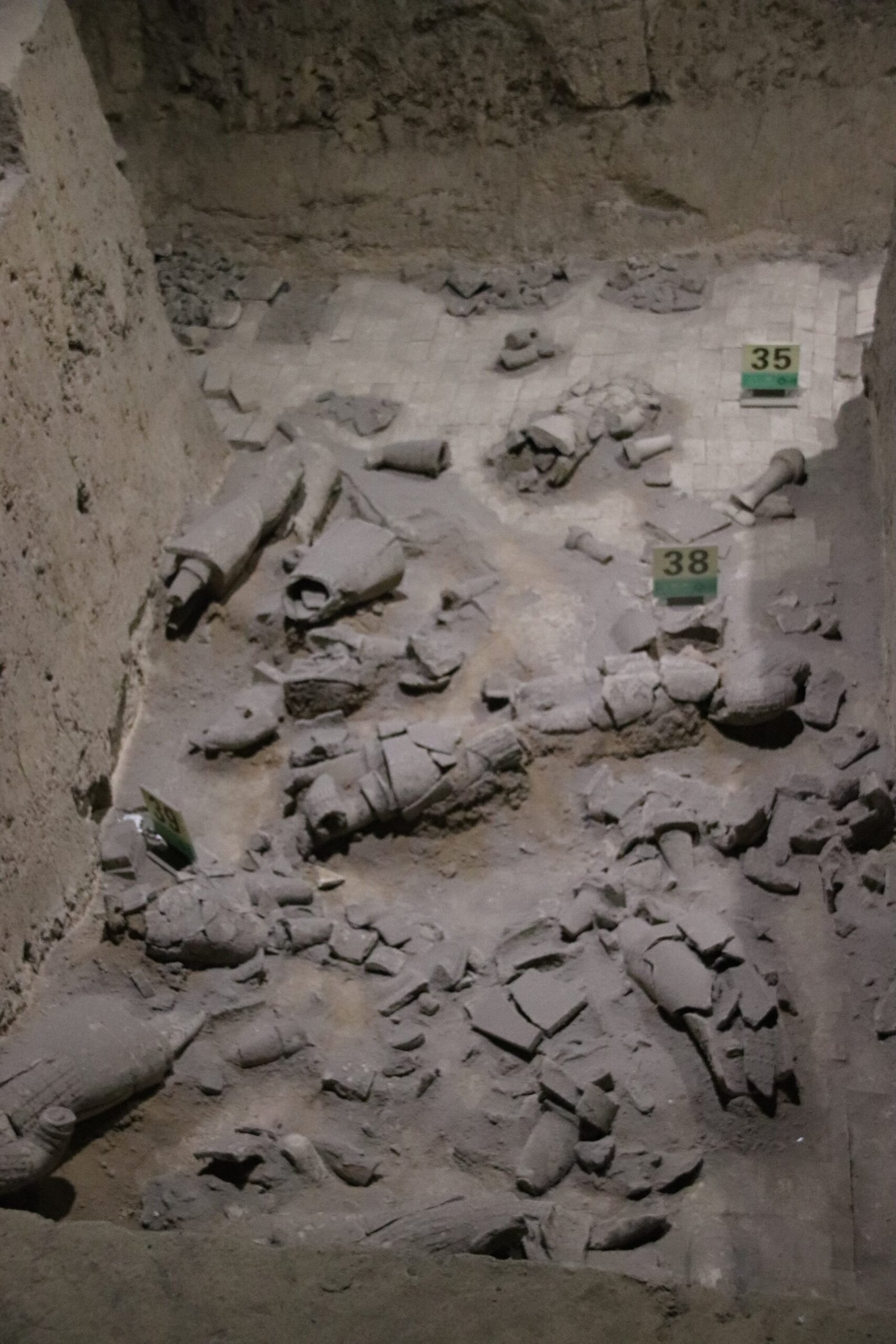 EXHIBIT C
 EXHIBIT D
 EXHIBIT E
Related files
- Gunung Padang: The “World’s Oldest Pyramid” That Was Retracted
- Yonaguni Monument: Is Japan’s Underwater Pyramid Man-Made?
Where the argument is, and where we come down
Two arguments here are routinely confused. The first is a genuine dispute among Chinese archaeologists about what the mercury readings mean. Duan Qingbo of Northwest University, who led work at the site from 1998 to 2008, argues the mercury distribution in the mound tracks the courses of the Yellow and Yangtze rivers as seen from the Qin capital, matching Sima Qian’s account of mercury rivers and seas inside, and has estimated at most around 100 tonnes. Zhang Yinglan of the Shaanxi History Museum argues the chamber collapsed long ago, that mercury would have dispersed through the soil, and that the present distribution cannot resolve into rivers or lakes at all. The second argument is public and much louder: “why isn’t the mausoleum excavated?” trends regularly on Chinese social media, most recently in late September 2026 after cinnabar mining and processing sites at Xunyang, Shaanxi, were linked to the tomb’s mercury, while English-language outlets answer the same question with claims about still-working booby traps.
The measurements are solid; the interpretations are not. Boreholes across roughly 12,000 square metres in the early 1980s found about 30 parts per billion of mercury in soil away from the centre against 250 ppb above the chamber and up to 1,500 ppb in places; a 2003 survey found elevated mercury in soil and inter-granular vapour plus a resistivity anomaly consistent with a conducting metal. What that cannot give is the quantity underground, its arrangement or its source — a point made in Chinese reporting in September 2026 and again by a cultural-relics restorer who said the Xunyang sites are an important lead, not proof. The booby-trap claim is the weakest link: one passage in the Shiji describing crossbows set to fire on intruders, written about a century after the burial, with no physical corroboration. The excavation question is not mysterious at all: Wu Yongqi, honorary director of the site museum, has said repeatedly that tombs should be opened only as rescue archaeology, that fragile organic material would be destroyed on exposure, and that the questions are better left open.
The argument exists because the decisive object is sealed and policy keeps it that way. Everything known about the chamber comes from texts written generations later and from remote sensing, so each survey is read as confirmation by one side and noise by the other. The Shiji supplies vivid detail no instrument can test, and a conservation decision is persistently retold online as fear of traps, which is the better story.
On the record as it stands, we put more weight on the measurements than on any reconstruction of what they depict, and on conservation rather than danger as the reason the tomb stays closed. First, the mercury anomaly is replicated across two independent survey campaigns, while the river-map reading depends on the chamber being intact — contested by the excavation’s own deputy director. Second, the stated reasons for not digging come from the site museum’s leadership and concern organic preservation, not hazards. We could be wrong if the chamber proved intact with mercury arranged as Duan describes, making his reading right all along. If the tomb is opened, or new geophysics resolves the chamber’s condition, we will rewrite this section.
Sources for this section: chemistryworld.com · thestar.com.my · scmp.com · stdaily.com · discovermagazine.com · heritagedaily.com · nbcnews.com
Editor’s note: why we would still wait
We think waiting is the right call. And yet, if the news broke tomorrow that the chamber was being opened, we would be among the first to look.
The treasure is part of it, but it is not the part we keep coming back to. What we really want to know is what the people of that time knew, and how far they could actually build. If Sima Qian’s rivers of mercury were real, how were they made to flow? If crossbows were set to fire at intruders, what was meant to trigger them, and was any of it built to last? None of that is confirmed. But seeing the inside of this tomb could change how we look at what Qin engineers were capable of.
So we say “keep it closed” with some regret. Honestly, we would like to see inside it in our lifetime. But wanting to see something is not a reason to risk destroying it. The paint on the soldiers began to fail within seconds of meeting the air. If the chamber were opened and something vanished before anyone could study it properly, we would lose not only the object but the answer we went in looking for.
We hope it is opened one day. Until then, we hope the people responsible take the time to be ready to protect what is inside.
What would you do: open it now, or wait for better tools? Tell us in the comments.
Quick answers: Qin Shi Huang’s tomb
Has Qin Shi Huang’s tomb ever been opened?
No. The burial chamber of Qin Shi Huang, China’s First Emperor, beneath the mound near Xi’an has never been excavated. China’s cultural heritage authorities say it will stay closed until there is technology to protect what is inside. Only a small part of the wider tomb complex has been excavated.
Is there really mercury in Qin Shi Huang’s tomb?
Elevated mercury has been measured over Qin Shi Huang’s tomb. Soil studies in the 1980s found mercury well above surrounding levels, and a 2016 laser-radar survey, published in 2020, detected mercury in the air above the mound at up to about 27 nanograms per cubic metre. The researchers said this adds credibility to Sima Qian’s account of mercury rivers.
Why haven’t archaeologists opened Qin Shi Huang’s tomb?
Qin Shi Huang’s tomb stays closed for several reasons: painted surfaces on the Terracotta Army began to fall apart within minutes of exposure, organic objects inside could be destroyed the same way, the chamber may contain toxic mercury, and once the seal is broken it cannot be restored.
Who discovered the Terracotta Army?
The Terracotta Army was discovered in late March 1974 (usually dated 29 March) by farmers digging a well near Xiyang village in Lintong, outside Xi’an. Yang Zhifa is credited with unearthing the first head, and several other villagers who were digging with him are also recognised as discoverers.
What is a little-known fact about Qin Shi Huang’s tomb?
A little-known fact about Qin Shi Huang’s tomb is that the purple paint on some of its terracotta soldiers, a synthetic pigment called Han purple, became a subject of quantum physics in 2006, when a Stanford-led team found it behaving like a two-dimensional magnet near absolute zero.
Illustrations are AI-generated artistic interpretations, not photos. No real person is depicted with a recognizable face. Read how we research and illustrate these files.
Sources
- Zhao G. et al., “Mercury as a Geophysical Tracer Gas: Emissions from the Emperor Qin Tomb in Xi’an Studied by Laser Radar,” Scientific Reports 10:10414, 2020
- University College London, “Scientists shed light on preservation mystery of Terracotta Army weapons,” 4 April 2019
- National Geographic, “Ancient terracotta warrior chrome weapon theory debunked,” April 2019
- China Daily, on Xia Yin and the loss of colour, September 2017
- National Geographic, “Terra-cotta warriors,” on the 15-second and four-minute paint loss
- U.S. National Science Foundation, “Purple haze,” on Han purple and the 2006 Stanford study
- UCL Terracotta Army project, “3D models and the faces of Qin?,” 2014
- National Geographic, “Discoveries may rewrite history of China’s terra-cotta warriors,” 2016
- Global Times, “Digital reconstruction reveals face of possible son of China’s first emperor,” 9 November 2026
- ECNS, on the Northwest University reconstruction, 9 November 2026
- China Kongzi / China Daily, “Ancient tomb delivers secrets from the past,” March 2024
- Travel China Guide, “Discovery of Terracotta Army in 1974”
- Chemistry World (Philip Ball), “Flowing rivers of mercury” (Duan Qingbo, Zhang Yinglan, 1980s and 2003 surveys)
- The Conversation, on the Greek-influence backlash (Zhang Weixing, Li Xiuzhen, Lukas Nickel)
- Lukas Nickel, “The First Emperor and sculpture in China,” Bulletin of SOAS (2013)
- History News Network / AFP, Chen Jingyuan and Queen Dowager Xuan (2009)
- China News Service, Pit 1 third excavation and the dug-open passage (Shen Maosheng, 12 Jan 2023)
- Sina / Beijing News, 2003 remote sensing results (Duan Qingbo)
- China Daily, the stepped structure above the chamber
- Heritage Daily, Xunyang cinnabar sites (2025)
- The Star / SCMP, 2026 online mercury claims, Wu Yongqi and the 1997 notice
- Discover Magazine, Sima Qian’s reliability and the crossbows (Michael Nylan)
- National Geographic, workers’ graves and the 700,000 figure
- UCL Terracotta Army project, the portrait debate (2014)