A 5,000-Year-Old King’s Tomb in China Held 350 Treasures. The King Was Gone
Yongcheng, Henan, China. A 5,000-year-old grave the archaeologists call M27, packed with jade, pottery and pig jawbones. Two coffins, one inside the other. Inside the inner coffin, a few toe bones. Who takes a king and leaves his treasure?

Narrated Mystery: press play and hear the whole case read aloud, like a true crime podcast episode, or an audiobook for a long drive (about 10 minutes). The narrator is an AI voice.
What the record shows
- What: One of the largest Dawenkou-culture tombs known, with more than 350 objects and two wooden coffins
- When: Buried about 5,000 years ago; site found in late 2021, tomb announced in October 2024
- Status: Only a few toe bones of the owner remain; excavation continues
Still uncertain
- Who the owner was, and whether he was a ruler.
- Who opened the grave, removed the body and broke the blades.
- What lies under the rest of the 630,000-square-metre site.
The treasure was all there. The king was not.
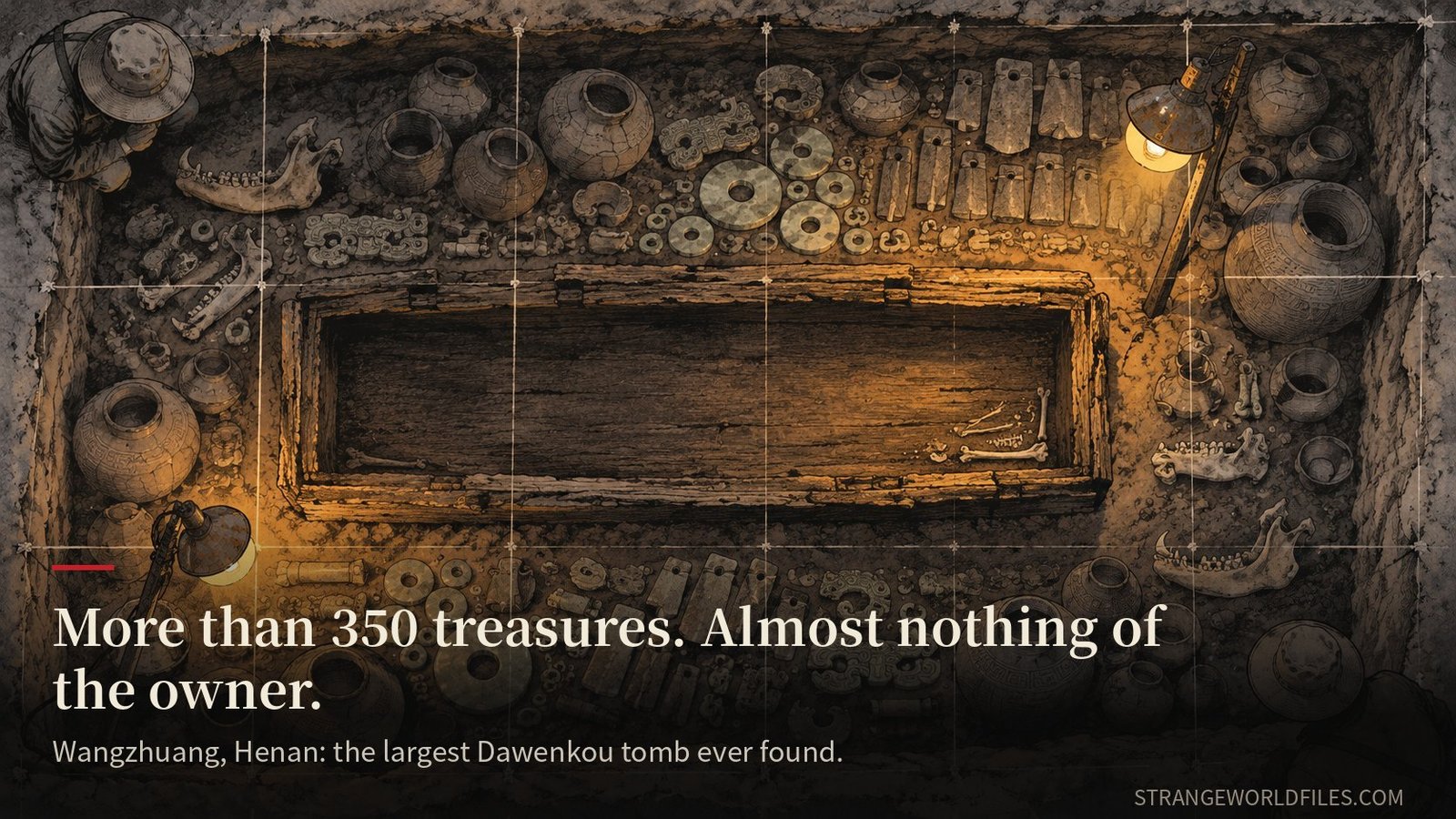
Yongcheng, Henan province, central China. A grave about the size of a small bedroom, dug some 5,000 years ago. The archaeologists call it M27.
Around the coffin, more than 350 objects: over a hundred clay pots, nearly two hundred pieces of jade, bone tools, and rows of pig jawbones, which in that world meant wealth. Two wooden coffins, one inside the other. Nothing about it is modest. (XINHUA) (XINHUACN)
Inside the inner coffin, almost nothing. Most of the skeleton is missing. A few toe bones are all that is left of whoever was buried there. (SIXTHTONE)
The team believes the owner was the ruler of an ancient kingdom. Somebody, long ago, came back for him. They stepped over a fortune in jade and carried away the one thing in the grave that could not be sold.
So this is not a story about tomb robbers. It is about a stranger question: who takes a king and leaves his treasure? To see how odd that is, start with a pond.
A village pond, and the toy nobody recognised


Wangzhuang is a village near the city of Yongcheng. For most of a century its ground had been trying to tell people something.
In 1958 a farmer digging a lotus pond found a square stone tube. It was given to a child as a toy, fell into a manure pit, and was later sold for 27 yuan. It was a prehistoric jade cong, a ritual object thousands of years old. (ZHU)
In the early 1990s villagers turned up jade and painted pottery. Treasure hunters arrived. The police stopped the digging, and the ground went quiet again.
Then, in late 2021, workers tidying the village pond found a batch of jade on its south bank. This time archaeologists came: the Henan Provincial Institute of Cultural Heritage and Archaeology and Capital Normal University in Beijing, working together there since 2023. (ZHU) (SCMP) (XINHUA)
They had expected a cemetery. What lay under that pond was bigger than anyone expected.
Why a grave this size should not exist
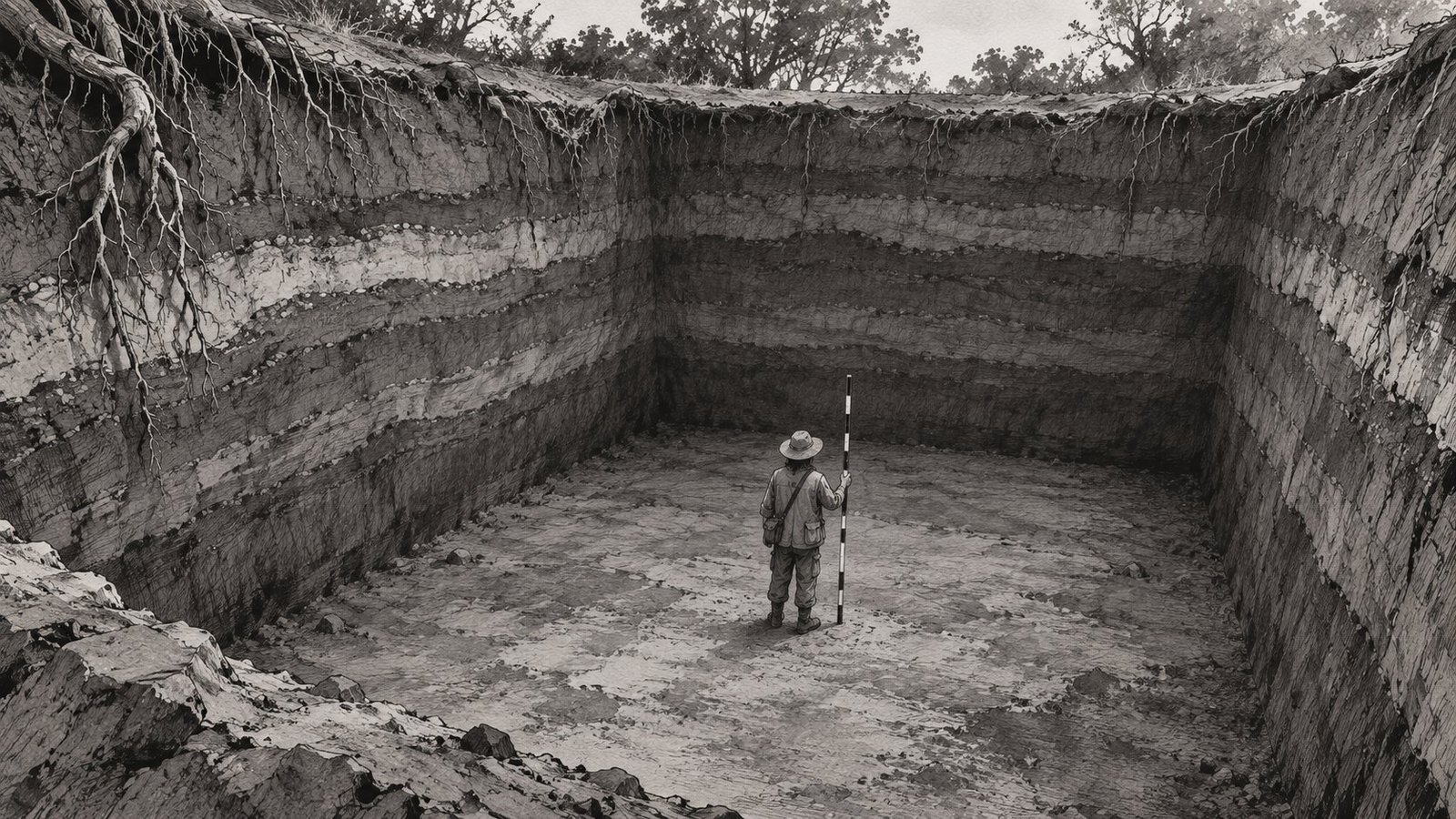
The tomb covers more than 17 square metres: between 4.52 and 4.8 metres long and between 3.47 and 3.68 metres wide. It held an outer coffin and an inner one, both of wood. (XINHUACN)
In the Dawenkou culture, which flourished in eastern China roughly 6,000 to 4,500 years ago, few graves come anywhere close. The excavation leader, Zhu Guanghua of Capital Normal University, called the tomb “unique” for its size and for the number of precious objects inside it. (XINHUA) (SIXTHTONE)
Size alone would make M27 important. It was also full.
Pig jaws, painted pots and a measure of power
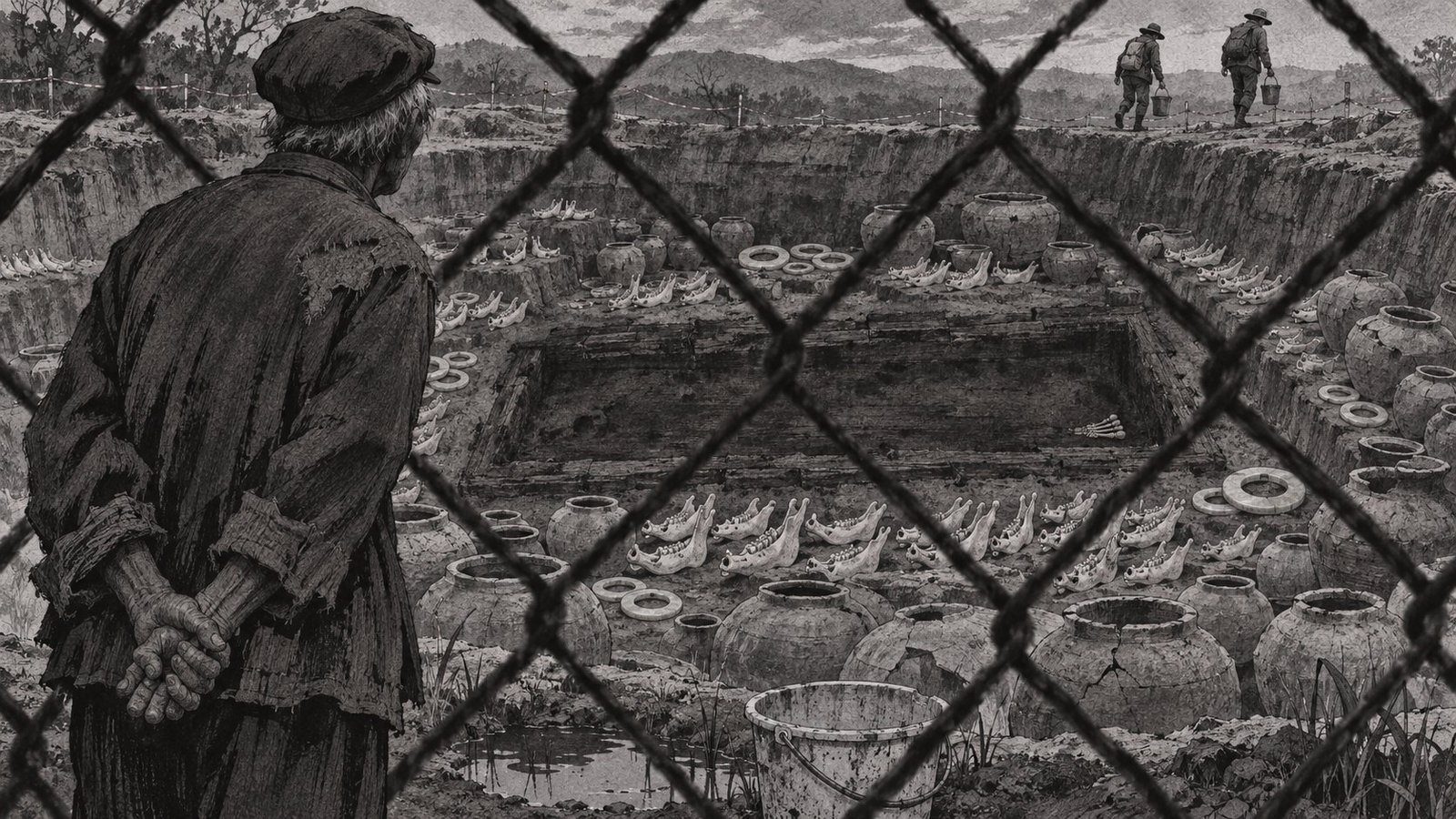
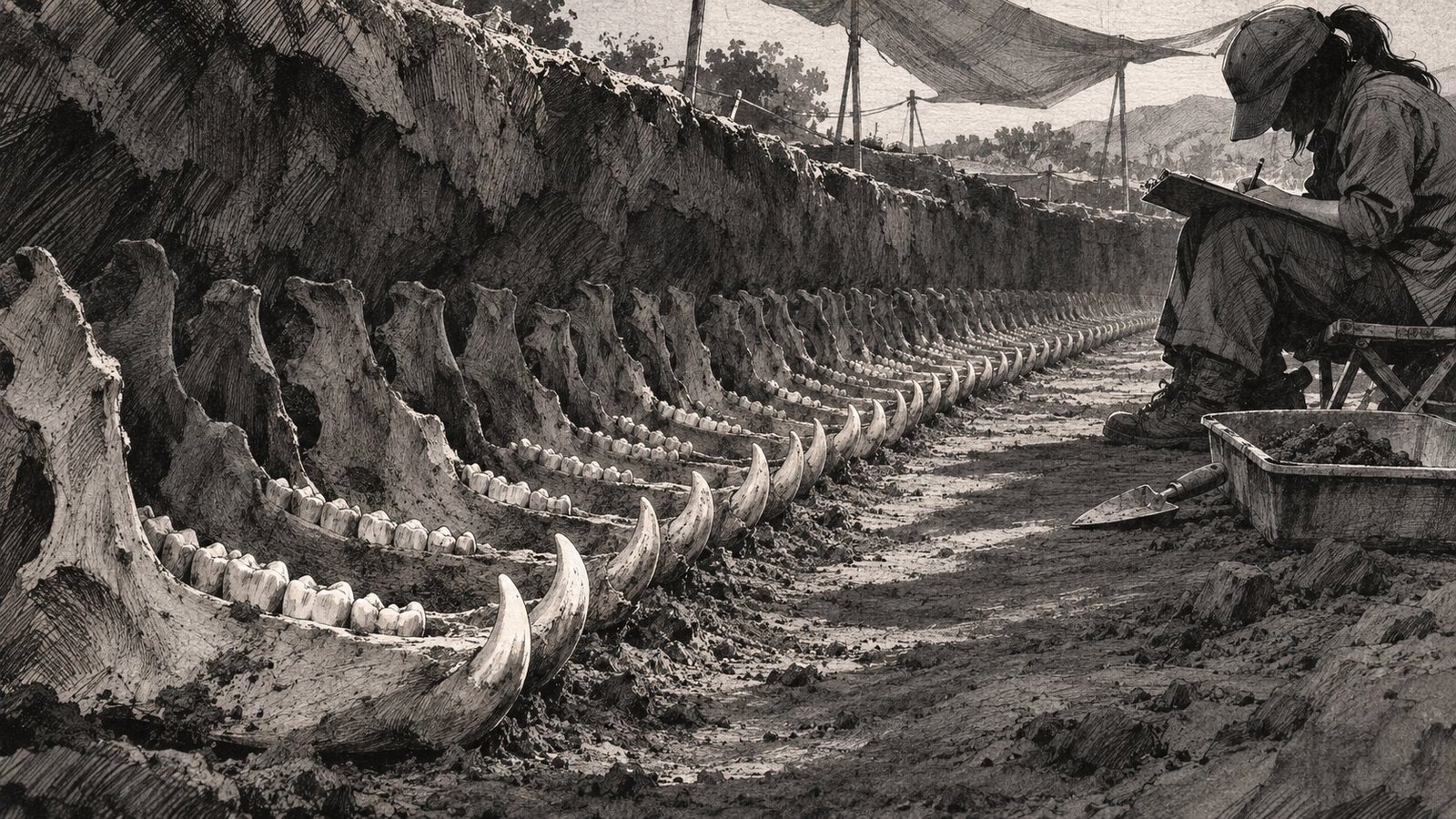
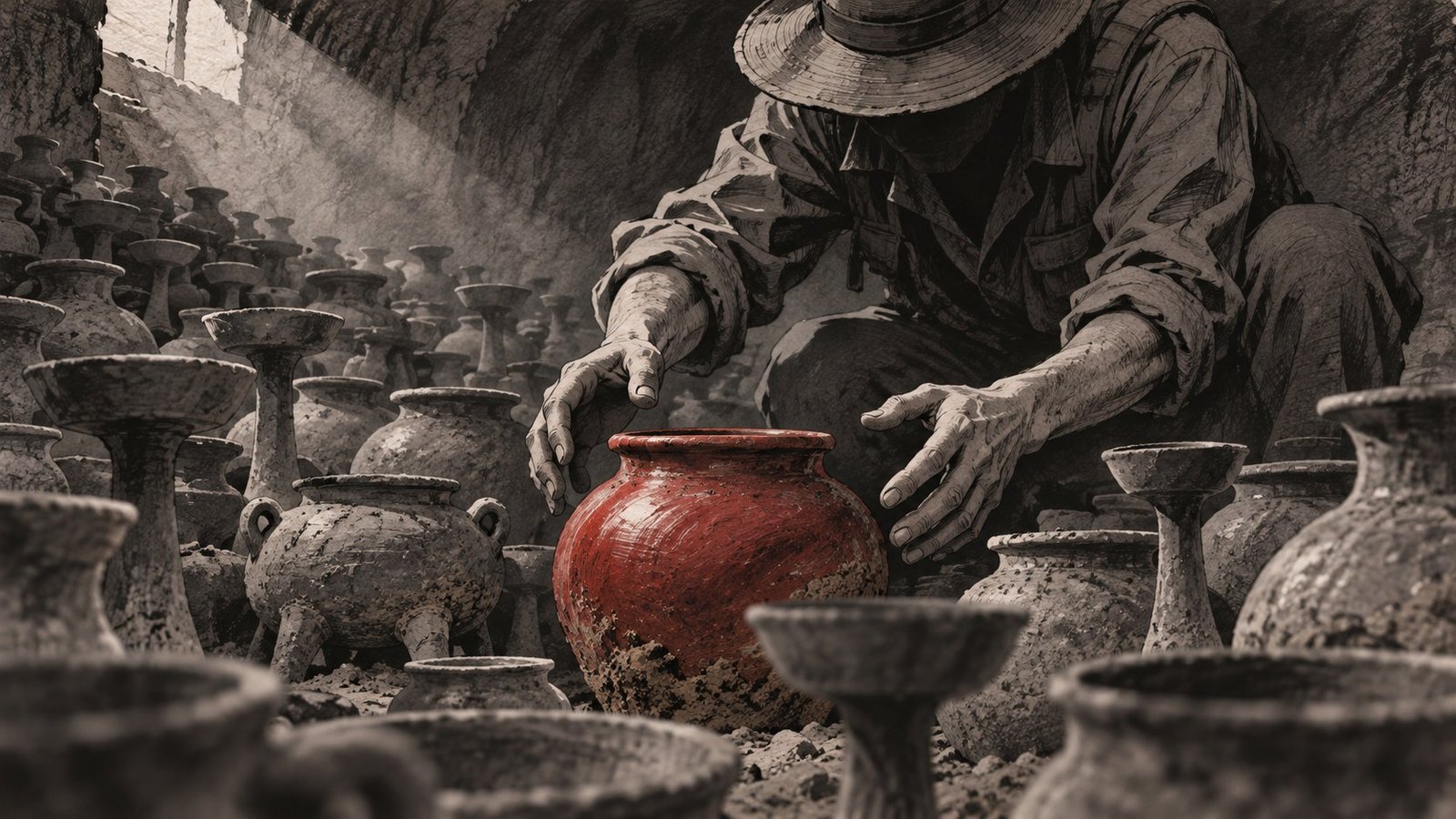
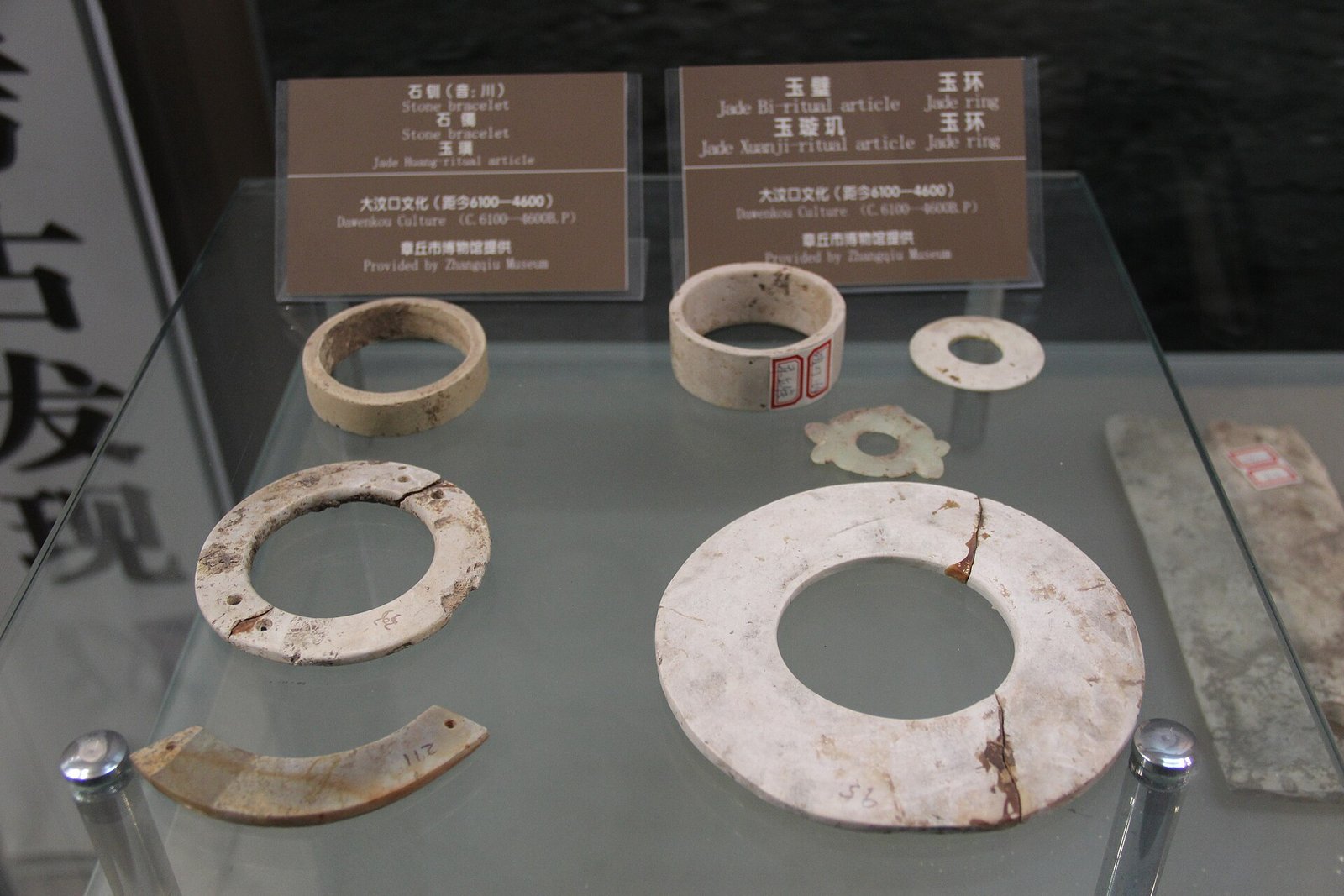
Pig jawbones were buried in the tomb. In Dawenkou graves they are a mark of wealth: the more jaws, the richer the dead. (XINHUA)
The pottery tells its own story. Some of the vessels, such as small-mouthed pointed-bottom jars, belong to the Yangshao tradition, another culture of the region. Two worlds, side by side in one grave.
The richness of a burial was closely tied to its size, said Liu Haiwang, leader of the joint team. At Wangzhuang, that link marks out a society with rulers at the top. (XINHUA)
And some of what lay around the coffin had travelled a very long way.
Goods from three cultures, hundreds of kilometres apart
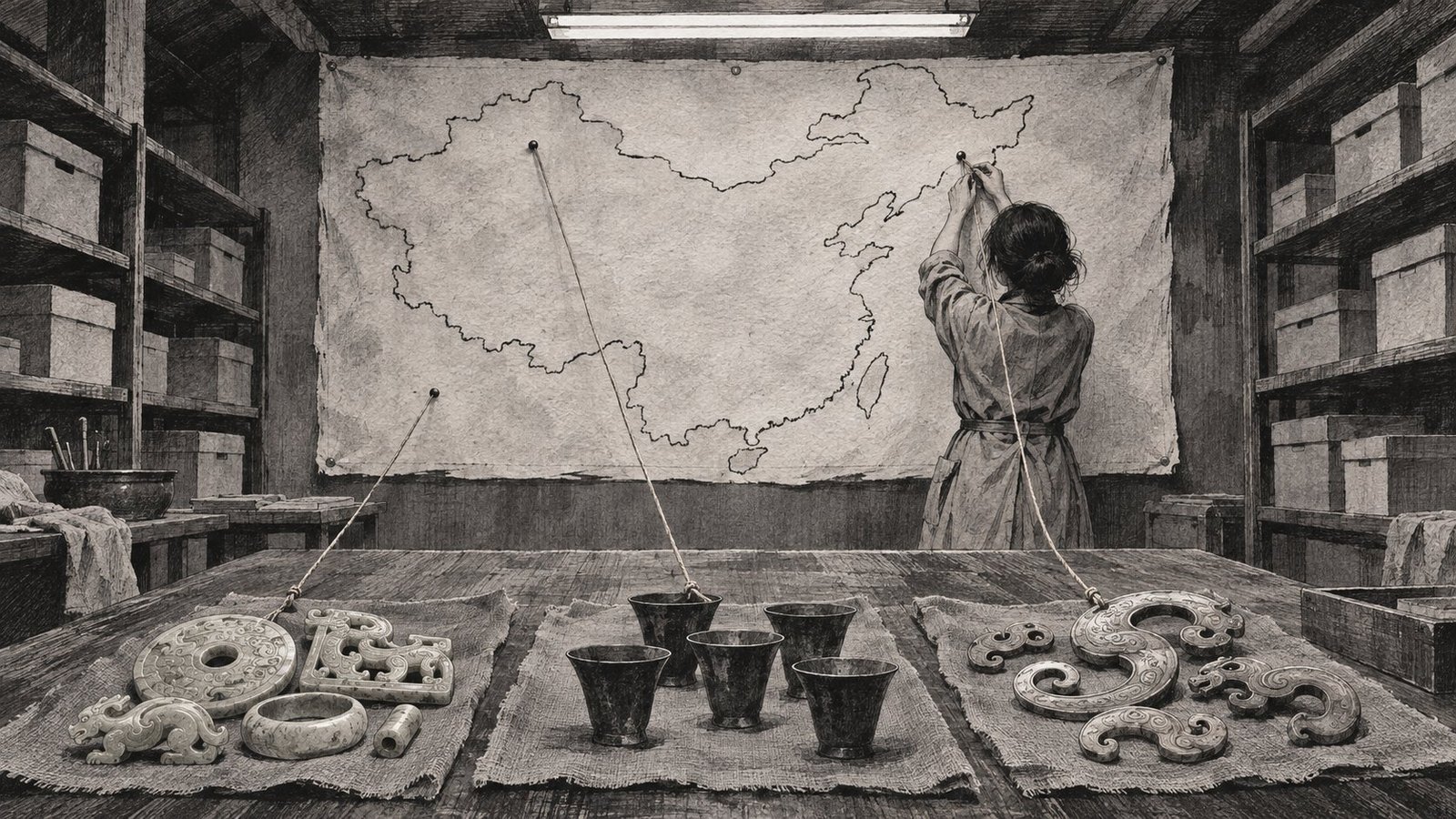
Objects in the tomb were traced to other cultures: the Liangzhu culture of the lower Yangtze, the Qujialing culture of the middle Yangtze, and the Hongshan culture of the Liao River basin in the far northeast. (SIXTHTONE)
“The ancient residents were clearly influenced by the cultures of the eastern and the central regions,” said Li Xinwei of the Chinese Academy of Social Sciences. (XINHUA)
A person who could gather things from that far away, five thousand years ago, was not an ordinary villager. That is the case for calling him a king.
But the most startling jade at Wangzhuang was not in this tomb at all.
The jade face that was in the wrong grave


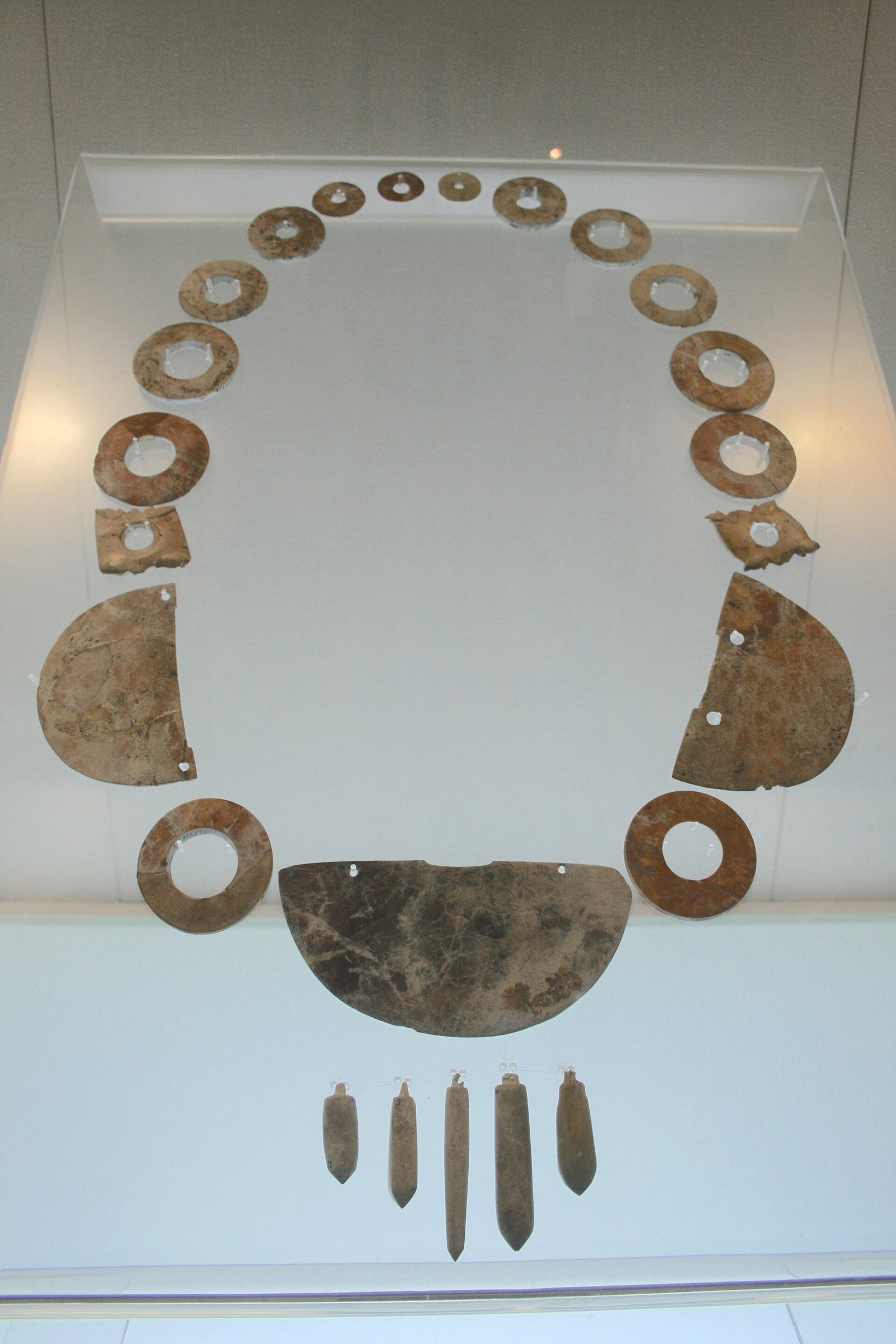
Nearly two hundred small jade ornaments came out of M27. Yet the most famous jade at Wangzhuang came from a smaller grave in the same cemetery, dug in 2023. (ZHU)
There, over the skull, lay more than 30 pieces of jade and turquoise: discs, beads and thin plates covering the forehead and face. Two jade discs sat exactly over the eye sockets. It was not a solid mask. It was a face assembled piece by piece on the dead. Chinese archaeologists call it the earliest jade face covering known from Neolithic China. (ZHU) (KNEWS)
Here the story you may have read and the record part ways. Some English reports placed this mask inside the king’s tomb. The excavation leader’s own account places it in the other grave, numbered IVM6.
The cemetery also produced sets of gui, flat pointed tablets used in ritual. English coverage calls them jade. The excavators call them stone, and the earliest gui yet found in China. (XINHUA) (ZHU) (KNEWS)
So the neighbours kept their faces. The man in the biggest grave did not even keep his bones.
What was left of the owner


The skeleton should have been the centre of the find. It was gone.
“Most of the skeletal remains inside the wooden coffin are missing,” Zhu said. “Only a few toe bones remain.” Small jade ornaments lay scattered both inside and outside the coffin, as if the contents had been turned over. (XINHUA) (SIXTHTONE)
Here is the strange part. Whoever disturbed the grave took the body and some of the most important objects, but left hundreds of others behind. Robbers do not usually leave the jade. (XINHUA) (ARCHMAG)
It would be natural to stop there and call it a looting that went wrong. The blades say otherwise.
Not stolen. Broken.


Many of the stone ceremonial blades in the tomb had been snapped. Not by the weight of soil over fifty centuries. Deliberately. (XINHUA)
The tomb, the team reports, was badly damaged in antiquity: the owner’s remains were removed and important objects were taken. Researchers think it was destroyed on purpose, not long after the burial. The reason is still being studied. (ARCHMAG)
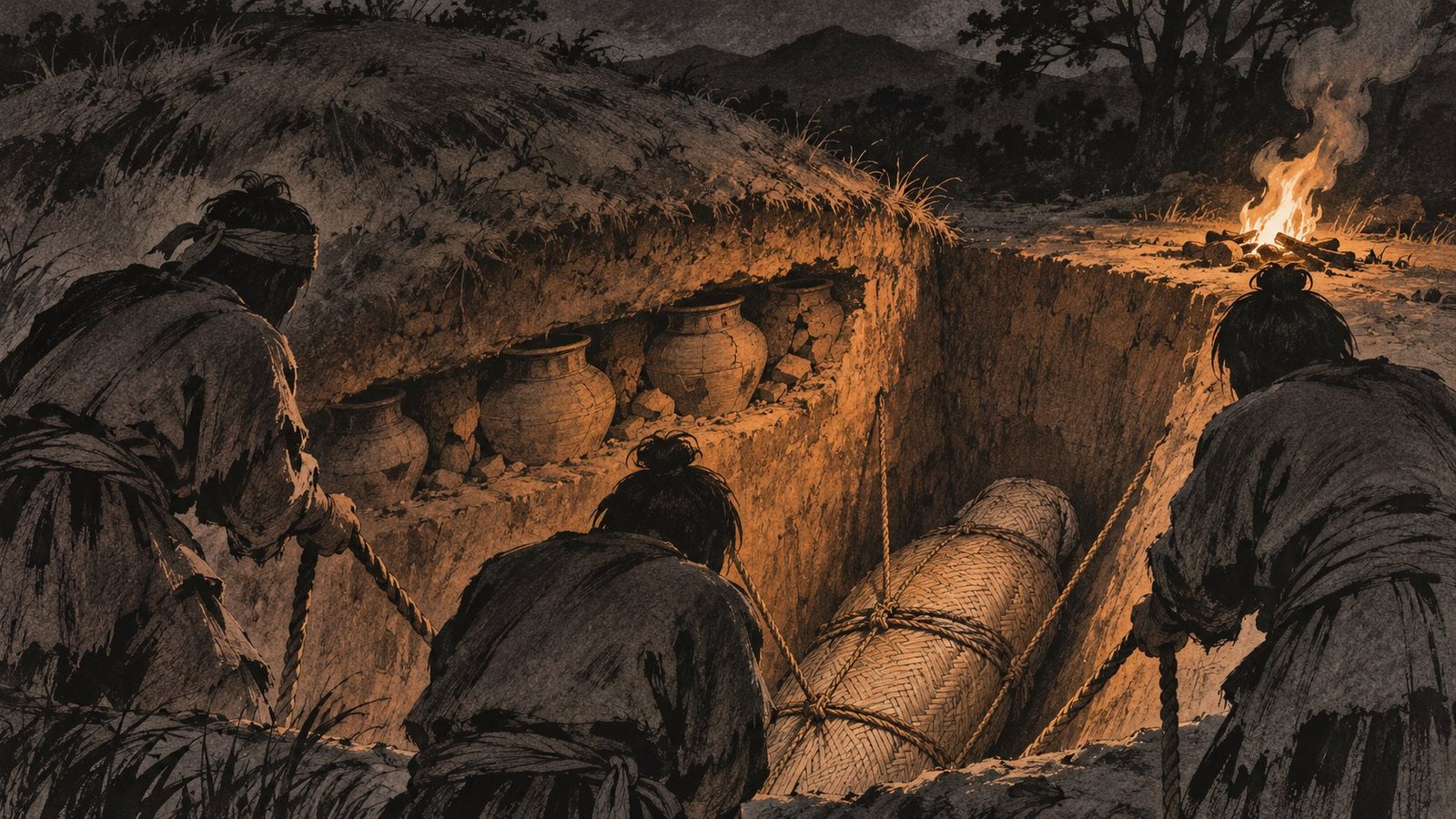
Zhu has suggested that enemies may have done it, and may have taken the body away. That is an idea, not a finding. The second picture here imagines that night; nobody knows who was there. (SIXTHTONE)
A thief wants the jade. Whoever did this wanted the man, and wanted his blades to stop working. To see what they were destroying, picture the day it was made.
How the burial may have looked

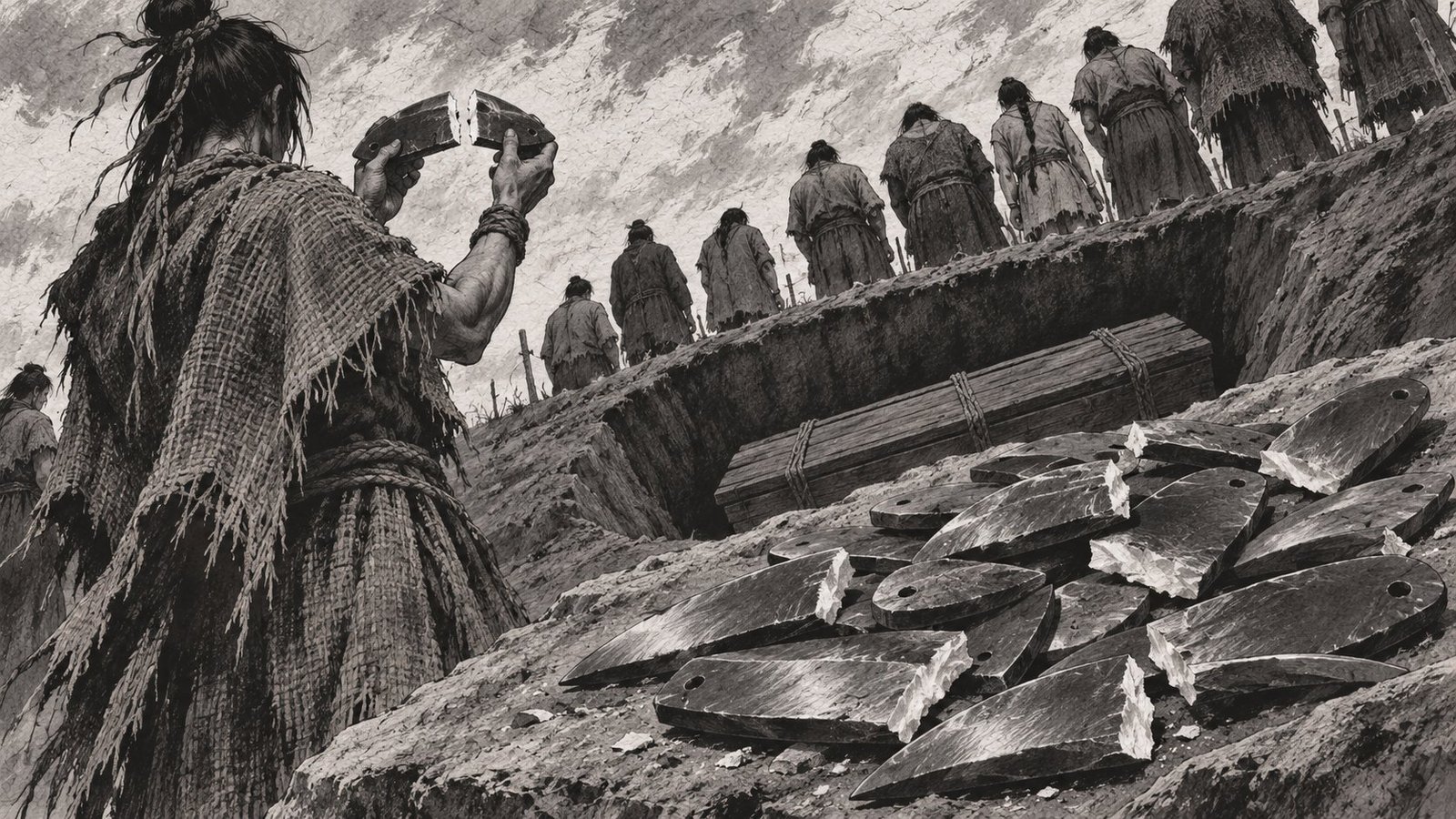
No one saw this funeral. These two pictures are reconstructions: one possible burial procession, and one possible moment when the blades were broken.
What the soil does record: a wooden coffin inside another coffin, pots and jade laid around it, pig jaws, and stone blades found in pieces. Who broke them, and when, is exactly what the team is still trying to work out. (XINHUA)
There is one more reason the destruction stands out. This cemetery had its own, gentler way of opening a grave.
The cemetery that reopened its own graves, carefully
Elsewhere in the cemetery the team found something no other Dawenkou site has shown. In several rows, later gravediggers deliberately cut into an earlier grave, left the first person’s bones and goods where they lay, and buried a new body on top. The two layers sit almost exactly over each other. (ZHU) (KNEWS)
Zhu thinks the people stacked this way may have been related. That is a custom, carried out with care.
What happened to the big tomb was something else: one grave, singled out and wrecked. In a place where people opened graves gently to add their own dead, somebody opened this one to take a man out.
And that one grave is only the beginning.
Forty-five tombs in a single year

The king’s tomb is one of many. In 2024 alone the team found 45 Dawenkou tombs at Wangzhuang and excavated 27 of them. More than 1,000 pieces of pottery and jade came out of the site that year. (XINHUA)
Some of the higher-ranking graves also held many objects and pig jaws. The dead show customs linked to the eastern Dawenkou heartland, such as burying the teeth of water deer and deliberately reshaping the back of the skull. (XINHUA)
All of it sits inside something far larger.
A few hundred square metres of a 630,000-square-metre question


Zhu does not think Wangzhuang was an ordinary village. He calls it the capital of a prehistoric kingdom. (ARCHMAG)
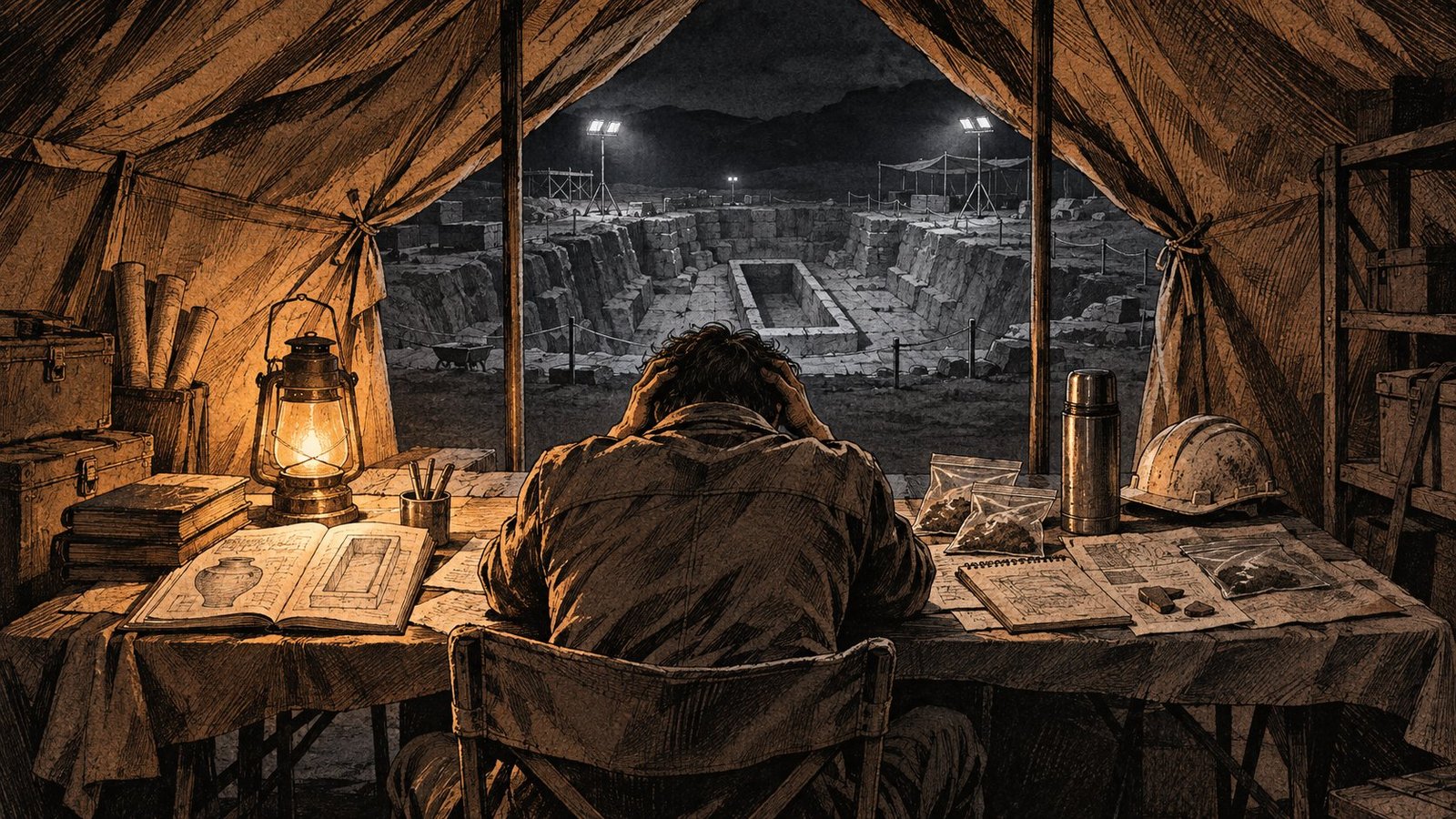
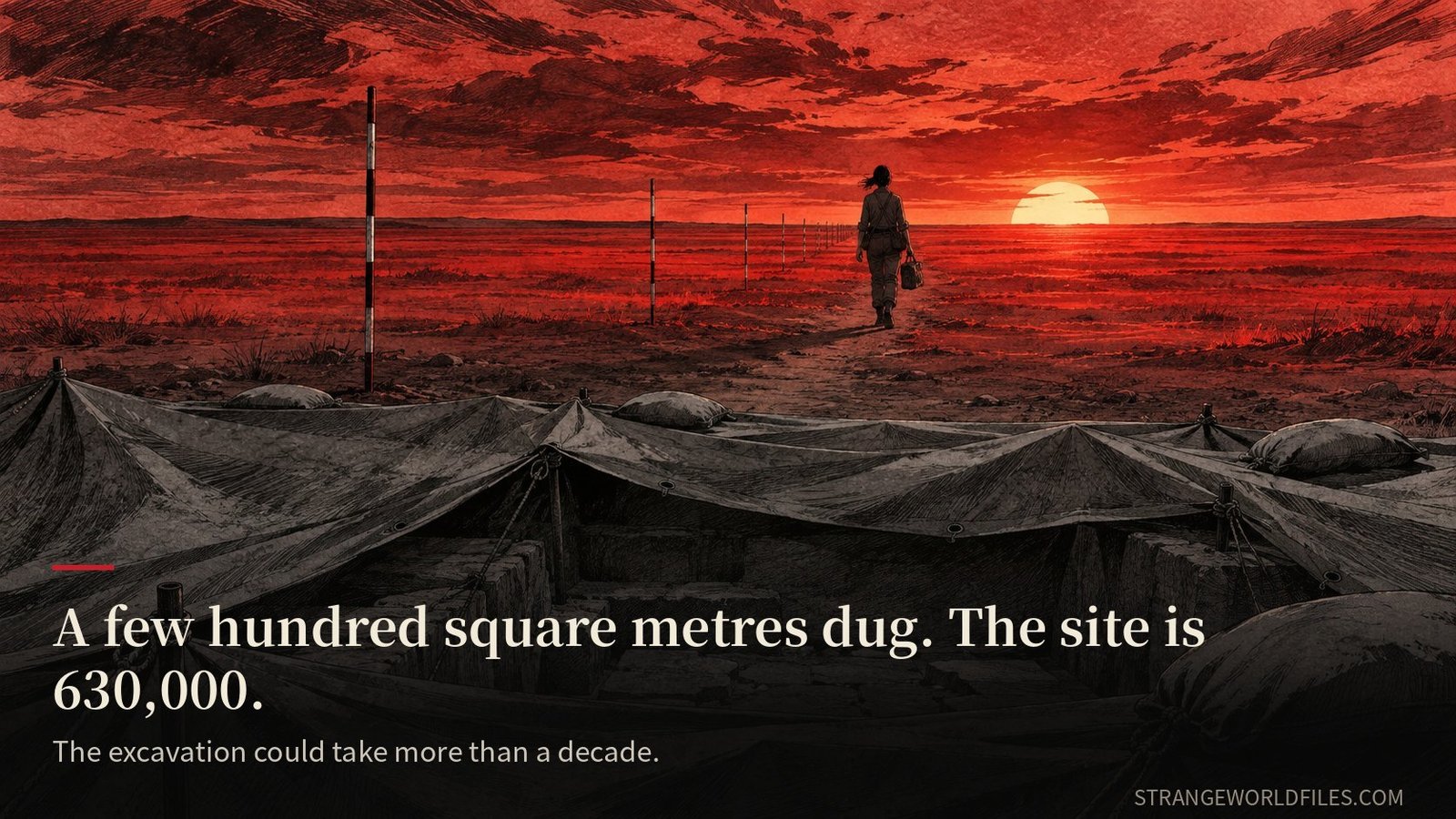
The settlement covers at least 630,000 square metres. So far, only a few hundred square metres have been dug. The cross-section above is imagined: nobody yet knows what lies under the rest. (SIXTHTONE)
Zhu estimates the excavation could take more than ten years. Every season could change the counts in this file, and the excavators say so themselves.
Which brings it back to the empty coffin.
The story you may have heard, and what the file says
| What gets repeated | What the record says |
|---|---|
| A 5,000-year-old king was found wearing a jade mask | The jade face covering came from a smaller grave, IVM6, dug in 2023. The excavation leader places it there, not in M27. (ZHU) |
| Tomb robbers looted the grave | More than 350 objects, including nearly 200 jade pieces, were left behind. What was taken was the body and a few key items, and the blades were broken on purpose. (XINHUA) (ARCHMAG) |
| The tomb held jade gui tablets | The excavators describe the gui as stone, and call them the earliest yet found in China. Only some English coverage says jade. (XINHUA) (ZHU) |
| It is the tomb of a king, the largest Dawenkou tomb ever | Xinhua’s Chinese report says the owner is “presumed” to be the ruler of an ancient state, and calls M27 “one of” the largest. The excavators keep the hedge. (XINHUACN) |
| Enemies dug him up and carried him off | That is Zhu Guanghua’s suggestion for what happened, offered as a possibility. The team says the reason for the destruction is still being studied. (SIXTHTONE) (ARCHMAG) |
Why the record is stranger than the legend: the legend needs a looting, and a looting is the one thing the ground rules out. Thieves take jade and leave bodies. At Wangzhuang someone did the reverse, and then stopped to break the blades. The careful hedges in the Chinese reports, “presumed” ruler, “one of” the largest, do not make the case smaller. They make the one certain fact stand out more sharply: the richest grave of its culture, and the man inside it is gone.
A king without a body

Here is what we know. Around 5,000 years ago, someone powerful was buried at Wangzhuang in the richest grave of his culture, with goods from far away.
Soon after, someone opened that grave, broke the ceremonial blades, scattered the jade, and took the body, along with some of the most important objects. More than 350 others stayed in the ground.
Robbers usually come for valuables. Here, someone also carried away the dead man himself.
How sure is each part? The size of the tomb, the two coffins and the object counts come from the excavators. The missing body comes from Xinhua’s English report and a 2026 Chinese documentary. The enemy raid is one archaeologist’s idea, and he says so. (XINHUA) (DOC) (SIXTHTONE)
So who wanted the king himself, and why?
Related cases: Qin Shi Huang’s tomb and its terracotta army; the Sanxingdui bronze masks, burned and buried on purpose; the burial jars on Laos’s Plain of Jars.
The evidence file
The reports this case rests on, and what each one supports.
Exhibits
- Exhibit A: The Xinhua report, October 2024. Tomb size (4.52 to 4.8 m by 3.47 to 3.68 m), inner and outer coffins, more than 350 objects, nearly 200 jade ornaments, more than 100 pots, pig jaws, only a few toe bones left, blades deliberately broken, 45 tombs found in 2024. Quotes from Zhu Guanghua, Liu Haiwang and Li Xinwei. (Xinhua via China Kongzi)
- Exhibit B: Sixth Tone’s report. Zhu Guanghua’s direct comments, the idea that enemies may have taken the body, links to the Liangzhu, Qujialing and Hongshan cultures, and a settlement of at least 630,000 square metres. Its wording on the jade mask, the “jade gui” and “reburial” differs from the Chinese accounts. (Sixth Tone)
- Exhibit C: Archaeology Magazine, 25 October 2024. Summary of the Xinhua report: the toe bones, the scattered jade, the broken blades, and Zhu’s view that Wangzhuang was the capital of a prehistoric kingdom. (Archaeology Magazine)
- Exhibit D: The excavation leader’s own account, May 2024 (in Chinese). Zhu Guanghua on the finds of 1958, the early 1990s and 2021, the jade face covering from grave IVM6 (more than 30 pieces, two discs over the eye sockets), the stone gui, and the custom of digging new graves into old ones. (Sina News)
- Exhibit E: Xinhua’s Chinese report, 14 October 2024. The tomb number M27, coffin and outer chamber, and the cautious wording: “presumed” to be the tomb of the ruler of an ancient state, and “one of” the largest. (Xinhua)
Limits: no full excavation report has been published yet, so object counts may change as the work goes on.
Quick answers: the Wangzhuang tomb
What was found in the Wangzhuang tomb in Henan?
A roughly 5,000-year-old Dawenkou-culture tomb, numbered M27, of more than 17 square metres, with inner and outer wooden coffins and more than 350 objects: about 200 jade ornaments, over 100 pots, bone tools and pig jaws. Almost none of the owner’s skeleton survived.
Who was buried in the Wangzhuang tomb?
Nobody knows his name. The excavation leader, Zhu Guanghua, says the owner was certainly a member of the elite. Chinese reports presume he was the ruler of an ancient state of the middle to late Dawenkou period.
Why is the Wangzhuang tomb almost empty of bones?
The grave was badly damaged in antiquity, probably soon after the burial. The owner’s remains were removed and only a few toe bones were left. Researchers are still studying who did it and why.
What is a little-known fact about the Wangzhuang tomb?
The famous jade mask did not come from the king’s tomb. It came from a smaller grave nearby and was not a solid mask: more than 30 pieces of jade and turquoise laid over the face, with two discs over the eyes.
Case notes: the king who was taken from his own tomb
A 5,000-year-old tomb at Wangzhuang in Henan, the richest of the Dawenkou culture, was found with more than 350 objects around a coffin that held only a few toe bones. It was deliberately damaged soon after the burial (XINHUA) (SIXTHTONE).
Where the case stands (as of November 2026)
Open. Excavation at Wangzhuang continues, and the team expects it to take more than a decade (SIXTHTONE).
No full excavation report has been published yet. The owner’s identity and the reason the tomb was destroyed remain unknown (XINHUA).
Timeline
| When | What happened |
|---|---|
| About 5,000 years ago | A powerful person is buried at Wangzhuang in a two-coffin tomb with more than 350 objects (XINHUA) |
| Soon after | The tomb is deliberately damaged: the body is removed, important objects taken, jade scattered, blades broken (XINHUA) (ARCHMAG) |
| Same period | In other rows of the cemetery, new graves are deliberately dug into older ones (ZHU) |
| 1958 | A farmer digging a lotus pond finds a jade cong, later sold for 27 yuan (ZHU) |
| Early 1990s | Villagers dig up jade and painted pottery; police stop the digging (ZHU) |
| Late 2021 | Workers tidying the village pond find a batch of jade (ZHU) (SCMP) |
| 2023 | A jade face covering of more than 30 pieces is found in grave IVM6 (ZHU) (KNEWS) |
| 2023 | A joint team from the Henan Provincial Institute of Cultural Heritage and Archaeology and Capital Normal University begins work (XINHUA) |
| 2024 | 45 Dawenkou tombs found, 27 excavated; the king’s tomb is announced (XINHUA) |
Where the records disagree
| Detail | What sources say |
|---|---|
| Number of objects in the tomb | More than 350 (Xinhua); 300 so far (Sixth Tone); more than 500 (a 2026 Henan television documentary notice) (XINHUA) (SIXTHTONE) (DOC) |
| King, or presumed ruler | English headlines say king, even first king; Xinhua’s Chinese report says the tomb is presumed to be that of the ruler of an ancient state (SCMP) (XINHUACN) |
| Largest, or one of the largest | Some English reports say the largest Dawenkou tomb; Xinhua’s Chinese wording is one of the largest (XINHUACN) |
| Where the jade mask was found | Sixth Tone reads as if it came from the big tomb; the excavation leader places it in grave IVM6, dug in 2023 (SIXTHTONE) (ZHU) |
| The gui tablets | Jade (Sixth Tone); stone (the excavators) (SIXTHTONE) (ZHU) |
| The missing body | Reported in Xinhua’s English text in 2024; not in its Chinese text that year; confirmed in Chinese by a 2026 documentary notice (XINHUA) (XINHUACN) (DOC) |
| Date range of the site | Dawenkou culture, 4000 to 2600 BC (Xinhua); about 4300 to 2500 BC (Sixth Tone) (XINHUA) (SIXTHTONE) |
| Who damaged the tomb | Under study (Xinhua); possibly enemy forces, in Zhu’s view (Sixth Tone) (XINHUA) (SIXTHTONE) |
What we still don’t know
- Who the owner was, and what he was called.
- Who opened the grave, took the body and broke the blades, and why.
- How the far-away objects reached Wangzhuang: trade, gifts or war.
- What lies in the rest of the 630,000-square-metre site, almost all of it still unexcavated.
Editor’s note
What I most want to know is where they took him. That someone opened the grave and carried off some of the burial goods, I can follow; graves have been robbed for as long as there have been graves. But they went further. They opened the coffin and removed the body itself, and the excavators found the ceremonial stone blades had been broken deliberately, not by time. Whatever happened in that tomb was more complicated than theft.
The reading the archaeologists favour, that this was a political act, a destruction of a dead ruler’s standing, feels plausible to me. Even in death a person’s status can be a problem for someone. But the looting complicates the picture. Were the people who took the body and the people who took the objects the same people, working with one purpose, or two different visits with two different motives, centuries apart? The evidence in the ground cannot yet tell us.
And so the question I keep returning to is the simplest one. Whoever lifted that body out of its coffin five thousand years ago: where did they carry it, and why did it matter to them that it should not stay?
— Strange World Files
Case file summary
- What: One of the largest and richest Dawenkou-culture tombs ever found, with its owner’s body missing
- Where: Wangzhuang, near Yongcheng, Henan province, China
- When: Buried about 5,000 years ago; site found in late 2021, excavated from 2023, tomb M27 announced in October 2024
- Finds: More than 350 objects, including about 200 jade ornaments; a jade face covering came from a nearby grave
- Status: Excavation ongoing
Illustrations are AI-generated artistic interpretations, not photos. No real person is depicted with a recognizable face. Read how we research and illustrate these files.
Sources
- Xinhua, via China Kongzi: “Excavation unearths 5,000-year-old royal tomb amid capital speculation” (October 2024)
- Sixth Tone: “Stunning Tomb Find Sheds New Light on Prehistoric China” (2024)
- Zhu Guanghua (excavation leader): “王庄遗址:礼制内涵丰富的大汶口文化聚落” (Sina News, 13 May 2024, in Chinese)
- Kankanews: Wangzhuang in the final round of China’s top ten archaeological discoveries (21 March 2024, in Chinese)
- Xinhua (Chinese): “河南发现距今约5000年大墓 推测为古国君主墓葬” (14 October 2024)
- South China Morning Post: report on the Wangzhuang tomb (October 2024)
- Henan Radio and Television documentary notice: “沉睡的古国” part one (1 March 2026, in Chinese, via Sina)
- Archaeology Magazine: “Possible Prehistoric Royal Tomb Excavated in Central China” (25 October 2024)