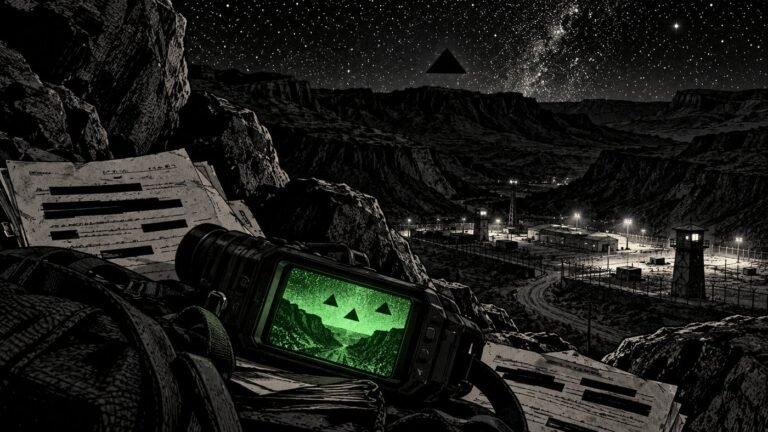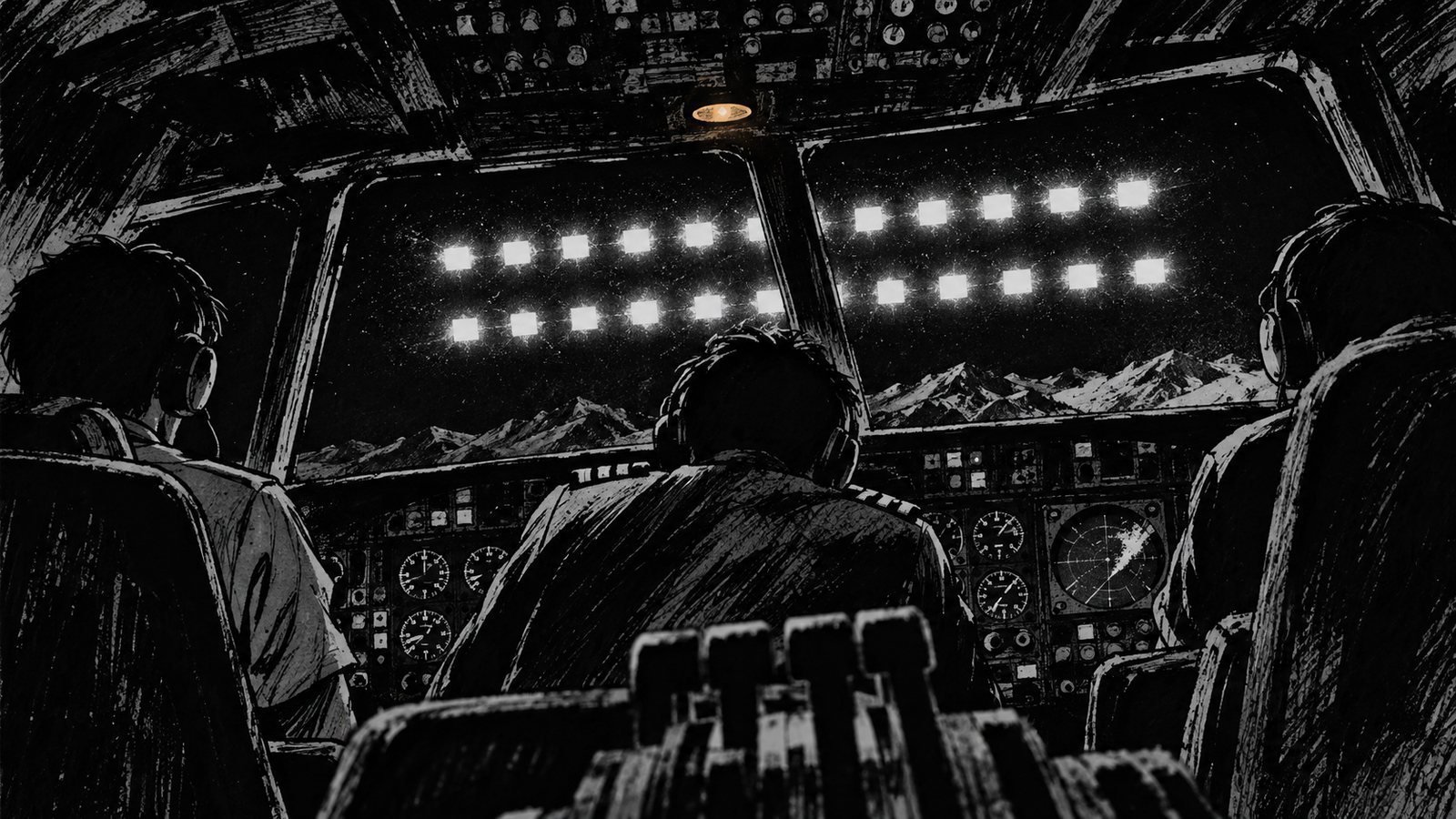
JAL Flight 1628: The Alaska UFO a Pilot Refused to Have Chased

Narrated Mystery: press play and hear the whole case read aloud, like a true crime podcast episode, or an audiobook for a long drive (about 10 minutes). The narrator is an AI voice.
What the record shows
- Who: The three-man crew of Japan Air Lines cargo Flight 1628, a Boeing 747
- When: Monday 17 November 1986, about 5:19 to 5:53 p.m. local time, over interior Alaska
- Status: Radar returns explained by the FAA in March 1987; the lights were never officially identified
Still uncertain
- What the lights were. The FAA never tried to find out.
- What caused the brief military radar returns.
- Whether the captain was taken off flying afterwards.
“Negative, negative”

Why would a pilot who believed something enormous was following his aircraft turn down a fighter escort?
Monday 17 November 1986, early evening, over the Alaskan interior. A Japan Air Lines cargo 747 had been reporting strange lights to Anchorage air traffic control for about twenty minutes. The controller came on the radio with an offer. Would the captain like the military to scramble on the traffic?
The answer came back in four seconds. “Negative, negative.” (FAA-ATC)
Captain Kenju Terauchi explained later, in a written statement for the Federal Aviation Administration, that he did not think even an F-15 would be safe near what he was looking at. (FAA-TER)
No jets launched. What he saw has never been identified. Most of what people believe about that night, though, is not what the record shows.

Wine for Tokyo

Flight 1628 was a Boeing 747 freighter on its way from Paris to Tokyo, with stops at Keflavík in Iceland and at Anchorage. It carried French wine. Terauchi’s statement mentions “special French wine”; news reports at the time said Beaujolais. (FAA-TER) (NEWSMINER) (PG)
There were three men on the flight deck. Terauchi, 47, had been flying for 29 years, according to a United Press International report that week. With him were First Officer Takanori Tamefuji and Flight Engineer Yoshio Tsukuba. The spellings of all three names vary from one FAA document to the next. (PG) (BV)
They were at 35,000 feet, and it was already dark.
“Like two bear cubs”
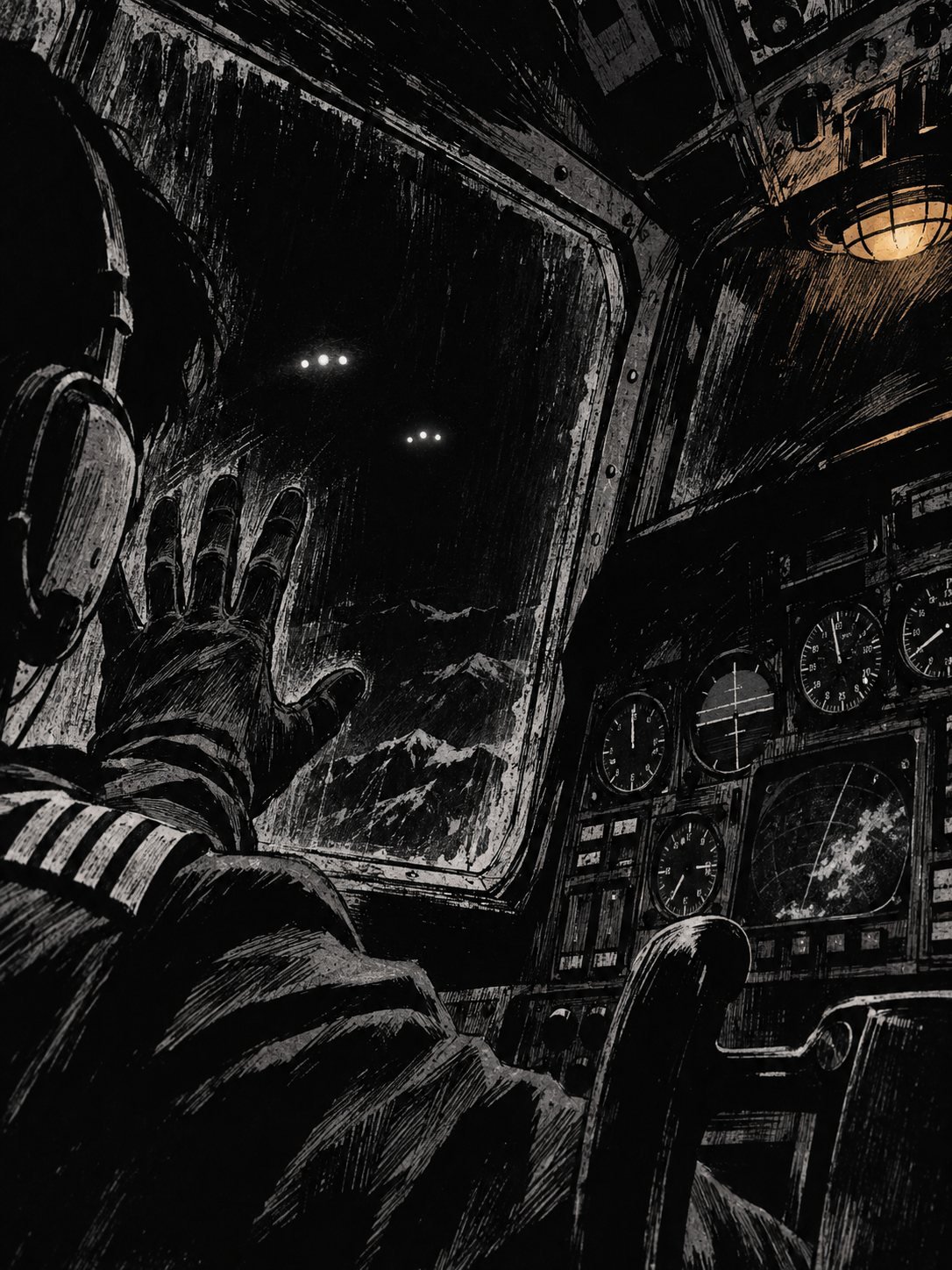
Terauchi wrote that he first noticed lights ahead and to the left, about 2,000 feet below, and took them for aircraft. Then they moved in a way he did not expect. He compared them to “two bear cubs playing with each other.” (FAA-TER)
At 5:19 p.m. he called Anchorage Center and asked whether there was any traffic near him. The controller had none. Terauchi reported traffic about a mile ahead at his own altitude. Asked what he could see, he said navigation lights and strobes. “The color is, ah, white and yellow, I think.” (FAA-CHRON) (FAA-ATC) Objects that one crew can see and the official record cannot account for keep turning up: a House task force took testimony in September 2025, and wrote to the Defense Secretary the following March, about an orb over Yemen that a Hellfire missile appeared to hit without stopping it.
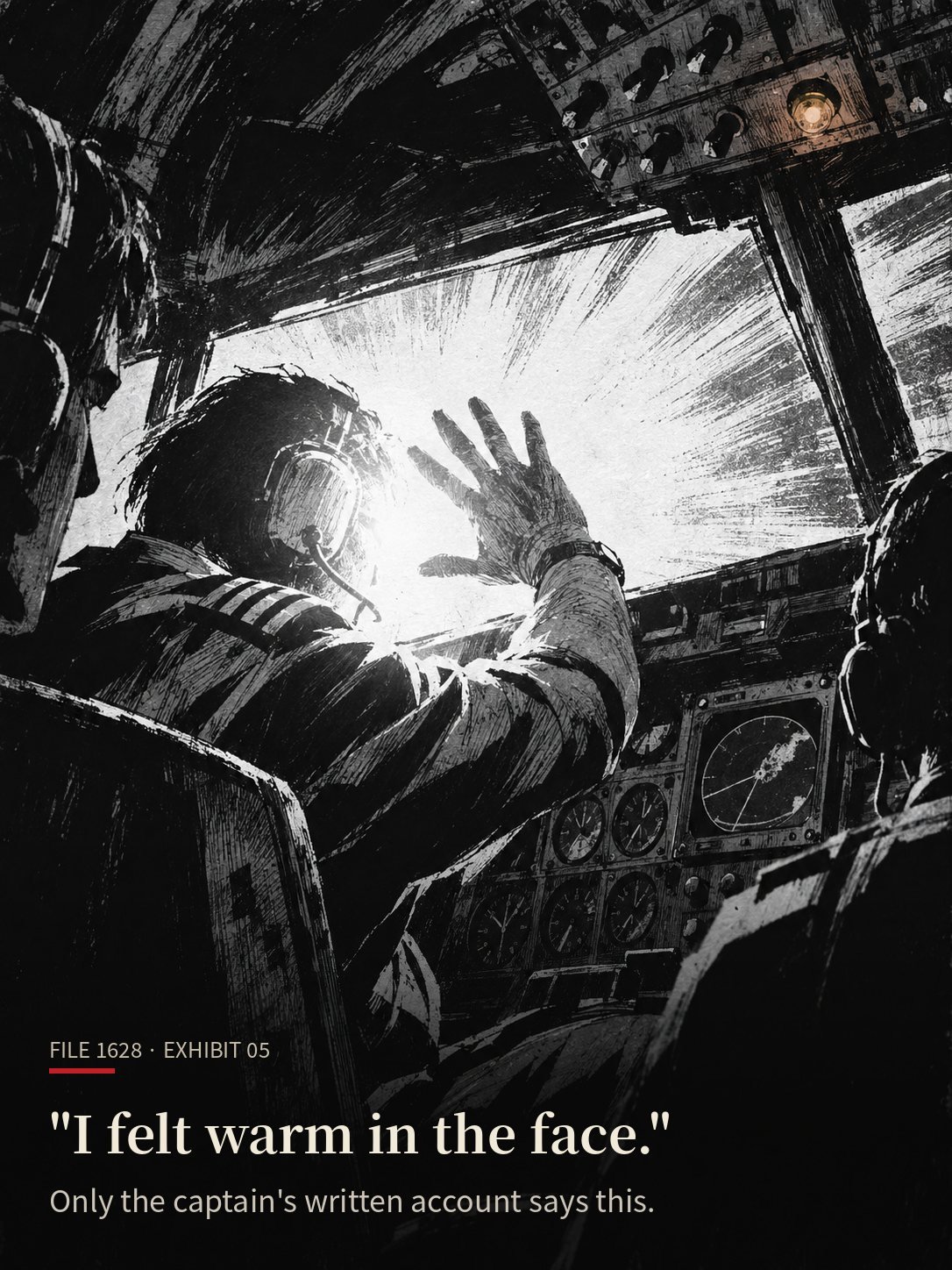
His written account, prepared weeks afterwards, goes much further. The two objects, he wrote, “stopped in front of our face.” The cockpit lit up. “I felt warm in the face.” He described each one as roughly the size of a DC-8’s body, covered in what looked like rows of exhaust pipes. (FAA-TER)
None of that is in the radio transcript. On the air, he reported lights.
So far it was one man’s eyes against an empty radar screen. Then the aircraft’s own radar joined in.
The radar agreed with him. For about a minute
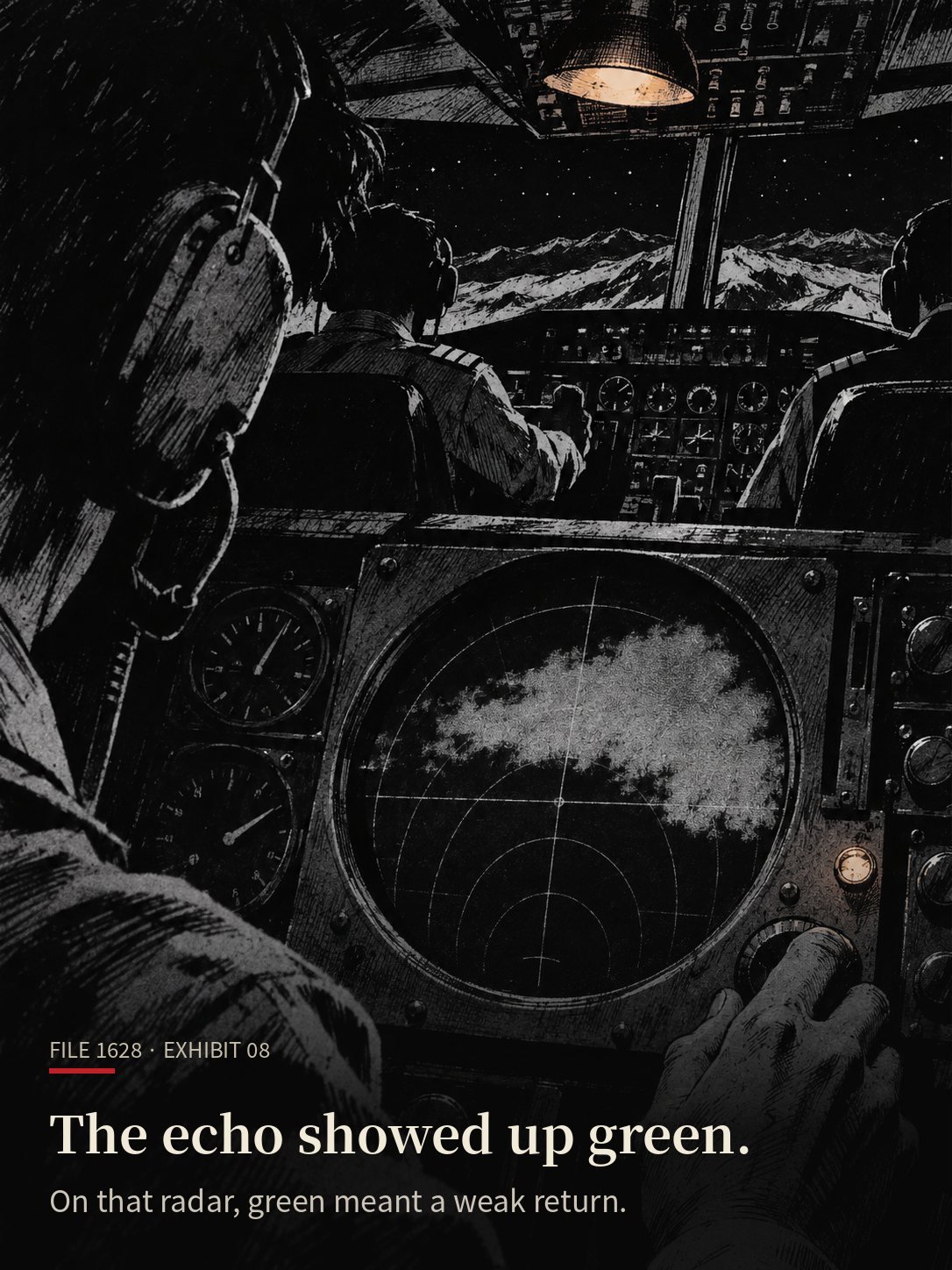
At 5:25 Terauchi told the controller the traffic was now on the 747’s own radar, at eleven o’clock and eight miles. (FAA-CHRON)
In his statement he described that echo as large, green and round. He also added something a sceptic might have written for him: when the radar picks up another aircraft, it normally shows red. (FAA-TER)

Green, on a weather radar of that era, meant a weak return. Air & Space magazine pointed out in 1987 that it is the colour of light rain. Aviation writer Philip Klass argued it fitted thin cloud made of ice crystals. (AIRSPACE) (SKEPTOID)
Anchorage then phoned the military radar centre at Elmendorf Air Force Base. A minute later Elmendorf said it had a faint return about eight miles from the jet. A minute after that, it was gone. (FAA-CHRON)
That could have been the end of it. Then Terauchi looked back over his left shoulder.
The lights turned out to be the small part
Then came the part that made headlines around the world.
Looking back and to the left as the aircraft passed near Fairbanks, Terauchi wrote, he saw “a silhouette of a gigantic spaceship.” He called it the mothership. Press reports gave its size as two aircraft carriers, or twice one carrier, depending on the paper. (FAA-TER) (AIRSPACE) (WIKI)

At 5:31 he told the controller the traffic was “quite big.” At 5:32 he asked to descend, and was cleared from 35,000 to 31,000 feet. He reported that the traffic was coming down with him, “in formation.” (FAA-CHRON)
One full circle: did it follow, or disappear?

At 5:36 the controller asked for a right turn, all the way round, to see whether the traffic would stay with the 747. Terauchi made the turn by hand. (FAA-ATC) (FAA-TER)
What happened during that circle is the most disputed moment of the flight.
Terauchi afterwards said the object stayed with him. The transcript has him saying, at 5:39, “It, ah, disappeared,” and the FAA chronology for the same minute records that he no longer had the traffic in sight. (FAA-ATC) (FAA-CHRON)
While he was turning, Elmendorf reported a “flight of two” at his position, one of them a bare radar echo with no transponder signal. By 5:42 that had dropped away too. (FAA-CHRON)
At 5:40 came the scramble offer and the double negative. Then, at 5:44, Terauchi reported the traffic again, off his left side.
Two more aircraft went to look. Neither saw it

The controller had another idea. A United Airlines flight was heading north out of Anchorage. With the pilot’s agreement, it was turned a few degrees to pass the Japanese jet and take a look. (FAA-CHRON)
The United pilot’s report is on the tape. “The Japan airliner is silhouetted against a light sky. I don’t see anybody around him at all.” (FAA-ATC)
An Air Force C-130, call sign Totem 71, also had the 747 in sight. Its crew reported nothing near it either. (FAA-ATC) (BASIS)
In Terauchi’s account, the timing was no coincidence: “When the United plane came by our side, the spaceship disappeared suddenly.” At 5:53 the controller asked him to confirm that he no longer saw the traffic. “Affirmative.” (FAA-TER) (FAA-ATC)
The 747 landed at Anchorage at about 6:20 p.m. The crew were debriefed by FAA staff after landing. (BV) (WIKI)
The jet was on the ground and the crew had been heard. For about six weeks the story stayed out of the newspapers. Then it got out.
“UFO sighting confirmed.” Then it wasn’t

The story reached the newspapers at the very end of December. Within days, headlines such as this one were running in American papers: “UFO sighting confirmed by FAA, Air Force radar.” (WIKI)
It did not hold. By about 8 January the FAA was saying that the second blip on its own screens looked like a split image of the 747 itself. (BADUFOS)
FAA investigators interviewed the three crewmen separately that month: Terauchi on 2 January, the first officer on 5 January, the flight engineer on 15 January. (BV)
Their accounts did not match the captain’s. Asked whether he could tell the lights ahead from stars, the first officer answered “No.” The flight engineer said he saw lights that were not town lights, but no structure, and was not sure whether it was a UFO. Only Terauchi described a giant craft. (BADUFOS) (DEBRIEF)
On 11 January, flying the same route, Terauchi reported strange lights again. Radar showed nothing. The FAA suggested village lights scattered by thin ice-crystal cloud, and Terauchi reportedly accepted that explanation. (BADUFOS) (WIKI)
The FAA explained the radar, and left the lights alone

On 5 March 1987 the FAA’s Alaskan Region released its file. (FAA-RADAR)
An FAA specialist, Dennis Simantel, had gone through about 61 minutes of recorded radar data. He found nothing in it “that could be associated with any type of target” beyond the 747. The extra returns, public affairs officer Paul Steucke explained, were an “uncorrelated primary and beacon target.” (FAA-RADAR)
In plain terms: ground radar saw the jet twice. One return was the raw echo off its metal skin, the other the reply from its transponder. When the two fall slightly out of step, one aircraft can look like two. Simantel called this “not uncommon.” (FAA-RADAR)
That settled the radar. The lights were another matter, and the FAA left them alone. The agency, Steucke said, “does not have the resources or the Congressional mandate to investigate sightings of unidentified flying objects.” And: “We have not tried to determine what the crew of JAL Flight 1628 saw.” (BV)
The FAA did say one thing about the crew. Its investigators described them as “normal, professional, rational,” with no sign of drugs or alcohol. (WIKI)
That closed the file. It did not close the story.
Evidence box: documented vs. claimed
| What it is | What it supports | Its limits | |
|---|---|---|---|
| Documented | FAA air traffic transcript, 0219–0253 UTC | The crew reported lights for about 34 minutes, descended, circled, and declined a military scramble | Records what was said, not what was there |
| Documented | FAA radar review, 25 Feb 1987, about 61 minutes of data | No separate target near the 747; the extra blip was the jet’s own split return | Covers FAA radar only |
| Documented | Reports from United 69 and an Air Force C-130 | Both saw the 747 and nothing else | They arrived near the end |
| Documented | Crew interviews, January 1987 | The first officer and flight engineer saw lights, not a craft | Taken six to eight weeks later |
| Claimed | Terauchi’s written statement | Two craft with rows of “exhaust pipes,” heat on his face, a “gigantic spaceship” | One witness; written afterwards; not in the radio record |
| Claimed | Brief military radar returns | Something may have been near the jet for a minute or two | Elmendorf doubted the returns itself; the FAA treated them as clutter |
| Claimed | John Callahan’s account of a CIA briefing | A cover-up | No document; two reported attendees do not recall it that way |
Evidence locker
Real photographs and primary records only.
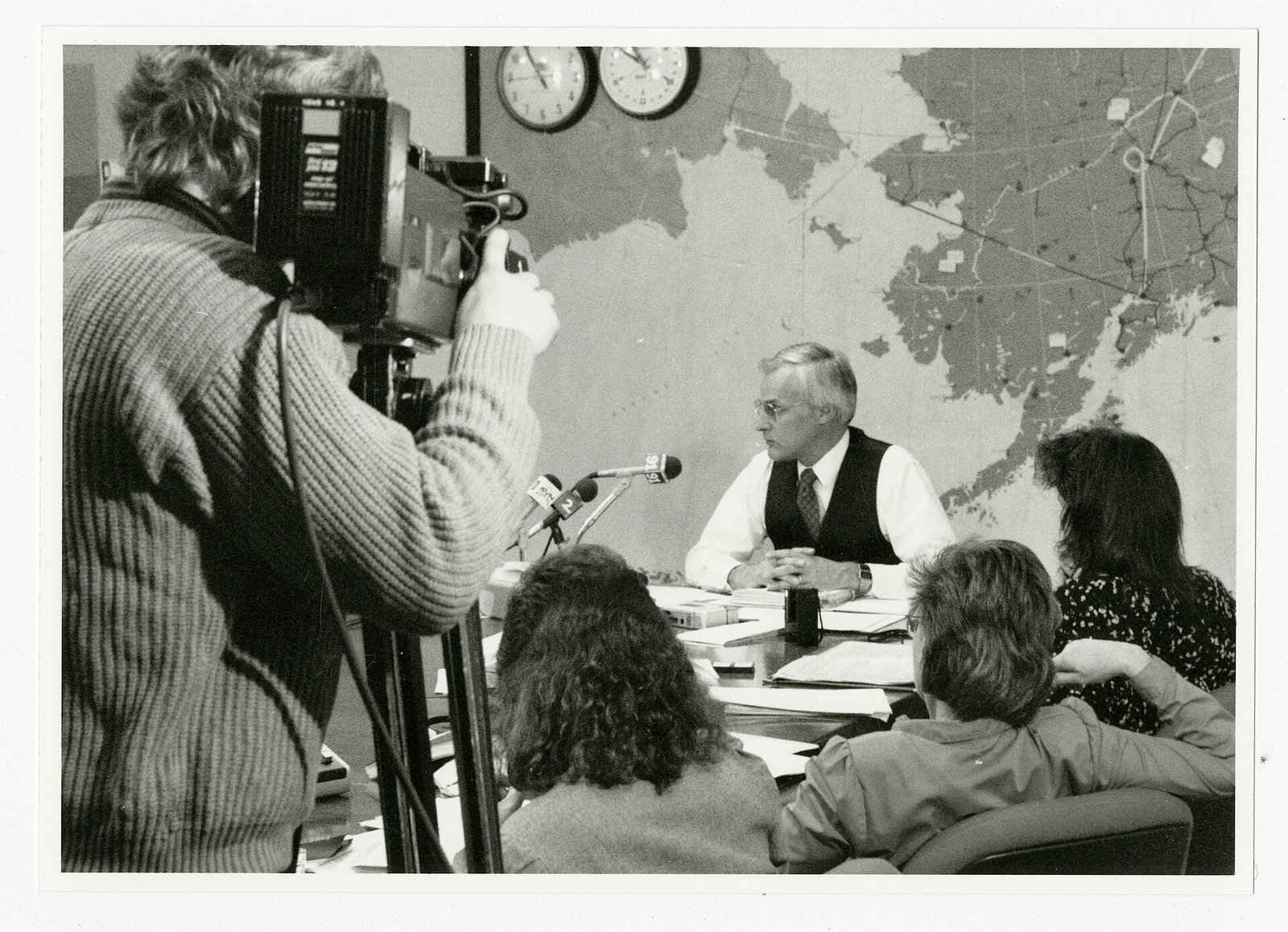 EXHIBIT A
 EXHIBIT B
 EXHIBIT E
 EXHIBIT F
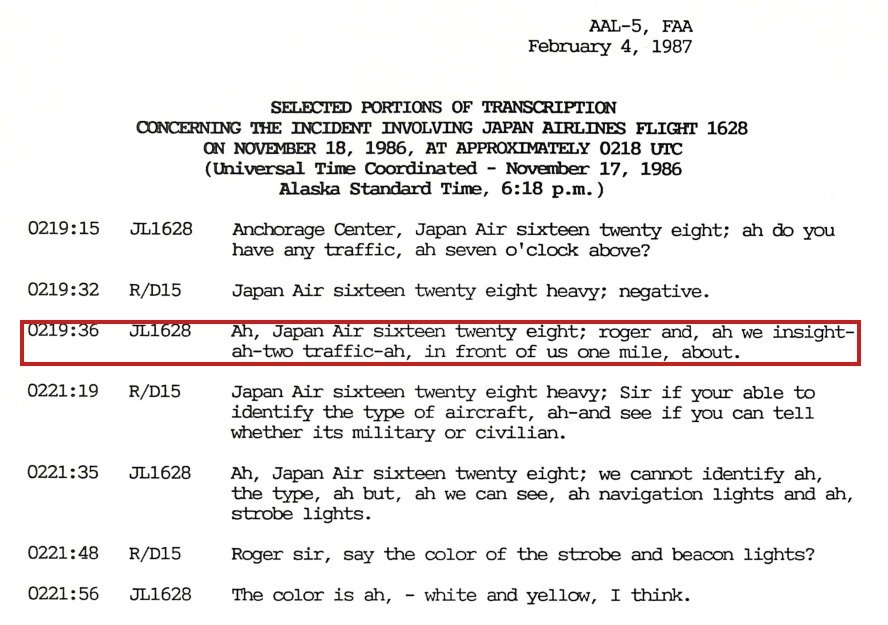 EXHIBIT G
 EXHIBIT H
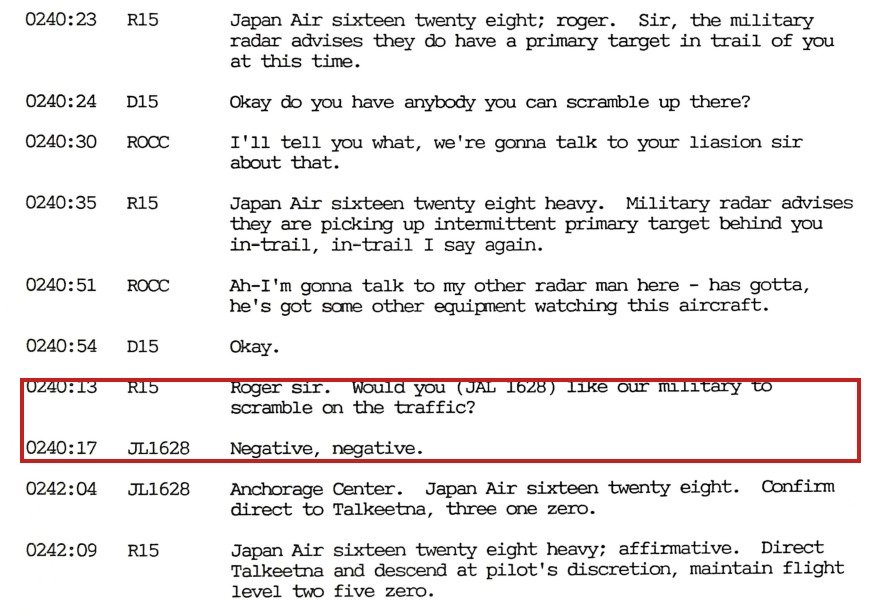 EXHIBIT I
 EXHIBIT J
Timeline
All times Alaska Standard Time, 17 November 1986, converted from the FAA’s UTC log. (FAA-CHRON) (FAA-ATC)
| Time | Event |
|---|---|
| Shortly after 5 p.m. | Terauchi first notices lights, by his own account |
| 5:19 | He asks Anchorage Center about traffic; none on radar |
| 5:25 | Reports the traffic on the 747’s radar, eight miles ahead |
| 5:26–5:27 | Elmendorf has a faint return, then loses it |
| 5:31 | Terauchi calls the traffic “quite big” |
| 5:32 | Descent from 35,000 to 31,000 feet |
| 5:36 | Controller requests a full right-hand circle |
| 5:38 | Elmendorf reports a “flight of two” |
| 5:39 | Terauchi: “It, ah, disappeared” |
| 5:40 | Scramble offered. “Negative, negative” |
| 5:44–5:48 | Traffic reported again, to the left and behind |
| 5:45 | United 69 turned to take a look |
| 5:51 | United: “I don’t see anybody around him at all” |
| 5:53 | Terauchi confirms the traffic is gone |
| About 6:20 | Landing at Anchorage (BV) |
| 29–31 Dec 1986 | First press reports |
| 2, 5, 15 Jan 1987 | FAA interviews the three crewmen (BV) |
| 11 Jan 1987 | Terauchi reports lights again; radar shows nothing |
| 25 Feb 1987 | FAA radar analysis completed (FAA-RADAR) |
| 5 Mar 1987 | FAA releases its file (FAA-RADAR) |
The story you may have heard, and what the file says
Forty years of retelling have changed this case. Here are the claims that travel furthest online, set against the FAA’s own record. The sources for each line are cited in the sections above.
| The popular version | What the record shows |
|---|---|
| All three crewmen described the same craft. | Their accounts did not match the captain’s. Asked whether he could tell the lights from stars, the first officer answered “No.” The flight engineer saw lights but no structure. |
| Civil and military radar confirmed a giant object. | The FAA concluded its second blip was a split image of the 747 itself. The military returns were brief and were never tied to anything solid. |
| Nobody else was in the sky to check. | A United Airlines flight and an Air Force C-130 were steered over to look. Both saw the 747. Neither saw anything near it. |
| The object was hundreds of times the size of the jet. | Terauchi wrote of “a silhouette of a gigantic spaceship.” Press reports gave its size as two aircraft carriers, or twice one carrier. |
| The crew were silenced and disappeared. | One researcher wrote that the captain was grounded and later reinstated. We found no confirmation from Japan Air Lines or from a major newspaper. |
None of that makes the night ordinary. An experienced captain reported something he could not name for more than half an hour, and the agency that held the tapes said plainly that it never tried to find out what he saw. The real file is stranger than the legend, because it leaves the central question open.
The explanations, side by side
Jupiter and Mars. Philip Klass, an editor at Aviation Week and the best-known UFO sceptic of his day, checked the sky. Jupiter was shining at magnitude −2.6 about ten degrees above the horizon, on the captain’s left, where he placed the mothership. Mars was about twenty degrees to its right, and fainter. Klass noted that Terauchi never mentioned seeing a bright planet as well as the object. (BASIS) (BADUFOS)
The weak point: a planet does not light up a cockpit, warm a face, or sit a mile ahead. Physicist and UFO researcher Bruce Maccabee, who studied the FAA file in 1987, rejected the Jupiter answer on those grounds. (MACCABEE) Sceptics reply that those details appear only in the later written statement, not on the radio.
Ice-crystal cloud. Klass suggested thin cloud could account for the weak green radar echo, and possibly for scattered light. It fits the second sighting in January well. For November it is an inference; nobody measured the cloud. (SKEPTOID)
Radar artifacts. This is the strongest of the three, because it rests on recorded data. The FAA’s split-return explanation covers its own radar. The short military returns were never tied to anything solid, and Elmendorf’s operators suspected at the time that they were spurious. (FAA-RADAR) (DEBRIEF)
An unknown craft. Supporters point to an experienced captain, a crew judged rational, and a sighting that went on for more than half an hour through a descent and a turn. Against it: one man described a craft, two aircraft sent to look saw nothing, and the radar confirmation was withdrawn.
A cover-up. John Callahan, who has been described as head of the FAA’s Accidents, Evaluations and Investigations Division in the 1980s, has said since the early 2000s that he briefed CIA officers and White House science staff on the radar data, and that a CIA man told the room: “This event never happened; we were never here.” (NEWSMINER) This is his account alone. Bruce Maccabee and former CIA analyst Ron Pandolfi, who by their own account attended such a meeting, reportedly did not remember any order of secrecy. (SKEPTOID) (BADUFOS)
Where the records disagree
| Detail | What sources say |
|---|---|
| Length of the sighting | About 50 minutes (Terauchi); 34 minutes on the radio log; “nearly forty” (Klass) (FAA-TER) (FAA-CHRON) (BASIS) |
| Size of the “mothership” | Two aircraft carriers; twice the size of one carrier (AIRSPACE) (WIKI) |
| The circle | Object followed (Terauchi, later); “disappeared” (transcript) (FAA-ATC) |
| Captain’s given name | Kenju, Kenjyu, Kenji (BV) (WIKI) |
What we still don’t know
- What the lights were. The FAA never tried to find out.
- What caused the brief military radar returns.
- Whether Terauchi was taken off flying afterwards. Bruce Maccabee wrote that he was grounded and later reinstated. We found no confirmation from Japan Air Lines or from a major newspaper. (MACCABEE)
The file that was “destroyed”

One odd footnote. In 2001 the FAA told a records requester that its JAL 1628 documents would be destroyed within 30 days. In 2009 it said they were gone. Years later a copy of more than 1,500 pages turned up at the U.S. National Archives, in Record Group 237, identifier 733667. It includes the transcript, the radar printouts, the interviews and hundreds of pages of letters from the public. It can be read online at [The Black Vault](https://www.theblackvault.com/casefiles/the-vault-files-1986-alaska-jal-flight-1628/). (BV)
Quick answers: JAL Flight 1628
What was the JAL Flight 1628 incident?
On 17 November 1986 the crew of a Japan Air Lines cargo 747 reported unidentified lights pacing their aircraft over Alaska for more than half an hour. The captain later described two craft and one enormous “mothership.”
Did radar confirm a UFO near JAL 1628?
No. Early press reports said so, but the FAA’s review found the second blip was a split image of the 747’s own radar and transponder returns. Brief military returns were treated as clutter.
Did anyone else see the object?
All three crew members saw lights. Only the captain described a craft. A United Airlines flight and an Air Force C-130 sent to look saw the 747 and nothing else.
What did the FAA conclude?
That its radar data showed no second aircraft. It did not say what the crew saw, and stated that it had no mandate to investigate UFO sightings.
Was it Jupiter?
Possibly, in part. Jupiter was very bright and low in the direction the captain described, with Mars nearby. That fits a distant light. It does not fit his account of objects close enough to light the cockpit.
What is a little-known fact about JAL Flight 1628?
When Anchorage controllers offered to scramble military jets, the captain declined within four seconds. He later wrote that he did not think even an F-15 would be safe near what he was looking at. (FAA-ATC) (FAA-TER)
Why is JAL Flight 1628 still a real history mystery?
Because the crew watched the lights for about half an hour over Alaska in November 1986, and the official answer only covered part of it. The FAA explained the radar returns in March 1987, but the lights the crew described were never officially identified.
Related files
Editor’s note
The moment I keep coming back to is the four seconds. A captain has spent twenty minutes telling air traffic control that something is following his aircraft. Then the controller offers him exactly what you would think he wants, other pilots in military jets coming up to look, and he turns it down almost before the sentence is finished. “Negative, negative.” If I believed something was pacing my plane in the dark over Alaska, I would want a second pair of eyes out there. So why say no so fast?
His own statement gives one answer: he did not think even an F-15 would be safe near what he was looking at. That may be the whole truth, and it may be the most unsettling part of the file. It means that in that moment he was not worried about being disbelieved. He was worried about someone else getting hurt. I would give a lot to know what went through his head in those four seconds, because nothing else in the record explains it as well as that one reflex does.
What leaves me deflated is the ending. The FAA worked through about an hour of radar and explained the extra blip, and I accept that. But the question that made this a story in the first place, what three experienced airmen saw out of their windows that night, is the one question the agency said it would not try to answer. “We have not tried to determine what the crew of JAL Flight 1628 saw.” The explanation is tidy. It just stops one step short of the thing I actually wanted to know, and that gap is why this file still feels unfinished to me forty years later.
— Strange World Files
Case file summary
- What: A cargo crew reported unidentified lights following their 747
- Where: Interior Alaska, between Fort Yukon and Talkeetna, USA
- When: Monday 17 November 1986, about 5:19 to 5:53 p.m. local time
- Toll: None. The aircraft landed safely
- Status: Radar returns explained by the FAA in March 1987; the lights never officially identified
Illustrations are AI-generated artistic interpretations, not photos. No real person is depicted with a recognizable face. Read how we research and illustrate these files.
Sources
- FAA Anchorage ARTCC, “Unidentified Traffic Sighting by Japan Airlines,” memo and chronology, 18 Dec 1986 (NARA RG 237, 733667)
- FAA air traffic control transcript, JAL 1628
- Capt. Terauchi’s written statement, English translation
- FAA radar review: Steucke release 5 Mar 1987, Morse memo 27 Feb 1987, Simantel analysis 25 Feb 1987
- The Black Vault, “The Vault Files: 1986 Alaska JAL Flight 1628,” 25 Aug 2025
- CSICOP press release on the Alaska sighting, reprinted in Bay Area Skeptics newsletter, April 1987
- Robert Sheaffer, “JAL 1628: Capt. Terauchi’s Marvellous ‘Spaceship’,” Bad UFOs, 18 Jul 2014
- Brian Dunning, “The Japan Air Lines Alaska UFO,” Skeptoid 753, 10 Nov 2020
- Jazz Shaw, “What Really Happened to Japan Airlines Flight 1628 in 1986?” The Debrief, 7 Jun 2021
- Bruce Maccabee, “The Fantastic Flight of JAL 1628,” International UFO Reporter, 1987
- Dennis Stacy, “When pilots see UFOs,” Air & Space, Dec 1987/Jan 1988, reprint
- Dermot Cole, “Close encounter over Interior Alaska draws coverage on UFO show,” Fairbanks Daily News-Miner, 28 Aug 2011
- Patrick Gross, JAL 1628 case page with 1986–87 press reports
- “Japan Air Lines Cargo Flight 1628,” Wikipedia (leads only)