Seongsu Bridge Collapse: The Seoul Bridge That Was Too Young to Inspect

Narrated Mystery: press play and hear the whole case read aloud, like a true crime podcast episode, or an audiobook for a long drive (about 16 minutes). The narrator is an AI voice.
At the morning rush on 21 October 1994, a 48-metre section of Seoul’s Seongsu Bridge dropped into the Han River. 32 people died, many of them on their way to school and work.


What the record shows
- What: A 48-metre deck section of Seongsu Bridge fell into the Han River at rush hour, killing 32
- When: Friday 21 October 1994, about 7:40 a.m.
- Status: 16 convicted in 1995, a 17th on appeal in 1997; the Supreme Court dismissed every appeal on 28 November 1997
Still uncertain
- What exactly was in the city’s internal records on the opening deck joints, and who saw them. Only press reports of them are public.
- The full Seoul National University investigation report and the 1995 prosecutors’ white paper are not online; their figures are known through citations.
- What happened to the driver’s 6 a.m. report after it was made.
The front of the bus was still on the bridge

At about 7:40 on a wet Friday morning, 21 October 1994, a 48-metre piece of Seongsu Bridge broke away and dropped into the Han River.
City bus No. 16 was almost across. The road ended in front of it.
The bus caught on the broken edge by its middle. Its front sat on solid deck. Its back hung over the river.
Then it tipped backwards and went over, onto the slab that had fallen about 20 metres into the water.
Thirty-two people died that morning. The bridge was 15 years old, and in the weeks before, people whose job was to look after it had seen that something was wrong. (SS-FRONT) (SS-FALL) (KH) (SS-GAP)
Built for half the expected price

Seongsu was the 11th bridge built across the Han in Seoul. Dong Ah Construction put it up between April 1977 and October 1979.
The company had won the job with a bid of about half the expected cost.
It ran 1,160 metres on four lanes, joining Seongdong on the north bank to Gangnam on the south. Its middle spans were steel trusses, hung from other trusses by welded vertical members.
For 15 years it carried Seoul across the river. The problem was inside those welds. (WIKI) (KOSCI)
Two millimetres deep
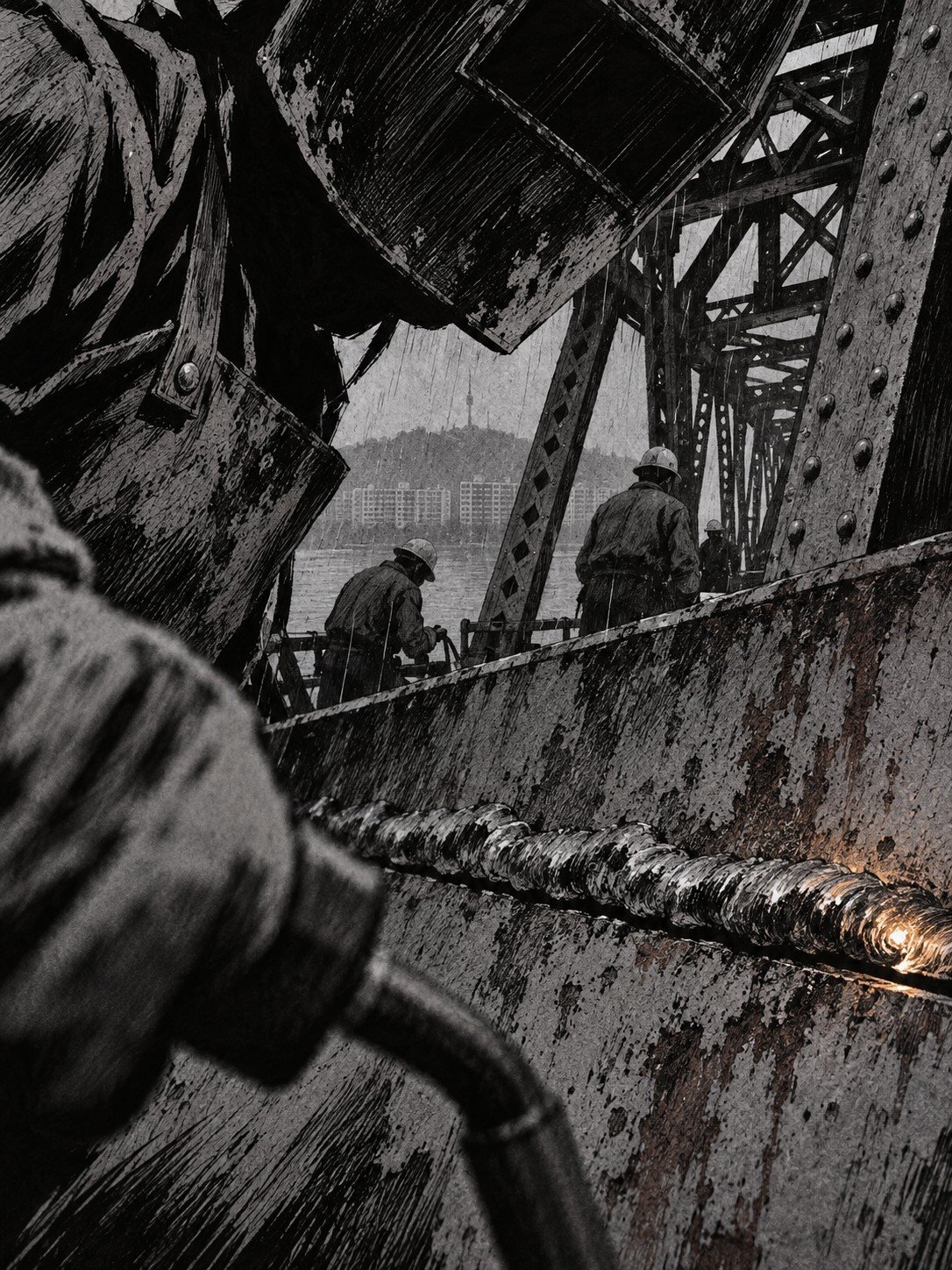
After the collapse, investigators X-rayed the welded connections. By the count in the prosecutors’ 1995 white paper, 110 of 111 had defects.
The steel was 18 millimetres thick. Some welds went only 2 millimetres into it, about the thickness of a coin. The best went 8.
Prosecutors said in November 1994 that the vertical members had been cut at a 1:3 angle instead of the 1:10 in the specification, to save time, and welded in an I shape rather than the X shape the design called for.
Their verdict on the welds was blunt. Even with no traffic at all, they said, the joints would have let go on their own in about 30 years.
A later simulation with the same faulty welds, reported by The Korea Herald, gave the bridge 12 years under the loads it was designed for. Under the loads it actually carried, 8.5. Seongsu was open for 15. (WIKI) (SS-WELD) (KH)
Twice the traffic it was built for
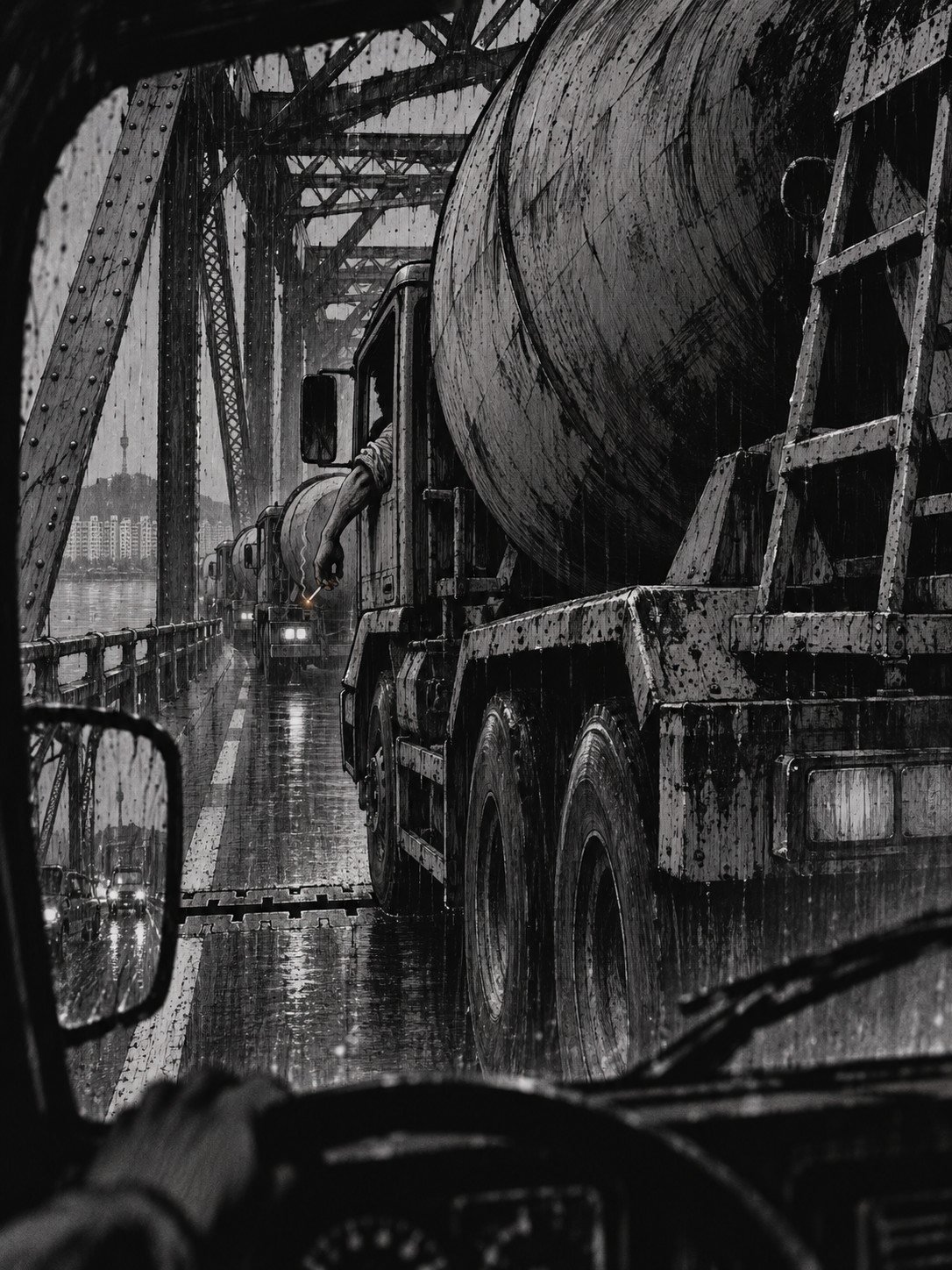
The bridge was designed for about 80,000 vehicles a day. By October 1994 it was carrying more than 160,000.
The jump followed the opening of a new stretch of the Dongbu Expressway, between Seongsu and Sanggye, the year before.
Cement mixer trucks from a nearby plant, up to 25 tonnes each, crossed every day. Nobody regulated them. The Korea Herald puts the bridge’s original limit at 18 tonnes a vehicle.
Years later, Seoul’s own city government listed lax enforcement against overweight trucks among the causes of the collapse.
And in all that time, nobody had looked closely at the bridge. (KH) (SEOUL-SAFE)
Too young to inspect

Seoul sent its older bridges for professional safety checks. Bridges under 20 years old got a visual look.
Seongsu was 15. In its whole working life it never had a detailed inspection.
In December 1993 the city announced that a check of the Han River bridge piers had found nothing abnormal. The week before the collapse, the construction minister said there was no cause for concern about the Han bridges.
In August 1994, the city office responsible for the bridge found a serious defect during its own inspection. It repaired it. According to Seoul Shinmun, it did not properly report it to its superiors.
Then the gaps started opening. (SS-INSPECT) (WIKI) (SS-GAP) (MT)
The gap they kept quiet

Looking after Seongsu was the job of the Dongbu construction office, part of Seoul’s city government.
Two to three weeks before the collapse, the office ran its own check and found that deck joints over some of the piers were opening up. That is what internal city records said, as reported by Seoul Shinmun the day after the disaster.
The finding was not made public.
Every day, the cement trucks kept crossing.
On Thursday 20 October, the night before, a patrol went out onto the deck. (SS-GAP) (SC-1741) (KH)
A steel plate, then rain

Three men on foot found holes in the deck above piers 2 and 3.
They covered them with steel plate. When it started to rain, they left.
They did not put up an “under construction” sign.
Officials told reporters the next day that repairs planned for that Thursday evening had been put off because of bad weather.
In the hours before the collapse, drivers saw a loose metal plate over a gap in the deck. It measured 1.3 by 2 metres, a little bigger than a single bed. (SS-GAP) (MT) (KH)
6 a.m.: a driver calls it in

At about 6 o’clock on Friday morning, a driver reported an abnormal impact on the bridge.
That was roughly an hour and a half before the deck fell.
No emergency measures were taken. The bridge stayed open.
Rush hour began. (KH)
Friday, half past seven
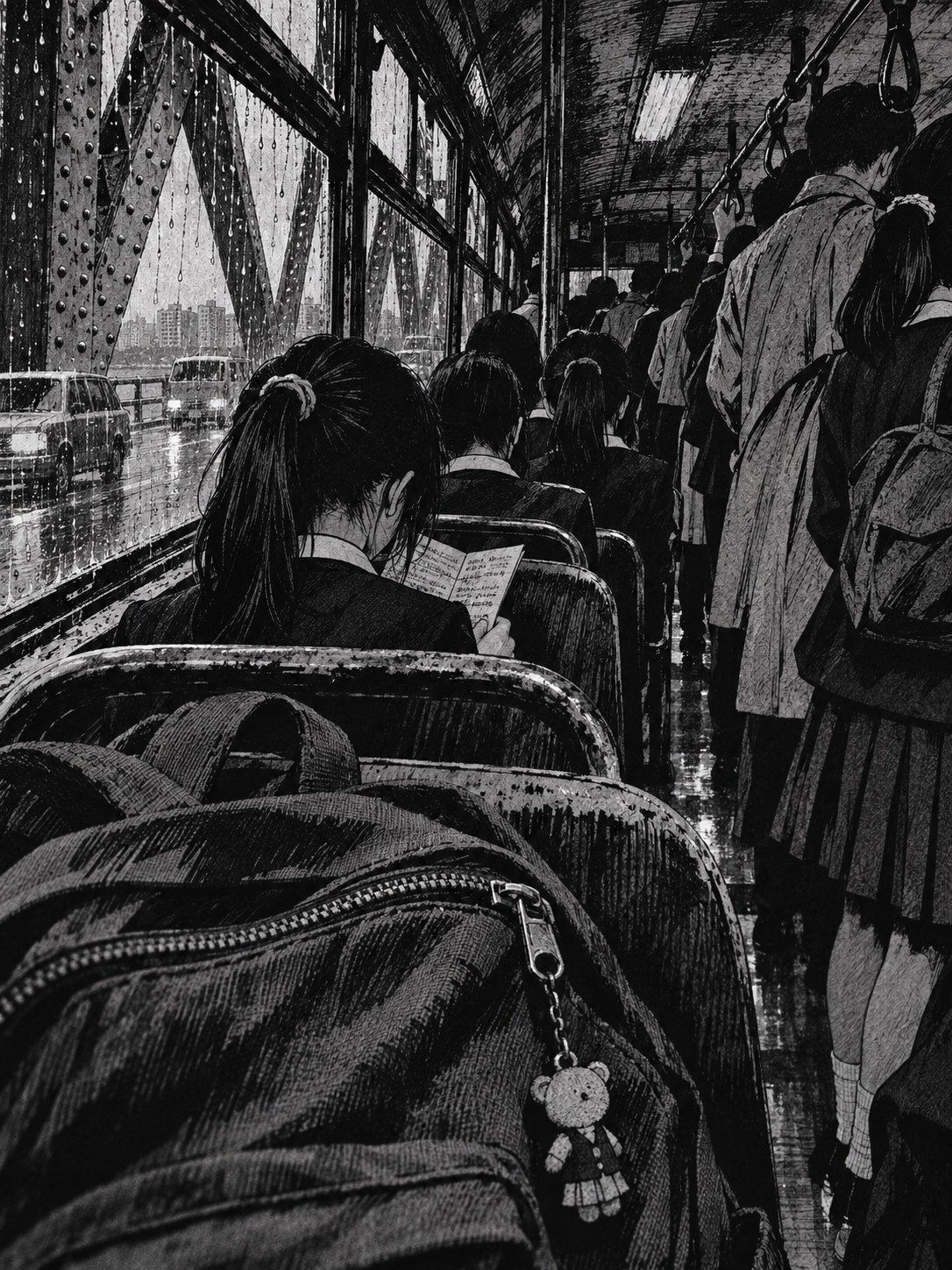
Bus No. 16 belonged to Hansung Transportation. That morning it was carrying office workers and students.
Some of the girls were heading for Muhak Girls’ High School in Haengdang-dong, on the north bank. Students were due in by 7:30.
It was raining lightly. Traffic on the bridge was moving at around 40 km/h.
Somewhere in the same stream of cars was a police van carrying officers who had been picked out for an honour. (SS-FRONT) (SS-SCENE) (ASIAE) (KH) (WIKI)
On their way to collect awards

21 October is Police Day in South Korea.
The van belonged to the 40th company of the Seoul police’s 3rd Mobile Unit. It carried 10 officers chosen for commendation and a 22-year-old driver.
They were heading to the unit’s base in Gaepo-dong to receive their Police Day awards.
About 30 seconds after they drove onto Seongsu Bridge, they heard a loud crash. (SS-POLICE) (WIKI)
Forty-eight metres, gone
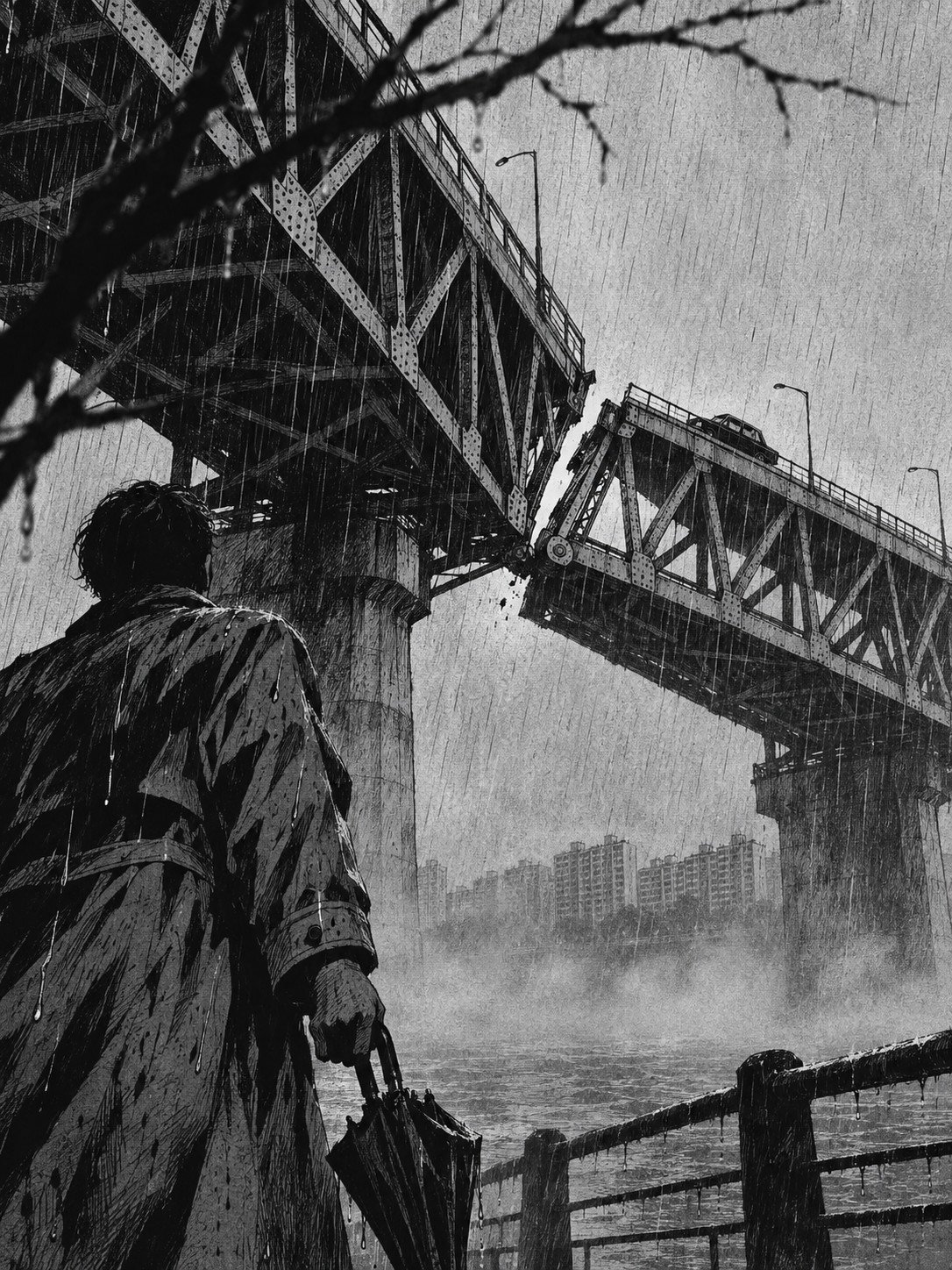
The time was about 7:40 a.m. Most later accounts put it at 7:38.
A whole section between two piers came loose. At 48 metres, it was longer than four city buses parked end to end, and it fell about 20 metres, roughly the height of a six-storey building.
Witnesses told reporters there had been no warning. The central section “sheared cleanly” away.
Six vehicles went down with it.
Bus No. 16 hung at the edge for a moment. Then it flipped and landed on the fallen slab. (SS-FRONT) (KH) (MT) (SS-2015) (SS-FALL)
“I thought it was an earthquake”
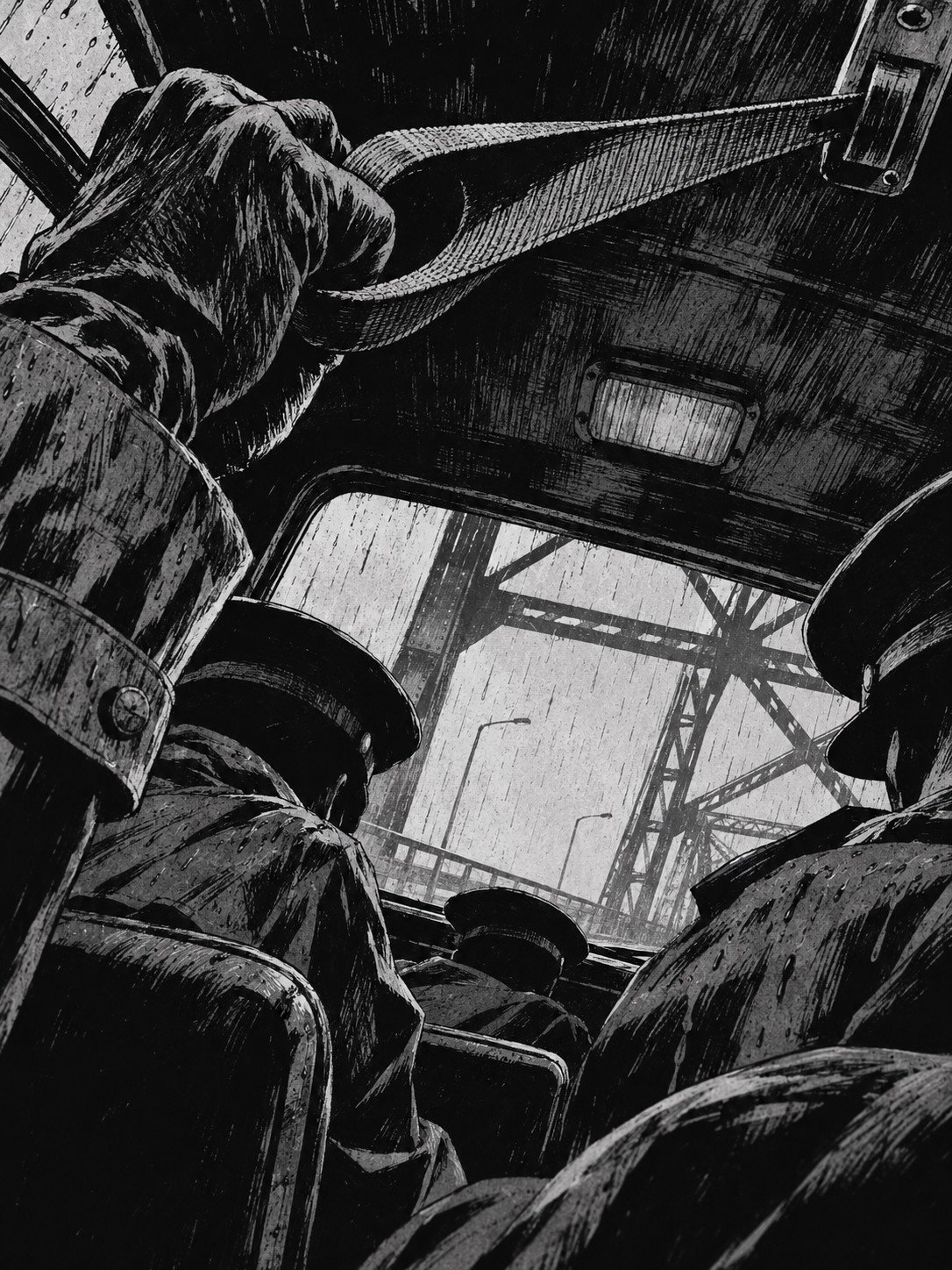
In the police van, the driver pulled the handbrake. The deck behind them gave way, and the back of the van dropped.
“I thought, there’s been an earthquake,” one of the officers told Seoul Shinmun.
The van’s rear wheels caught on the broken deck. It hung there, over the water. The officers climbed out through the front door.
Below them the bus lay overturned. About 50 metres away a car was sinking, two women in the water shouting for help. Four officers jumped into the river.
By the paper’s count, the men from the van pulled 15 people to safety, 13 of them from the bus. Then they waited for help to arrive. (SS-FALL) (SS-POLICE)
Twenty minutes
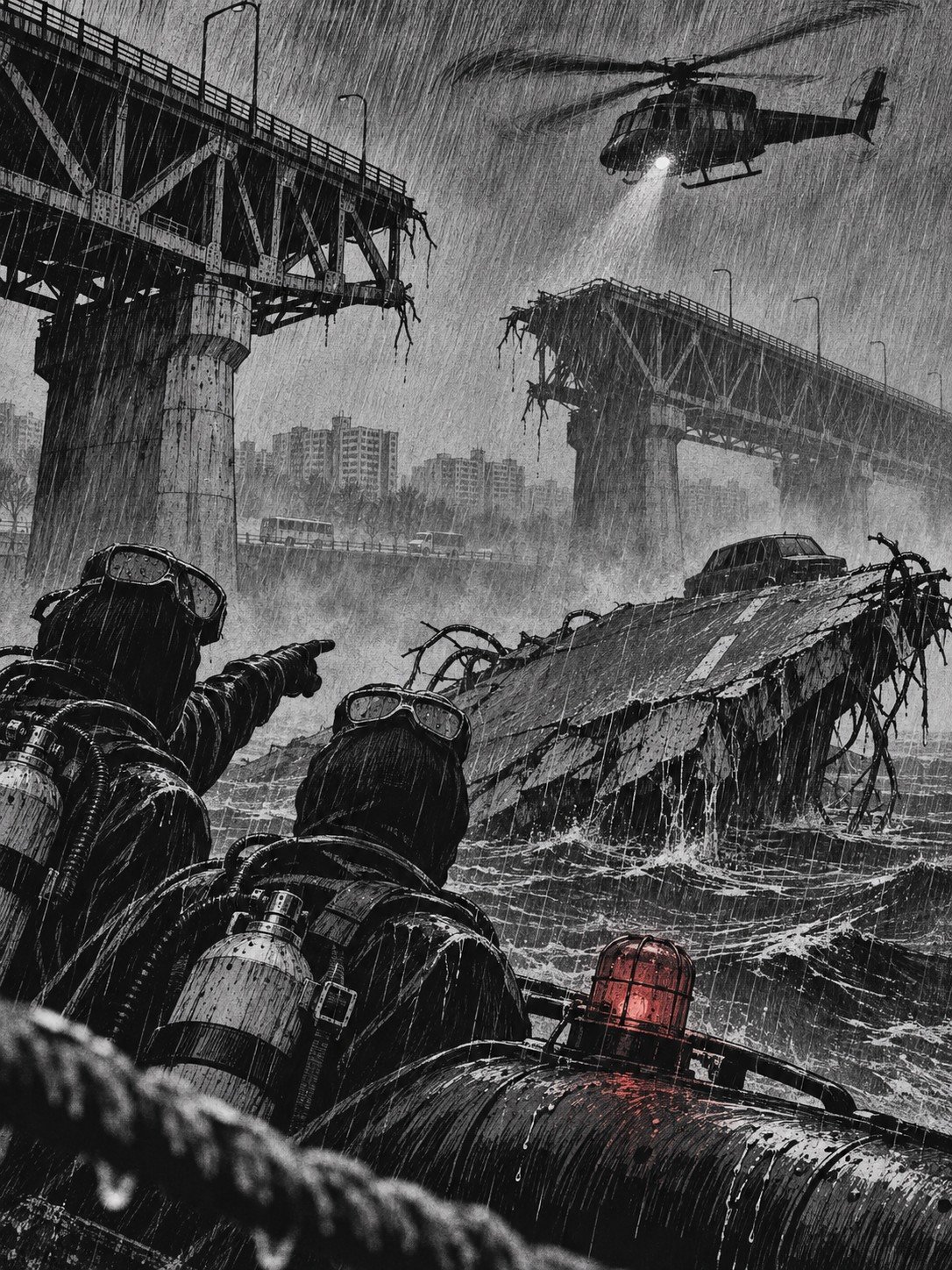
The official rescue began about 20 minutes after the collapse. The officers on the slab remembered it as closer to 30 before helicopters and boats reached them.
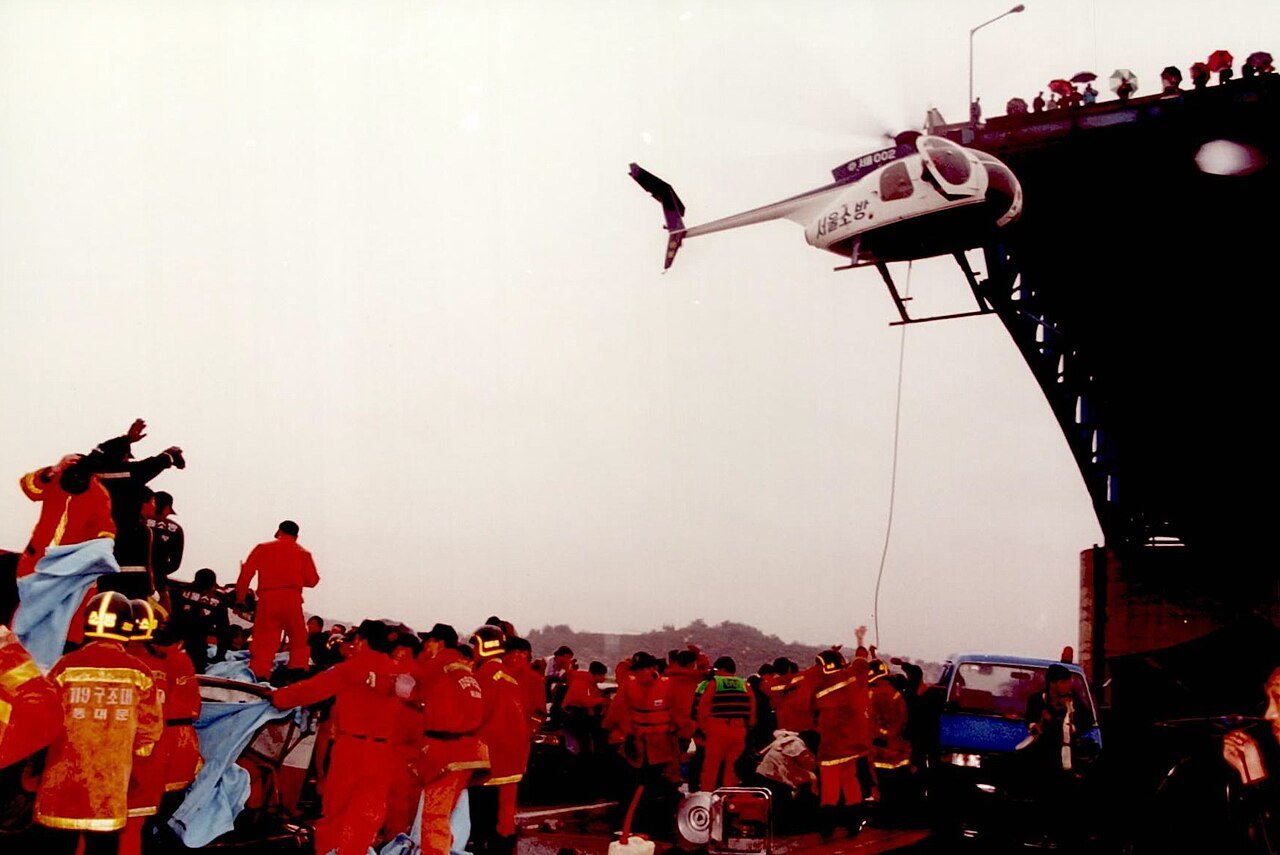
When it came, it came in numbers: about 1,500 personnel, 16 helicopters, six patrol boats and around 150 special forces underwater searchers.
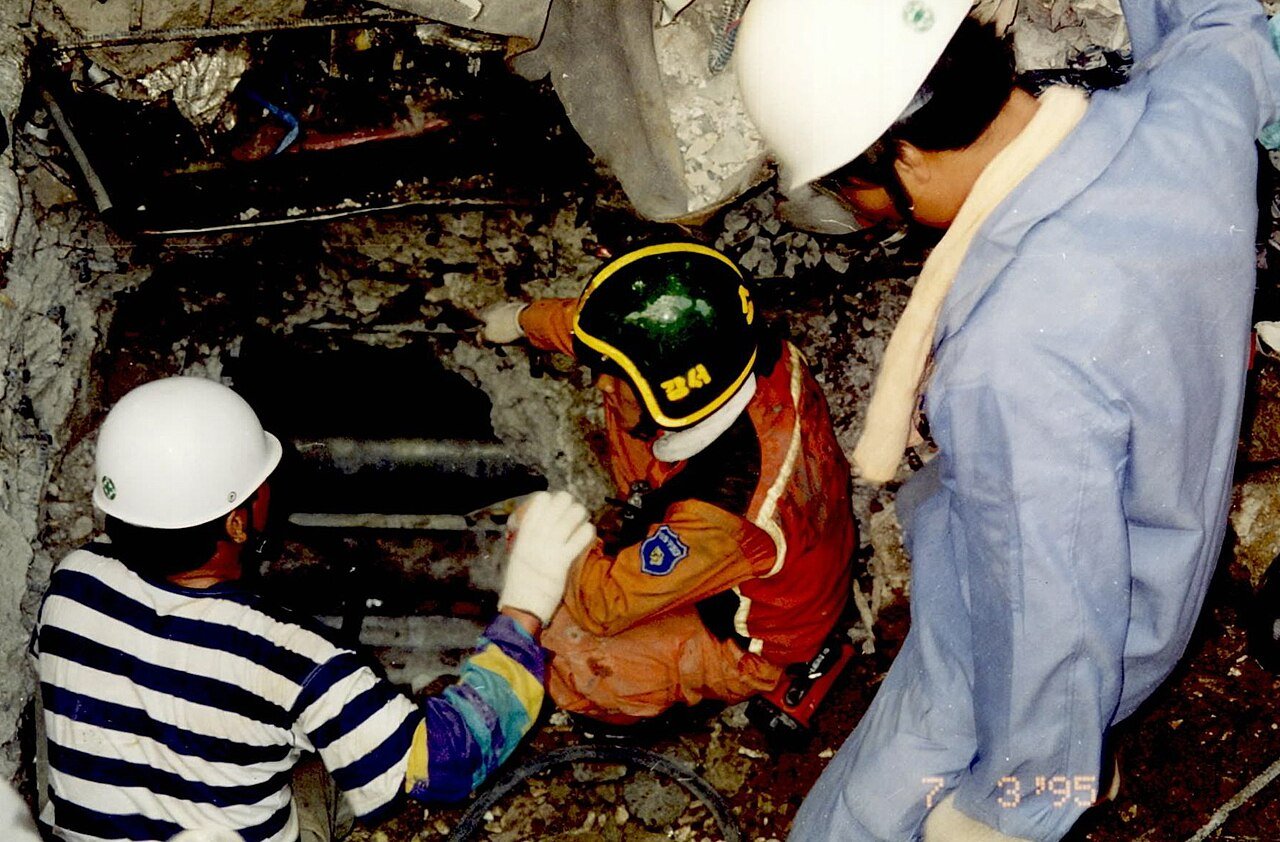
The current was strong and the water was murky, which made the search hard.
One schoolteacher got out of her car and swam until a rescue boat picked her up. “How could a bridge which millions of citizens use every day collapse so easily?” she asked. (SS-FALL) (SS-POLICE) (MT)
School bags on the slab

Inside the bus, students’ bags and shoes lay scattered, with a teddy bear and photographs, Seoul Shinmun’s reporters wrote.
At Muhak Girls’ High School, more than 20 students had not arrived by 7:30. The school heard about the bridge at around 8 a.m.
Parents flooded the school with phone calls. At about 1 p.m., after fourth period, teachers sent everyone home.
Eight Muhak Girls’ High School students died.
In the city, nobody yet knew how many people had been lost in all. (SS-SCENE) (SS-2015) (YTN)
Forty-eight, then thirty-two

The first number was wrong. Police announced 48 dead, then found they had counted people twice as they were moved between hospitals.
The final toll was 32 dead, 16 men and 16 women, and 17 injured. Twenty-nine of the dead had been on bus No. 16.
About 2,000 people gathered on the Olympic Expressway and the riverside roads to look. In Gangnam, women rang their husbands’ offices to check they had made it in.
The city gave its first explanation: overloaded traffic had snapped the pins that held the deck together.
About 5,000 vehicles had to be rerouted. The jams lasted until 11 that night. By then, Seoul needed a new mayor. (SS-SCENE) (SS-FRONT) (KH) (WIKI)
Gone by nightfall

That evening, President Kim Young-sam accepted the resignation of the mayor of Seoul.
The new mayor lasted 11 days. He left office when questions came up about his own earlier role in the city government’s handling of the bridge.
The prime minister offered to resign as well. The president refused. “We cannot deny that we’ve pursued quantity over quality, and demonstration over practicality,” he said.
Prosecutors did not arrest the mayor who resigned. They found no evidence that he had been told the bridge was about to fail.
The arrests went further down the chain. (MT) (WIKI) (KH)
Sixteen convictions, no bribery charges

Seventeen people were arrested, Seoul city officials and staff from Dong Ah Construction among them.
Their lawyers argued it was too late to prosecute: the bridge had been built 15 years earlier. The courts disagreed. The clock started when the bridge fell, not when it was welded.
On 20 April 1995, 16 were convicted and one acquitted. Every sentence was suspended. On appeal in June 1997 the acquitted defendant was convicted too.
On 28 November 1997 the Supreme Court dismissed every appeal, in one ruling for the builders and supervisors and another for the city’s maintenance officials. It was “easily foreseeable”, the court held, that their failures added together could bring the bridge down.
Corruption was widely suspected. No bribery charges were brought. (WIKI) (SS-WELD) (SC-1740) (SC-1740-KO) (SC-1741) (KH)
Every bridge, then a department store
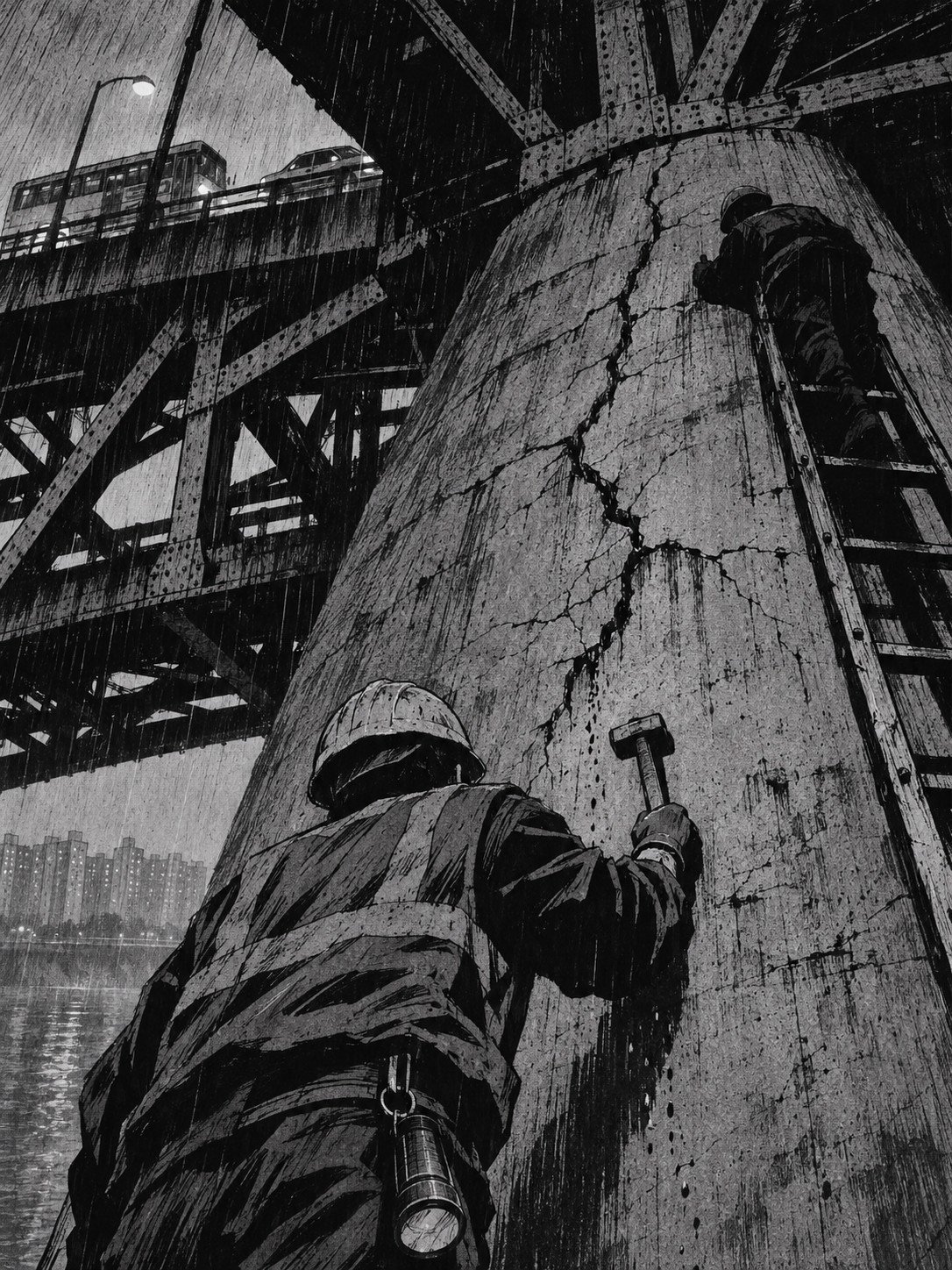
Seoul checked its other Han River bridges. The Dangsan Railway Bridge had severe structural problems and was rebuilt. The Gwangjin, Hannam, Mapo and Yanghwa bridges were repaired.
In January 1995 a special act made regular inspections by outside experts compulsory for structures ten years old or more.
About eight months after Seongsu, the Sampoong Department Store in Seoul collapsed. More than 500 people died. The period got a nickname: the “era of calamities”.
Hyundai Engineering & Construction rebuilt Seongsu from March 1996 for 78 billion won, almost seven times the original cost. It reopened on 3 July 1997. Today the city says it carries a second safety system, meant to stop the deck from falling into the river even if it breaks.
The families got a memorial. (KH) (WIKI) (SEOUL-HUB) (SEOUL-SAFE)
“Mum won’t forget”

The memorial went up on 21 October 1997, at the north end of the bridge.
It stands beside Seoul Forest, boxed in by roads built for cars, and it is hard to reach on foot. There was no crosswalk to it until April 2015. Families have asked for it to be moved somewhere people would see it. The city has not agreed.
They come every October anyway. At the 30th anniversary in 2024 they read out the names of all 32.
At the service in 2015, a yellow banner hung at the memorial. It read: “Even if the whole world forgets, Mum won’t forget.” (WIKI) (ASIAE) (SS-2015) (YTN)
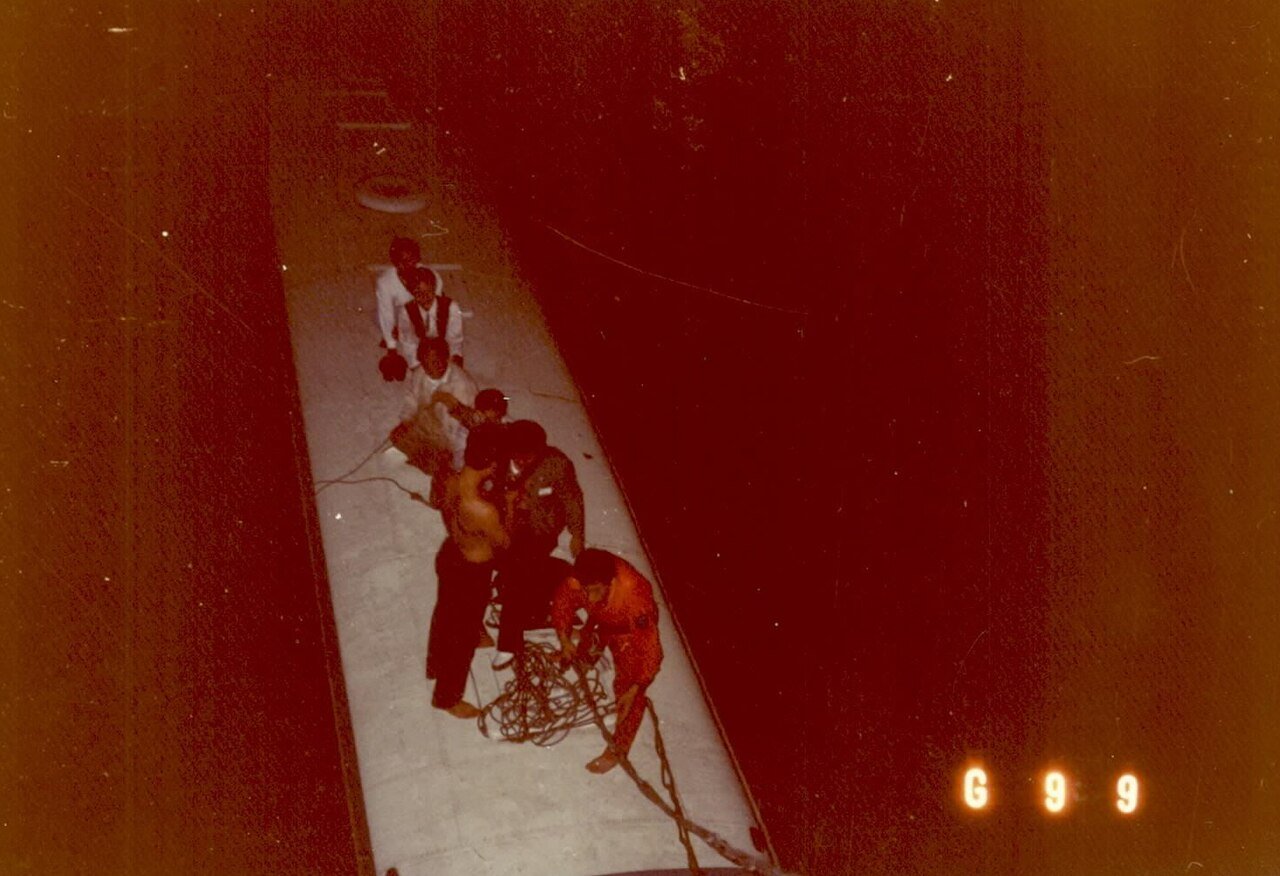
Evidence photos
Real photographs and published figures, kept separate from our illustrations. Each one says what it shows, and what it cannot prove.
Quick answers: the Seongsu Bridge collapse
What happened to Seongsu Bridge in 1994?
At about 7:40 a.m. on Friday 21 October 1994, a 48-metre section between two piers of Seongsu Bridge in Seoul dropped about 20 metres into the Han River at rush hour. Six vehicles fell with it, including city bus No. 16. Thirty-two people died and 17 were injured.
Why did Seongsu Bridge collapse?
Investigators and the courts blamed bad welding when the bridge was built from 1977 to 1979, together with poor maintenance by Seoul city officials. Radiography found defects in 110 of 111 welded connections, and the bridge was carrying about twice the traffic it was designed for.
Who died in the Seongsu Bridge collapse?
Twenty-nine of the 32 dead were on bus No. 16, which was carrying commuters and students. Eight of them were students from Muhak Girls’ High School on their way to class.
Was anyone punished for the Seongsu Bridge collapse?
Seventeen people were arrested, all Seoul city officials or staff of the builder, Dong Ah Construction. Sixteen were convicted with suspended sentences in April 1995, and the one acquitted defendant was convicted on appeal. The Supreme Court upheld the convictions in November 1997. The bridge was rebuilt and reopened on 3 July 1997.
What is a little-known fact about the Seongsu Bridge collapse?
Hours before it fell, drivers had already noticed a loose steel plate, about 1.3 by 2 metres, over a gap in the bridge deck. (SS-GAP) (MT) (KH)
Case notes: the bridge too young to inspect
On 21 October 1994 a 48-metre section of Seongsu Bridge fell into the Han River in Seoul, killing 32 people. The courts found that bad welding at construction and failures in maintenance by city officials added together to bring it down (SC-1740) (SC-1741).
Where the case stands (as of November 2026)
Closed. The Supreme Court upheld all 16 convictions on 28 November 1997 (SC-1740) (SC-1741) (WIKI). No bribery charges were brought (KH). Families still hold a memorial service at the north end of the bridge every October (ASIAE) (YTN).
The city’s own bridge office knew the deck joints were opening weeks before the collapse.
PROVENEXAMINED
Timeline
| When | What happened |
|---|---|
| Apr 1977 – Oct 1979 | Dong Ah Construction builds Seongsu Bridge, the 11th bridge across the Han in Seoul (WIKI) |
| Dec 1993 | Seoul announces a check of Han River bridge piers found nothing abnormal (SS-GAP) |
| Aug 1994 | The city’s Dongbu construction office finds and repairs a serious defect; it is not properly reported up (SS-GAP) |
| Early Oct 1994 | The office’s own check finds deck joints opening; the finding is not disclosed (SS-GAP) |
| Thu 20 Oct 1994 | A three-man patrol covers holes in the deck with steel plate, leaves when rain starts, puts up no sign (SS-GAP) (MT) |
| Fri 21 Oct, about 6:00 | A driver reports an abnormal impact on the bridge; no emergency measures (KH) |
| Fri 21 Oct, about 7:40 | A 48 m section falls about 20 m into the Han with six vehicles, including bus No. 16 and a police van (SS-FRONT) (SS-2015) |
| 21 Oct, about 20 min later | Official rescue begins: about 1,500 personnel, 16 helicopters (SS-FALL) |
| 21 Oct, evening | The President accepts the mayor’s resignation; the new mayor leaves after 11 days (MT) (KH) |
| Jan 1995 | Special Act on the Safety Management of Structures (WIKI) (KH) |
| 20 Apr 1995 | 16 defendants convicted with suspended sentences, one acquitted (WIKI) |
| Jun 1995 | Sampoong Department Store collapses in Seoul, about eight months after Seongsu (WIKI) (KH) |
| 11 Jun 1997 | Appeal court convicts the defendant acquitted at first instance (WIKI) (SC-1740) |
| 3 Jul 1997 | The rebuilt Seongsu Bridge reopens (WIKI) |
| 21 Oct 1997 | Families’ memorial erected at the north end of the bridge (WIKI) |
| 28 Nov 1997 | Supreme Court dismisses all appeals in rulings 97do1740 and 97do1741 (SC-1740) (SC-1741) |
| 21 Oct 2024 | 30th anniversary service; families read out all 32 names (ASIAE) (YTN) |
Evidence locker
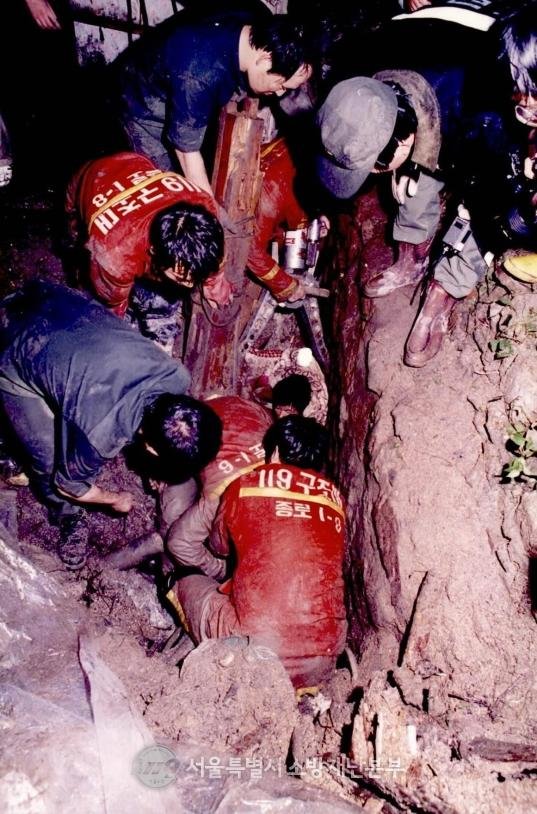
Real photographs taken on the day of the collapse, and the court ruling that settled the cause.
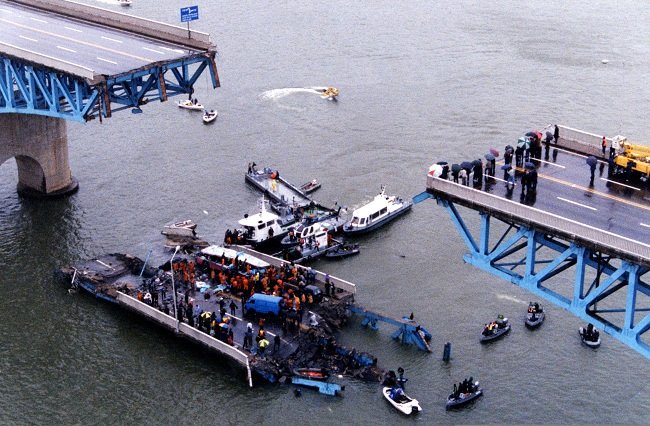 EXHIBIT A · TAP TO ENLARGE
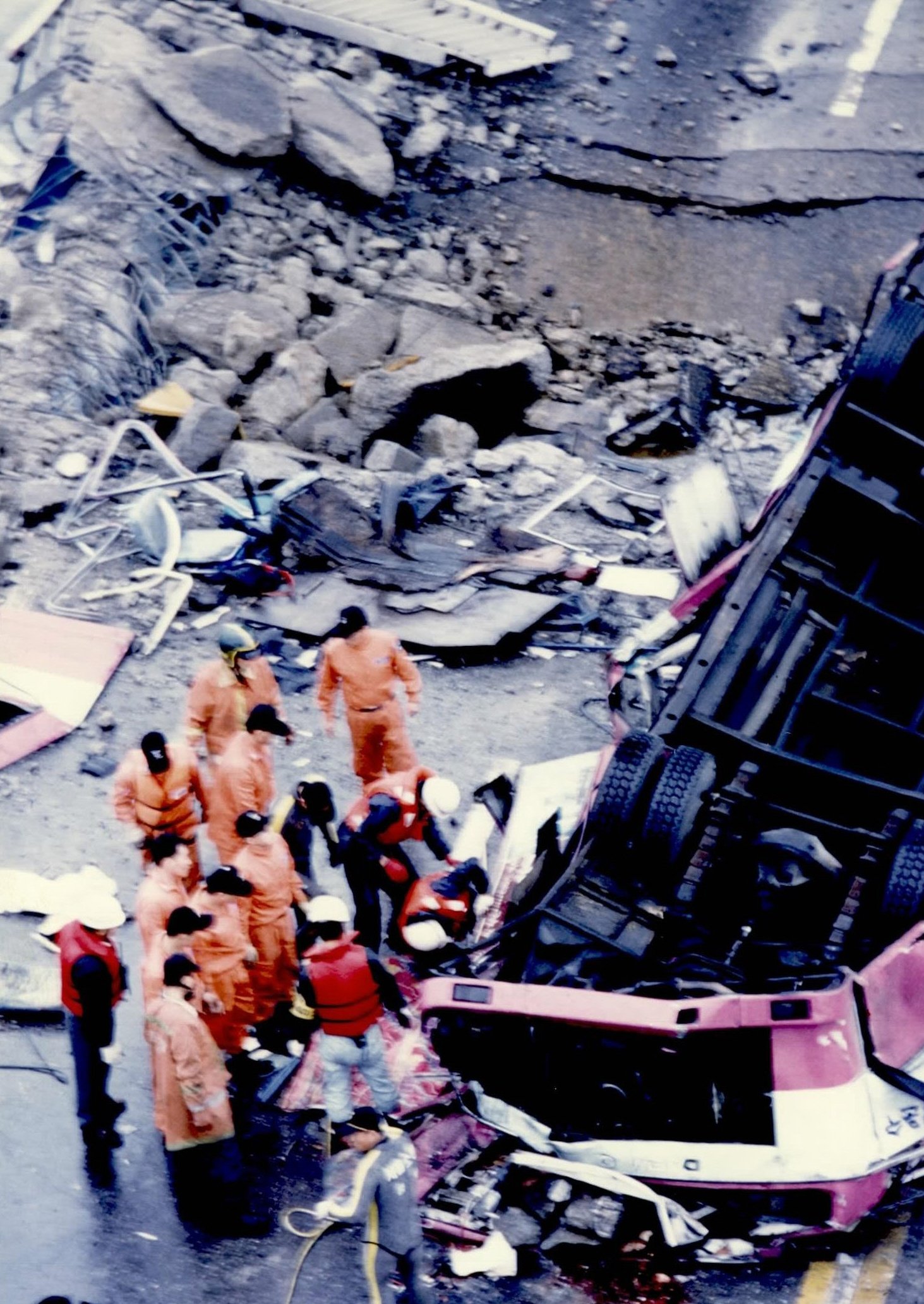 EXHIBIT B · TAP TO ENLARGE
 EXHIBIT C · TAP TO ENLARGE
 EXHIBIT D · TAP TO ENLARGE
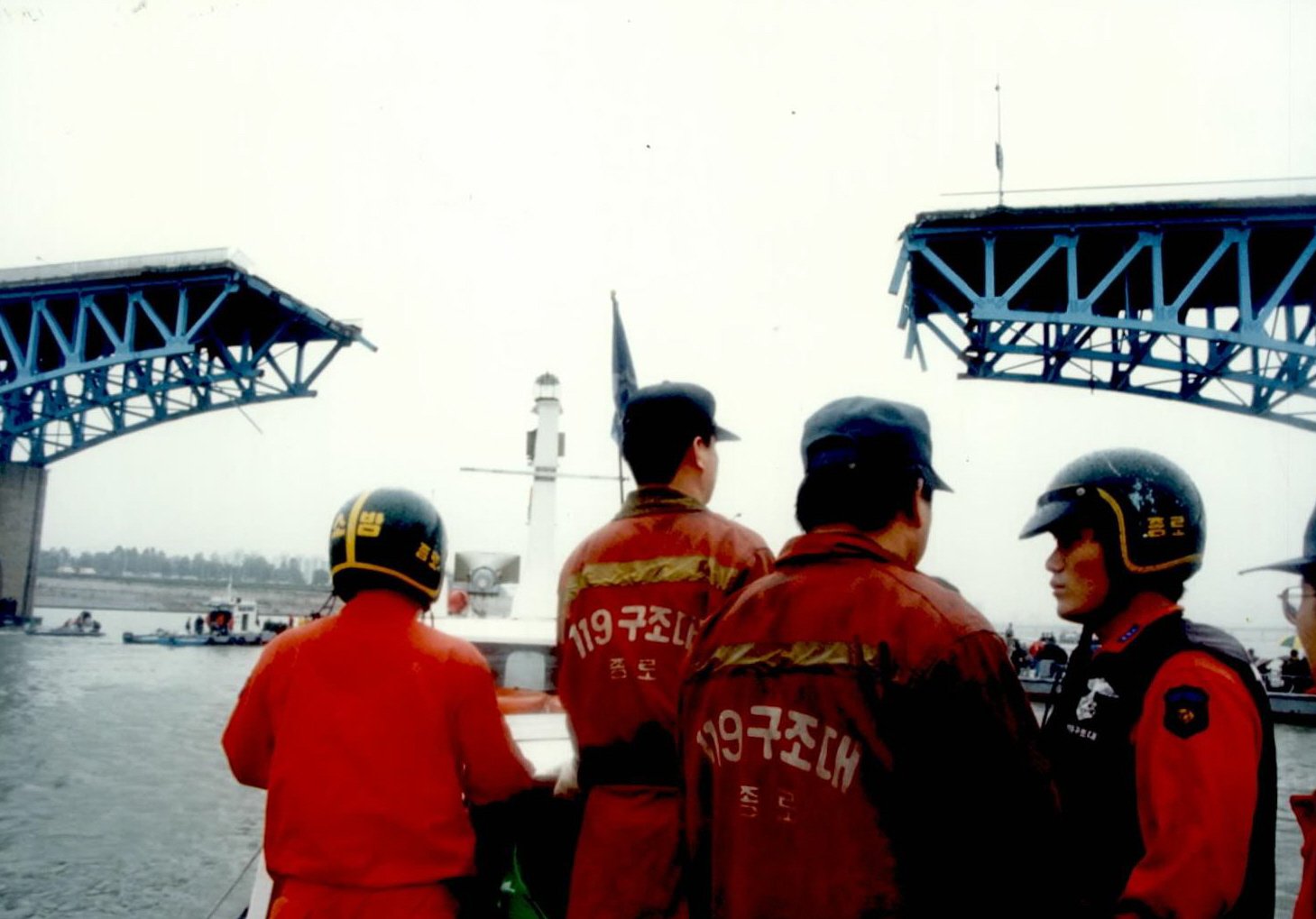 EXHIBIT E · TAP TO ENLARGE
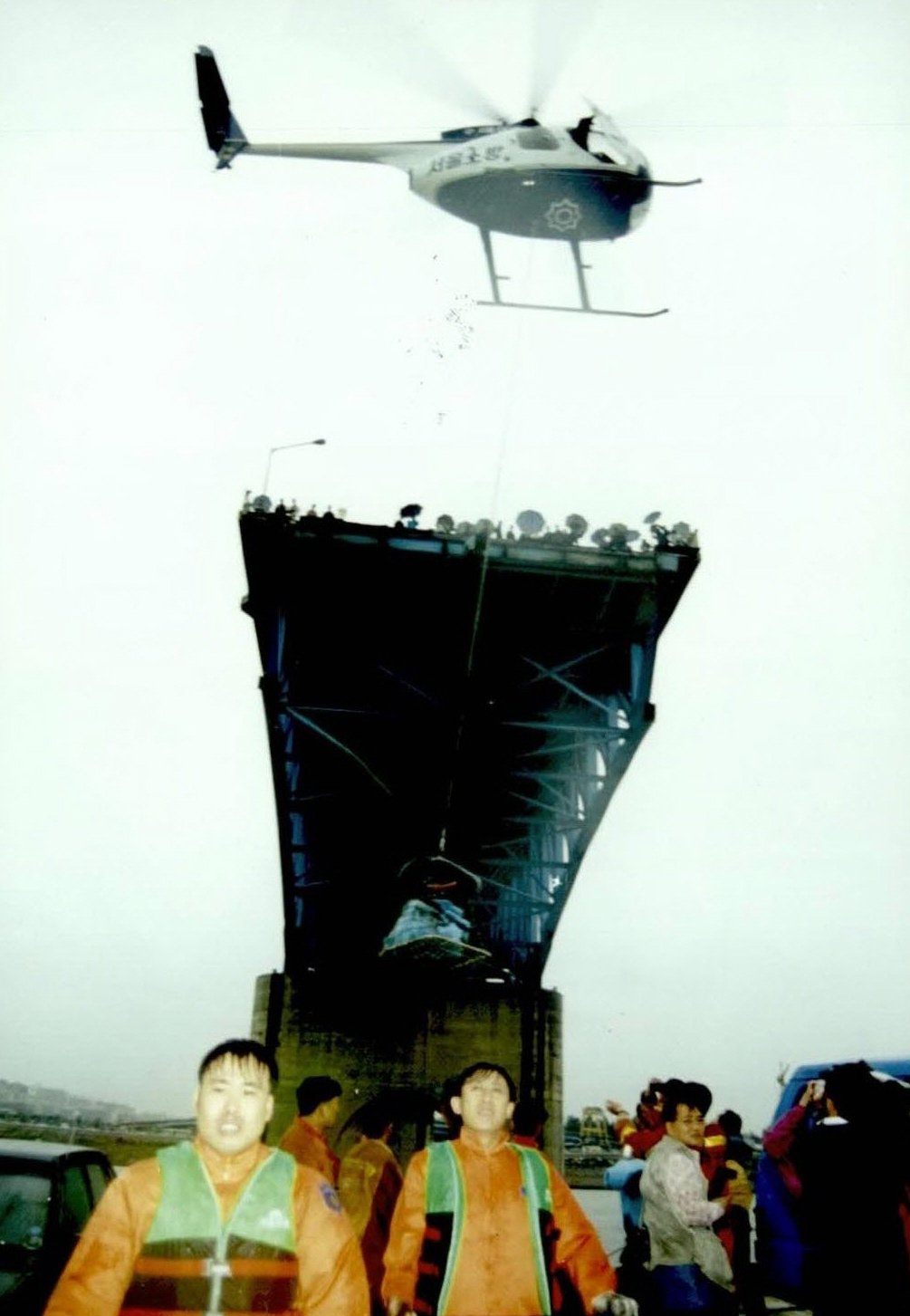 EXHIBIT F · TAP TO ENLARGE
Access: Copy (an English translation of 97Do1740 on a legal database; 97Do1741 in Korean transcript).
Supports: That bad welding and poor maintenance together caused the collapse, as a matter of court record.
Limits: We read the published rulings, not the full trial record.
Where the records disagree
| Detail | What sources say |
|---|---|
| Time of the collapse | About 7:40 a.m. (Seoul Shinmun 1994 and 2015, YTN, Seoul city) (SS-FRONT) (YTN) (SEOUL-HUB); 7:38 (Korea Herald, Asia Business Daily) (KH) (ASIAE); about 7:30 in the Supreme Court judgment text (SC-1740) |
| Where on the bridge | Between piers 5 and 6 (Seoul Shinmun) (SS-FRONT) (SS-2015); between piers 10 and 11 (Seoul city safety portal) (SEOUL-SAFE); the second suspended truss on the north side (court findings, as cited in a 2024 law article) (KOSCI) |
| How many vehicles fell | Six (most sources and the Supreme Court) (SS-2015) (SC-1740); “about ten” in the first day’s front-page report (SS-FRONT) |
| Students who died | Eight Muhak Girls’ High School students (SS-SCENE) (SS-2015) (YTN); the Korea Herald and Wikipedia add one from the middle school, making nine (KH) (WIKI) |
| People on bus No. 16 | All agree 29 of them died; 32 on board per the Korea Herald, 31 per Wikipedia (KH) (WIKI) |
| First death toll | 48, from double counting during hospital transfers (SS-SCENE); “over 40” (WIKI). Final: 32 (SS-FRONT) |
| The officers’ rescue | 15 people saved, 13 from the bus (SS-POLICE); Wikipedia says 10, using clothes tied into a rope (WIKI) |
| When help arrived | Rescue began about 20 minutes after (SS-FALL); officers on the slab said about 30 (SS-POLICE) |
| Vehicle weight limit | 18 tonnes (Korea Herald) (KH); a Dong Ah official told reporters 33 tonnes (MT) |
| The patch on 20 October | Over piers 2 and 3 (SS-GAP); “about 50 m from the collapse site” (WIKI) |
| Why the new mayor left | He had approved the original construction (Korea Herald) (KH); he had been deputy mayor when internal reports questioned the bridge (Wikipedia) (WIKI) |
What we still don’t know
- What exactly was in the city’s internal records on the opening deck joints, and who saw them. Only press reports of them are public.
- The full Seoul National University investigation report and the 1995 prosecutors’ white paper are not online; their figures are known through citations.
- What happened to the driver’s 6 a.m. report after it was made.
- Whether corruption played a part. It was widely suspected, but no bribery charges were brought.
What happened after
In January 1995 a special act made regular inspections by outside experts compulsory for structures ten years or older (WIKI) (KH). Seoul checked and repaired its other Han River bridges and rebuilt the Dangsan Railway Bridge (KH).
Seongsu Bridge reopened on 3 July 1997 and was widened to eight lanes in 2004 (WIKI) (SEOUL-HUB). The families’ memorial is still hard to reach; a proposal to move it to Seoul Forest has not been agreed by the city (ASIAE).
Editor’s note
The detail we can’t get past is the one about the gap. According to reporting at the time, the city’s own maintenance office had found the deck joints opening two to three weeks before the collapse, and said nothing. We keep coming back to the same question: what if someone had closed the bridge then and gone to look?
The people who crossed it every morning didn’t know any of that. They got on the same bus they always took. What makes us angriest is that the people who knew about the danger and the people who ended up paying for it were not the same people.
Sixteen convictions can sound like accountability. It’s hard to feel that it was enough. For the families, life without the people they lost goes on for decades; next to that, the punishments look very short. And the fact that no bribery was ever proven doesn’t make the failure smaller. Not doing the job you are responsible for, when other people’s lives depend on it, is serious on its own, and it should be treated that way.
English-language accounts often file Seongsu under “Korea’s rush-rush culture” and move on. There is some truth in that, but we’d ask readers to go one step further. The students on bus No. 16 didn’t rush the construction or skip an inspection. They were going to school. Blaming a whole society’s character can blur the part that matters: who made the decisions, and who paid for them.
So if you remember one thing from this file, let it be this: on an ordinary Friday morning, people set out to start their day, and they never came home.
— Strange World Files
Case file summary
- What: A 48-metre deck section of Seongsu Bridge fell into the Han River at rush hour
- Where: Seongsu Bridge, between Seongdong and Gangnam, Seoul, South Korea
- When: Friday 21 October 1994, about 7:40 a.m.
- Toll: 32 dead, 17 injured
- Cause: Faulty welding and failed maintenance, with heavy traffic (court and city findings)
- Status: 16 convictions upheld by the Supreme Court, 1997
Illustrations are AI-generated artistic interpretations, not photos. No real person is depicted with a recognizable face. Read how we research and illustrate these files.
Sources
- Seoul Shinmun front page, “Seongsu Bridge collapse: 32 dead; connecting pin appears broken, 48 m deck falls” (성수대교 붕괴 32명 사망, 22 Oct 1994)
- Seoul Shinmun, “Vehicles plunge into the river one after another” (차량들 잇따라 강물속으로, 22 Oct 1994)
- Seoul Shinmun, “Deck gap known two weeks before, and hidden” (「상판 틈」 2주전 알고도 숨겼다, 22 Oct 1994)
- Seoul Shinmun, “On the way to collect Police Day awards, their van fell; injured, they risked their lives to save bus passengers” (22 Oct 1994)
- Seoul Shinmun, scene report from the collapse site and Muhak Girls’ High School (22 Oct 1994)
- Seoul Shinmun, “Han River piers losing their strength: 15 bridges to get precision checks” (22 Oct 1994)
- Seoul Shinmun, “First cause of collapse: faulty truss welding” (2 Nov 1994)
- Supreme Court of Korea, Decision 97Do1740, 28 Nov 1997, English translation (legalengine, copy)
- Supreme Court of Korea, 97도1740, 28 Nov 1997, Korean text (nepla, transcript)
- Supreme Court of Korea, 97도1741, 28 Nov 1997, Korean text (nepla, transcript)
- The Korea Herald, Yoon Min-sik, “[Korea History] Bridge collapse lays bare dark side of ‘Han River miracle'” (26 Jul 2023, read via Daum)
- The Moscow Times, “Korean Bridge Collapse Claims 32” (22 Oct 1994)
- The Asia Business Daily, 30th anniversary memorial report (21 Oct 2024)
- Seoul Shinmun, “Even if the whole world forgets, Mum won’t forget” (21st memorial, 22 Oct 2015)
- YTN, “30th memorial for the Seongsu Bridge collapse: ‘May the sacrifice never be repeated'” (21 Oct 2024)
- Seoul Metropolitan Government safety portal, “Han River bridge collapses” (updated 20 Feb 2025)
- Seoul Metropolitan Government (Mediahub), “20 years after collapse, Seongsu Bridge is now safe” (15 Oct 2014)
- Kim Choodeok, “Criminal liability for building safety accidents,” Archi & Law (2024, PDF)
- Wikipedia, “Seongsu Bridge disaster”