The Candy Man: The Poisoned Pixy Stix Ronald Clark O’Bryan Handed Out on Halloween 1974
| What | A father poisoned Halloween candy to collect life insurance on his children |
| Where | Pasadena and Deer Park, Texas |
| When | 31 October 1974 |
| Toll | One child killed; four more children given poisoned candy, none of whom ate it |
| Status | Convicted 1975; executed 1984; never confessed |
🎧 Narrated Mystery: press play and hear the whole case read aloud, like an audiobook (about 28 minutes). The narrator is an AI voice.
A stapled Pixy Stix in a pumpkin bucket: Halloween 1974 in Pasadena, Texas
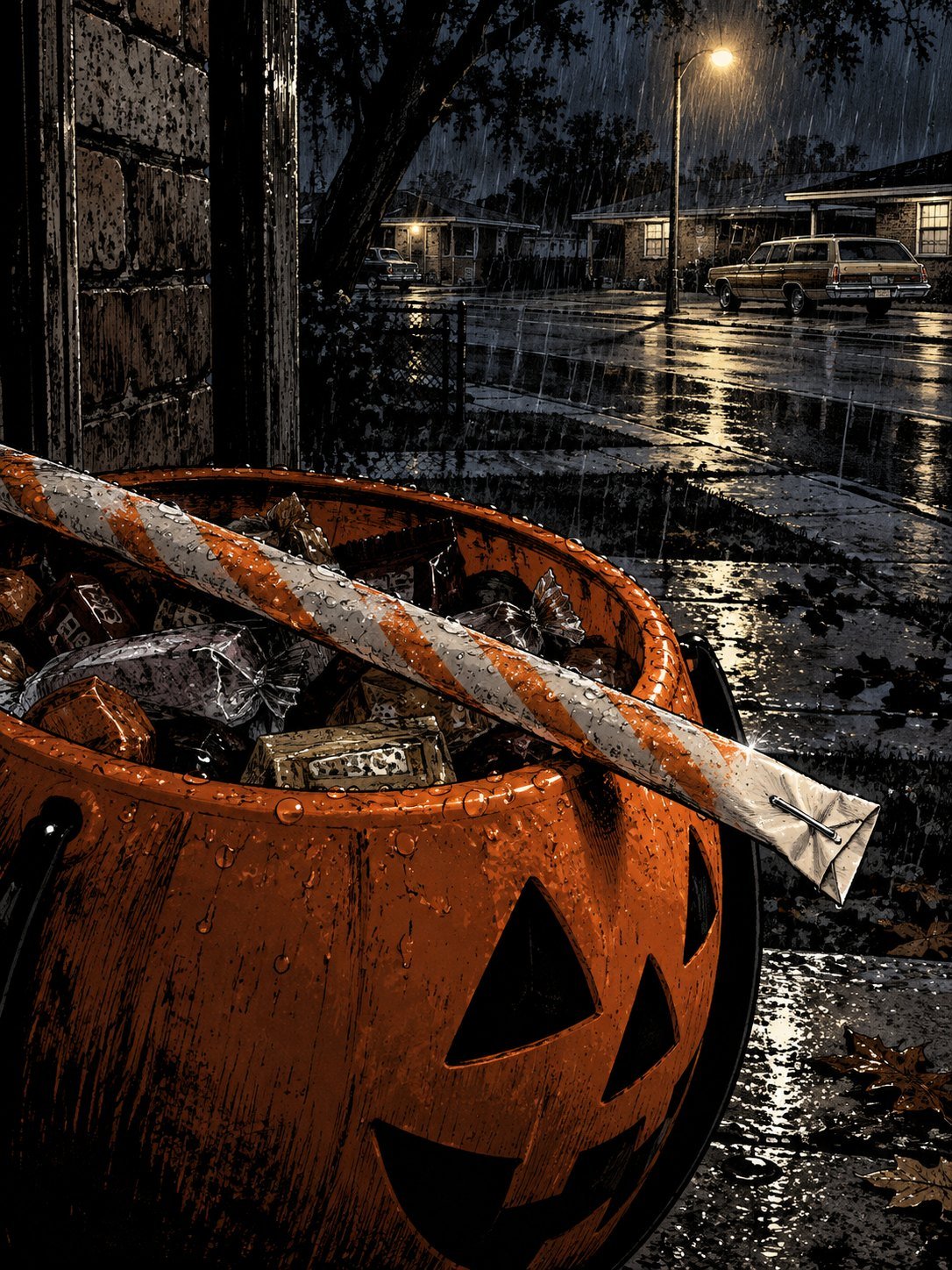
Picture a child’s orange pumpkin bucket on a wet doorstep. Lying across the top is a long plastic straw of powdered candy.
One end has been folded over and closed with a metal office staple.
It is Halloween 1974, a Thursday, on the edge of Houston. The weather has turned cold and wet.
“It was kind of a cold, and kind of a misty, damp night,” retired Pasadena detective Harold Nassif remembered.
The candy was a “giant pixy styx,” as the court later spelled it: a long plastic tube of sweet powder.
That night, five children were handed one each.
One of them was Timothy Marc O’Bryan. He was eight years old.
The straws that were later recovered had each been closed with a staple.
The company that made them said its straws are never stapled.
So who had closed them, and when? (TCCA-1979) (ABC13-2018) (SNOPES) (UPI-1984-03-31)
The dark house on Donerail: thirty seconds alone at a shut door
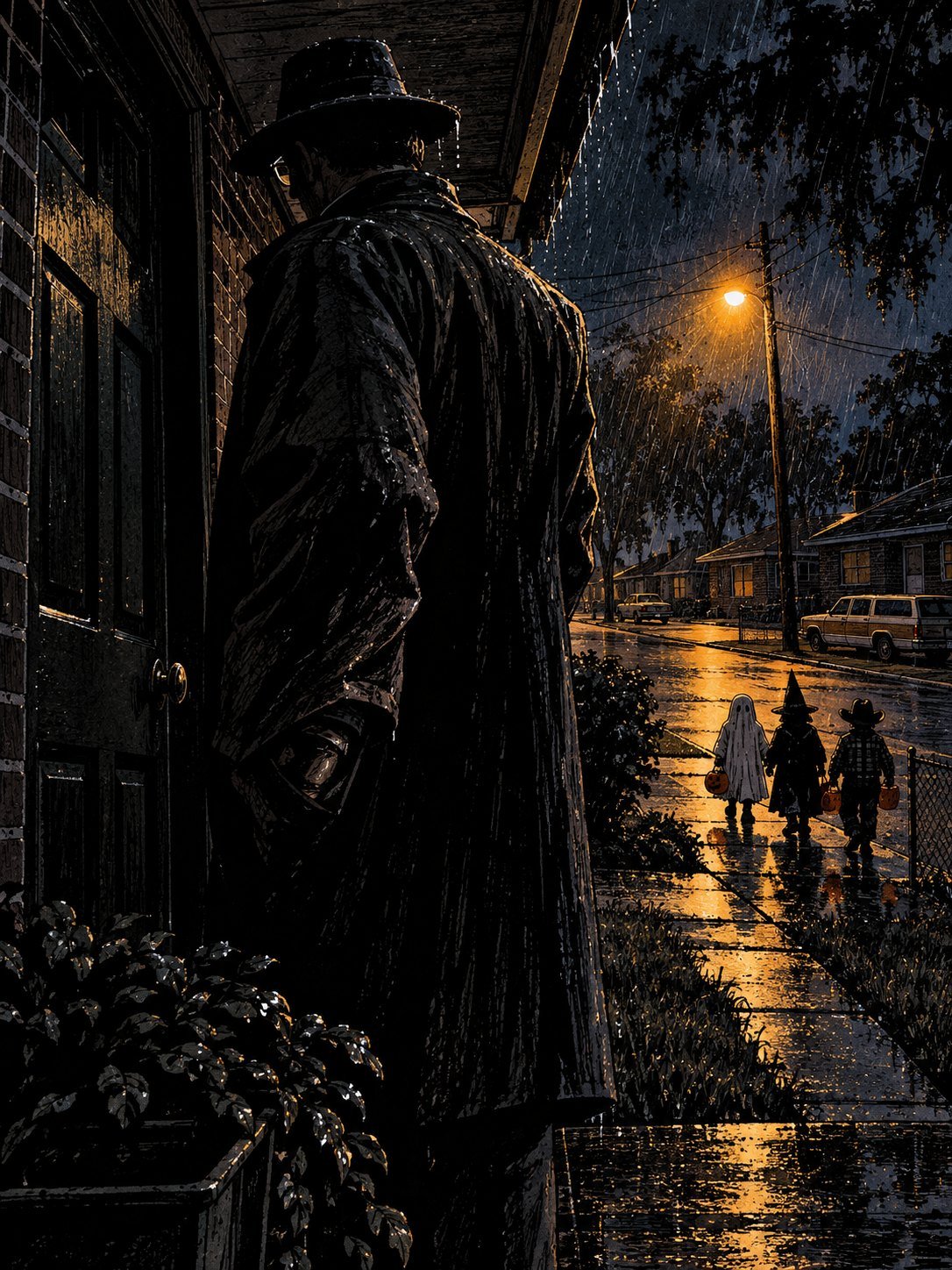
A brick house with its porch light off. Every window black. A tall man standing alone at the door.
Earlier that evening, Ronald Clark O’Bryan, a 30-year-old optician, had driven to the home of his friend Jimmy Bates in Pasadena. His own family was already there.
“Both families sat down to dinner,” the court record says. “By the time dinner was over, rain was falling.”
Because of the rain, the group trick-or-treated on only two streets, Citation and Donerail, in a Pasadena subdivision near the O’Bryans’ home in Deer Park.
Three children went out: Timothy, his five-year-old sister Elizabeth, and one Bates child. The two fathers went with them.
At one house on Donerail, O’Bryan walked the children to the door while Bates waited on the sidewalk. No one answered.
The children went on. O’Bryan stayed behind for about thirty seconds.
When he left, Bates saw him holding at least two giant Pixy Stix, the court said.
Nassif later said O’Bryan had hidden the candy “up the sleeves of his raincoat.” According to the district clerk’s account, he told the children the owner had given it to him for them.
The straws went into the children’s bags. Then the families went home. (TCCA-1979) (AP-BATT-1974-11-06) (AP-BATT-1974-11-07) (KUFF-2004) (ABC13-2018) (HCDC-2021) (VICE-2016)
“The candy tasted bad”: a glass of Kool-Aid at bedtime
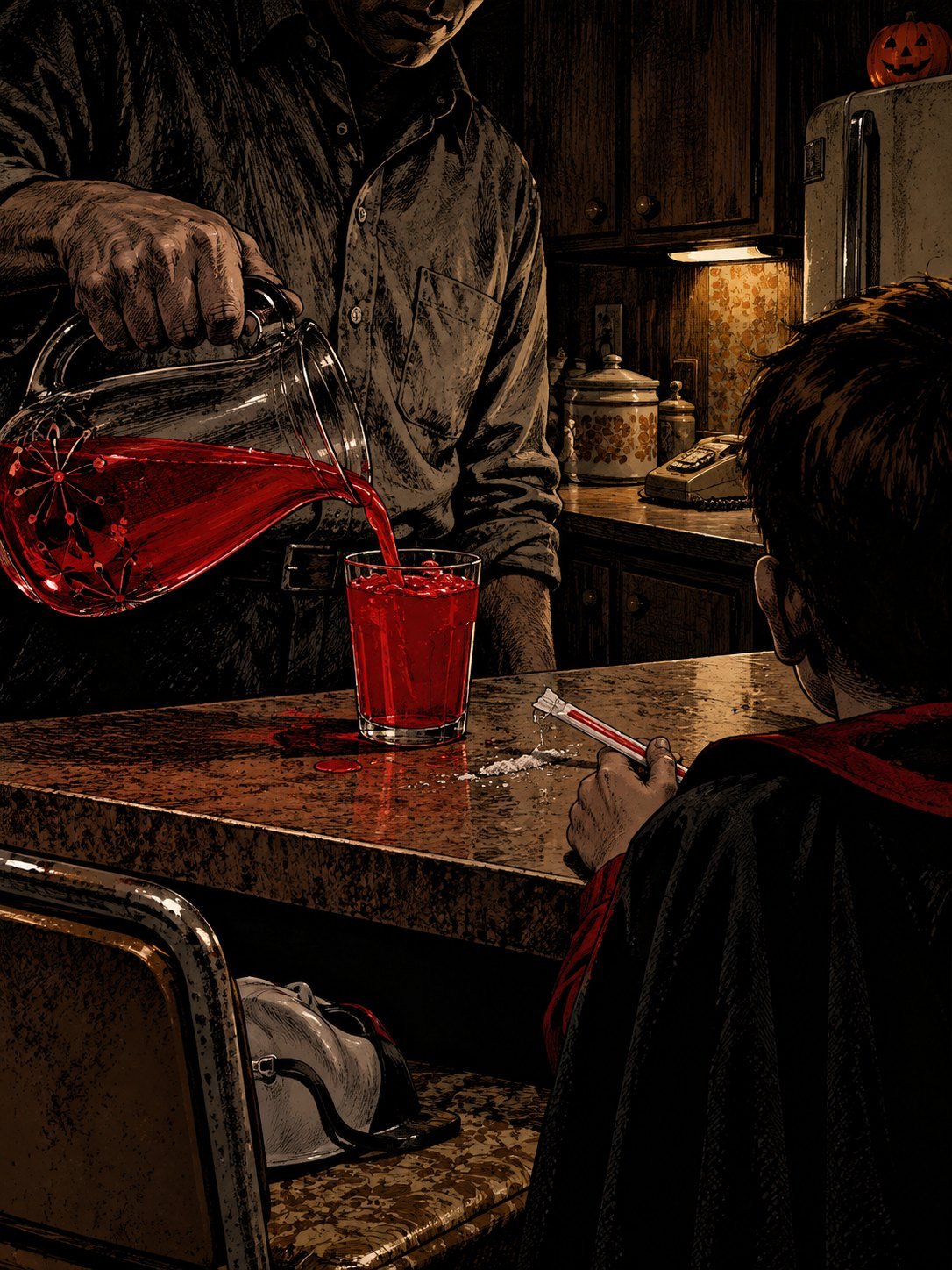
A glass of bright red Kool-Aid, poured to the brim. Beside it, a torn candy straw and a little spilled white powder.
Back at the Bates home, O’Bryan handed out the straws, took them back, then gave them out again: one to each child.
That included the Bates child who had stayed home.
A fifth went to a boy who came trick-or-treating at the Bates house, after the boy told O’Bryan he went to his church.
Then the O’Bryans went home to Deer Park. At bedtime, Timothy was allowed one treat.
Prosecutors said his father urged him to try the Pixy Stix.
The powder was stuck inside the straw. O’Bryan rolled it between his hands to loosen it, the court said.
“Timothy took a second gulp and complained that the candy tasted bad.”
“Appellant gave Timothy some Kool-Aid to wash the bad taste out of his mouth.”
Within minutes, the boy was sick. (TCCA-1979) (VICE-2016) (KPRC-2024) (KUFF-2004) (HCDC-2021)
An ambulance in Deer Park: how Timothy O’Bryan died of cyanide
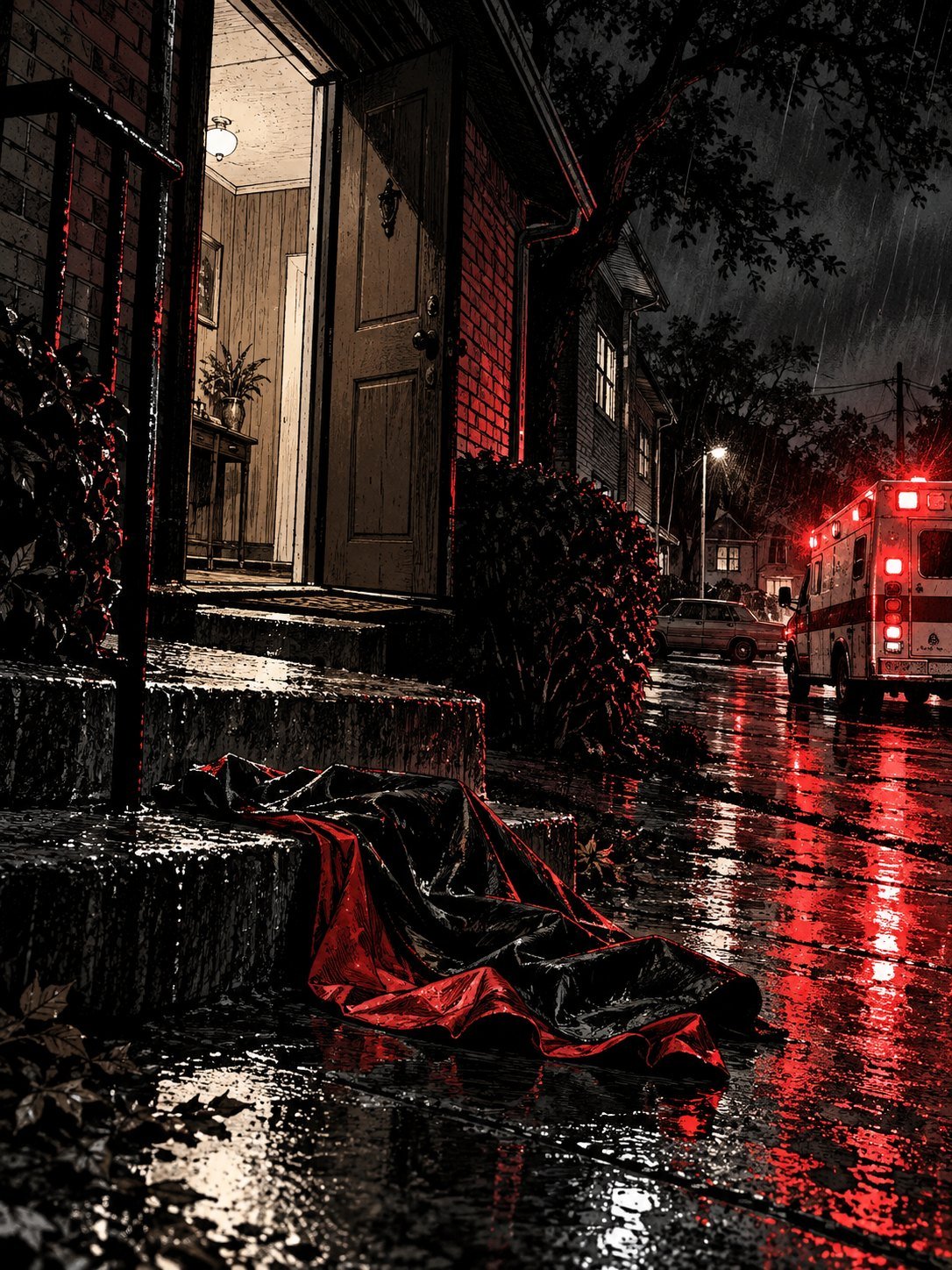
A small Halloween cape on wet townhouse steps. A front door standing open. Red ambulance light washing over everything.
Timothy went to the bathroom and began vomiting. Then came convulsions, while his father held him up, according to the court.
O’Bryan called for an ambulance.
The first officer at the scene was Jesse Zesiger, a Deer Park patrolman who had been on the force for four months.
“The feeling of helplessness was overwhelming,” he said decades later.
While trying to explain what had happened to the ambulance crew, O’Bryan twice said he felt ill and went to the bathroom. He refused treatment.
Timothy was taken to a local hospital. He died within an hour, the court said.
O’Bryan told reporters he had held his son in his arms, and that he did not realise the boy had been poisoned until police told him.
The poison was cyanide.
And four more straws were still out there, in the hands of four more children. (TCCA-1979) (KPRC-2018) (AP-BATT-1974-11-06)
The boy asleep with the straw: the midnight search for the other Pixy Stix
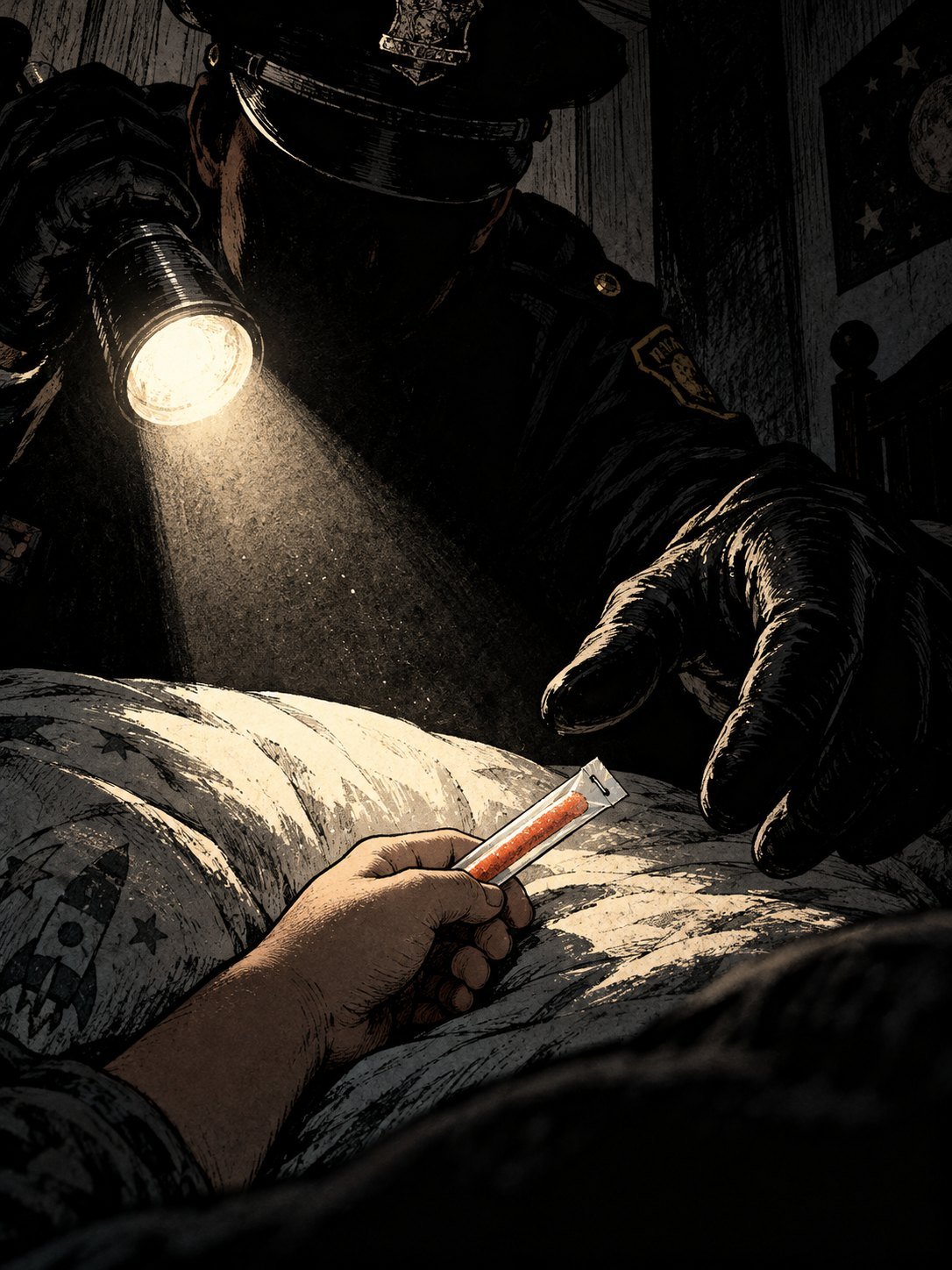
A flashlight beam in a dark bedroom. A small hand on a pillow, still holding a candy straw stapled shut at one end.
Mike Hinton, later a prosecutor on the case, happened to be on duty that night. “It was just a coincidence that I was working the police intake that night,” he said.
Pasadena police searched through the night for the other treats.
One boy was found asleep with the unopened straw still in his hand, according to Houstonia, the Washington Examiner and the Houston Chronicle.
It had been stapled shut.
“He didn’t have enough strength to get it open,” Hinton said.
ABC13 tells a different story about another child: his mother would not let him eat the straw that night, and told him he could have it the next afternoon.
The two accounts may describe two different children.
Either way, by morning, police had every straw back.
What they found inside them turned a tragedy into a murder case. (VICE-2016) (HOUSTONIA-2013) (WASHEX-2010) (KUFF-2004) (ABC13-2014)
Four stapled straws in evidence bags: a fatal dose in every one
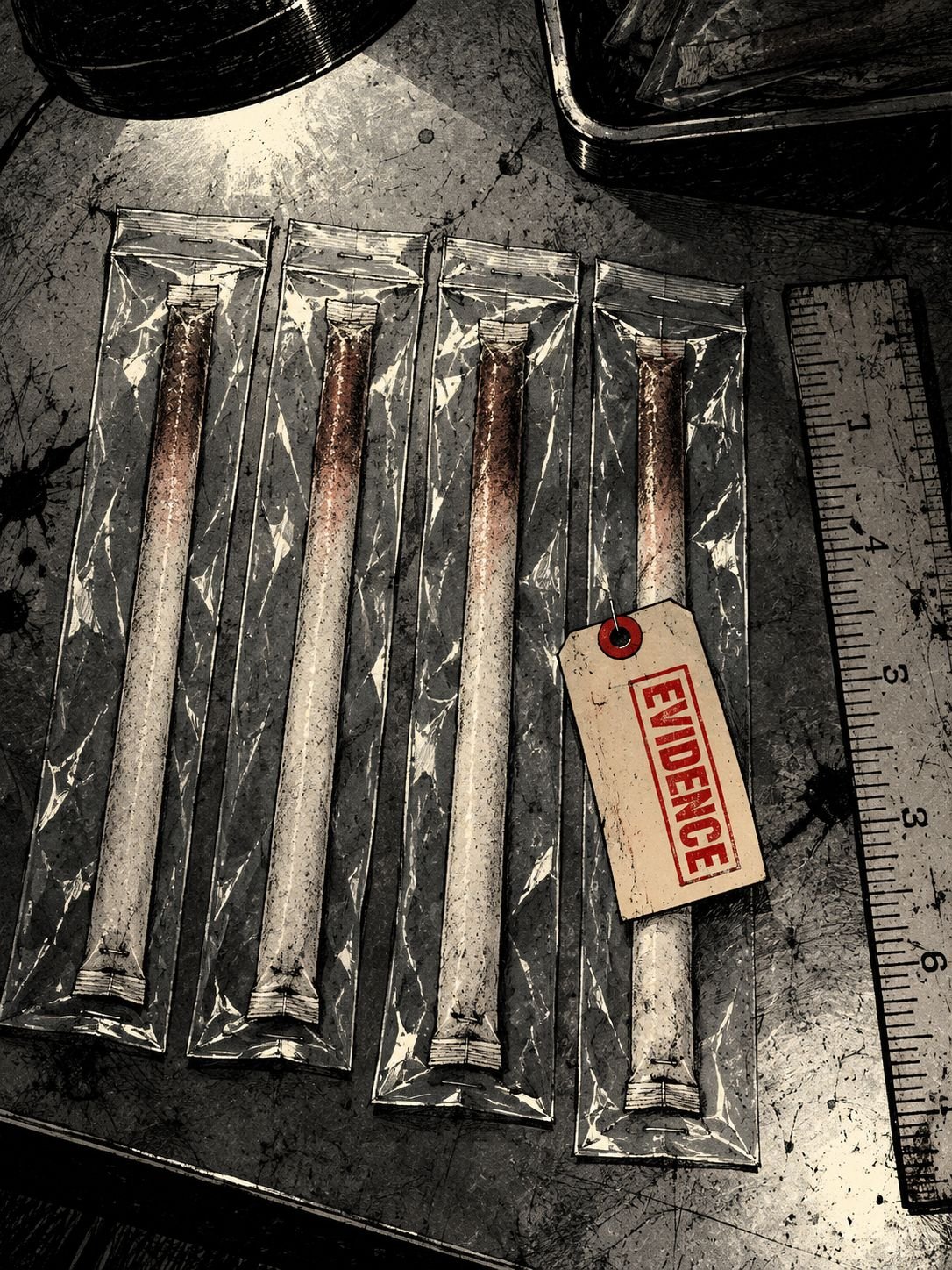
Four long candy straws on a grey steel table, each in a clear evidence bag, each stapled at one end.
All four had been recovered uneaten.
Each one held a fatal dose of cyanide in its first two inches.
One end of every straw was heat-sealed. The other end was closed with a staple.
The manufacturer told investigators its straws are never stapled.
Someone had opened them, poured poison into the top, and closed them again.
That meant five children had each been handed a lethal dose.
The appeals court later put it plainly: to carry out his plan, O’Bryan “was willing to and attempted to commit murder four more times.”
Those four children survived only because they never ate the candy.
The fifth straw, Timothy’s, told its own story. (TCCA-1979)
16 milligrams: what the lab found in Timothy’s straw
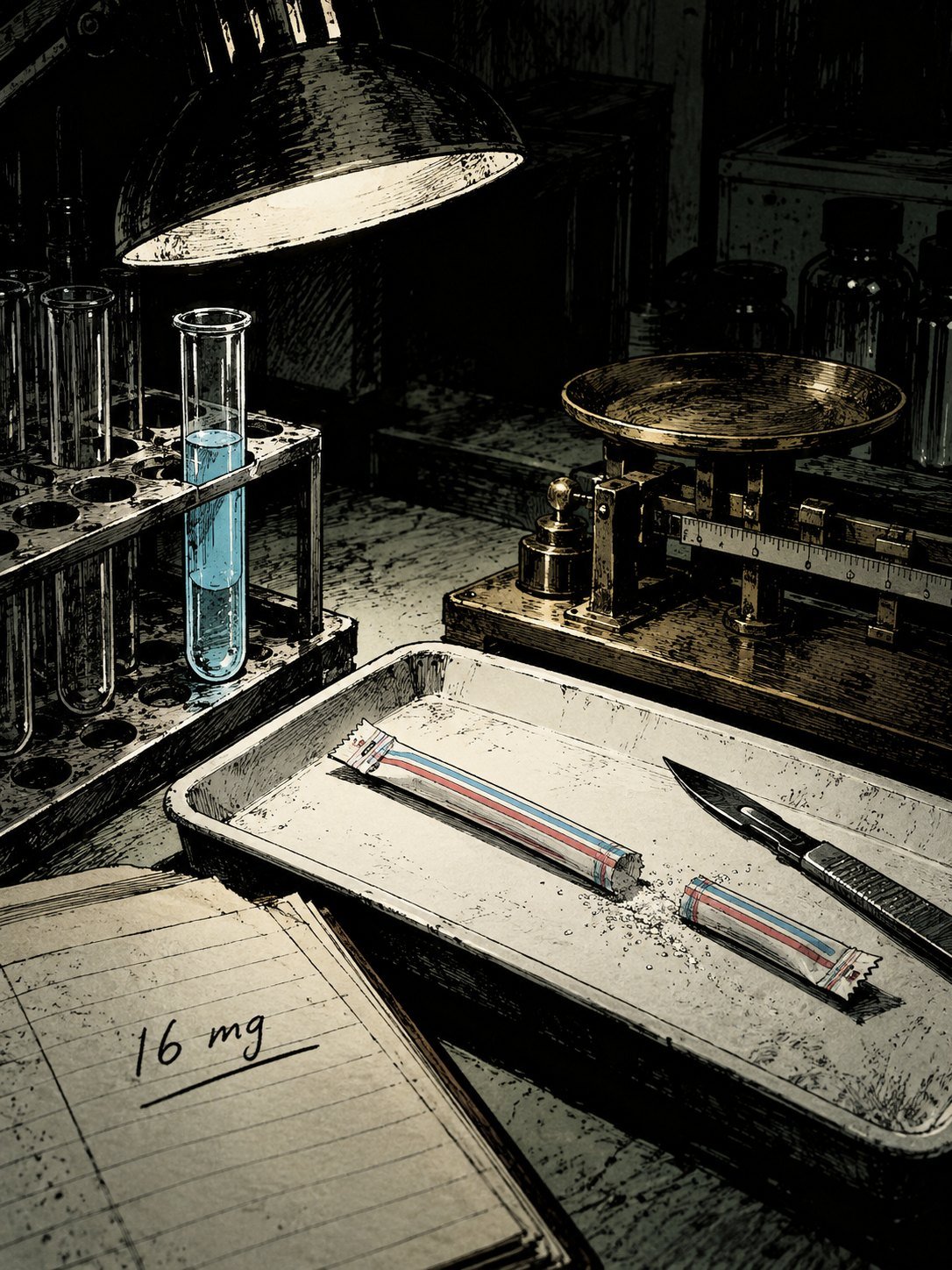
A test tube in a rack. A brass balance. A candy straw cut open on a white tray, and a notebook page reading “16 mg.”
Timothy’s stomach contained 16 milligrams of cyanide, the court said.
His blood held 0.4 milligrams. A fatal blood level is 0.2 to 0.3.
Later retellings described the dose as enough to kill two or three adults.
Then the lab looked at what was left of Timothy’s own straw.
The first four inches were missing.
The rest of the straw tested negative for cyanide.
The poison had been loaded into the top of the straw, the part a child eats first.
This was no accident, and no Halloween prank.
So why would anyone want an eight-year-old dead? Investigators started with the money. (TCCA-1979) (VICE-2016) (AETV-2020) (KPRC-2024)
$20,000 policies on each child: the life insurance his wife didn’t know about
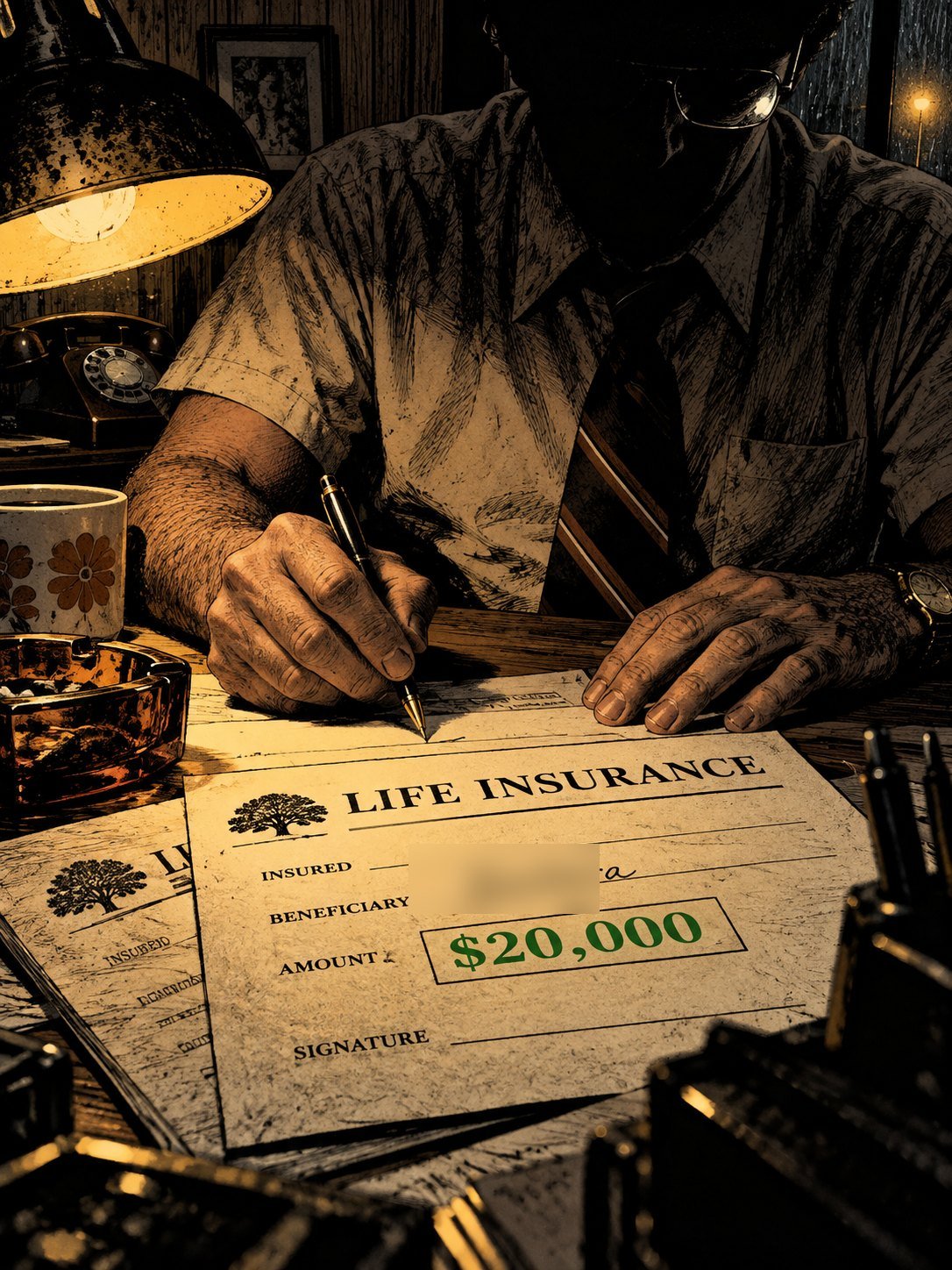
A life insurance policy under a desk lamp. The amount box reads $20,000. A second, identical policy lies beneath it.
In January 1974, O’Bryan had joined the “New Outlooks Club” at Pasadena State Bank. It covered every member of the family with a $10,000 life policy.
Then, “in late September or early October,” he went against his insurance agent’s advice and bought $20,000 policies on each of his children.
His wife, Daynene, did not know about them.
She had objected even to the small premiums. Life insurance on the children, she said, was unnecessary.
“By mid-October, both of appellant’s children were covered by several life insurance policies,” the court found.
O’Bryan himself had little or no coverage.
Taken together, that came to about $30,000 on each child.
KPRC says the new policies were taken out less than a month before the murder.
The policies were not the only thing he had been shopping for that autumn. (TCCA-1979) (UPI-1984-03-31) (HOUSTONIA-2013) (HCDC-2021) (KPRC-2024)
“How much would kill a person?” An optician goes looking for cyanide
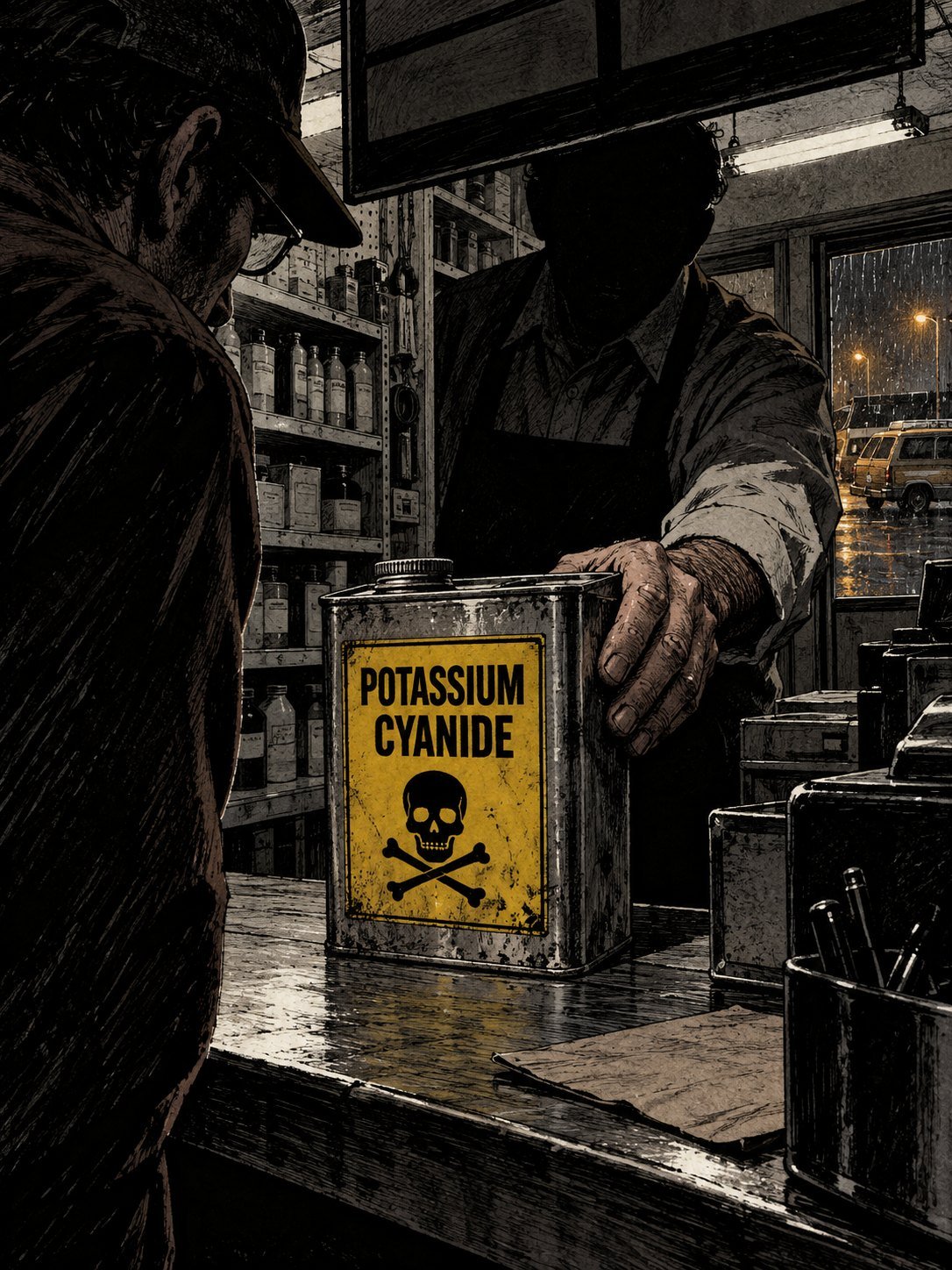
A big metal tin on a shop counter, labelled POTASSIUM CYANIDE. A man’s hand pushing it back across the counter.
In August 1974, O’Bryan asked his branch manager at Texas State Optical for cyanide. He said he wanted it to clean gold eyeglass frames.
About three weeks later, he asked again.
In early September, he phoned a former coworker, Bobby Terry, who pointed him to chemical companies.
Under “the guise of ‘curiosity,'” the court said, he asked how much would be fatal to a person, and how unknown chemicals are detected in a dead body.
At Curtin Matheson Scientific, he asked a salesman for a small quantity of cyanide.
He turned down the smallest container on offer. It held five pounds.
The court noted that the salesman’s earlier testimony had been inconsistent.
Where O’Bryan finally got his poison is still not settled. The district clerk’s case summary says he bought it from a garden shop on Halloween morning, but the court record shows no purchase.
What the record does show is why he wanted money so badly. (TCCA-1979) (HOUSTONIA-2013) (HCDC-2021)
A man drowning in debt: the adding-machine tape a detective found
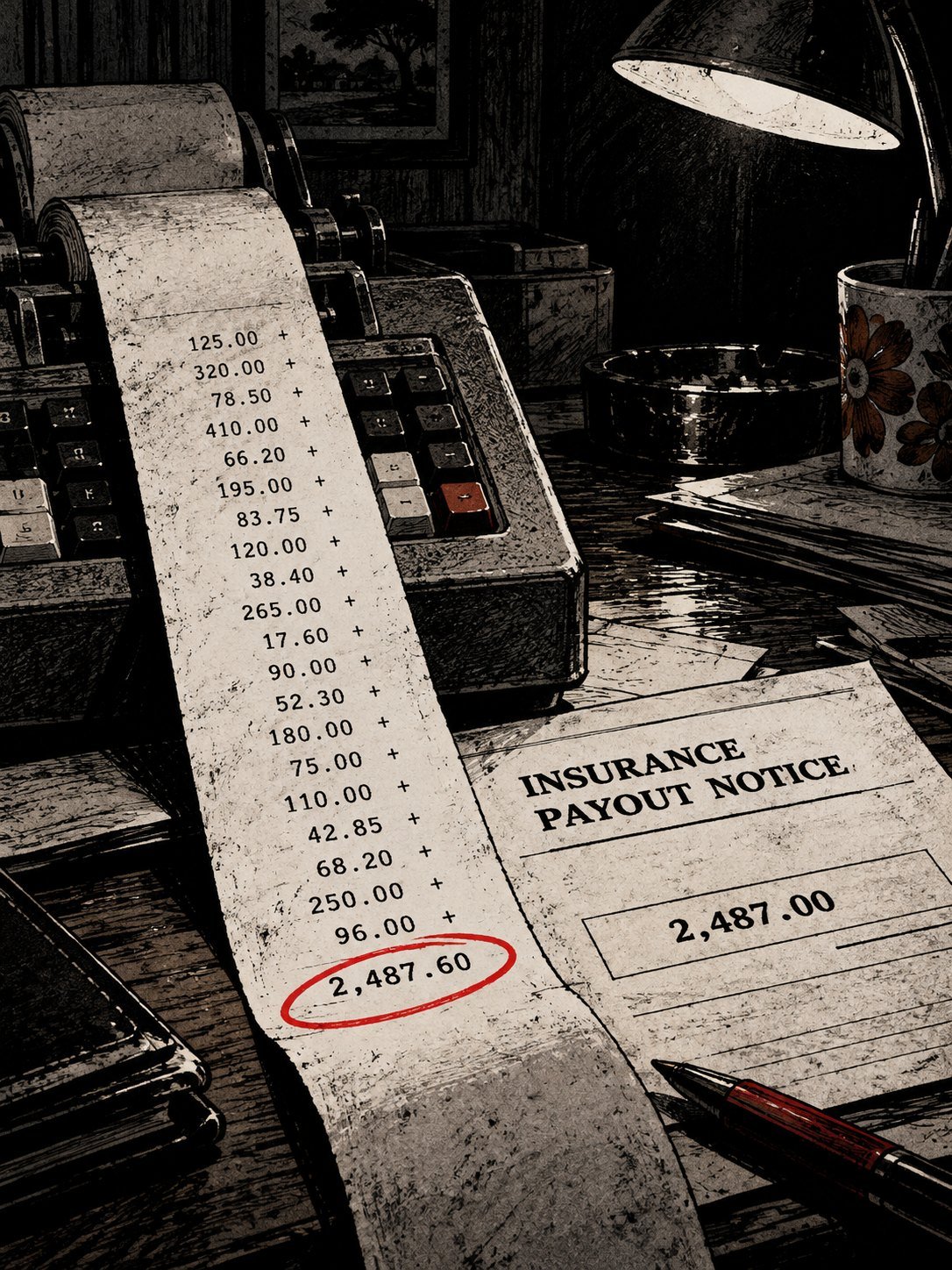
A long curl of paper tape spilling off an adding machine. The total at the bottom circled in red.
O’Bryan’s take-home pay was “about $150 per week,” the court said.
His debts were somewhere “between $20,000 and $100,000.”
He owed about $2,000 on a delinquent loan and $800 to the government. He was eight months behind on $149 car payments.
He had already sold the family home and put the $6,000 toward his debts. A lender had turned down his request for a $1,750 loan.
On 23 October, eight days before Halloween, he told his credit union he expected a large sum of money before the end of the year.
He told a coworker he would quit on 15 November. He talked with Jimmy Bates about buying a house, and asked him not to tell his wife.
Detective Harold Nassif found an adding-machine tape listing O’Bryan’s bills.
“It came to almost the exact amount of what he stood to collect.”
The morning after Timothy died, O’Bryan picked up the phone. (TCCA-1979) (ABC13-2014)
9am the next morning: an insurance call and six death certificates
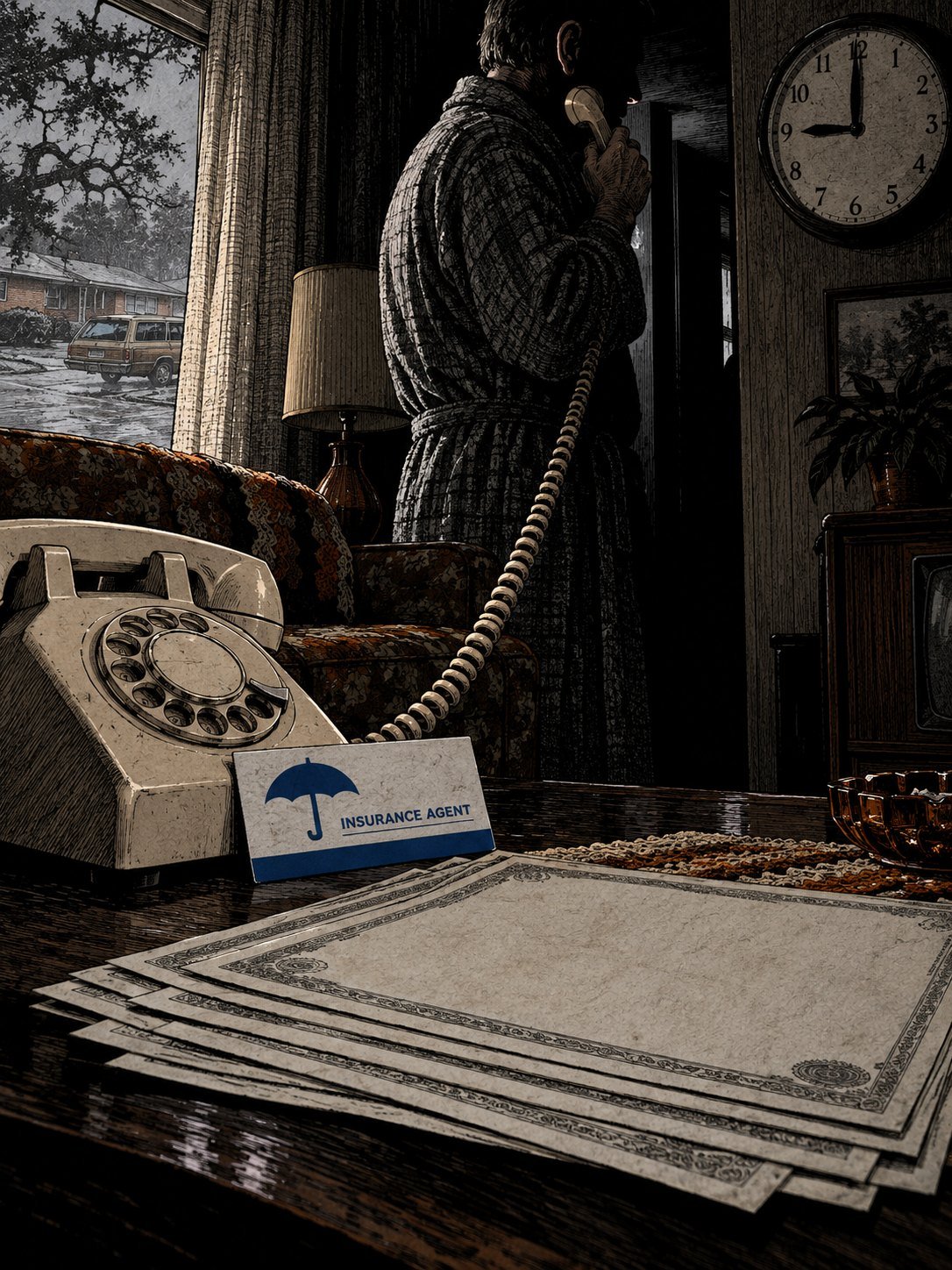
A beige rotary phone with the receiver lifted. A wall clock at nine. Six blank certificates stacked on a coffee table.
On Friday 1 November, the day after Halloween, O’Bryan met a funeral director and ordered six death certificates.
At about 9am, he phoned his life insurance agent to ask about collecting.
At about 9:30, he asked his bank about a policy held there.
He talked openly about how he would spend the insurance money, including on an extended vacation, the court said.
In public, he seemed grief-stricken.
In private, the court said, he showed no emotional shock. He seemed “excited” by the news coverage of his son’s death.
He told Jimmy Bates he did not see how “they can pin [Timothy’s death] on anybody.”
Two days later, he would stand up in front of his church.
And he would speak about his son. (TCCA-1979)
A deacon at the pulpit: the eulogy for Timothy O’Bryan
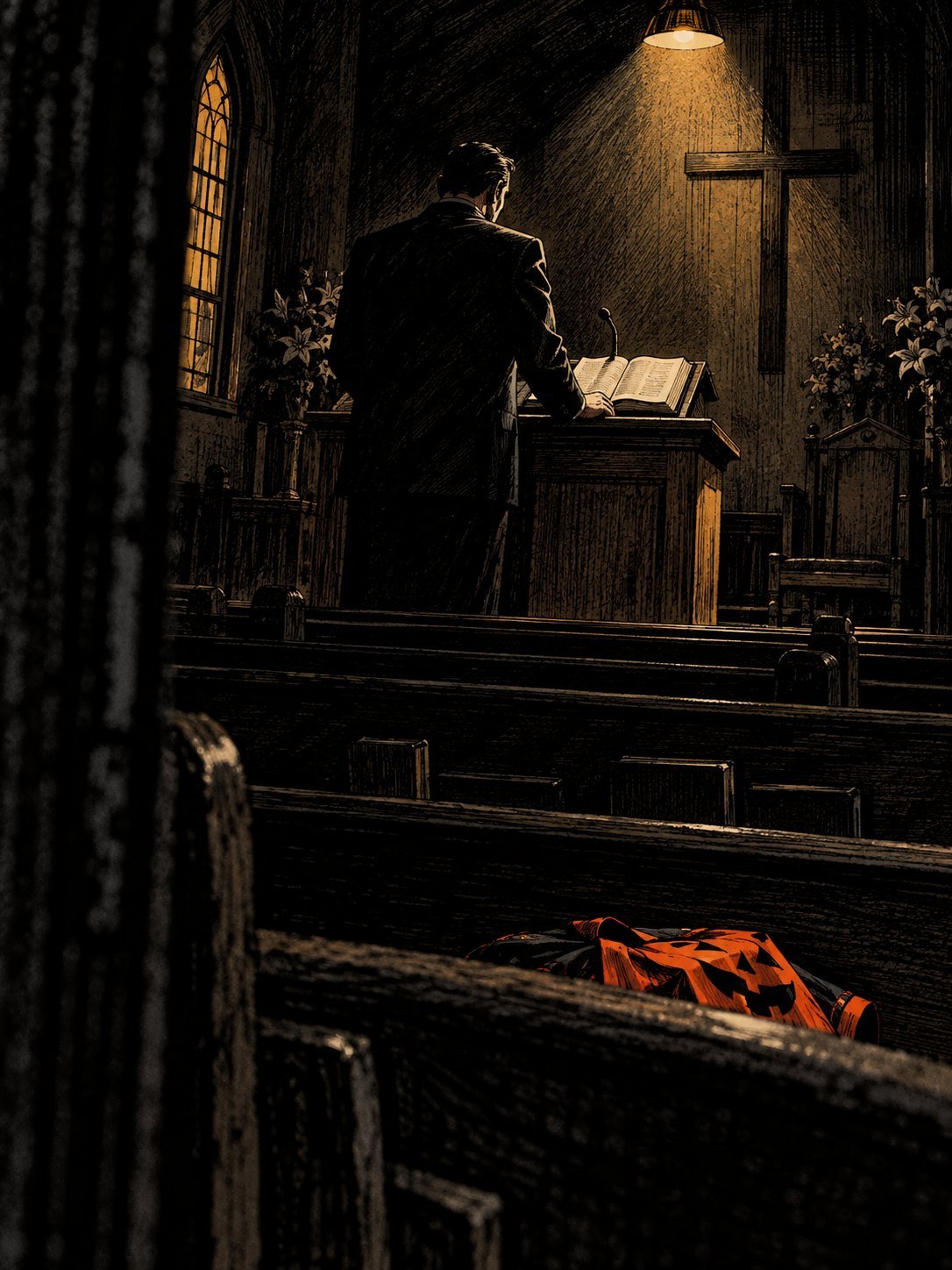
An empty church pulpit with an open Bible. A tall man in a dark suit, seen from behind. A small folded cape in the front pew.
The O’Bryans attended Second Baptist Church in Pasadena.
O’Bryan was described as a deacon and a member of the choir.
Neighbours told AP the family was active in the church, and that O’Bryan closely supervised his son.
About two weeks before Halloween, he had brought costumes home. The court said he seemed unusually excited about trick-or-treating.
Timothy’s memorial service was held on Sunday 3 November 1974.
His father gave an emotional eulogy.
By then, his account of where the candy came from had already started to wobble.
Police were looking hard at the man in the pulpit.
And they wanted to see the house he said the candy came from. (AP-BATT-1974-11-06) (HCDC-2021) (AETV-2020) (HOUSTONIA-2013) (TCCA-1979) (ABC13-2014) (ABC13-2018)
Citation and Donerail: the shifting story of where the candy came from
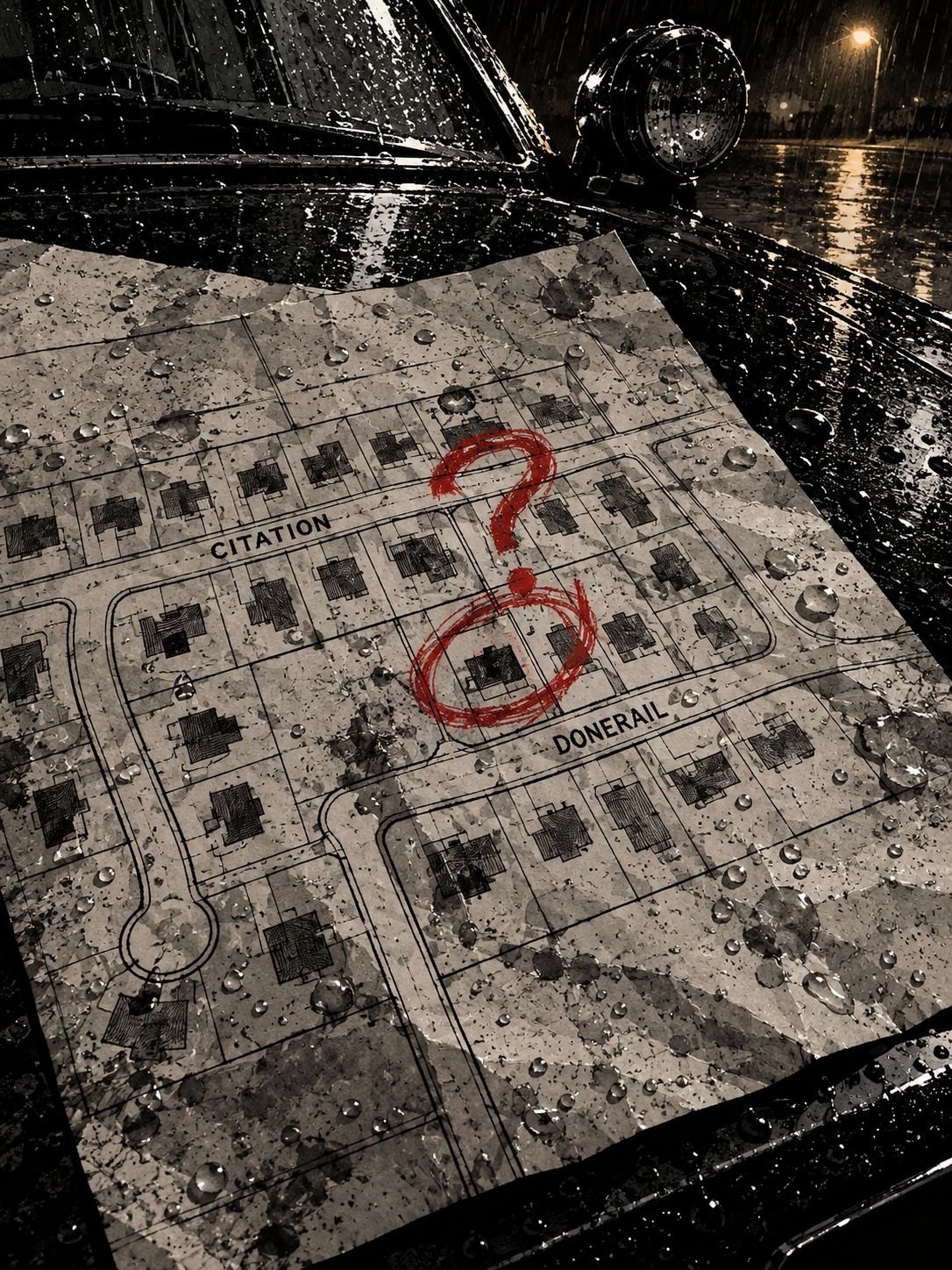
A rain-spotted street map on a police car bonnet. Two streets labelled CITATION and DONERAIL. One house circled, and a question mark over the circle.
At first, O’Bryan told police the candy came from a house in the same subdivision as the Bates home.
Over several days, his story changed, the court said.
Eventually he led police to Donerail.
He pointed to the dark house where he had stood alone for thirty seconds.
And he named the man who lived there, Courtney Melvin, as the one who had handed him the candy.
He said he was “almost positive.”
It was the story a frightened town was ready to believe: a stranger behind a dark door, poisoning children.
Police went to check it.
It did not survive the first check. (TCCA-1979)
Hobby Airport: the alibi that cleared the neighbour
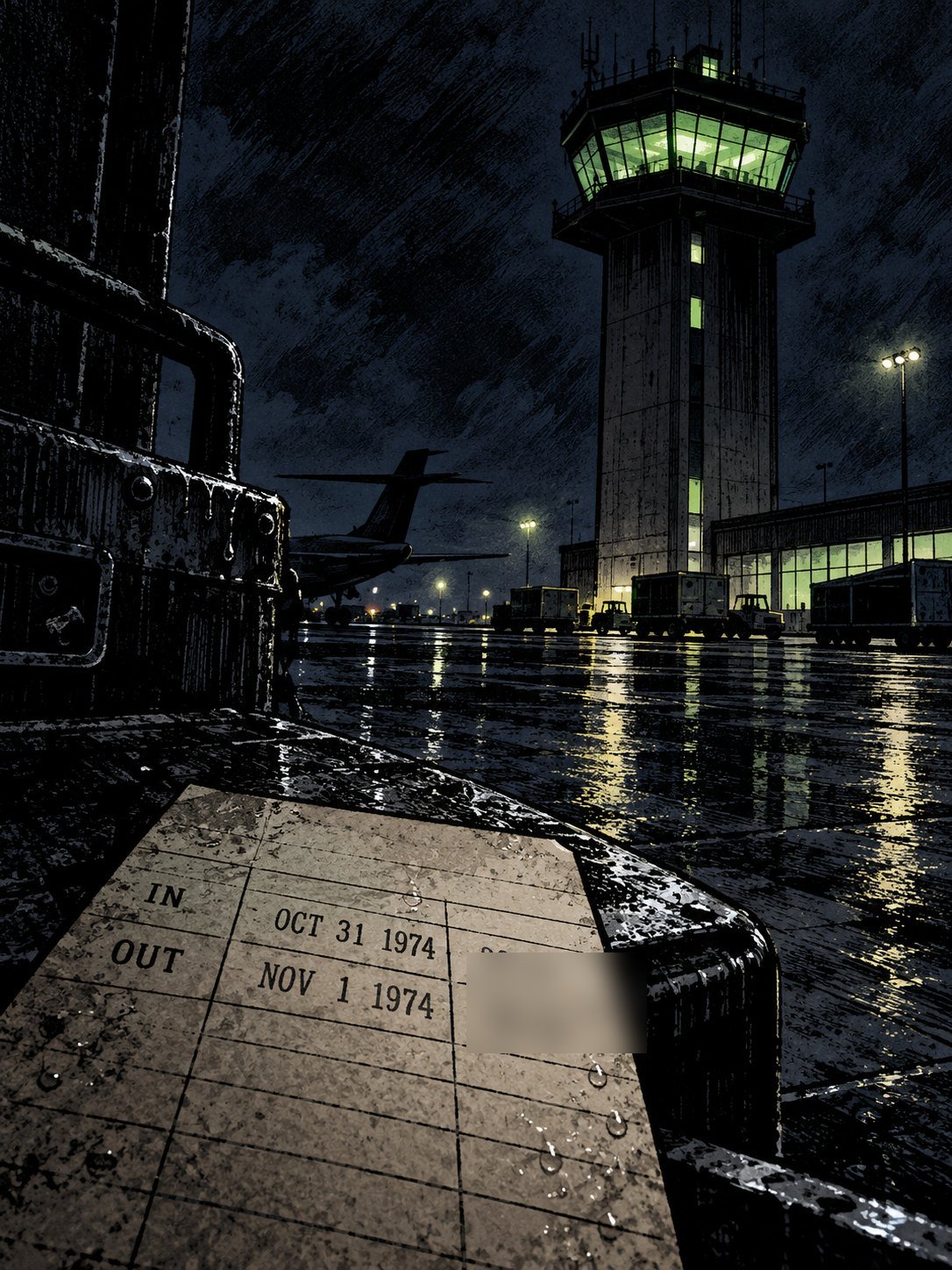
An airport control tower glowing against the night. In the foreground, a time card with its punch-in and punch-out stamps.
Courtney Melvin had left for work at 1:30pm on Halloween. He worked until 10:30pm and got home by 10:45.
He worked at Hobby Airport, and numerous witnesses confirmed he was there that night, KPRC reported.
His wife, Carolyn, had handed out treats until they ran out at 6:45pm.
After that, she did not answer the door.
No Pixy Stix had been given out from the house at all, the court said.
Whatever O’Bryan did in those thirty seconds, nobody in that house gave him candy.
A neighbour, C. E. Melvin, told AP: “We knew our neighbors. And we knew there was no way that one of our neighbors had poisoned that boy.”
The stranger at the dark door did not exist.
That left one man who had held the candy. (TCCA-1979) (KPRC-2024) (AP-BATT-1974-11-06)
The polygraph and the arrest: Ronald Clark O’Bryan charged with murder
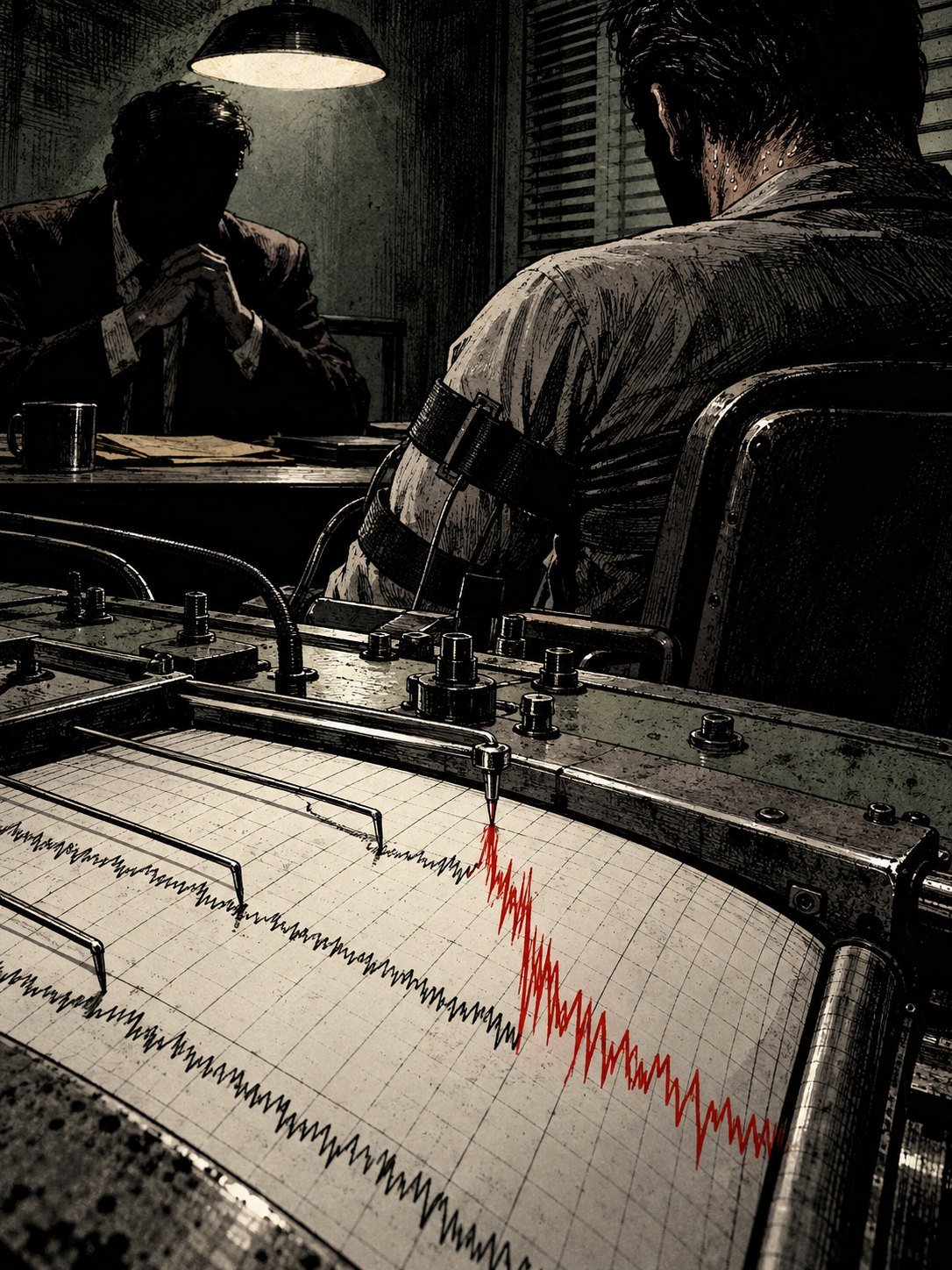
A 1970s polygraph machine, its pens scratching jagged lines. An empty chair facing it. One needle jumping off the scale.
On Monday 4 November, O’Bryan took a polygraph test.
By then, police had also learned about the life insurance.
He was charged with murder. AP reported he was arrested “late Monday night.” A&E gives the date as 5 November.
Either way, it was within days of Halloween, and the day after his son’s memorial.
Police Capt. R. E. Rhodes said: “At this time, we cannot comment as to any other aspect of this case.”
District Attorney Carol Vance said police believed they had “sufficient evidence to back the charge.”
O’Bryan’s lawyer, Richard Harrison of Dallas, said he would seek an early hearing.
The case against him did not rest on the polygraph.
It rested on small, ordinary objects. (AP-BATT-1974-11-06) (AP-BATT-1974-11-07) (AETV-2020)
A stapler in a parking lot: the evidence that tied the father to the poison
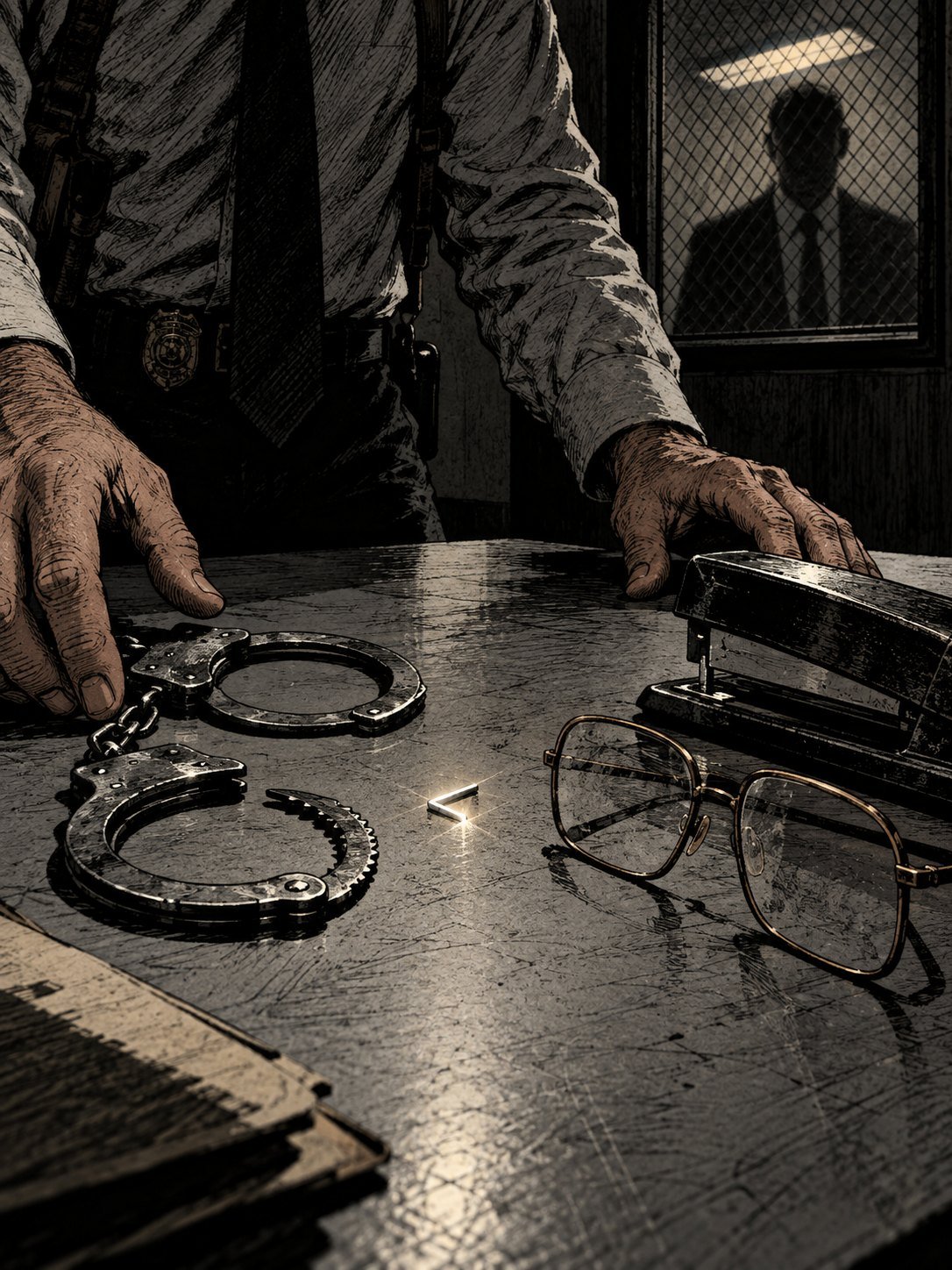
A pair of open handcuffs on a grey table, beside an office stapler and wire-rimmed optician’s glasses. One tiny staple caught in the light.
On Halloween day, a customer saw O’Bryan in the parking lot of the shopping centre where his optical store stood.
He was carrying a stapler and a bag. Its contents were unknown, the court said.
In the family home, police found scissors and a knife carrying a substance similar to candy residue.
Comparison did not produce a positive match, the court noted.
The Houston Chronicle later reported traces of plastic and candy powder on the blade of his pocketknife.
Bond was set at $100,000.
Within a week, local mayors were calling for an end to Halloween treats. Residents had raised more than $1,800 for a reward fund.
The town had been braced for a stranger. Instead, it was getting ready for a trial.
His wife would be one of the witnesses. (TCCA-1979) (KUFF-2004) (AP-BATT-1974-11-06)
46 minutes: the 1975 trial and death sentence of the Candy Man
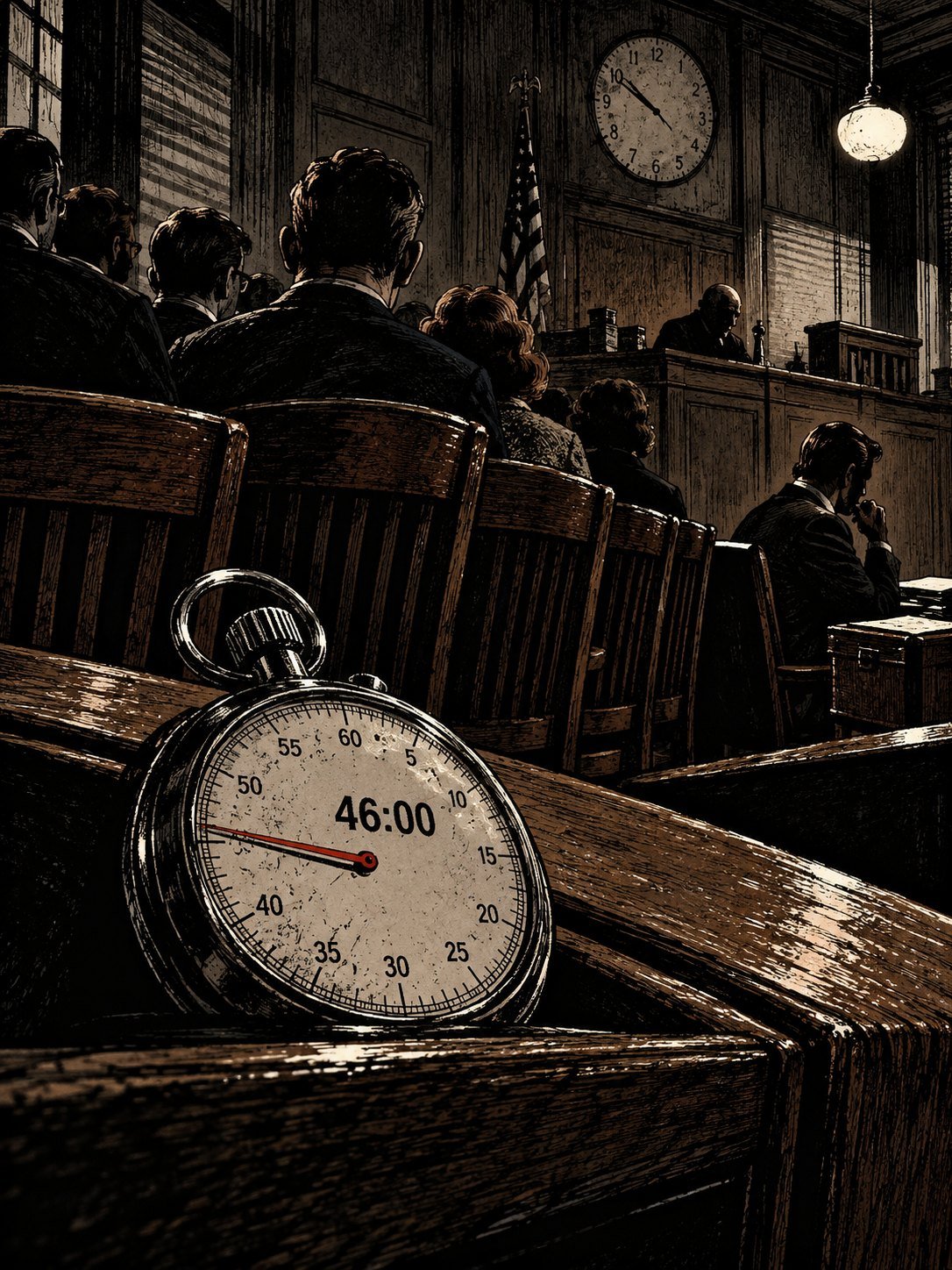
An empty jury box. On the rail, a stopwatch stopped at 46:00.
O’Bryan was tried in Harris County for capital murder for remuneration: killing his son for insurance money.
Coworkers testified. So did the chemical salesman, and his in-laws.
His wife, Daynene, testified for the prosecution.
O’Bryan took the stand and denied everything. Other witnesses said his reputation for truthfulness was bad.
In closing, prosecutor Vic Driscoll said: “He sacrificed his only son, not on the altar of God as Abraham might have done, but on the altar of his own greed.”
The jury took 46 minutes to convict him.
It took 71 minutes to return a sentence of death. The verdict came on 3 June 1975.
He was also convicted on four counts of attempted murder, one for each child who did not eat the candy.
He would spend the next nine years insisting he was innocent. (TCCA-1979) (AETV-2020) (KUFF-2004) (KPRC-2024) (KPRC-2022) (HOUSTONIA-2013) (HCDC-2021) (BRECK-2021) (VICE-2016)
“I do not want to die”: nine years of appeals from death row
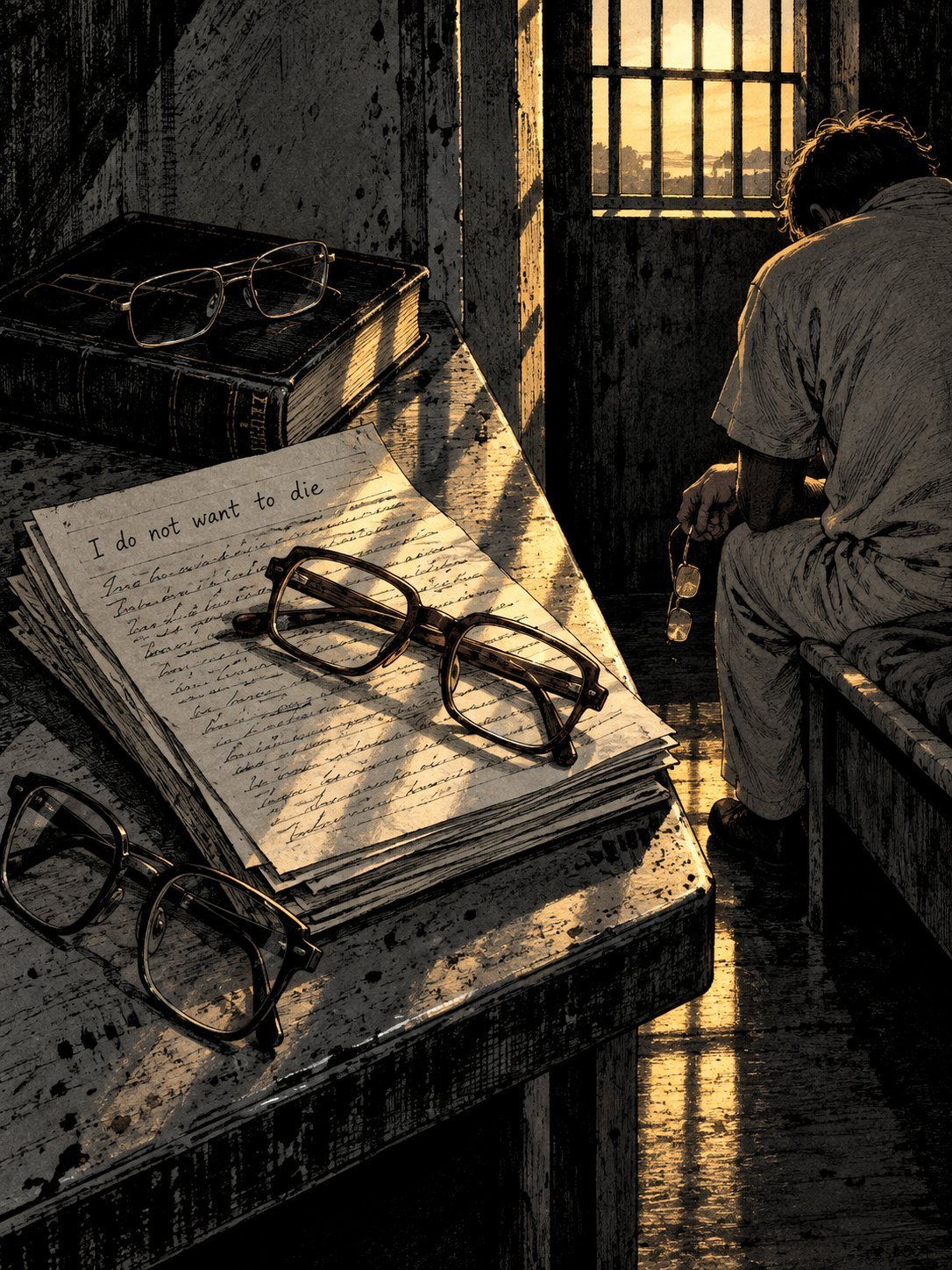
Three pairs of eyeglasses in a prison cell: one on a shelf, one on a stack of letters, one beside a Bible.
On 26 September 1979, the Texas Court of Criminal Appeals upheld the conviction.
“A more calculated and cold-blooded crime than the one for which appellant was convicted can hardly be imagined,” it wrote. “The record reflects months of premeditation and planning.”
The US Supreme Court declined to hear the case in 1980. State appeals failed in 1980 and 1982.
His execution was set for 31 October 1982, eight years to the day after Timothy died. A federal court stayed it.
In March 1984, the parole board voted 4 to 2 against a reprieve. “It seems there has to be some finality to jury decisions in this state,” prosecutor Bert Graham said.
O’Bryan told reporters: “I’ve stated from the beginning that I had absolutely nothing at all to do with this, and I maintain that now.”
He wrote by hand to Governor Mark White asking for 30 more days: “I do not want to die!” White said he would not be inclined to grant a stay “without good reason.”
Reporter Tony Pilkington visited him that month. O’Bryan wore glasses, had a second pair in his pocket and a third on a shelf. His eyes, Pilkington wrote, were “cold and steely.”
On 29 March, the Fifth Circuit refused to stop the execution. (TCCA-1979) (CA5-1984) (UPI-BATT-1982-10-29) (UPI-BATT-1984-03-28) (UPI-BATT-1984-03-29) (BATT-1984-03-30) (BRECK-2021)
“Trick or treat!”: the crowd outside the Huntsville execution
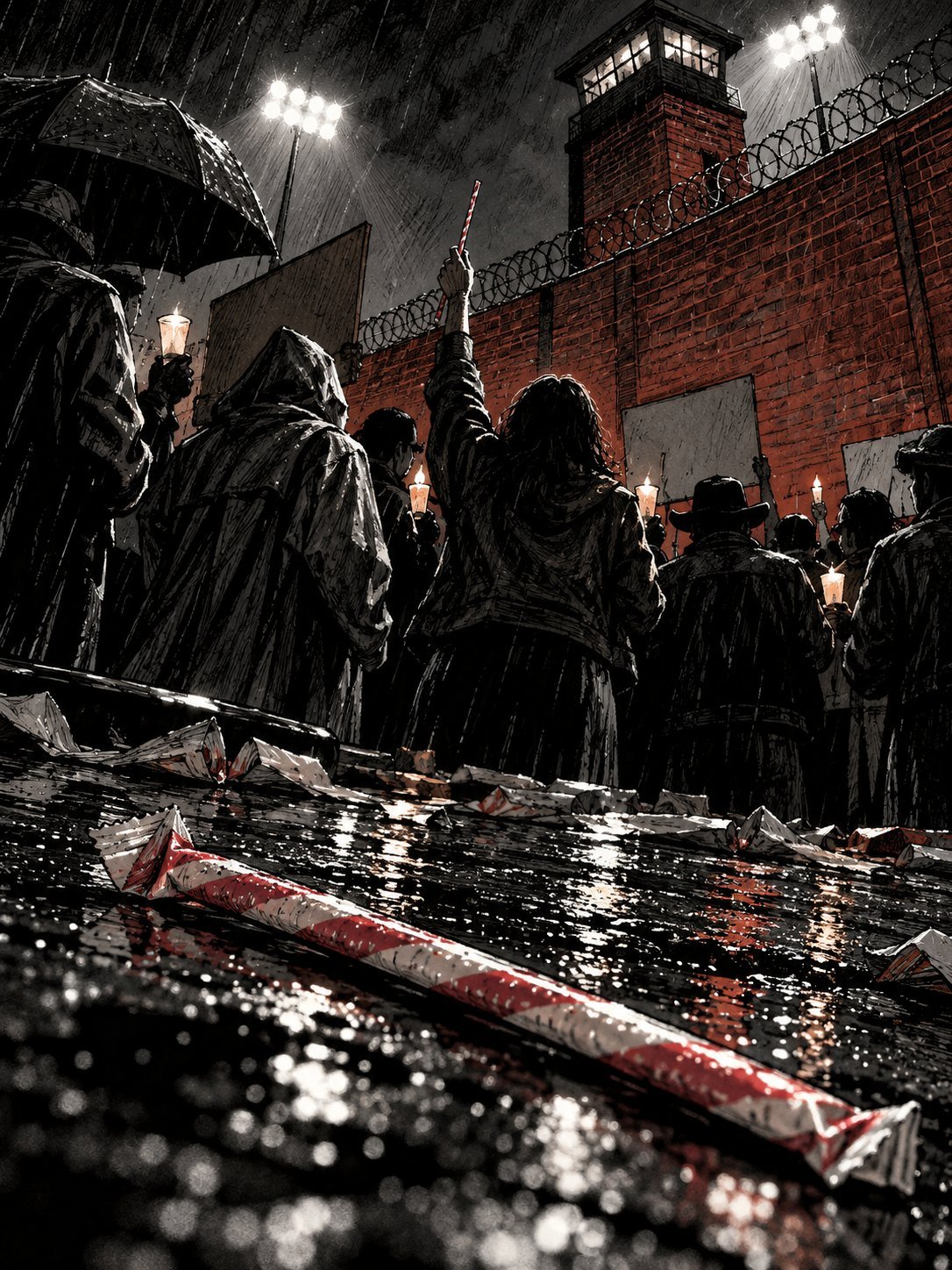
A candy straw on wet pavement outside a red-brick prison wall. Floodlights. A crowd seen from behind, one hand raising another straw into the air.
About 300 people gathered outside the Huntsville Unit on the night of 30 March 1984.
Some shouted “Trick or treat!” and threw candy at anti-death-penalty protesters.
Pilkington saw nuns praying on one side. On the other, supporters of the death penalty held Halloween-themed signs and waved Pixy Stix.
Inside, O’Bryan’s last statement began: “What is about to transpire in a few moments is wrong!”
“Therefore, I would forgive all who have taken part in any way in my death,” he said.
He was executed by lethal injection and pronounced dead at 12:48am on 31 March 1984. He was the third person in Texas to die by injection.
His father, Bill O’Bryan, said: “No son of mine will be buried in a convict’s grave because he’s no convict.”
His former wife, Daynene, said: “It’s over. It’s over. That’s fine. Justice has taken a slow turn but it’s done.” Jean Bates said: “Ron O’Bryan put himself in that death chamber.”
He was gone. The fear he left behind was not. (VICE-2016) (HCDC-2021) (BRECK-2021) (TDCJ-LAST) (UPI-1984-03-31)
Checking every piece: how the Candy Man changed Halloween
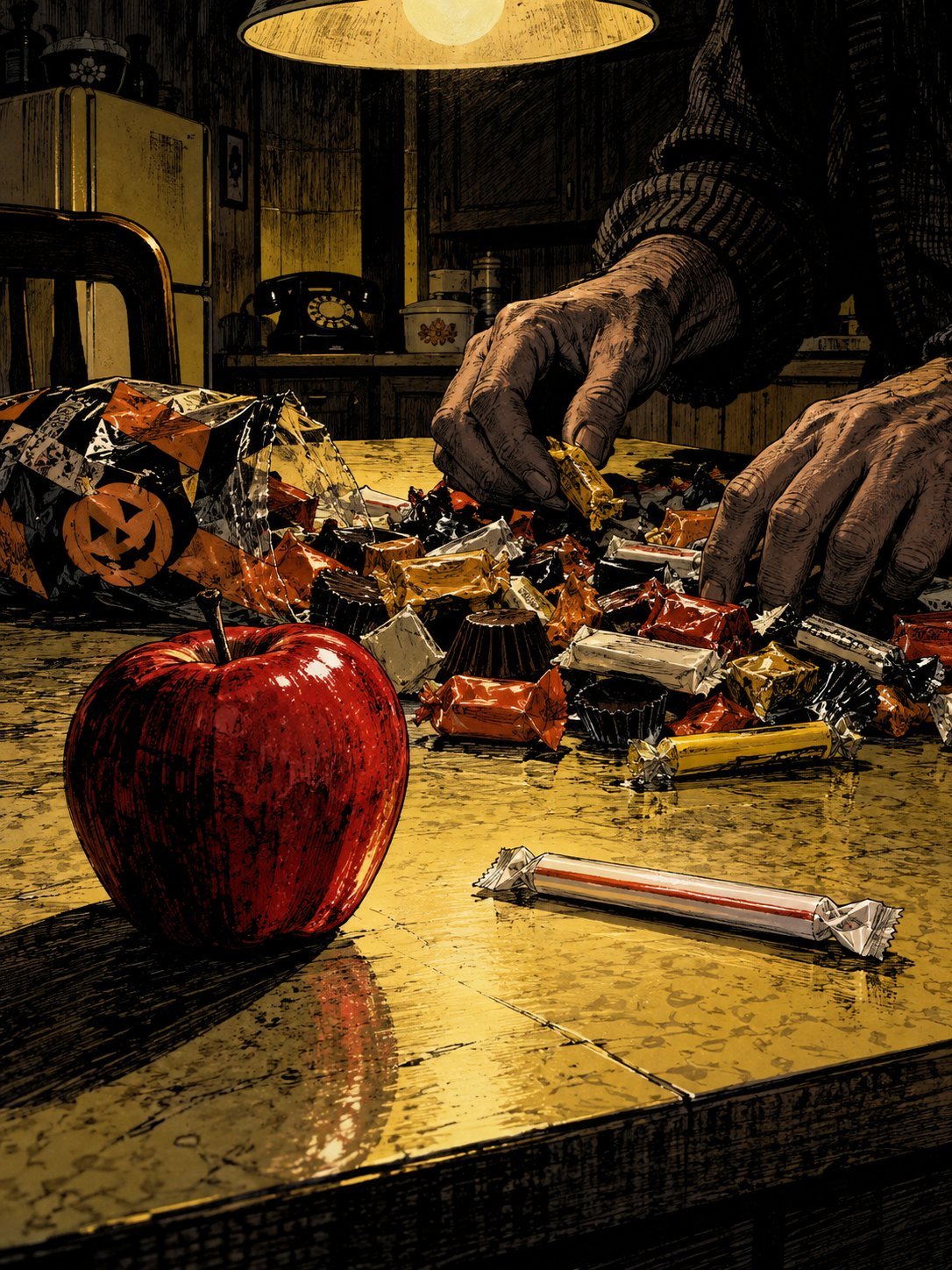
A child’s Halloween haul tipped out on a kitchen table. An adult’s hands sorting it, piece by piece. One sweet set aside on its own.
A KPRC reporter said in 1984 that O’Bryan was notorious for two reasons: “he killed his own son, and he ruined the tradition of Halloween trick or treating.”
He became known as “The Candy Man” and “The Man Who Killed Halloween.”
Parents went through their children’s candy. Fire stations offered to X-ray it, Houstonia reported.
In 1975, a Houston mother came up with “Punkin Money,” coupons to hand out instead of candy.
John Ditmars, 11 at the time, remembered Halloween 1975: “It was dead, nobody went trick or treating.”
Driscoll called the case Halloween’s “9/11 moment.”
But the fear was older than O’Bryan. In 1970, the New York Times had already run an unsubstantiated warning about razor blades hidden in treats.
O’Bryan’s crime seemed to prove the nightmare true.
Then a sociologist went looking for the other cases. (KPRC-2022) (KUFF-2004) (HOUSTONIA-2013) (CHRON-BLOG-1975) (KPRC-2024) (COUNTER-2017)
Joel Best’s finding: no child killed by a stranger’s poisoned Halloween candy
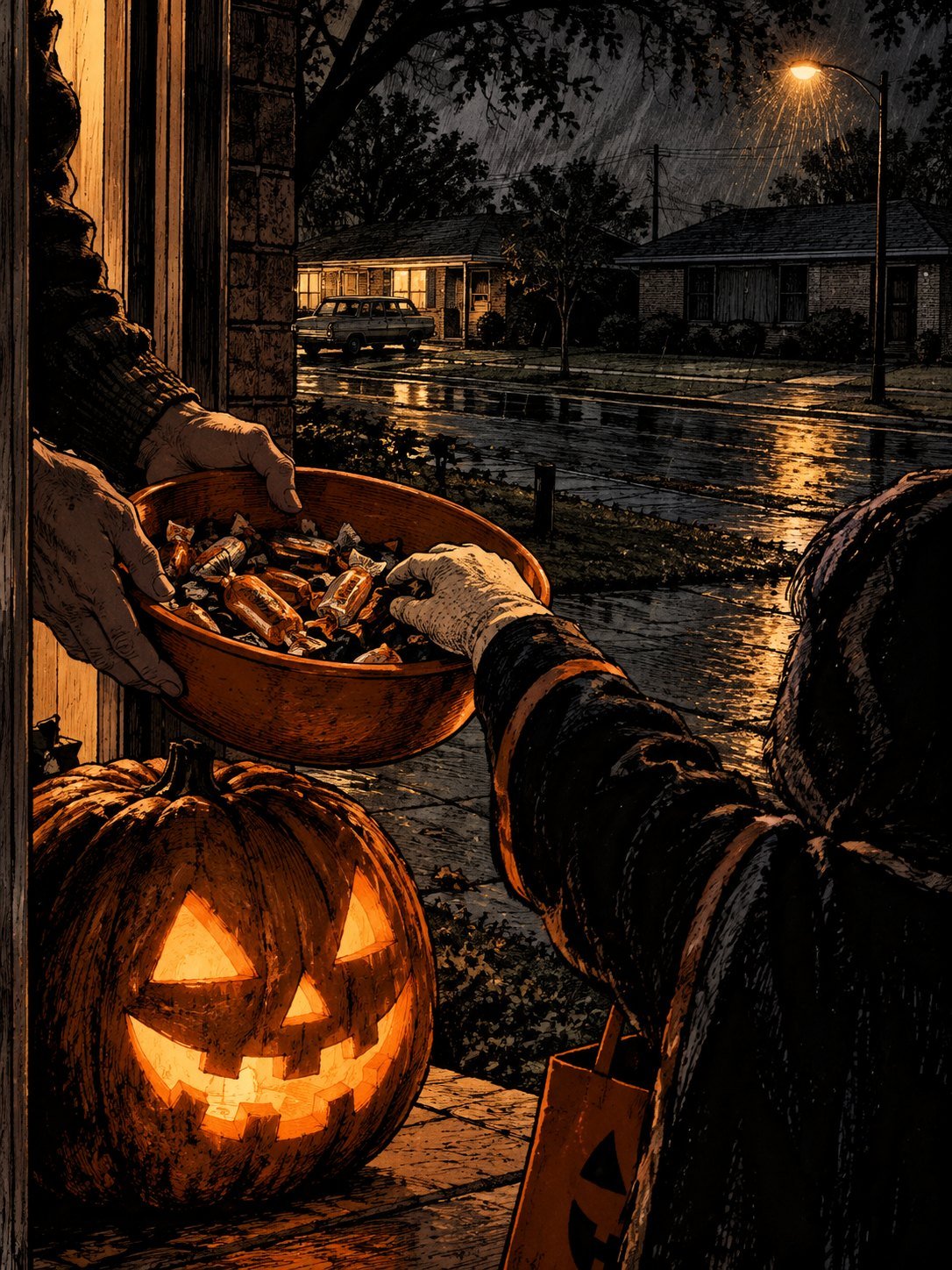
A jack-o’-lantern glowing on a doorstep. A small gloved hand reaching into a bowl of candy. Across the street, one house stands dark.
In 1985, sociologist Joel Best and Gerald Horiuchi studied reports of Halloween candy tampering going back to 1958. They called the threat “greatly exaggerated.”
Best searched the New York Times, the Los Angeles Times and the Chicago Tribune.
“I could not find a single report of a child who had been killed or seriously injured by a contaminated treat picked up on the course of trick-or-treating,” he wrote.
He has kept counting for decades. His tally lists five deaths once blamed on Halloween poisoners.
Three turned out to have natural or medical causes.
The other two were caused by family. One was a Detroit boy in 1970 who had found heroin in a relative’s home.
The other was Timothy O’Bryan.
“An urban legend is harder to kill than a vampire,” Best said.
No child is known to have been killed by poisoned candy from a stranger. The only Halloween candy killer anyone could find was a father, and the boy he killed was his own. (JSTOR-2015) (BEST-UD) (BEST-EVIDENCE)
Case notes: Ronald Clark O’Bryan, the Candy Man
On Halloween night, 31 October 1974, eight-year-old Timothy O’Bryan died after eating a giant Pixy Stix laced with cyanide. His father, Ronald Clark O’Bryan, an optician from Deer Park, Texas, had handed out five poisoned straws to children that night, including his own son and daughter. He had taken out life insurance on both children weeks earlier (TCCA-1979). He was convicted of capital murder in 1975 and executed on 31 March 1984. He never admitted the crime (UPI-1984-03-31) (TDCJ-LAST).
Timeline
| When | What happened |
|---|---|
| Jan 1974 | $10,000 policies on every family member through a bank club (TCCA-1979) |
| Aug–Sep 1974 | Asks coworkers and a chemical supplier about cyanide (TCCA-1979) |
| Late Sep/early Oct 1974 | Buys $20,000 policies on each child without his wife’s knowledge (TCCA-1979) |
| 31 Oct 1974 | Trick-or-treating on two Pasadena streets in the rain; Timothy dies within an hour (TCCA-1979) |
| 1 Nov 1974 | Calls his insurance agent at about 9am; orders six death certificates (TCCA-1979) |
| 4–5 Nov 1974 | Charged with murder; bond set at $100,000 (AP-BATT-1974-11-06) |
| 3 Jun 1975 | Convicted; sentenced to death (VICE-2016) (HOUSTONIA-2013) |
| 26 Sep 1979 | Texas Court of Criminal Appeals affirms the conviction (TCCA-1979) |
| 31 Mar 1984 | Executed by lethal injection at Huntsville (UPI-1984-03-31) |
Evidence locker
Real places and records only. Illustrations elsewhere in this file are AI-generated.
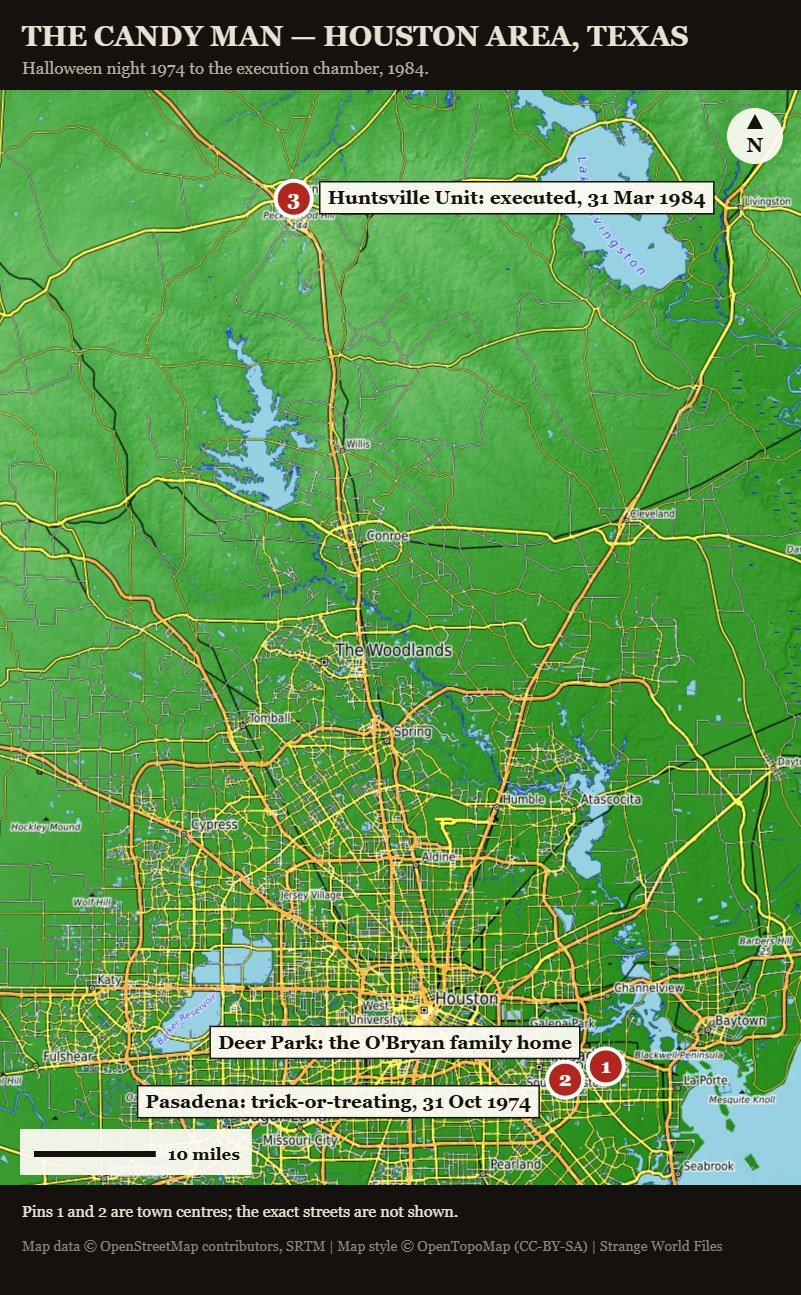 EXHIBIT A · TAP TO ENLARGE
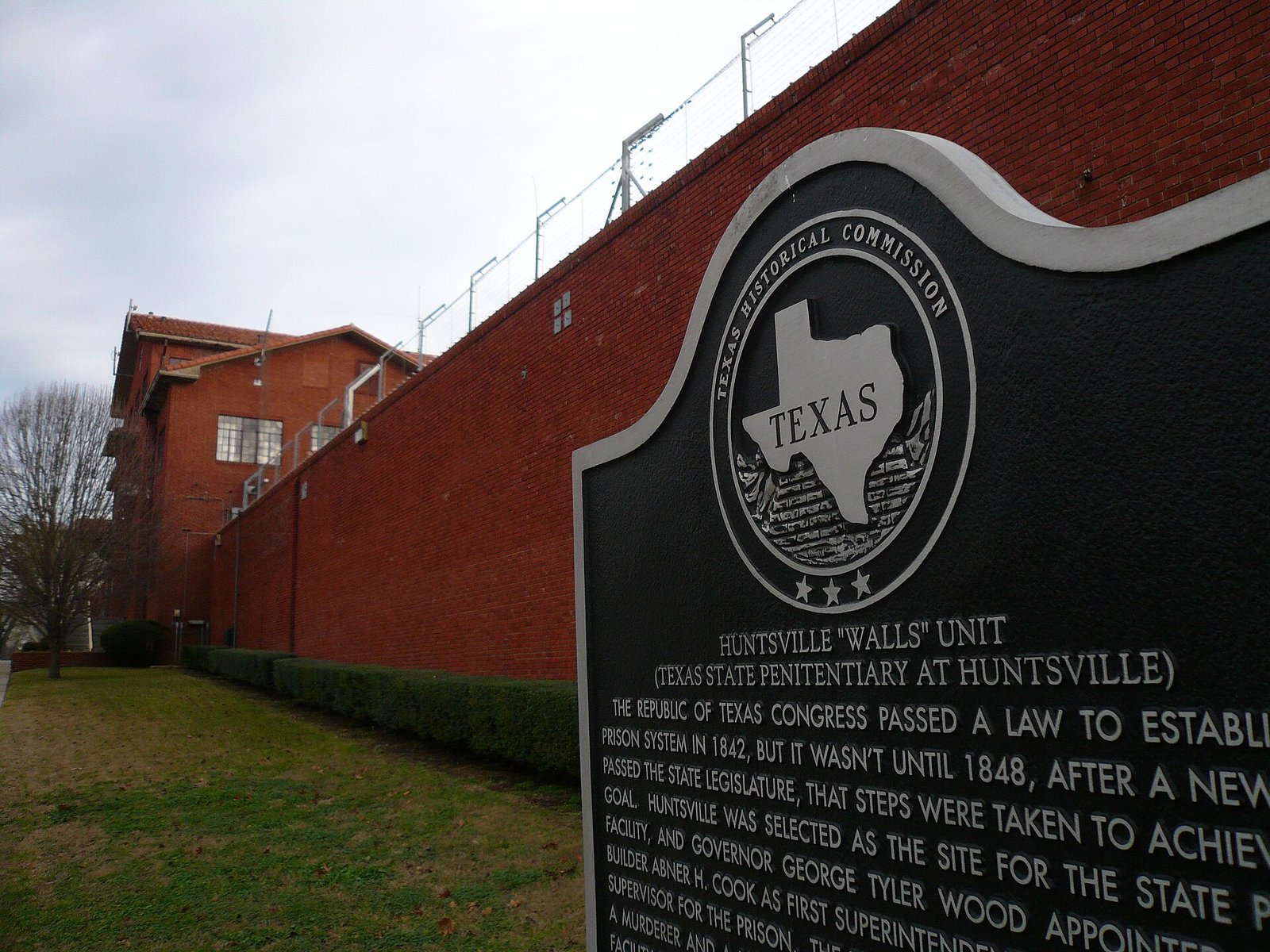 EXHIBIT B
Where the records disagree
| Detail | What sources say |
|---|---|
| Insurance amount | The court record works out to about $30,000 per child; other reports give totals from $20,000 to about $100,000 (TCCA-1979) (UPI-BATT-1984-03-28) |
| Pasadena or Deer Park | The family lived in Deer Park; dinner and trick-or-treating were in a Pasadena subdivision (AP-BATT-1974-11-06) (TCCA-1979) |
| Arrest date | Late on Monday 4 November (AP) or 5 November (AP-BATT-1974-11-06) |
| Execution date | Prison records list 30 March 1984; he was pronounced dead at 12:48am on 31 March (TDCJ-LAST) (UPI-1984-03-31) |
| Where the cyanide came from | Never established in the court record (TCCA-1979) |
What we still don’t know
- Exactly where and when O’Bryan obtained the cyanide.
- When and where he filled and stapled the straws.
- Why he chose that dark house on Donerail.
Editor’s note
Some cases are hard to read. This one made me question humanity itself. A father stood on a rainy porch for about thirty seconds, came back with five candy straws, and handed one to his own eight-year-old son. The next morning, at about nine, he was on the phone to his insurance agent.
Korea has had its share of crimes committed for insurance money, and I won’t list them here. What stays with me is how ordinary that night looked: two families out in the rain, a boy from church knocking at the door, a child who fell asleep still holding a straw he couldn’t open.
For fifty years, parents have checked their children’s Halloween bags for a stranger’s poison. In this case there was no stranger. It was his father. That is the part I still cannot make sense of.
— Strange World Files
Case file summary
- What: A father poisoned Halloween candy to collect life insurance on his children
- Where: Pasadena and Deer Park, Texas
- When: 31 October 1974
- Toll: One child killed; four more children given poisoned candy, none of whom ate it
- Status: Convicted 1975; executed 1984; never confessed
Illustrations are AI-generated artistic interpretations, not photos. No real person is depicted with a recognizable face. Read how we research and illustrate these files.
Related files
- One Sip of Iced Coffee, Then She Collapsed. Jessica Wongso Got 20 Years, but No Camera Saw the Poison Go In
- The Hwaseong Murders: The Real Killer Behind ‘Memories of Murder’ Was Always Right There
- Ted Bundy Was Never Charged With Killing the Police Chief’s Daughter. 52 Years Later, DNA Proved He Did
Sources
- O’Bryan v. State, 591 S.W.2d 464 – Texas Court of Criminal Appeals (26 Sep 1979) (opinion text via HallApproved)
- O’Bryan v. McKaskle, 729 F.2d 991, Nos. 84-2182/84-2183 – U.S. Court of Appeals, Fifth Circuit (29 Mar 1984)
- O’Bryan v. Estelle (summary only) – Studicata / Fifth Circuit (1982)
- Ronald Clark O’Bryan, last statement – Texas Department of Criminal Justice
- Case of the Month, October 2021 (State of Texas v. O’Bryan) – Harris County District Clerk (Oct 2021)
- “Took out insurance: Halloween poisoning charged against dad” (AP) – The Battalion, Texas A&M (6 Nov 1974), p. 4
- “Defense wants early hearing date” (AP) – The Battalion (7 Nov 1974), p. 7
- “Texas asks Supreme Court for Halloween ‘Candy Man’ execution” (UPI) – The Battalion (29 Oct 1982), p. 7
- “O’Bryan’s reprieve denied” (UPI) – The Battalion (28 Mar 1984), p. 3
- O’Bryan still pleading innocence (UPI; headline partly illegible) – The Battalion (29 Mar 1984), p. 5
- O’Bryan’s note to governor (staff and wire reports; headline partly illegible) – The Battalion (30 Mar 1984), p. 1
- O’Bryan dies by injection – UPI Archives (31 Mar 1984)
- The Man Who Killed Halloween (John Lomax) – Houstonia (30 Sep 2013)
- Forty years ago, ‘Candyman’ turned Halloween truly terrifying – ABC13/KTRK (1 Nov 2014)
- The Candyman: Houston’s own real-life Halloween horror story – ABC13/KTRK (31 Oct 2018)
- Houston’s horror story: ‘Man Who Killed Halloween’ remembered decades later (Keith Garvin) – KPRC Click2Houston (28 Oct 2018)
- The Evidence Room, Episode 2 – The man who killed Halloween (Jason Nguyen, Robert Arnold) – KPRC (19 Oct 2022)
- A legacy of fear, 50 years after ‘The Candyman’ tainted trick-or-treating (Robert Arnold) – KPRC (31 Oct 2024)
- 50 years ago, a Houston killer dubbed the ‘Candyman’ poisoned his son’s Halloween candy – KHOU 11 (c. Oct 2024; undated on page)
- The True Story of the Notorious Trick-or-Treat Murderer (Michael Segalov) – VICE (31 Oct 2016)
- The Haunting Legacy of Ronald Clark O’Bryan, the Man Who Killed Halloween (Crystal Ponti) – A&E (22 Oct 2020)
- Crime History: Texas father poisons son with trick-or-treat candy (Scott McCabe) – Washington Examiner (28 Oct 2010)
- Looking into the eyes of evil: The day I covered the execution of Texas’ infamous Halloween killer (Tony Pilkington) – Breckenridge Texan (28 Oct 2021)
- “The Candy Man”, 30 years later (blog reproducing a 2004 Houston Chronicle article; Chronicle original not opened) – Off the Kuff (29 Oct 2004)
- October 30, 1975 (Punkin Money) – Houston Chronicle Bayou City History blog
- Halloween poisonings – Snopes (undated legacy page)
- Halloween Sadism: The Evidence (Joel Best) – University of Delaware UDSpace (revised annually; table through 2025)
- My Seasonal Job (Joel Best) – University of Delaware Research magazine (undated)
- Trick or Treat Sadists: A Halloween Urban Legend (Erin Blakemore) – JSTOR Daily (30 Oct 2015)
- Halloween sadism: the history behind the myth of poisoned treats (Joe Fassler) – The Counter (31 Oct 2017)
- Ronald Clark O’Bryan – Wikipedia (accessed 31 Oct 2026; cross-check only)