JAL Flight 123: The Tail Fin Tore Away and All Four Hydraulic Systems Failed. Four of 524 Survived
What the record shows
- When: Monday 12 August 1985, 6:56 p.m.
- Toll: 520 dead, 4 survivors, of 524 aboard
- Cause: A faulty 1978 repair to the aft pressure bulkhead (official finding)
Still uncertain
- Whether more people could have been saved if rescuers had reached the ridge during the night.
- What exactly was said and decided about US help on the night of 12 August.
- Why the crew never put on their oxygen masks.
Narrated Mystery: press play and hear the whole case read aloud, like a true crime podcast episode, or an audiobook for a long drive (about 15 minutes). The narrator is an AI voice.
Listen to the narration above first, then read along. The key words are underlined in the story.
- fatigueweakening of metal caused by repeated stress
- rivetsmetal pins that hold metal sheets together
- hydraulicssystems that move parts using liquid under pressure
- phugoida slow up-and-down swing of a plane’s nose
- thrustthe pushing force produced by an engine
- decompressiona sudden loss of air pressure inside a plane
- reluctantnot willing to do something
- debrisbroken pieces left after a crash
1. What happened to the same aircraft on 2 June 1978?
It struck its tail on the runway while landing at Osaka.
2. For how long did the crew steer with engine power alone?
For 32 minutes.
3. When did local firemen reach the wreck?
At about 9 a.m. on 13 August, more than 14 hours after the crash.
On 12 August 1985 a fully booked Japan Air Lines 747 lost its tail fin and every hydraulic line. The crew steered with engine power alone.


“Immediate, ah, trouble”
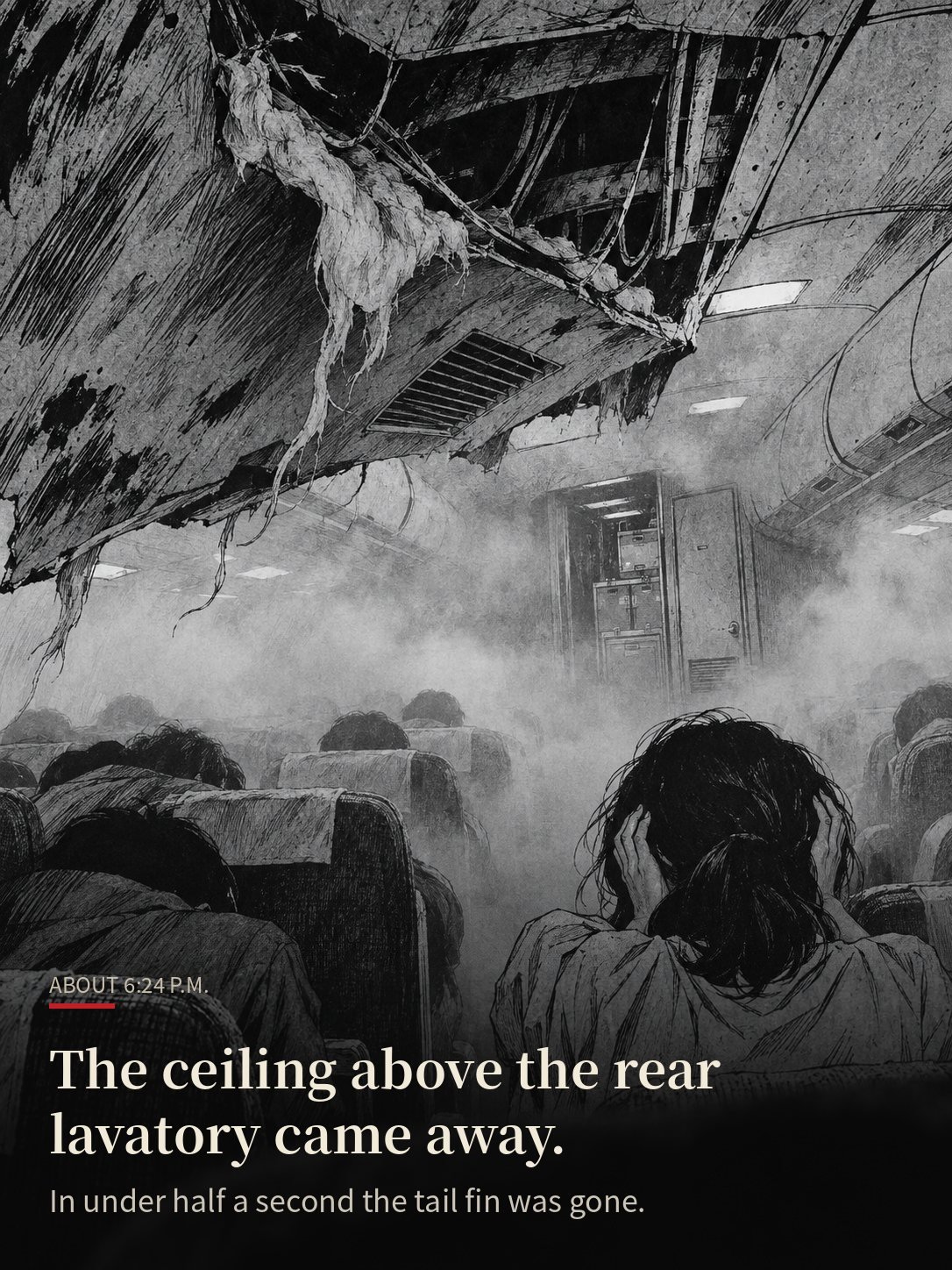
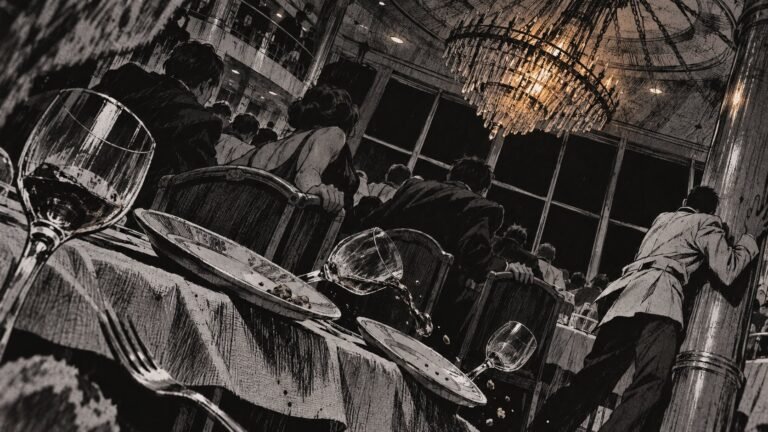
Monday 12 August 1985, a few minutes before half past six in the evening. Japan Air Lines Flight 123 is climbing toward Osaka at about 24,000 feet.
There is a bang. A vibration runs through the airframe.
Near the back of the cabin sits an off-duty JAL flight attendant, travelling as a passenger in row 56. She hears the noise and feels a sharp pain in her ears. A white mist forms in the air. Above the rear lavatory, the ceiling comes away.
Behind that ceiling, where no one on board could see, the back of the aircraft had just burst. Less than half a second later most of the tail fin was gone, and with it every line of hydraulic fluid the pilots needed to steer.
524 people were aboard. They had 32 minutes left. (TIME-1985) (FAA-LL) (PCI)
The eve of Obon
It was the night before Obon, the mid-August holiday when much of Japan goes home to honour family ancestors. Seats out of Tokyo were hard to find.
Flight 123 was a short evening hop, Tokyo Haneda to Osaka, and it was fully booked: 509 passengers and 15 crew.
The aircraft was a Boeing 747SR, a version of the jumbo built for short, crowded domestic routes. Its registration was JA8119.
That evening it was making its fifth flight of the day. In total the airframe had made 18,835 landings. (BRIT) (PCI) (FAA-LL)
6:12 p.m.
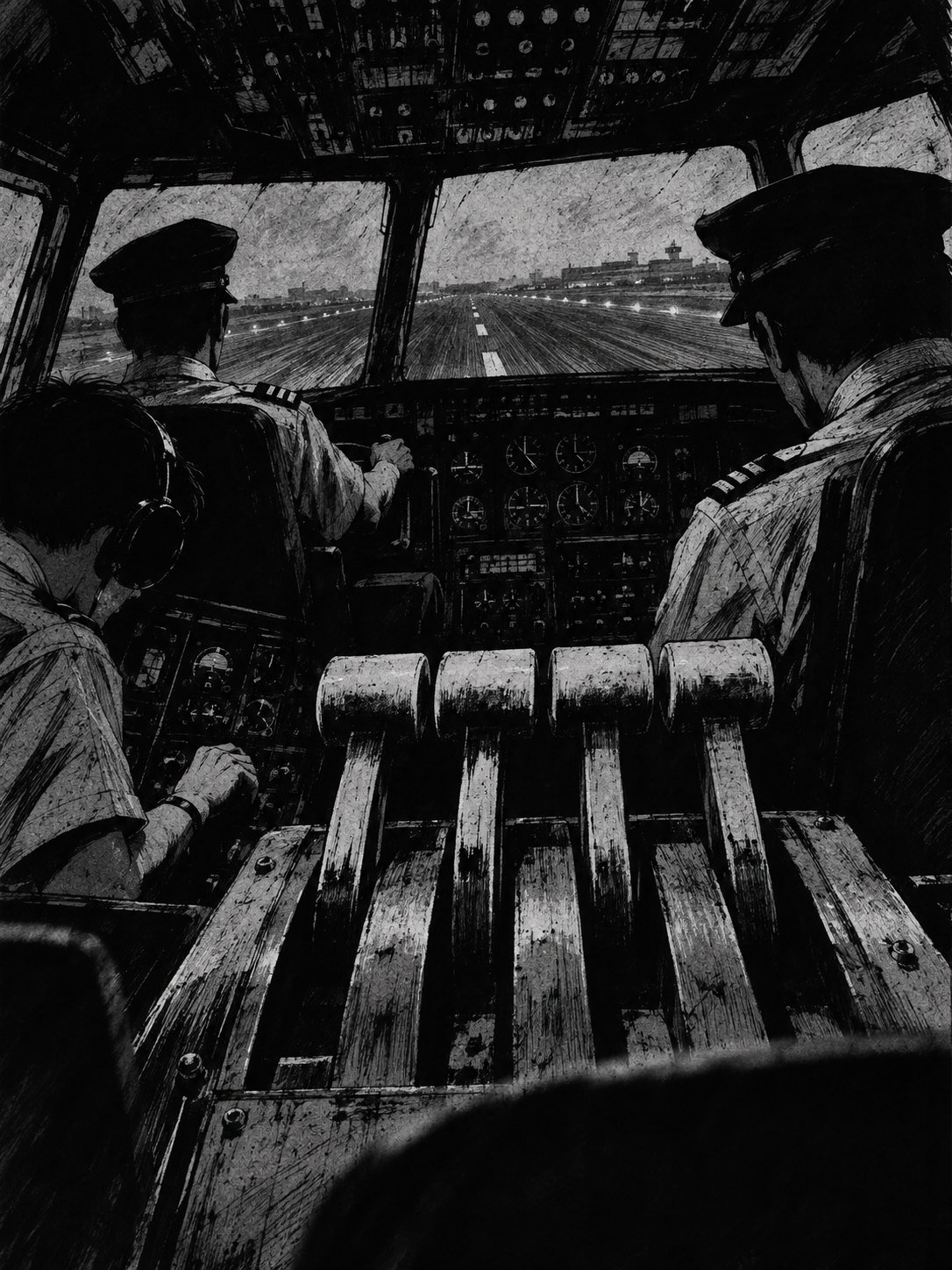
It took off from Haneda at 6:12 p.m., twelve minutes late.
Three men sat on the flight deck. Captain Masami Takahama was in the right-hand seat. The left seat, normally the captain’s, belonged that evening to First Officer Yutaka Sasaki, who was training for his own command and was flying the aircraft. Behind them sat the flight engineer.
Nothing about the departure stood out.
The fault that would bring the jet down had been inside it for seven years. (TIME-1985) (FAA-LL) (SCMP) (BRIT)
Osaka, 1978
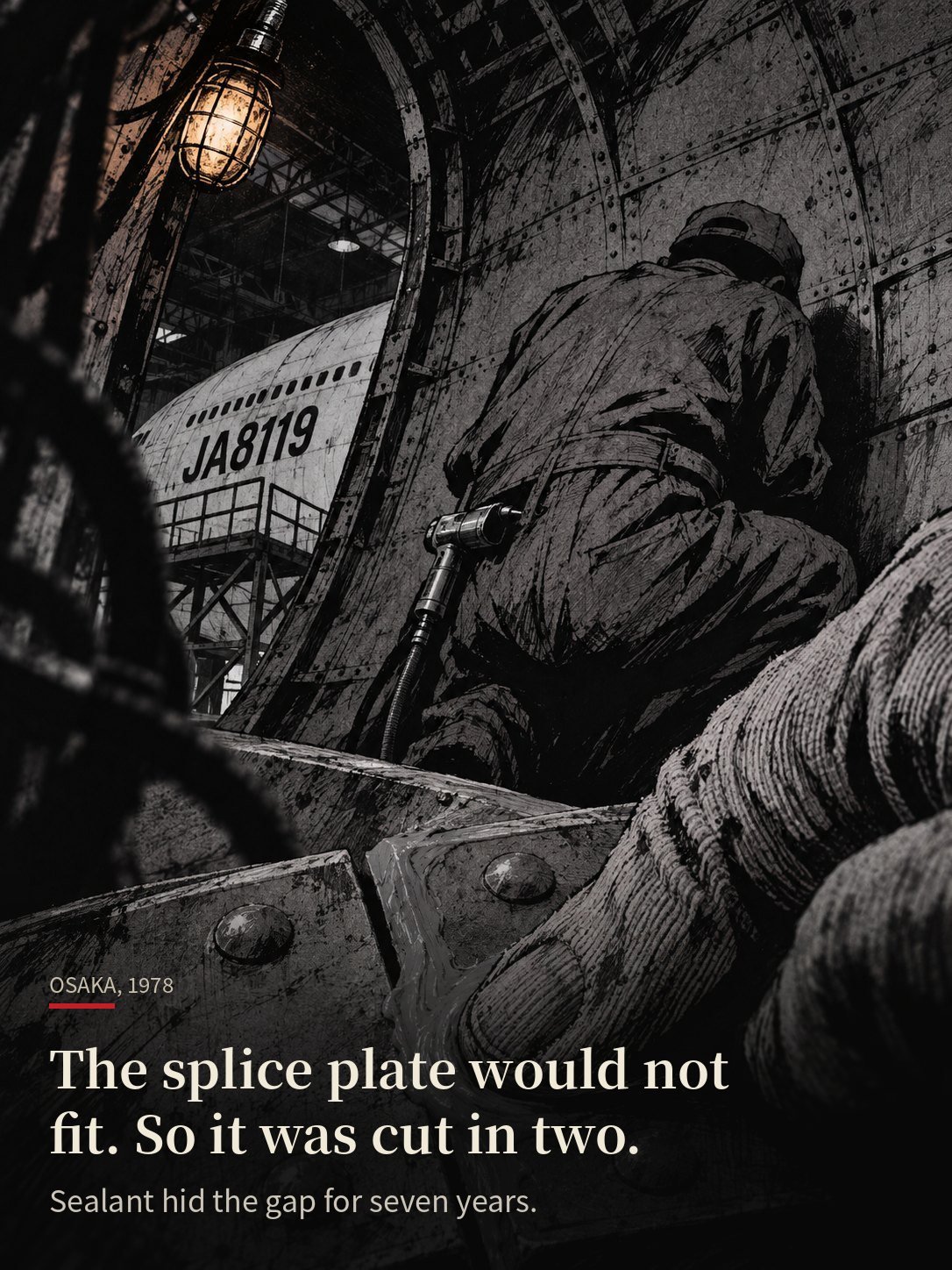
On 2 June 1978 the same aircraft, JA8119, struck its tail on the runway while landing at Osaka. Twenty-five passengers were injured.
The strike damaged the rear fuselage and the aft pressure bulkhead, the dome-shaped wall at the back of the cabin that holds the cabin’s air pressure in at altitude.
JAL brought in a Boeing repair team, and they replaced the lower half of the bulkhead. The design called for the two halves to be joined by one splice plate, fastened with two rows of rivets. The plate was hard to fit. So it was cut into two pieces, and along the cut the joint was held by a single row.
Sealant covered the gap. From either side the repair looked correct. Investigators later estimated the joint kept only about 70 percent of its intended strength, and over the next seven years fatigue cracks grew along that one overloaded row of rivets. (FAA-LL) (TIME-1985) (NTSB-1985)
Squawk 7700
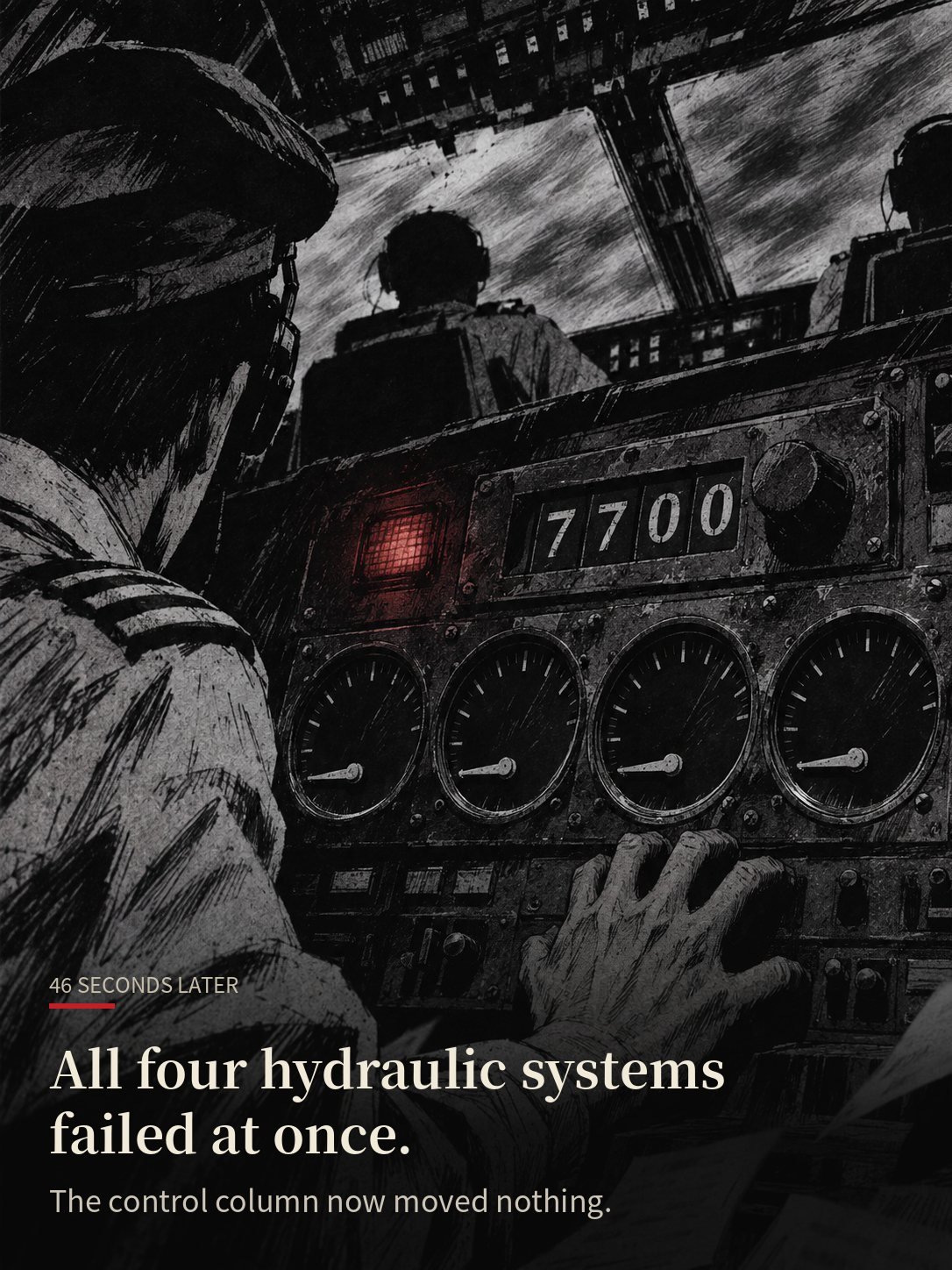
Forty-six seconds after the bang, the crew declared an emergency and asked to go back to Tokyo.
They spoke to Tokyo Control in English, as Japanese crews did on that frequency. “Immediate, ah, trouble.” Then: “Request turn back to Haneda. Descend and maintain 220.”
On the flight engineer’s panel, all four hydraulic systems were draining away.
Four systems are there so that losing one, or even three, still leaves something to fly with. On JA8119 all four had been cut in the same instant, when the tail broke apart. (FAA-LL) (TIME-1985)
“But now uncontrol”
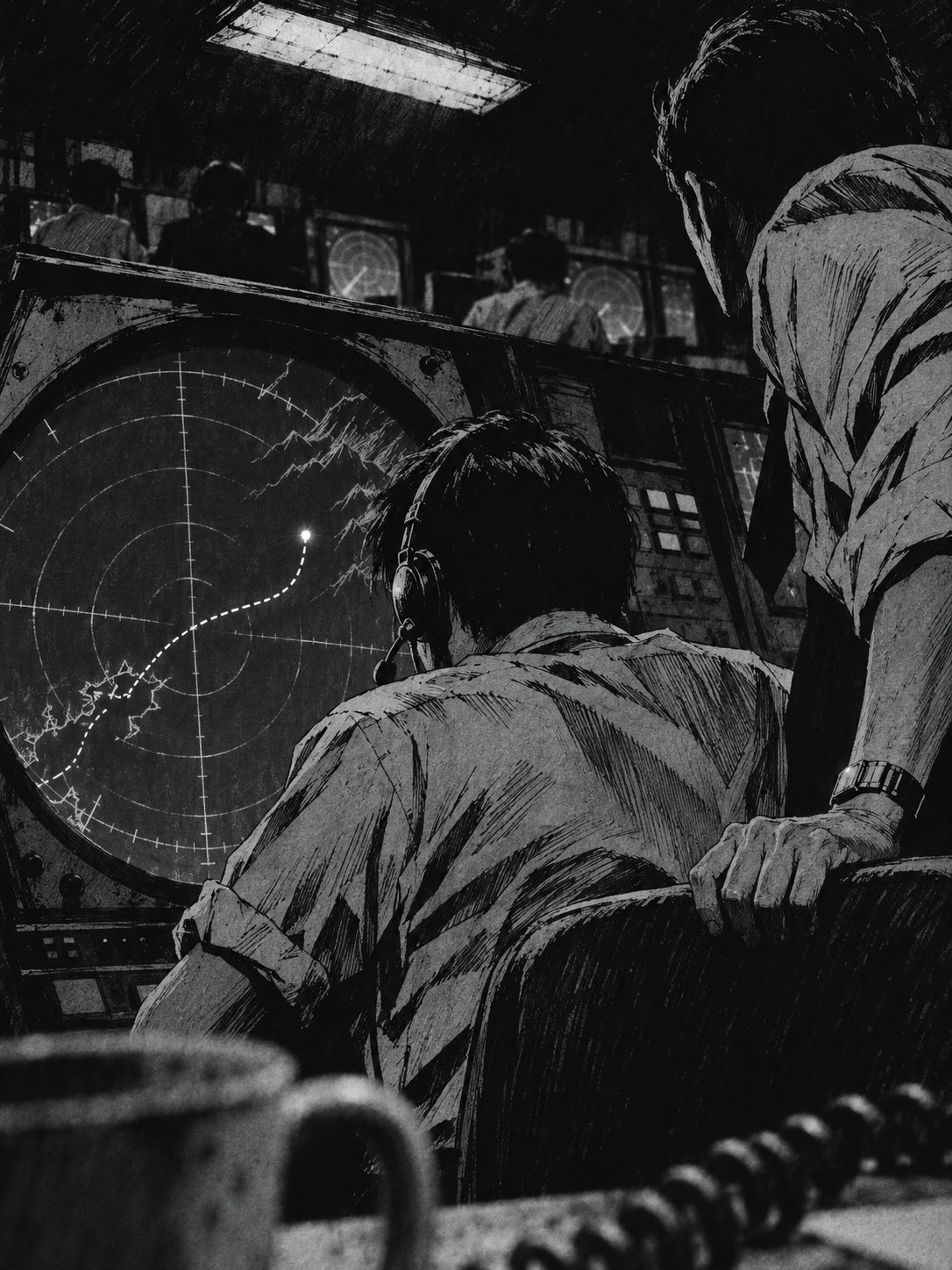
Tokyo Control told the flight to fly a magnetic heading of 90 degrees.
The reply came back: “But now uncontrol.”
Around 6:33 p.m. the crew reported “R5 broken”, meaning a rear door they believed had failed. No door had failed. Then: “Cabin-pressure drop.”
On the controllers’ screens, Flight 123 was not turning where it was told to turn. It could not. (TIME-1985) (CSM-0814)
Steering with the engines
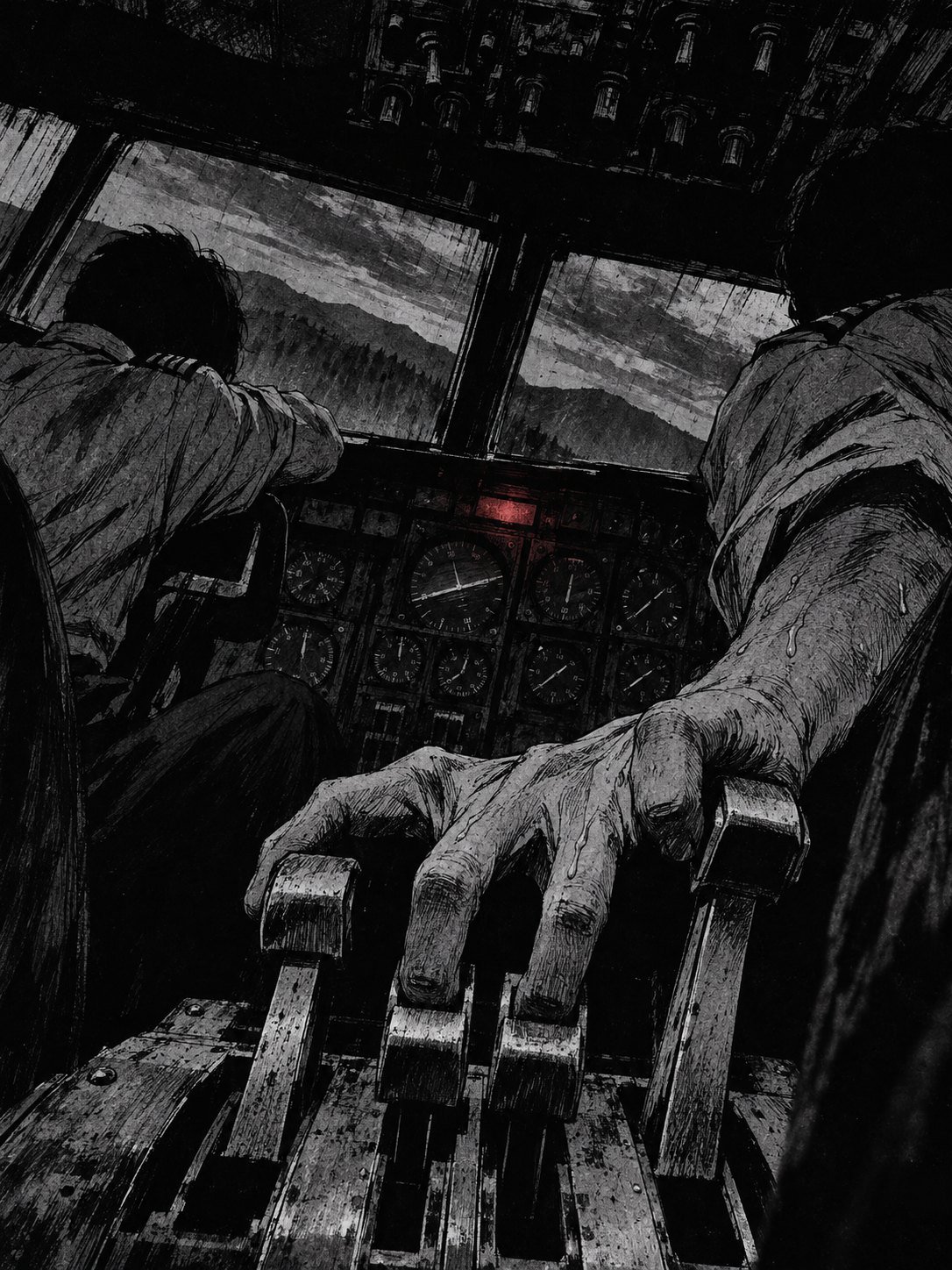
Without hydraulics the control column moved nothing at all. The jumbo began two motions at once: a long, slow swing of the nose up and down, which pilots call a phugoid, and a side-to-side rocking and yawing called a Dutch roll.
The only thing the crew could still use was engine power. More thrust lifts the nose of a 747; less lets it sink. More power on one side than the other turns it.
For half an hour they flew a 500-ton aircraft that way.
JAL’s deputy chief 747 pilot put it plainly afterwards: “the plane was kept aloft by engine thrust only.” (FAA-LL) (TIME-1985)
Masks
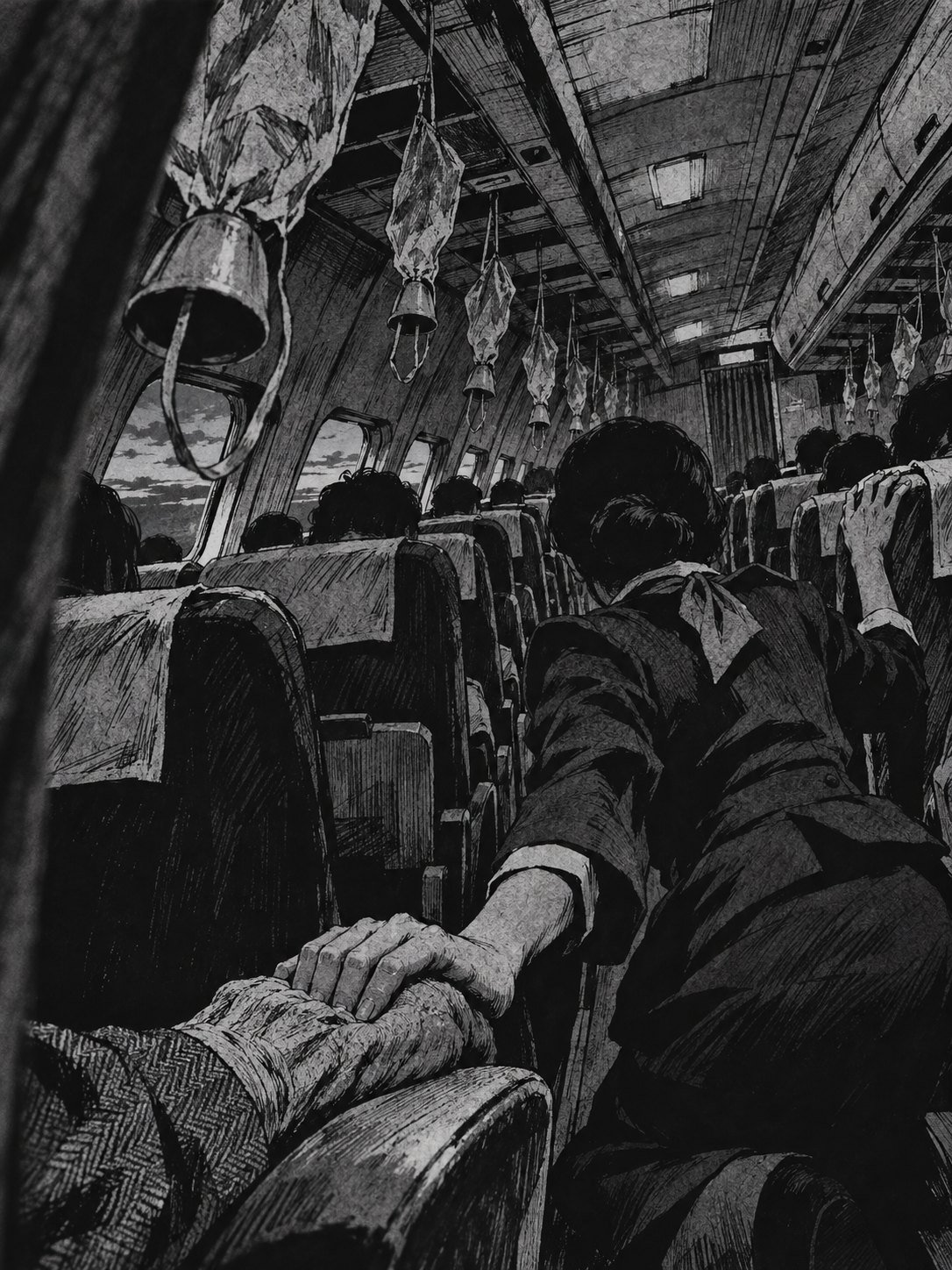
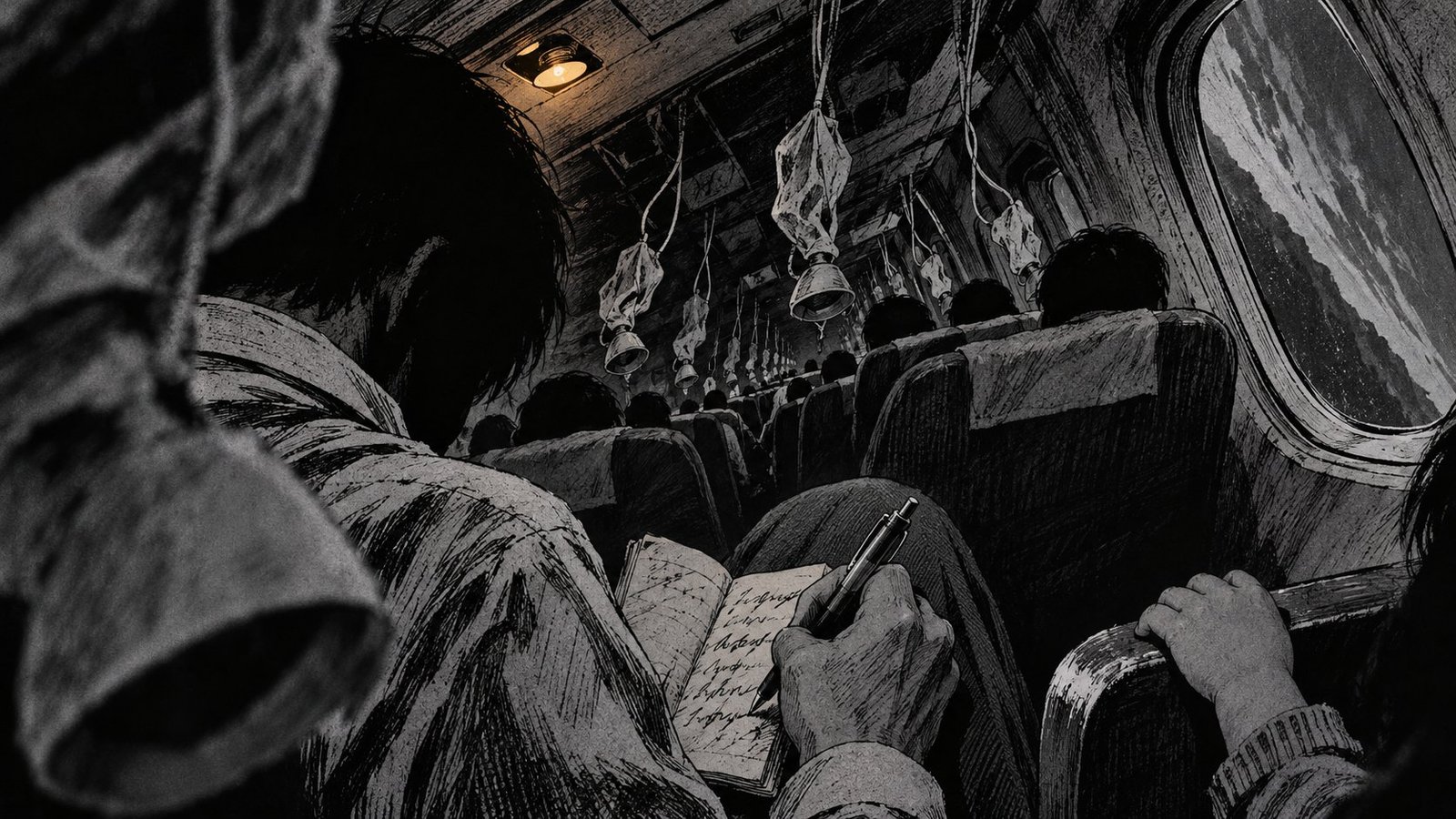
The oxygen supply for the passengers did not last. Around 6:35 p.m. it ran out.
In the cockpit, the three men never put on their own oxygen masks, even though the flight engineer suggested it.
Why they didn’t is still argued about. Some see the effects of thin air on the crew. Others use the same detail to question how violent the decompression really was.
Fifteen crew were aboard. Among them were the cabin crew working the aisles of a jet that would not hold level. (TIME-1985) (MCA) (WIKI) Two years earlier, another Boeing 747 met a very different end when a Soviet fighter shot down Korean Air Lines Flight 007 off Sakhalin, with all 269 aboard lost.
Mount Fuji in the window
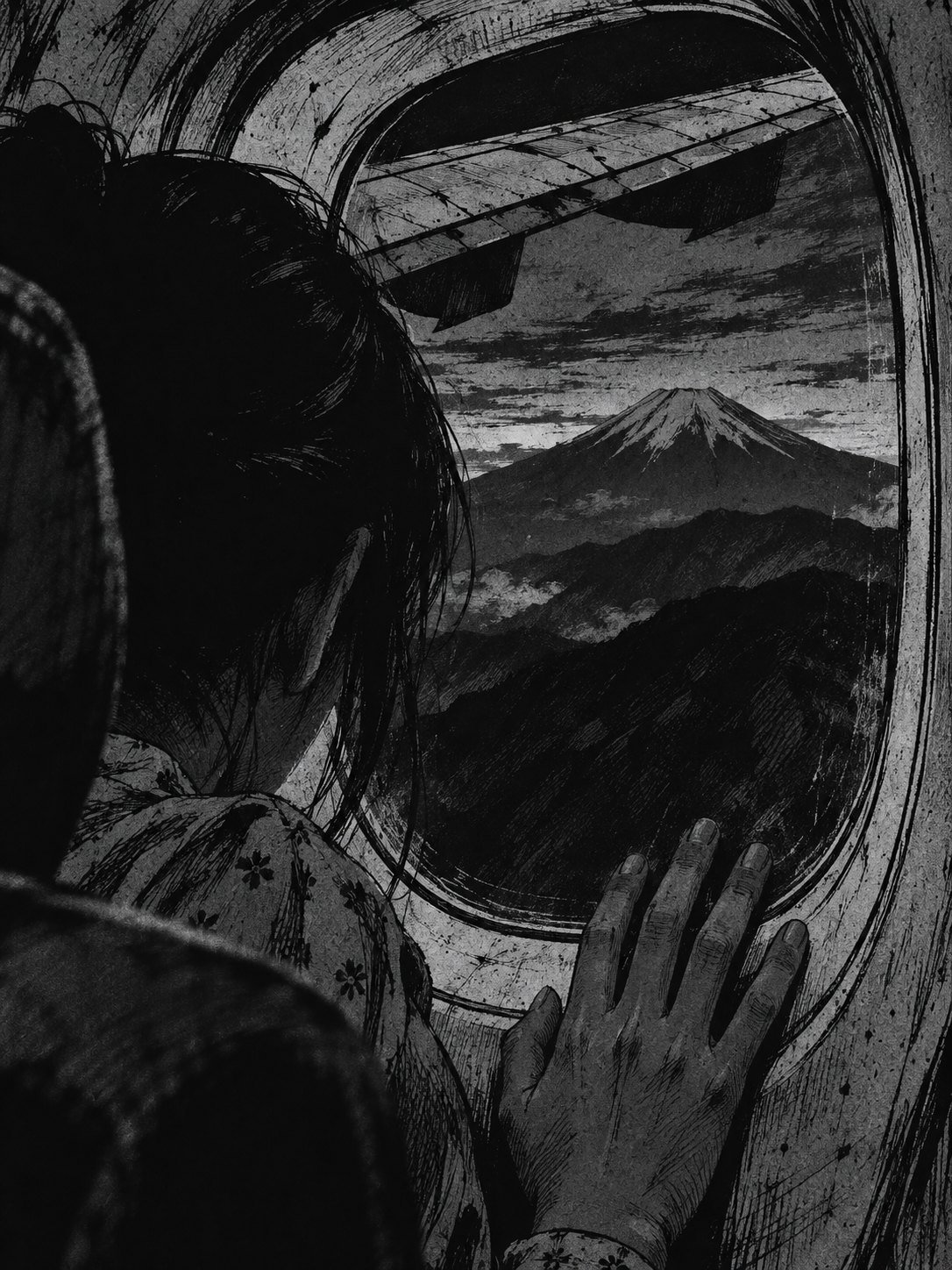
Around 6:40 p.m. the off-duty flight attendant looked out of her window and saw Mount Fuji.
On radar, the jet had just flown a complete circle.
About 29 minutes into the flight the landing gear came down. The rocking got worse.
Descending through about 5,300 feet, the crew saw mountains ahead. They added power and the jumbo climbed back to about 10,000 feet. (TIME-1985) (FAA-LL)
“Uncontrollable”
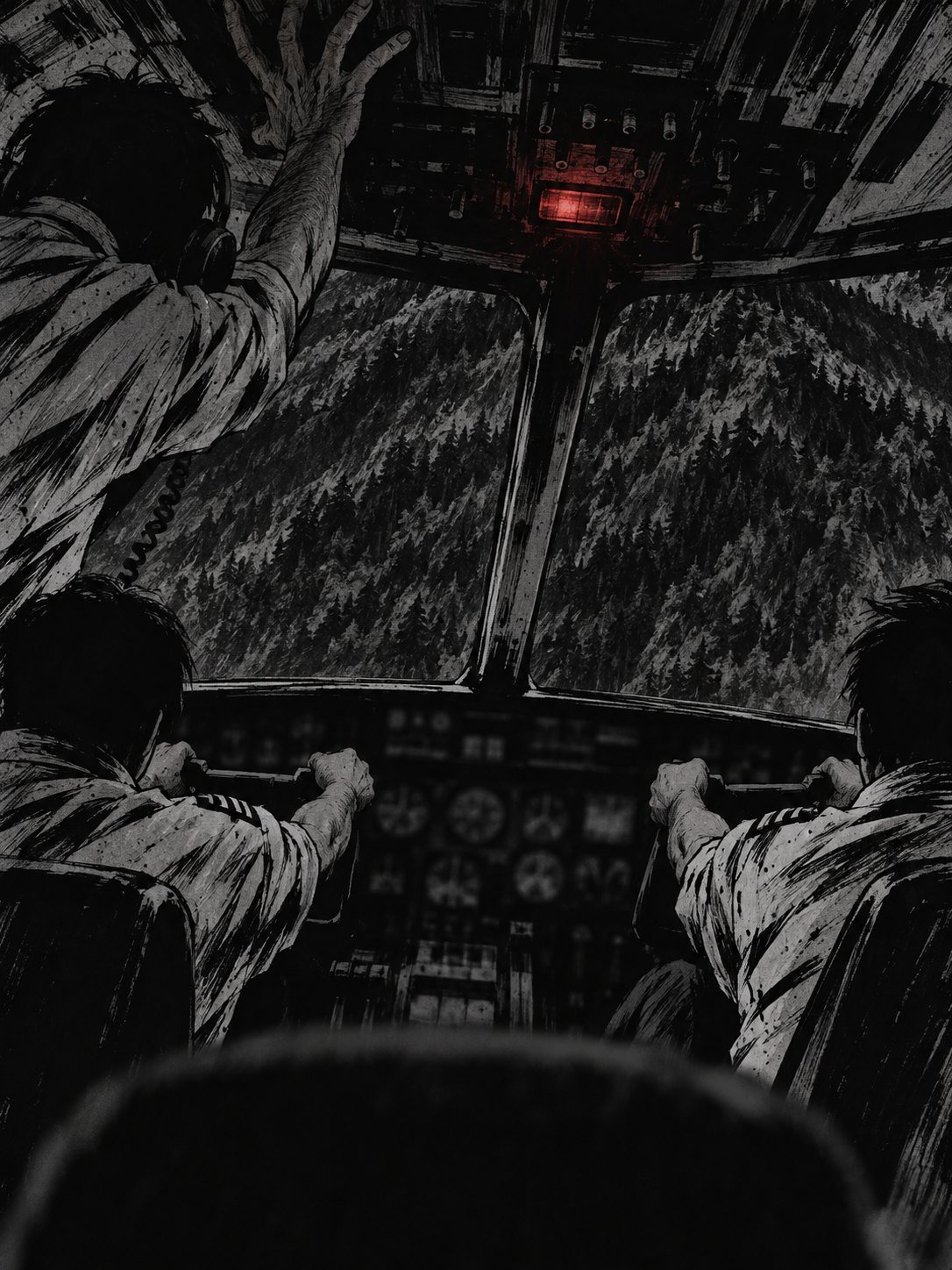
About 6:46 p.m. Tokyo called again. “Uncontrol.” Did they want to contact Haneda? “Yes, please!” Could they control the aircraft? “Uncontrollable.”
According to the cockpit transcript reported in the press, the captain said: “This may be hopeless.”
In the cabin, some passengers took out notebooks and wrote to their families. One father wrote: “Please take good care of the children.” He also noted the time. “It’s 6:30 now, the plane is turning and descending rapidly.”
At about 41 minutes into the flight the crew extended the flaps. The jet rolled to about 60 degrees, the nose dropped, and it fell at roughly 18,000 feet a minute. Near 5,000 feet it briefly came back. Then control was lost. The captain called again and again for the nose to come up.
The last word on the radio was a crewman’s “Roger.” At 6:56 p.m. Flight 123 disappeared from radar and struck a forested ridge at about 340 knots. (TIME-1985) (WIKI) (JT-2006) (TW) (FAA-LL) (PCI)
A light on the mountain
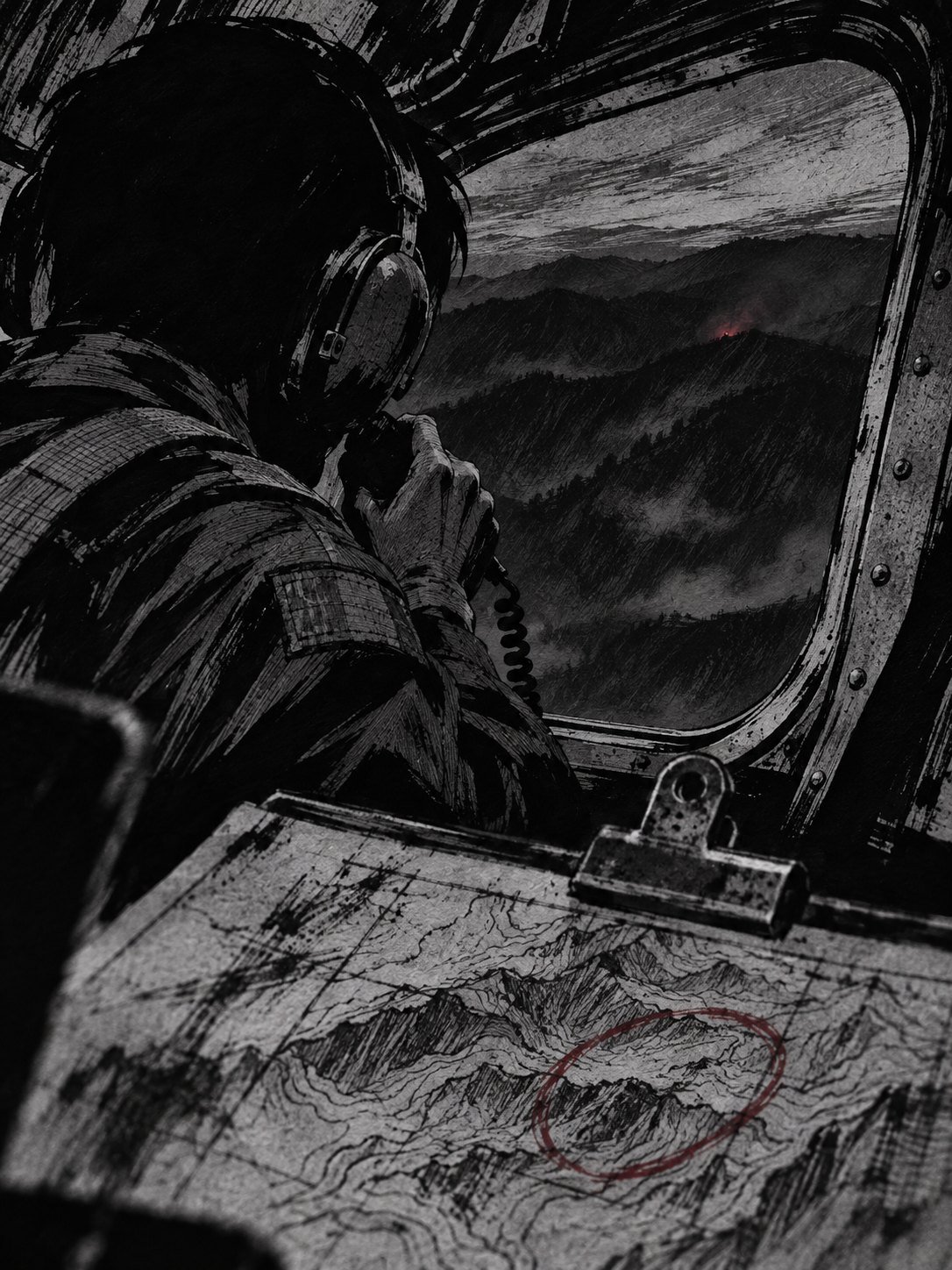
The ridge was Mount Takamagahara, near Mount Osutaka, in Ueno village in the mountains of southern Gunma. It was first reported as Osutaka, and the name stayed. In Japan the place is known as Osutaka Ridge.
What happened in the next hours is told in versions that do not agree.
A former US Air Force navigator, Michael Antonucci, said in 1995 that his C-130 crew spotted the site about 20 minutes after the crash and radioed its position. In his account, American forces got ready to send a rescue team and were stood down at the request of Japanese authorities.
A 1985 Pacific Stars and Stripes report said US personnel at Yokota were on standby but were never called. Another version says the C-130 was ordered back, allegedly because it was short of fuel. (BRIT) (JT-2020) (MCA) (WIKI) (TW)
“No signs of survivors”
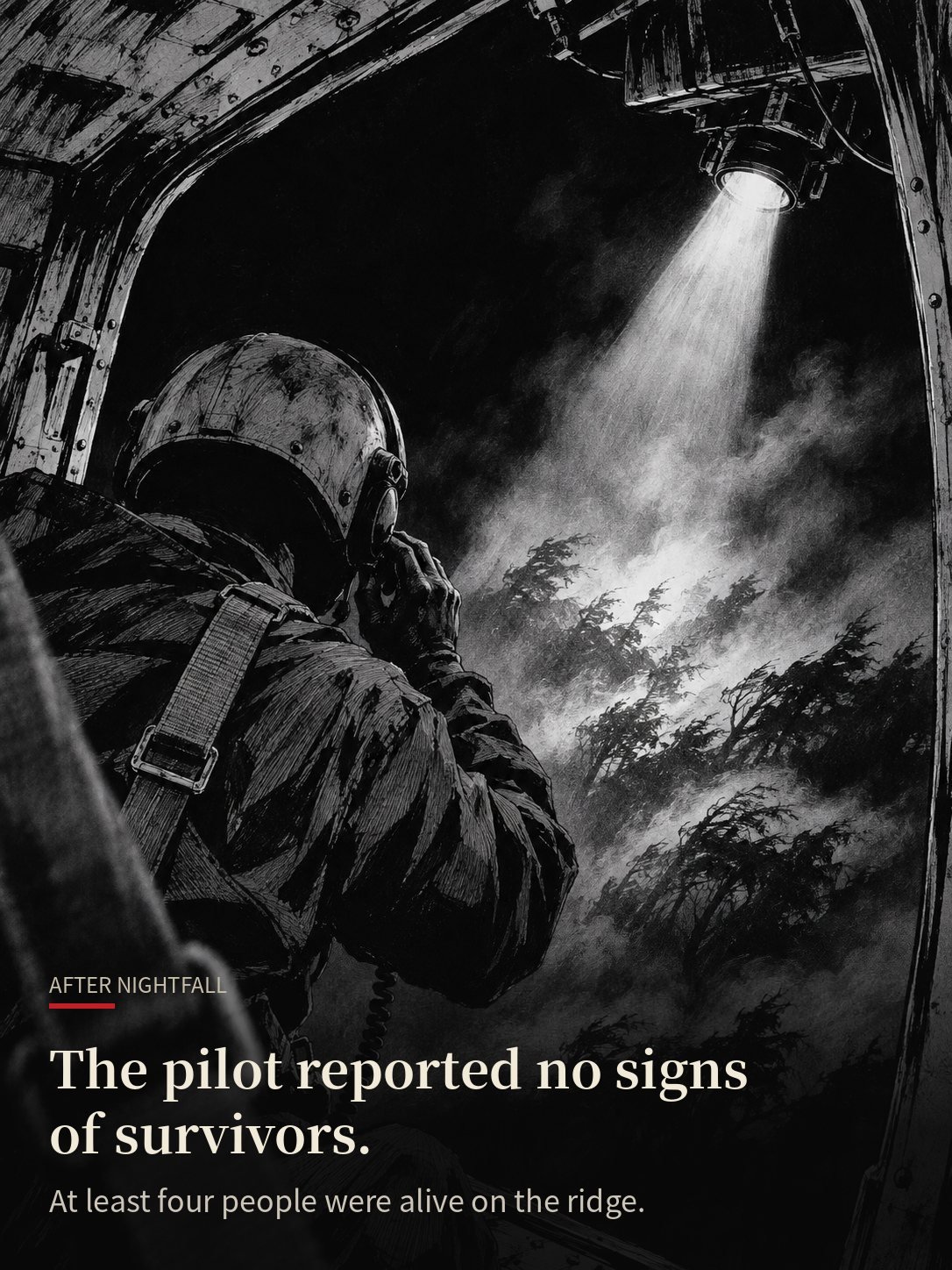
After nightfall a helicopter of the Japan Self-Defense Forces found the wreck.
Its pilot reported no signs of survivors.
That one report shaped the night. The authorities believed no one could have lived through the impact, and the rescue went in late. (MCA) (WIKI) (PCI)
The night camp
Ground teams did not set out for the ridge that night. They camped at a makeshift village and waited. Crash survivors cannot always wait for rescue: in 1971 a 17-year-old fell into the Amazon still in her seat and walked out of the rainforest alone.
Up on the mountain, among the wreckage, at least four people were alive.
Nobody below knew. (MCA) (WIKI) (BATT)
The climb
Local firemen reached the wreck at about 9 a.m. on 13 August, more than 14 hours after the crash.
Some rescuers were lowered from helicopters onto the slope. Others climbed, among them volunteers from Ueno village. About 2,000 people took part in the effort. (TIME-1985) (BRIT) (BATT)
“Survivors found!”
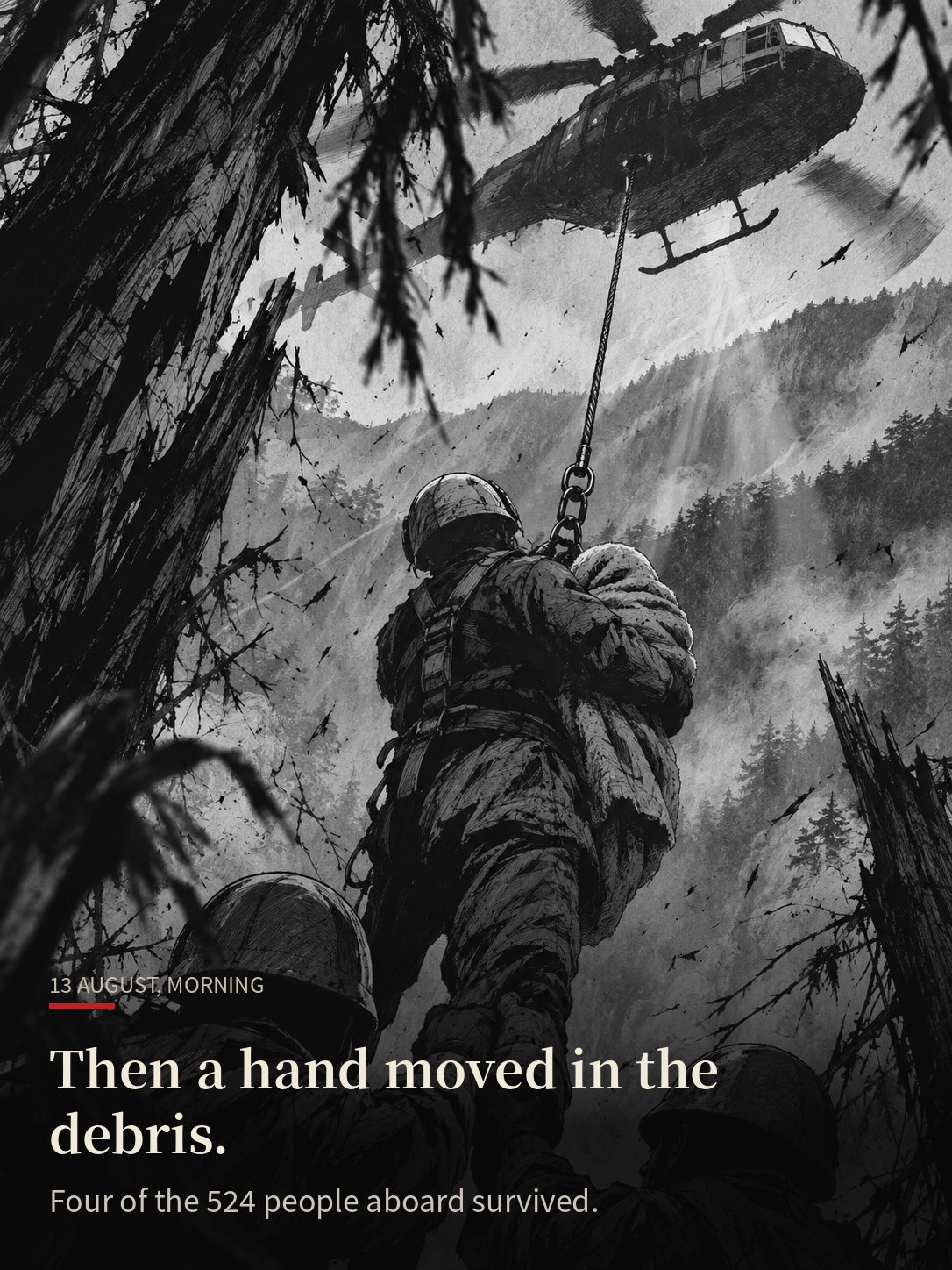
Searchers first noticed one survivor when a hand moved in the debris.
A rescuer later remembered: “When it was almost 11 o’clock, we heard a cry of ‘Survivors found!'”
Four people were alive, all women and girls, all seated toward the rear. A fireman found the off-duty flight attendant between the seats, conscious. A 12-year-old girl was found caught in a tree, in Time’s words. A mother and her 8-year-old daughter were found under debris. Military helicopters flew them to hospital in Fujioka.
A doctor at the site said: “If the discovery had come ten hours earlier, we could have found more survivors.”
520 people died, 505 passengers and all 15 crew. Among them was the singer Kyu Sakamoto, known around the world for “Sukiyaki.” It is still the deadliest accident involving a single aircraft. (BATT) (FRIDAY) (TIME-1985) (FAA-LL) (PCI) (SCMP)
One row of rivets
The morning after the crash, a Japanese destroyer recovered a section of the tail fin from Sagami Bay. Much of the fin was never found.
JAL’s president, Yasumoto Takagi, took full responsibility. He apologised to the families and told Prime Minister Yasuhiro Nakasone he would step down.
On 6 September 1985 Boeing acknowledged that its 1978 repair had been faulty, with a splice plate wrongly installed over about 17 percent of the splice. It said more analysis was needed to decide whether the repair had contributed. Thirty years later, former US officials said the American side had given the repair flaw to a US newspaper while Japanese authorities were reluctant to release it.
In December 1985 the NTSB recommended changes to the 747’s tail and hydraulics and fresh checks of bulkhead repairs. On 19 June 1987 Japan’s Aircraft Accident Investigation Commission blamed the faulty repair and the fatigue cracks that grew from it. A hydraulic fuse was later added to the 747’s No. 4 hydraulic system.
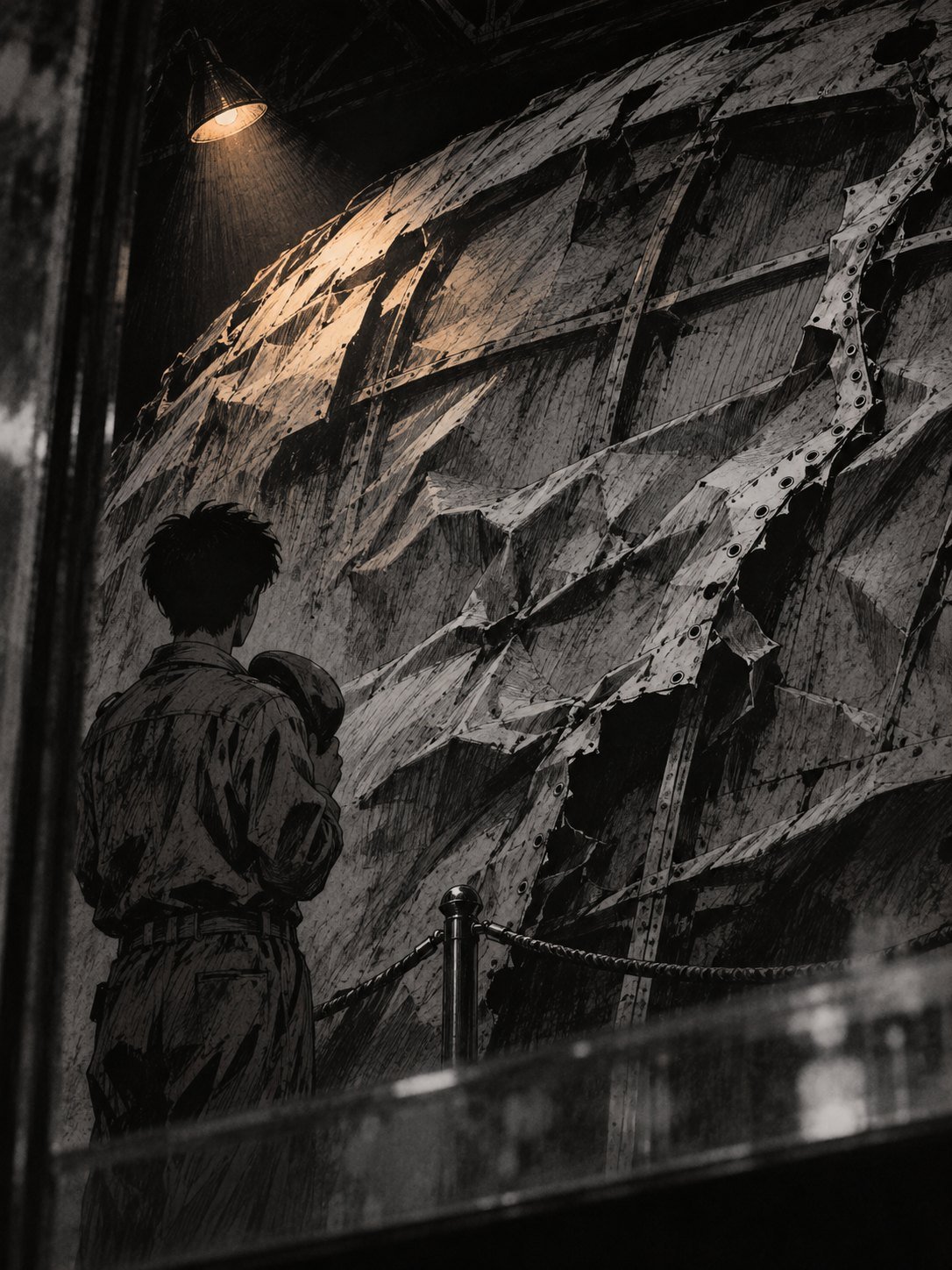
The crumpled bulkhead itself is now on display at JAL’s Safety Promotion Center at Haneda, which opened in April 2006. Passengers’ farewell messages were later shown there too. (TIME-1985) (CSM-0814) (PPRUNE) (JT-2015) (NTSB-1985) (FAA-LL) (JT-2006)
6:56 p.m., every August
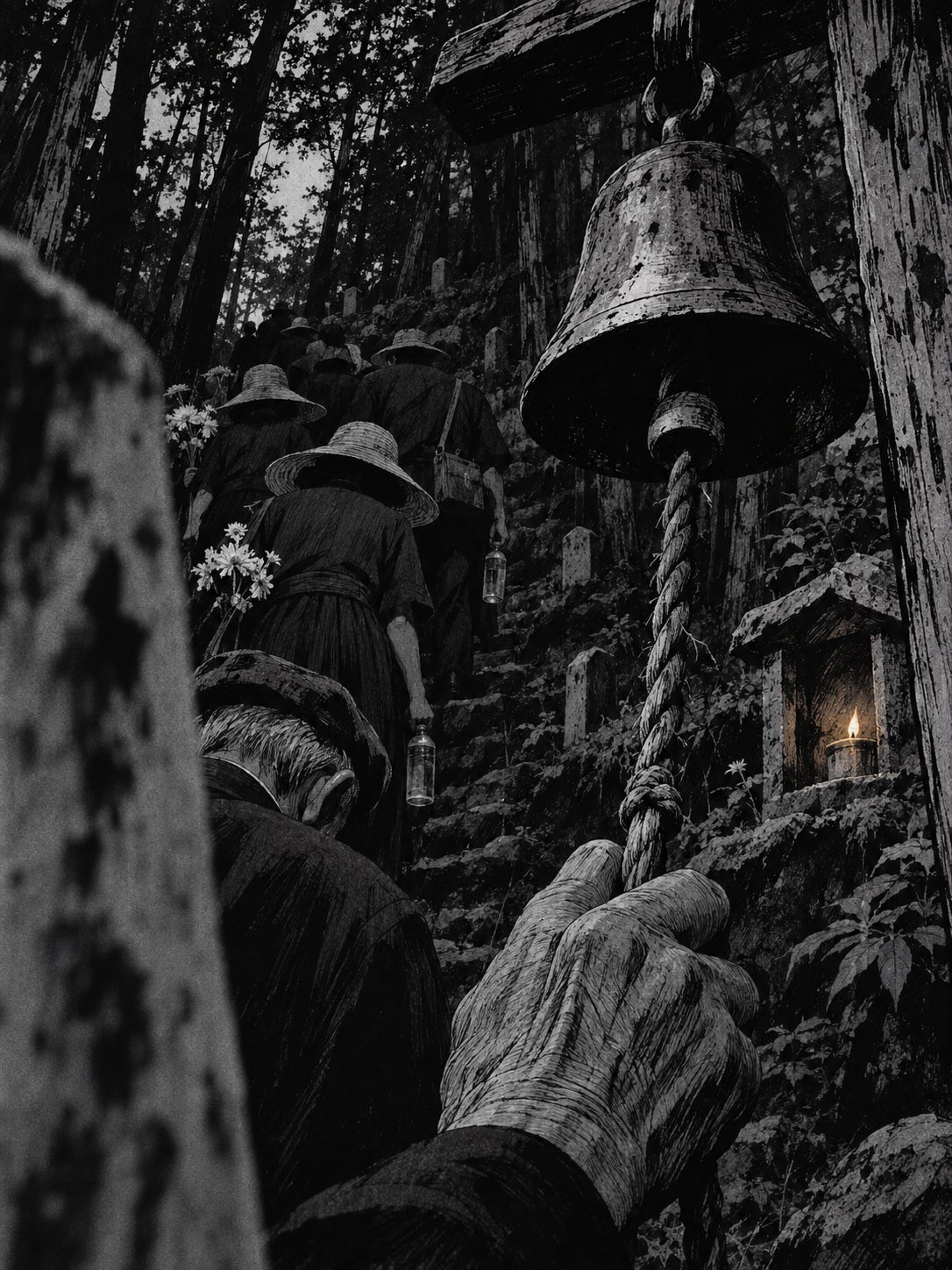
Every year on 12 August, families climb Osutaka Ridge to the grave markers placed where their relatives were found. At 6:56 p.m. they hold a moment of silence. In 2023, 272 people from 76 families made the climb.
In 2024 JAL’s president, Mitsuko Tottori, climbed with them. “I renewed my awareness that there should be no compromise in safety,” she said.
Some families want more than remembrance. They have asked for the investigation to be reopened, for the cockpit and flight data to be released, and for the rest of the fin to be raised from Sagami Bay.
In August 2025, forty years on, Japan’s transport minister asked Boeing and the FAA to explain how the repair error had happened, after new information came from the United States. (ARAB-JIJI) (SCMP) (WIKI) (AG-2020) (SANKEI-GN)
Case notes: one row of rivets, 32 minutes
In 1985 a fully booked Japan Air Lines jumbo lost its tail over central Japan and flew on for half an hour with no working controls. Four of the 524 people aboard lived (FAA-LL) (PCI).
Where the case stands (as of November 2026)
The official finding has not changed since 1987: the 1978 repair to the aft pressure bulkhead was done wrongly, fatigue cracks grew from it, and the bulkhead failed in flight (AAIC-1987) (FAA-LL).
It is not closed for everyone. Families have asked for the investigation to be reopened and the recorder data released, and in August 2025 Japan’s transport minister asked Boeing and the FAA to explain how the repair error happened (AG-2020) (SANKEI-GN).
One badly repaired row of rivets, seven years old, brought down Flight 123.
Timeline
| When | What happened |
|---|---|
| 2 June 1978 | JA8119 strikes its tail landing at Osaka; 25 passengers injured (FAA-LL) (TIME-1985) |
| 1978 | Boeing team replaces the lower half of the aft pressure bulkhead; the splice plate is cut in two (FAA-LL) |
| 12 Aug 1985, 6:12 p.m. | Flight 123 leaves Haneda for Osaka with 524 aboard (TIME-1985) (PCI) |
| About 6:24–6:25 p.m. | Bang and decompression at about 24,000 ft; tail fin and all four hydraulic systems lost (FAA-LL) (TIME-1985) |
| About 6:35 p.m. | Passenger oxygen runs out (TIME-1985) |
| About 6:40 p.m. | Mount Fuji seen from the cabin; the jet flies a full circle on radar (TIME-1985) |
| 6:56 p.m. | Disappears from radar and strikes Osutaka Ridge, Ueno village, Gunma (FAA-LL) (PCI) |
| About 9 a.m., 13 Aug | Local firemen reach the wreck, more than 14 hours after the crash (TIME-1985) (BRIT) |
| Late morning, 13 Aug | Four survivors found and flown to hospital in Fujioka (BATT) (FRIDAY) |
| 6 Sept 1985 | Boeing acknowledges its 1978 repair was faulty (PPRUNE) |
| 5 Dec 1985 | NTSB recommends 747 tail, hydraulic and inspection changes (NTSB-1985) |
| 19 June 1987 | Japan’s accident commission blames the faulty repair and fatigue cracking (AAIC-1987) (FAA-LL) |
| 24 Apr 2006 | JAL Safety Promotion Center opens at Haneda with the bulkhead on display (JT-2006) |
| Aug 2025 | 40th anniversary; transport minister asks Boeing and the FAA about the repair error (SANKEI-GN) |
Evidence locker
Primary records and the closest copies we could trace. No photographs are shown for this case; illustrations elsewhere in this file are AI-generated.
Access: Copy (an English translation of the Japanese report, hosted on an FAA server). We worked from the FAA’s own summary of it and could not open every page of the PDF.
Supports: The cause of the crash as the Japanese investigators found it.
Limits: We have not examined the original Japanese text. Some victims’ families still ask for the investigation to be reopened.
Access: Direct original (the NTSB letter, via the University of North Texas web archive).
Supports: That US investigators treated the failure as a fleet-wide 747 risk, not a one-off.
Limits: A recommendation letter, not a finding of who was at fault.
Access: Via press.
Supports: That the bulkhead at the centre of the report still exists and can be seen.
Limits: We have not seen the display ourselves.
Where the records disagree
| Detail | What sources say |
|---|---|
| Time of the bang | 6:24 or 6:25 p.m., about 12 minutes after take-off (FAA-LL) (TIME-1985) (JT-2020) |
| Help from US forces | A former USAF navigator said a US rescue was stood down at Japan’s request; a 1985 report said US personnel were never called; another says the C-130 was recalled for fuel (MCA) (WIKI) (TW) |
| How long rescuers took | More than 14 hours to reach the wreck in most reports; families cite 11 hours (TIME-1985) (BRIT) (AG-2020) |
| The crash site’s name | First reported as Mount Osutaka; the impact was on Mount Takamagahara nearby (BRIT) |
| The cause | The official report blames the faulty repair; some families question its findings and want the case reopened (AAIC-1987) (AG-2020) |
| “Shot down” theories | Online claims that the jet was hit by a military missile; investigators found no explosive residue, the Defence Ministry calls it misinformation, and former SDF rescuers rejected it in 2025 (NIGHTLY) |
| The pilots’ oxygen | The crew never used their masks; read either as a sign of hypoxia or as a reason to question how violent the decompression was (MCA) (WIKI) |
What we still don’t know
- Whether more people could have been saved if rescuers had reached the ridge during the night.
- What exactly was said and decided about US help on the night of 12 August.
- Why the crew never put on their oxygen masks.
- What the missing part of the tail fin, still in Sagami Bay, would show.
What happened after
The FAA added a hydraulic fuse to the 747’s No. 4 hydraulic system and changed decompression and repair-assessment rules (FAA-LL). Since 2006 JAL has trained its staff at the Safety Promotion Center, where the wreckage and passengers’ farewell messages are displayed (JT-2006).
Editor’s note
The part of this case I cannot read quickly is the notebooks. While the jet rolled and dropped over the mountains, some passengers took out a pen and wrote to their families. One father wrote: “Please take good care of the children.” I keep wondering what went through his mind before he put that line down. He must have been terrified himself, and he spent those minutes worrying about children who would grow up in a house without him. Then I think about the moment his family opened that page and read it. For us, Flight 123 is 32 minutes on a timeline. For him, those minutes were all the time he had left to say anything at all.
This case also made me think of the Sewol ferry, which sank off Korea’s southwest coast in 2014. I don’t mean the causes were alike, or what happened at the scene. What links them for me is the waiting: people waiting to be rescued, and families on the outside waiting for news. We look back already knowing how it ended. On the night of 12 August 1985, families in Japan knew nothing for certain, and every phone call and every name read out could have been the news that someone was alive. When I read about a disaster like this, the death toll stays with me. So does that long stretch of not knowing.
On the rescue, I would rather leave the C-130 accounts as uncertain as they are in the file above. Nobody can say how many more people would have lived if rescuers had reached the ridge during the night, and I won’t pretend to know. But four people were found alive the next morning, and a doctor on the mountain said that ten hours earlier they could have found more survivors. That alone is reason to ask what information the decisions that night were based on, and whether there was a faster way up the mountain. I don’t want to blame the firemen, soldiers and villagers who climbed that slope. I also don’t think the judgments made that night should be left unexamined. For the families, the question of why no one got there sooner will never go away.
— Strange World Files
Case file summary
- What: A Boeing 747 lost its tail fin and all hydraulics in flight and crashed after 32 minutes
- Where: Osutaka Ridge (Mount Takamagahara), Ueno village, Gunma, Japan
- When: Monday 12 August 1985, 6:56 p.m.
- Toll: 520 dead, 4 survivors, of 524 aboard
- Cause: A faulty 1978 repair to the aft pressure bulkhead (official finding)
Illustrations are AI-generated artistic interpretations, not photos. No real person is depicted with a recognizable face. Read how we research and illustrate these files.
Sources
- Aircraft Accident Investigation Commission, Ministry of Transport, Japan — final report on JA8119, 19 June 1987 (PDF)
- FAA Lessons Learned — Boeing 747-SR100 JA8119
- NTSB safety recommendation letter A-85-133 to -137, 5 Dec 1985
- Time, Ed Magnuson, “Disasters: Last Minutes of JAL 123” (1985 report; archive date shows 2005)
- Encyclopaedia Britannica — Japan Airlines Flight 123
- PlaneCrashInfo — 12 Aug 1985 JAL 123
- The Battalion (Texas A&M), 14 Aug 1985, wire report
- Christian Science Monitor, News in Brief, 14 Aug 1985
- PPRuNe post reproducing an 8 Sep 1985 news article on Boeing’s acknowledgement
- South China Morning Post, “Remembering Flight 123…”, Aug 2015
- Japan Times, “JAL displays messages by 1985 crash victims”, 13 Jul 2006
- Japan Times/Kyodo, “U.S. leaked crucial Boeing repair flaw…”, 11 Aug 2015
- Japan Times, 35 years after the JAL crash, 12 Aug 2020
- Arab News Japan (Jiji), 38th anniversary climb, Aug 2023
- Tokyo Weekender, “A song born from the tragedy of JAL Flight 123”
- AirlineGeeks, “Anniversary of JAL 123 crash renews requests to re-open investigation”, 14 Aug 2020
- FRIDAY Digital, “In Memoriam: 40 Years after the Crash…”, 30 Aug 2025
- Moore County Airport blog, JAL Flight 123
- Ground News aggregation of Sankei News, 8 Aug 2025, transport minister asks Boeing/FAA
- Wikipedia, “Japan Air Lines Flight 123”